
TL;DR:
- Residential and commercial fire systems differ in design, materials, and regulatory standards.
- Correct system choice is critical for compliance, safety, insurance, and long-term protection.
- Consultation with licensed professionals ensures proper system selection tailored to property use.
Many Houston property owners and managers assume fire protection is basically the same across building types. It isn’t. Residential and commercial fire systems are built on different engineering principles, regulated by different codes, and carry very different consequences when something goes wrong. Choosing the wrong system for your property type can mean failed inspections, voided insurance, and most critically, inadequate protection when a fire breaks out. This guide breaks down the real differences so you can make informed, compliant decisions for your Houston property.
Table of Contents
- Understanding fire protection systems: residential vs commercial
- Key regulatory standards: NFPA 13, 13R, and 13D explained
- Critical differences in system design, installation, and maintenance
- How to choose the right fire protection for your Houston property
- Our take: Why one-size-fits-all thinking puts Houston properties at risk
- Get expert fire protection for your Houston property
- Frequently asked questions
Key Takeaways
| Point | Details |
|---|---|
| Know your building type | Houston properties must match fire protection systems to their official residential or commercial classification for legal safety. |
| Choose the right standard | NFPA 13, 13R, and 13D have different requirements and costs—using the correct one helps ensure compliance and better insurance rates. |
| Design impacts insurance | Material and system differences directly affect safety, maintenance, and your property’s insurance discounts. |
| Professional advice pays off | Consulting a Houston fire protection expert can help you avoid costly mistakes and stay ahead of code changes. |
Understanding fire protection systems: residential vs commercial
Before you can make smart decisions about fire protection, you need to understand what separates these two categories at a fundamental level. In Houston permitting, the distinction between residential and commercial isn’t just about building size. It’s about occupancy type, risk profile, and how the building is used day to day.
A residential system protects spaces where people live: single-family homes, condos, townhouses, and smaller apartment buildings. The primary goal is life safety. Get people out alive. These systems are designed to detect fire early and give occupants time to escape.
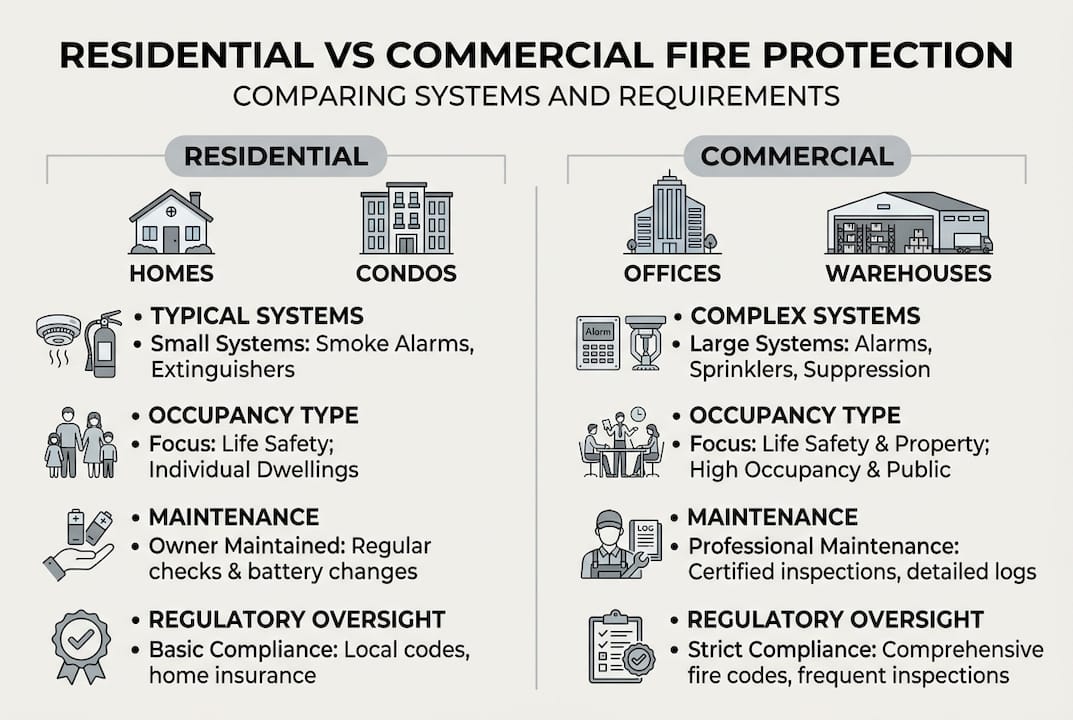
A commercial system covers retail stores, office buildings, warehouses, hotels, restaurants, and larger multi-family complexes. The goals are broader: life safety plus property protection, business continuity, and liability management. These systems must handle higher occupant loads, more complex floor plans, and stricter regulatory oversight.
Here’s a side-by-side look at the core components:
| Feature | Residential | Commercial |
|---|---|---|
| Pipe material | PVC or PEX | Steel or copper |
| Water source | Domestic supply | Dedicated fire main |
| System pressure | Low to moderate | High |
| Control panel | Basic | Advanced, addressable |
| Coverage scope | Life safety | Life safety + property |
| Inspection frequency | Annual or less | Quarterly to annual |
As noted in key system differences, commercial systems use steel or copper pipes with higher operating pressure, while residential systems typically rely on PVC or PEX connected to the domestic water supply. That gap in materials and pressure capacity is not a minor detail. It directly affects how much water a system can deliver and how fast.
Key residential system features include:
- Simpler sprinkler layouts with fewer heads
- Smoke detectors integrated with sprinklers
- Lower installation cost
- Designed for 1 to 4 story structures
For a deeper look at how these systems work in practice, fire sprinkler systems in Houston covers the mechanics in plain terms. And if you’re managing a commercial property, commercial fire protection basics is a solid starting point.
Pro Tip: Always confirm with your Houston permit office whether your building is classified as residential or commercial before selecting a fire protection system. Mixed-use and multi-family buildings often fall into gray zones that require professional review.
Key regulatory standards: NFPA 13, 13R, and 13D explained
The National Fire Protection Association (NFPA) sets the standards that govern sprinkler system design in the United States. Three standards apply to most Houston properties, and picking the wrong one is a compliance mistake that can be expensive to fix.
NFPA 13D is the most basic standard. It applies to one and two-family homes and manufactured housing. It’s the least expensive to install but offers minimal property protection. It’s designed purely to give occupants time to escape, not to control or suppress a fire.
NFPA 13R covers residential occupancies up to four stories. It’s a middle-ground standard commonly used in apartment buildings and townhouse complexes. It offers more coverage than 13D but still prioritizes life safety over full property protection.
NFPA 13 is the full commercial standard. It applies to most commercial buildings and larger multi-family structures. It provides the highest level of coverage, including protection for concealed spaces and attics that the other standards often omit.
| Standard | Typical use | Cost level | Property protection | Insurance benefit |
|---|---|---|---|---|
| NFPA 13D | Single-family homes | Lowest | Minimal | Limited |
| NFPA 13R | Apartments up to 4 stories | Moderate | Partial | Moderate |
| NFPA 13 | Commercial, large multi-family | Highest | Full | Best |
According to NFPA 13D vs 13R vs 13, NFPA 13D is the cheapest option but provides minimal property protection, while NFPA 13 is the preferred standard for properties seeking real insurance benefits.
Basic compliance steps for Houston properties:
- Identify your building’s occupancy classification with the City of Houston permitting office
- Match your occupancy type to the correct NFPA standard
- Hire a licensed fire protection contractor to design your system
- Submit plans for city review and approval
- Schedule inspections at each phase of installation
- Obtain final certification before occupancy
One edge case worth knowing: podium and mixed-use buildings in Houston may require NFPA 13 throughout the entire structure, even when the upper floors are residential. This surprises many developers and property managers who expected to use the cheaper 13R standard for the residential portion.
For a full breakdown of Houston fire protection standards and how to navigate the sprinkler compliance workflow, those resources will walk you through the process step by step.
Pro Tip: Choosing a higher standard than required, like NFPA 13 over 13R, often unlocks better insurance premiums. That long-term savings can offset the higher upfront installation cost within a few years.
Critical differences in system design, installation, and maintenance
Regulations tell you what’s required. But the actual engineering behind residential and commercial systems tells you why those requirements exist in the first place.
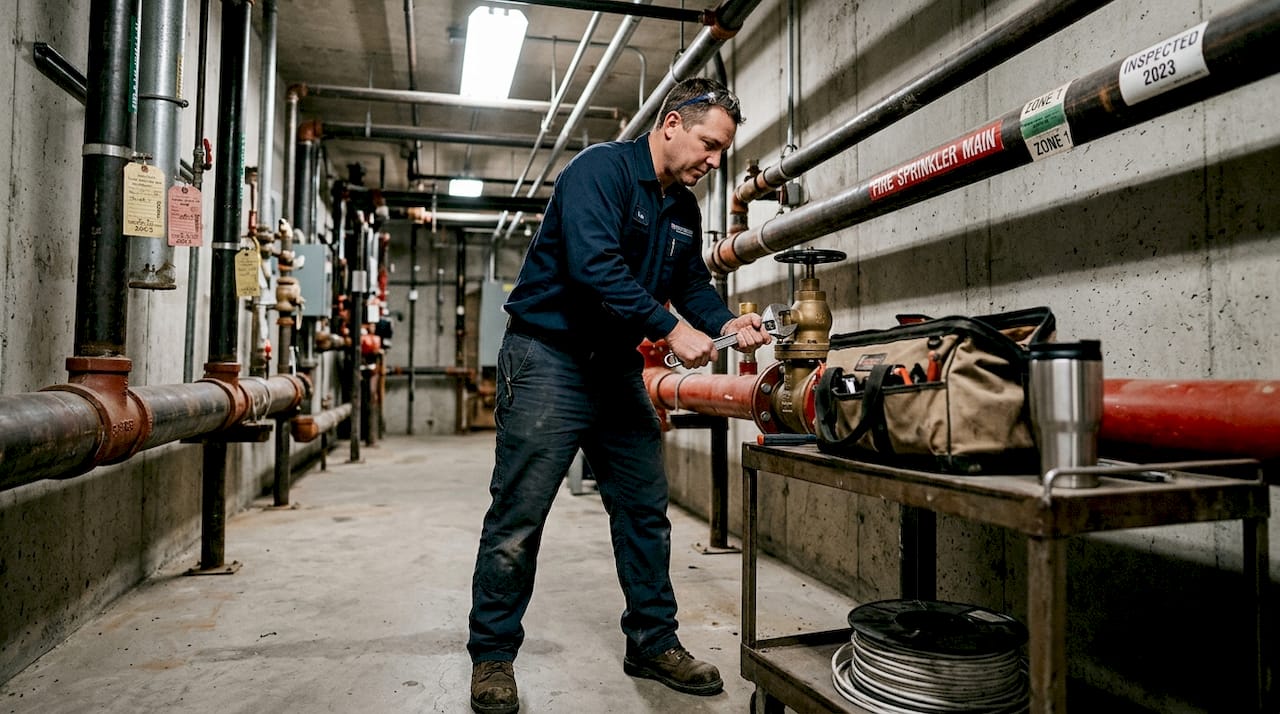
Material choice is one of the biggest dividing lines. Commercial systems use steel or copper pipes with higher operating pressure, while residential systems rely on PVC or PEX connected to the domestic water supply. Steel and copper handle heat and pressure far better than plastic. In a large commercial fire, a PVC system could fail before it even does its job.
Pressure requirements are another critical gap. Commercial systems draw from dedicated fire mains or storage tanks, not the same water line feeding your sinks and showers. That separation ensures consistent pressure during a fire event, even if multiple sprinkler heads activate at once.
Choosing the wrong pipe material or water source for your building type isn’t just a code violation. It’s a system that may physically fail to perform when you need it most.
Maintenance is where the operational differences become most visible. Commercial systems require formal inspection records, quarterly checks on certain components, and documented testing. Residential systems have lighter requirements, typically annual inspections. But that lighter schedule also means less oversight and a higher chance of undetected problems.
Key design distinctions that affect insurance and property value:
- Commercial systems require hydraulic calculations to verify pressure and flow
- Concealed spaces like attics and ceiling voids need coverage under NFPA 13
- Backflow preventers are mandatory in commercial systems to protect the public water supply
- Alarm notification devices must meet different decibel and placement standards
- Commercial systems often integrate with building automation and security systems
For more on how commercial fire detection advantages translate to real safety outcomes, and how sprinkler systems and safety compliance interact with Houston code, those pages offer practical detail.
How to choose the right fire protection for your Houston property
Knowing the differences is one thing. Translating that knowledge into a sound decision for your specific property is another. Here’s a practical framework.
Start with occupancy. What is the building actually used for? A four-story apartment complex and a four-story office building may look similar from the outside but carry completely different code requirements. Occupancy drives everything downstream.
Next, assess your risk profile. A restaurant with commercial cooking equipment faces fire risks that a residential condo does not. A warehouse storing flammable materials needs suppression capacity that a standard office building doesn’t. Your system must match your actual risk, not just the minimum code requirement.
Then factor in insurance. As NFPA standards guidance makes clear, NFPA 13D offers minimal property protection, while NFPA 13 systems are what insurers prefer for commercial properties. Choosing a lower standard to save on installation can cost you far more in premiums or denied claims.
Practical steps for Houston property owners:
- Confirm occupancy classification with the City of Houston
- Identify applicable NFPA standard for your building type
- Evaluate your specific fire risks beyond the minimum code
- Get a licensed contractor to run hydraulic calculations
- Compare total cost of ownership, not just installation price
- Review your insurance policy requirements before finalizing system design
- Schedule inspections and build a maintenance calendar from day one
For mixed-use or podium buildings, always assume NFPA 13 applies until you have written confirmation otherwise. The cost of upgrading mid-construction far exceeds the cost of planning correctly from the start.
Understanding the fire protection return on investment for your property type is a smart step before committing to a system. And when you’re ready to move forward, installing fire sprinklers in Houston has specific local requirements worth reviewing in advance.
Pro Tip: Always consult with a licensed Houston fire protection professional before finalizing your system selection. Local code interpretations and AHJ (Authority Having Jurisdiction) preferences can significantly affect your design options.
Our take: Why one-size-fits-all thinking puts Houston properties at risk
We’ve seen it happen more times than we’d like to admit. A property owner installs a residential-grade system in a building that functions commercially, or assumes their apartment complex qualifies for NFPA 13D when it clearly needs NFPA 13. The short-term savings feel real. The long-term consequences are worse.
The uncomfortable truth is that fire protection decisions made purely on cost or convenience tend to show their flaws at the worst possible moment: during a fire, during an insurance claim, or during a city inspection. None of those are good times to discover your system doesn’t meet code.
Smart fire protection anticipates where your property is going, not just where it is today. A building that starts as a single tenant office may become a multi-tenant mixed-use space within five years. Designing to the minimum standard today can mean a full system replacement tomorrow.
We also want to be direct about something: the gap between residential and commercial systems isn’t just technical. It’s a liability gap. Under-protected commercial properties expose owners to legal risk that no insurance policy fully covers. Comprehensive commercial fire safety planning is the only reliable way to close that gap.
Pro Tip: Invest in the right standard now. The cost difference between NFPA 13R and NFPA 13 is far smaller than the cost of retrofitting, litigation, or uninsured losses after a fire.
Get expert fire protection for your Houston property
Ready to put your fire protection plan in motion? Here’s how to get started:
At Reliable Fire Protection, we work with Houston property owners and managers every day to design, install, and maintain systems that meet code and actually protect what matters. Whether you’re trying to understand how fire alarm systems work or need a licensed contractor to guide you through the fire sprinkler system compliance process, we’re here to help.
We offer free consultations for Houston property owners who want a clear picture of their current system status and what upgrades, if any, are needed to meet 2026 code requirements. Don’t wait for an inspection failure or a fire event to find out your system isn’t up to standard. Reach out today and let’s build a protection plan that fits your property.
Frequently asked questions
What pipes are used in commercial vs residential fire systems?
Commercial fire protection often uses steel or copper pipes with higher pressure, while residential systems typically use PVC or PEX connected to the domestic water supply.
Which NFPA standard should an apartment building in Houston follow?
Apartment buildings often follow NFPA 13R, but podium or mixed-use projects may require NFPA 13 throughout, especially in Houston where local AHJ requirements can be stricter.
Is NFPA 13D enough for property insurance discounts?
NFPA 13D offers basic life safety but minimal property protection, and most insurers prefer NFPA 13 systems for full coverage benefits and premium discounts.
Do commercial fire systems require more maintenance than residential?
Yes, commercial systems require more frequent and formally documented maintenance to stay compliant with NFPA standards and local Houston fire codes, protecting both occupants and property owners from liability.
Recommended
- Commercial Fire Protection: Safeguarding Houston Properties
- Commercial Fire Safety Basics: Protecting Houston Properties
- Commercial Fire Safety: Protecting Houston Businesses
- Top advantages of commercial fire detection for Houston
- Fire Alarm System University Place TX
- Fire Alarm System Services in Bellaire, TX