Routine maintenance is the scheduled set of inspections and simple service tasks that protect uptime, reduce cost, and extend asset life. For facility managers, it is the operational foundation that keeps everything else from becoming a crisis. Done consistently, it delivers four concrete outcomes:
- Reduces emergency repairs by catching small failures before they escalate
- Stabilizes equipment performance and energy consumption over time
- Extends asset life, helping to defer capital replacement costs
- Supports regulatory and ITM (inspection, testing, and maintenance) compliance, especially for life-safety systems governed by NFPA standards
For fire alarms, sprinklers, suppression systems, and other life-safety equipment, routine rounds are not optional. NFPA-aligned ITM requirements set minimum frequencies and documentation standards that carry legal weight. Everything else in this article builds on that foundation.
Key Takeaways
Routine maintenance is the highest-leverage, lowest-cost layer of any facility management program, and its impact compounds when it is documented, measured, and connected to capital planning.
| Point | Details |
|---|---|
| Core role | Routine maintenance protects uptime, lowers lifecycle cost, extends asset life, and supports compliance. |
| ROI areas | Avoided emergency costs, energy savings, asset life extension, and operational continuity are the four measurable returns. |
| Workflow essentials | Asset register, SOPs, CMMS scheduling, documented rounds, and monthly KPI review form the complete loop. |
| Life-safety ITM | NFPA-aligned ITM for fire systems requires trained personnel, impairment permits, and records retained per AHJ rules. |
| Reliable-fire-protection | Provides scheduled fire system ITM, documentation support, and emergency response for Houston-area facilities. |
Table of Contents
- What is the role of routine maintenance in a facility?
- Common routine maintenance tasks by system and schedule
- How routine maintenance reduces downtime and saves money
- A practical workflow for planning and executing routine maintenance
- How to set the right frequency for routine tasks
- Which metrics tell you if your maintenance program is working?
- What goes wrong when routine maintenance gets skipped?
- A start-or-audit checklist for facility managers
- Why routine maintenance belongs in your strategic plan, not just your ops calendar
- How Reliable-fire-protection supports your maintenance program
- Sources
What is the role of routine maintenance in a facility?
Routine maintenance consists of simple, high-frequency tasks performed on a fixed schedule regardless of whether equipment shows signs of failure. Think building walkthroughs, drain clearing, hinge lubrication, filter checks, and grounds upkeep. The skill level required is low to moderate, and most tasks take minutes. What makes them powerful is consistency.
Where routine maintenance often gets confused is in its relationship to other maintenance types. They are not interchangeable:
| Type | Typical frequency | Skill level | Primary objective | When to choose it |
|---|---|---|---|---|
| Routine | Daily, weekly, bi-weekly | Low to moderate | Preserve baseline conditions | Always, as the baseline layer |
| Preventive | Monthly, quarterly, annually | Moderate to high | Prevent failure by time or usage | Scheduled on asset age or run hours |
| Predictive | Condition-triggered | High (sensors, analysis) | Predict failure before it happens | When sensor data justifies the cost |
| Reactive | After failure | Variable | Restore function | Unavoidable for minor, low-risk items |
Routine maintenance sits at the base of any asset-management hierarchy. It is what keeps a balanced program from collapsing into reactive firefighting. Planned maintenance programs that layer routine, preventive, and predictive work consistently outperform reactive-only approaches on both financial and operational metrics. Reactive maintenance is not a strategy; it is what happens when the other three break down.
Common routine maintenance tasks by system and schedule
The tasks below represent the core of what most facility teams run on a daily, weekly, or monthly cycle. They are organized by system, with notes on who typically owns each.
HVAC
- Daily: check thermostat setpoints, listen for unusual noise
- Weekly: inspect air filters for visible loading, clear condensate drain pans
- Monthly: lubricate fan bearings, check belt tension, log supply and return temperatures
Plumbing
- Weekly: flush floor drains and infrequently used fixtures, check for visible leaks under sinks
- Monthly: inspect water heater pressure relief valves, test backflow preventer indicators
Electrical
- Weekly: check panel indicator lights, test emergency lighting units
- Monthly: inspect cord and plug conditions in common areas, verify exit sign illumination
Building envelope and grounds
- Weekly: walk the perimeter for drainage issues, debris accumulation, or damaged seals
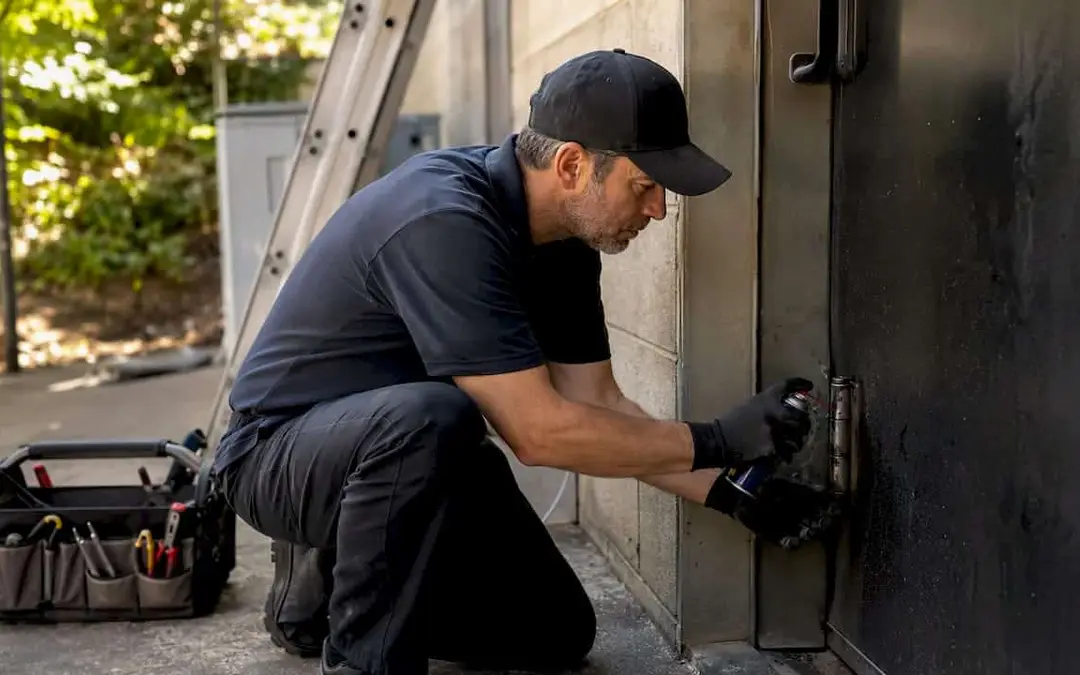
- Monthly: lubricate door hardware, inspect roof drains after rain events
Life-safety systems (fire alarms, sprinklers, extinguishers)
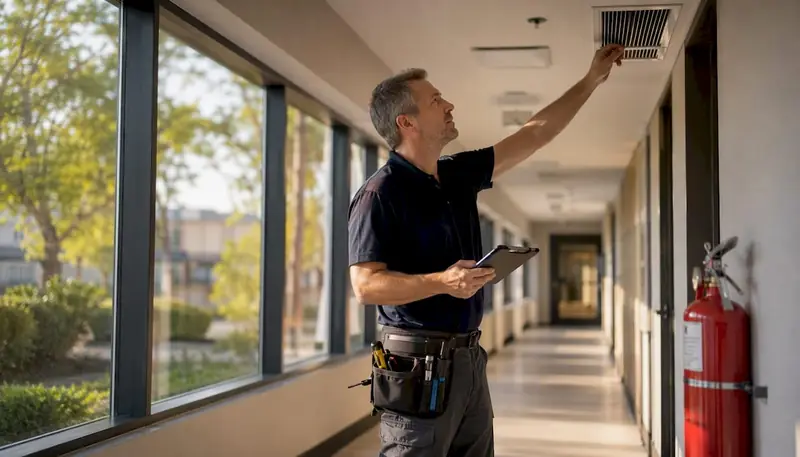
- Weekly: visual inspection of sprinkler heads for obstructions, corrosion, or paint overspray; check fire alarm system panel for fault indicators
- Monthly: verify extinguisher pressure gauges and accessibility; log findings per NFPA ITM requirements
General housekeeping
- Daily: clear egress paths, remove combustibles from mechanical rooms
- Weekly: wipe down equipment surfaces, check for pest evidence
Most routine tasks are in-house work. Life-safety ITM, however, often requires licensed contractors, especially for flow tests, alarm panel programming, and suppression system checks. The line between in-house and contractor is usually drawn at technical complexity and regulatory accountability.
Pro Tip: Bundle tasks by zone rather than by system. A single technician walking one floor can check HVAC filters, drain pans, exit signs, and extinguisher gauges in one pass. That cuts mobilization time and makes rounds auditable.
How routine maintenance reduces downtime and saves money
Routine maintenance is a risk-adjusted investment. The ROI of preventive maintenance flows through four measurable channels: avoided emergency repair costs, reduced energy consumption, extended asset life, and protected operational continuity. Each one is quantifiable if you track the right data.
The four ROI areas in practice:
- Emergency cost avoidance. A failed chiller in July costs far more than a monthly belt and bearing check. Emergency labor rates, expedited parts, and business interruption losses stack fast.
- Energy savings. Dirty filters, fouled coils, and worn belts force equipment to work harder. Consistent cleaning and adjustment keeps systems running at rated efficiency.
- Asset life extension. Equipment that runs within spec lasts longer. Deferring a $40,000 rooftop unit replacement by three years through consistent maintenance is a real budget win.
- Operational continuity. Downtime has a cost beyond repair bills: lost productivity, tenant dissatisfaction, regulatory exposure, and reputational risk.
The financial contrast between routine care and reactive repair is stark. A clogged condensate drain caught on a weekly round costs a technician ten minutes. Left undetected, it floods a ceiling, damages equipment, and triggers an emergency call on a weekend at two to three times the standard labor rate. Preventive maintenance shifts work from unpredictable urgent events to scheduled interventions, and that shift is where the savings accumulate.
Statistic callout: The IFMA’s framework for preventive maintenance ROI identifies energy performance gains as one of the most immediate and quantifiable returns, alongside extended equipment lifespan from consistent upkeep.
A practical workflow for planning and executing routine maintenance
The workflow verdict: plan once, schedule continuously, document every round, and review monthly. That four-step loop is what separates a maintenance program from a to-do list.
Core workflow steps:
- Build an asset register. List every maintainable asset with its location, criticality rating, manufacturer recommendations, and assigned owner. This is the foundation everything else runs on.
- Write standard operating procedures (SOPs). One SOP per task type. Keep them short: what to check, what to record, what triggers escalation.
- Schedule in a CMMS or spreadsheet. Assign tasks to calendar dates or usage triggers. A computerized maintenance management system (CMMS) like Fiix, UpKeep, or even a structured Google Sheet works. The key is that every task has a due date and an owner.
- Execute rounds and log findings. Technicians complete tasks, record readings (temperatures, pressures, visual conditions), and flag anomalies. No verbal-only reporting.
- Document work orders and ITM records. For life-safety systems, documentation requirements are not optional. FM Global’s DS 2-81 guidance specifies retaining ITM records for at least one year; many jurisdictions require longer.
- Review KPIs and triage the backlog monthly. Look at what was completed, what was skipped, and what anomalies were flagged. Anything deferred more than once needs a decision: fix it, escalate it, or add it to the capital plan.
For contractor-performed work, require documentation before closing a work order. Impairment permits for fire systems must be issued before any system is taken offline for testing, and the system must be restored before the permit closes.
Pro Tip: If you are not ready for a full CMMS, a shared spreadsheet with columns for asset, task, frequency, due date, completed date, and technician initials is enough to make rounds auditable. Add a “findings” column and you have the start of a trend log.
How to set the right frequency for routine tasks
Base routine task frequency on three factors: asset criticality, manufacturer recommendations, and usage or seasonal patterns. A cooling tower in a Houston summer needs weekly attention; the same unit in winter may need monthly checks. Criticality drives the floor; conditions drive the ceiling.
Decision guidance by cadence:
- Daily: life-safety egress paths, occupied-space visual checks, any asset where a single-day failure causes safety or production risk
- Weekly: HVAC filters and drains, fire system visual inspections, exterior drainage, emergency lighting
- Monthly: lubrication, belt and bearing checks, extinguisher gauges, door hardware, water heater inspections
- Seasonal: cooling tower startup/shutdown, roof drain clearing before rainy season, boiler inspections before heating season
- Usage-based: tasks triggered by run hours or cycle counts rather than calendar dates, common for pumps and compressors
For fire protection systems, frequency is not a judgment call. NFPA standards set minimum test intervals for sprinkler systems, fire pumps, alarm devices, and suppression agents. FM Global’s ITM guidance emphasizes that fire protection systems are idle until needed, which means a failure discovered during an emergency is too late. ITM must be planned to avoid extended impairments and to confirm overall system readiness. Consult your Houston sprinkler inspection schedule and local authority having jurisdiction (AHJ) for site-specific requirements.
Which metrics tell you if your maintenance program is working?
Track a mix of operational, financial, and reliability metrics. No single number tells the full story; the combination reveals whether your program is running or drifting.
Core KPIs for routine maintenance:
- Uptime/availability: percentage of time critical assets are operational; the most direct measure of program effectiveness
- Mean time between failures (MTBF): rising MTBF over quarters signals that routine work is catching problems early
- Emergency callout count: track month over month; a rising trend is the clearest sign that routine rounds are being skipped or are inadequate
- Maintenance backlog age: tasks deferred beyond their due date; anything aging past 30 days needs triage
- First-time fix rate: percentage of repairs completed without a return visit; low rates often trace back to inadequate routine diagnostics
- Energy usage trends: monthly utility data by system; a sudden spike in HVAC energy often precedes a failure
- Cost per asset or cost per square foot: normalizes spending for year-over-year comparison and benchmarking
Report these monthly to operations leadership and quarterly to senior management. Ownership matters: assign each KPI to a specific role, not a department. The facilities manager owns uptime and backlog age; the finance lead owns cost per square foot. Shared ownership is no ownership.
Combining multi-trade tasks into single mobilizations and capturing trend data from rounds turns maintenance from a reactive cost center into a measurable program with a defensible budget.
What goes wrong when routine maintenance gets skipped?
Ignoring routine maintenance increases emergency repair costs, shortens asset life, creates compliance gaps, and raises safety risk. The failure modes are predictable, and most of them are avoidable.
Common pitfalls:
- Inconsistent documentation. Rounds that are not logged might as well not have happened. Without records, you cannot prove compliance, identify trends, or defend against liability claims.
- Skipping rounds under production pressure. The most common failure. When operations teams push back on access, maintenance gets deferred. One deferred round becomes a habit.
- Poor contractor vetting. Unqualified contractors performing ITM on fire systems can introduce new hazards during testing. Require licenses, insurance, and documented experience before any contractor touches life-safety equipment.
- Inadequate impairment management. Taking a sprinkler zone offline without an impairment permit, fire watch, and a defined restoration timeline is both a compliance violation and a genuine safety risk.
- Failing to connect findings to capital planning. Maintenance data that never reaches the capital budget conversation is wasted. Trend logs should feed directly into five-year replacement forecasts.
For fire protection systems specifically, the consequences of neglected ITM are severe. FM Global’s data sheet on fire protection ITM warns that facilities neglecting inspection and testing risk large property damage and business interruption losses. The maintenance compliance documentation process is what keeps those risks visible and manageable.
Pro Tip: Schedule a quarterly internal audit of your maintenance records. Pull ten random work orders and verify that each has a completion date, technician name, findings note, and any follow-up action. If more than two are incomplete, your documentation process needs a fix before your next external inspection.

Pro Tip: Cross-train at least two staff members on every routine task. Single points of failure in maintenance staffing are as dangerous as single points of failure in equipment.
A start-or-audit checklist for facility managers
Run this checklist now and you will have quick wins within 30 to 90 days: reduced emergency calls, cleaner documentation, and a defensible compliance posture for your next inspection.
Asset register and SOPs
- [ ] Every maintainable asset is listed with location, criticality, and manufacturer maintenance requirements
- [ ] SOPs exist for each routine task type and are accessible to all technicians
Daily and weekly rounds
- [ ] Round routes are mapped by zone, not by system
- [ ] Technicians log findings digitally or on paper at the point of completion, not at end of shift
- [ ] Life-safety visual checks (sprinkler heads, alarm panels, extinguisher gauges) are on the weekly schedule
Documentation and ITM records
- [ ] Work orders are closed with findings notes, not just completion dates
- [ ] ITM records for fire systems are retained per NFPA requirements and local AHJ rules (minimum one year; confirm your jurisdiction)
- [ ] Impairment permits are issued and closed for every fire system outage during testing
Contractor contracts and certifications
- [ ] All contractors performing life-safety ITM hold current licenses and carry adequate insurance
- [ ] Contractor documentation is required before work orders close
CMMS or scheduling system
- [ ] Every task has a due date, an owner, and a completion field
- [ ] Overdue tasks generate an automatic alert or weekly report
KPI targets
- [ ] Uptime, MTBF, emergency callout count, and backlog age are tracked monthly
- [ ] KPI ownership is assigned to named individuals
Audit schedule
- [ ] Internal audit of work order records is scheduled quarterly
- [ ] External inspection readiness review is scheduled annually
For fire safety improvement tactics beyond routine rounds, verify that your NFPA-based ITM tasks are scheduled at the correct frequencies and that your record retention meets both state and local requirements.
Why routine maintenance belongs in your strategic plan, not just your ops calendar
Routine maintenance should live inside operational strategy and capital planning, not only in daily operations. That is the argument most facility managers have not fully made to their leadership teams, and it is costing them budget flexibility and risk exposure.
The connection is direct. Consistent maintenance data reveals asset degradation trends before they become capital emergencies. A rooftop unit that has needed three belt replacements in 18 months is telling you something a capital plan should hear. Maintenance records are the evidence base for replacement forecasting, and without them, capital requests are guesswork dressed up as planning.
There is also an insurance and risk management dimension that rarely gets enough attention. Facilities with documented ITM programs and clean inspection records present a materially different risk profile to insurers than those without. For life-safety systems in particular, the absence of maintenance records is not just a compliance problem; it is a liability exposure that can affect coverage and claims outcomes.
Tenant experience and operational resilience round out the case. A building that runs quietly, where HVAC works, lights stay on, and fire systems pass every inspection, commands higher occupancy and fewer lease disputes. Preventive maintenance as a financial strategy means measuring it, budgeting it, and reporting it the same way you would any other capital investment.
*— Results
How Reliable-fire-protection supports your maintenance program
Fire protection ITM is where the stakes are highest and the compliance requirements are most specific. Reliable-fire-protection provides Houston-area facilities with scheduled inspection, testing, and maintenance for fire alarms, sprinkler systems, fire extinguishers, suppression systems, and backflow preventers, all aligned with NFPA standards and local AHJ requirements.
The practical value for facility managers: you get trained technicians who know the ITM documentation requirements, impairment management protocols, and record retention rules that protect you during audits. Reliable-fire-protection handles the scheduling, the paperwork, and the emergency response if something needs immediate attention, so your team stays focused on the rest of the building. Services include fire alarm system maintenance, sprinkler maintenance workflows, and full ITM documentation support.
Contact Reliable-fire-protection for a free quote and to schedule your next fire system inspection.
Sources
- The ROI of Preventive Maintenance
- Pmc
- DS 2-81 Fire Protection System Inspection, Testing and Maintenance (Data Sheet)
- Inspection, Testing and Preventive Maintenance for Fire Protection Systems
- Types of maintenance strategies comparison guide