
TL;DR:
- Backflow preventers stop contaminated water from flowing back into drinking water supplies, with device selection based on hazard level. Proper installation and annual testing by certified professionals ensure compliance and protect public health. The type of preventer you need depends on the hazard classification and specific installation requirements.
Backflow preventers are mechanical assemblies designed to stop contaminated water from reversing flow into potable water supplies. The types of backflow preventers you need depend directly on the hazard level of your water connection, not on cost or personal preference. For property owners and managers in Houston and across Texas, choosing the wrong device can mean failed inspections, fines, and a real risk to public health. This guide covers every major backflow prevention device, how each one works, where it belongs, and what you must do to stay compliant in 2026.
1. How hazard level determines which backflow preventer you need
The single most important factor in backflow preventer selection is hazard classification. Regulations dictate device selection, not owner preference, which means your local water authority assigns the required assembly based on the risk your connection poses to the public water supply.
Hazard levels break down into three tiers:
- High hazard: Connections where backflow could introduce toxic, biological, or chemical contaminants. Examples include chemical processing facilities, medical buildings, and properties with irrigation systems using fertilizers or pesticides. The Reduced Pressure Zone (RPZ) assembly is required here.
- Moderate hazard: Connections where backflow could cause a nuisance but not a serious health threat. Commercial buildings, multi-family residential properties, and standard fire sprinkler systems typically fall here. The Double Check Valve Assembly (DCVA) is the standard choice.
- Low hazard / backsiphonage only: Connections where the only risk is backsiphonage caused by a drop in supply pressure. Residential irrigation and simple hose connections fall here. Pressure Vacuum Breakers (PVB) and Atmospheric Vacuum Breakers (AVB) cover these situations.
Backflow preventers are categorized by hazard level: RPZ for high hazard, DCVA for low-to-moderate hazard, and PVB/AVB for low-hazard backsiphonage protection. Knowing your hazard tier before shopping for a device saves time, money, and compliance headaches.
2. Air gap: the simplest and most reliable method
An air gap is a physical separation between the water outlet and the flood level of a receiving vessel. No mechanical parts means no mechanical failure. Water authorities recognize the air gap as the highest level of backflow protection available.
Air gaps appear in commercial dishwashers, food service sinks, and high-hazard industrial applications where contamination risk is severe. The gap must be at least twice the diameter of the supply pipe, and local codes specify exact measurements. The downside is that an air gap breaks the continuous water supply, so it only works where a break in flow is acceptable.
3. Reduced Pressure Zone (RPZ) assembly
The RPZ assembly is the required device for high-hazard connections. It uses two independently acting check valves separated by a pressure-monitored relief valve zone. If either check valve fails, the relief valve opens and discharges water rather than allowing contaminated water to flow backward.
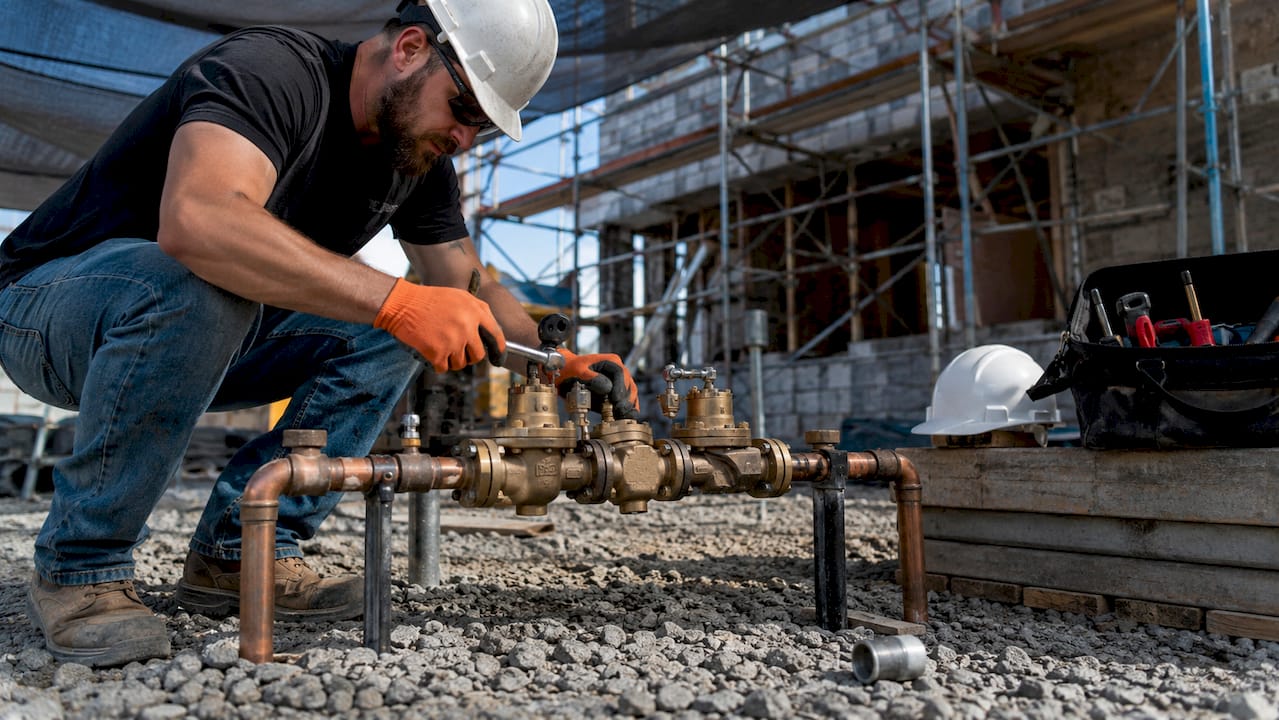
RPZ assemblies discharge through relief valves and require specific drainage to avoid indoor flooding during a failure event. This is a critical installation detail. An RPZ installed indoors without a proper floor drain can cause serious water damage when the relief valve activates. RPZ devices are common on commercial properties, hospitals, and any site using chemicals in the water system.
Pro Tip: If your RPZ is installed indoors, confirm a floor drain is directly beneath the relief valve port before the device is tested. Missing this detail is one of the most common causes of water damage during annual testing.
4. Double Check Valve Assembly (DCVA)
The DCVA uses two independently operating check valves in series. It has no relief valve, which makes it simpler and less expensive than an RPZ. The DCVA is the standard backflow prevention device for moderate-hazard connections.
Common DCVA applications include commercial buildings, multi-family residential properties, and fire sprinkler systems that do not use chemical additives. The DCVA works both indoors and outdoors, and it does not require drainage provisions. One important limit: the DCVA is not approved for connections where toxic chemicals could enter the water system. For those situations, an RPZ is required.
5. Pressure Vacuum Breaker (PVB)
The PVB protects against backsiphonage only. It contains a spring-loaded check valve and an air inlet valve that opens when supply pressure drops. When pressure falls, the air inlet opens and breaks the siphon before contaminated water can reverse into the supply line.
PVB devices must be installed at least 12 inches above the highest downstream outlet. This height requirement is non-negotiable and is the most commonly violated installation rule for residential irrigation systems. The PVB is the most popular backflow prevention device for residential and commercial irrigation in Texas because it handles backsiphonage effectively at a lower cost than an RPZ.
6. Atmospheric Vacuum Breaker (AVB)
The AVB is the simplest mechanical backflow prevention device available. It uses a float-operated air inlet that opens when pressure drops, admitting air to break a potential siphon. AVBs are inexpensive and easy to install, making them common on individual hose bibs and low-hazard irrigation zones.
The critical operational limit: AVB devices cannot remain under continuous pressure and must be unpressurized for at least 12 hours in every 24-hour cycle. This rules out AVBs for any zone that stays pressurized around the clock. AVBs also cannot be installed downstream of a shutoff valve, because that configuration keeps the device under pressure. For low-hazard, intermittent-use connections, the AVB is a cost-effective solution.
7. Installation and operational constraints you cannot ignore
Backflow preventer installation is not a casual plumbing job. Each device type carries specific rules that affect where it can go, how it must be oriented, and what support infrastructure it needs.
Key installation rules by device type:
- RPZ assemblies must have a floor drain or dedicated drainage path directly beneath the relief valve. Skipping this step risks flooding during testing or failure events.
- PVBs must be installed a minimum of 12 inches above the highest downstream outlet. Measure from the outlet, not from the ground.
- AVBs must not be installed downstream of any shutoff valve that could trap the device under continuous pressure.
- All devices require at least 1 foot of clear space around them. Landscaping or stored items blocking access can trigger non-compliance notices from water authorities.
- Outdoor installations need protection from freezing temperatures. In Houston, hard freezes are rare but do occur. Insulated covers are inexpensive insurance.
Pro Tip: Take photos of your device and its surroundings immediately after installation. If a water authority inspector questions clearance or drainage, dated photos are your fastest proof of compliance.
8. Maintenance best practices and compliance testing
Backflow prevention assemblies require testing at installation and at least annually by a certified professional, with results typically submitted to the water authority within 30 days. Missing this window can result in fines or a notice to discontinue water service.
Annual testing is the legal floor, not the full maintenance program. A complete maintenance approach includes:
- Monthly visual checks: Look for leaks around the body, corrosion on fittings, and listen for unusual sounds like water hammer or hissing. Monthly visual inspections catch failures early and prevent expensive emergency repairs.
- Recordkeeping: Log every test result, repair, and visual inspection with dates. Accurate documentation simplifies compliance and speeds up troubleshooting when something goes wrong.
- Clearance maintenance: Keep the area around the device free of plants, stored equipment, and debris at all times.
- No DIY repairs: Internal components like check valve discs and springs require certified technicians. Improper repairs void test certifications and can create liability.
For a detailed walkthrough of what to check and when, the property manager’s maintenance guide from Reliable-fire-protection covers the full inspection routine.
9. Comparative overview for common property scenarios
Choosing the right device comes down to three factors: hazard level, installation environment, and operational pattern. The table below maps common property scenarios to the correct device.
| Property type | Recommended device | Key reason |
|---|---|---|
| Residential irrigation | PVB | Backsiphonage protection, cost-effective, above-ground install |
| Commercial irrigation with chemicals | RPZ | High hazard, toxic contamination risk |
| Multi-family building main line | DCVA | Moderate hazard, no drainage required |
| Fire sprinkler system (no additives) | DCVA | Moderate hazard, indoor/outdoor suitable |
| Fire sprinkler system (with antifreeze) | RPZ | Chemical use elevates hazard classification |
| Single hose bib, low use | AVB | Low hazard, intermittent pressure, lowest cost |
| Industrial or medical facility | RPZ or Air Gap | Highest hazard, maximum protection required |
For Houston property managers navigating local code requirements, the backflow preventer testing guide from Reliable-fire-protection provides jurisdiction-specific detail on device approval and submission deadlines.
Key takeaways
The correct backflow prevention device is determined by hazard classification first, with installation environment and operational limits shaping the final choice.
| Point | Details |
|---|---|
| Hazard level drives selection | Local water authorities assign device type by hazard; owner preference does not override code. |
| RPZ for high hazard | RPZ assemblies protect against toxic contamination but require drainage provisions for relief valve discharge. |
| DCVA for moderate hazard | Double Check Valve Assemblies suit commercial and multi-family buildings without chemical water use. |
| PVB and AVB for low hazard | PVBs need 12-inch height clearance; AVBs cannot stay pressurized more than 12 hours per day. |
| Annual testing is mandatory | Certified testing at installation and yearly, with results submitted within 30 days, keeps you compliant. |
What working with backflow devices has taught me
Property owners consistently underestimate how much the device type matters after installation. Picking the cheapest option or the one that fits the space is a shortcut that fails inspection. The code is not flexible on this point.
The maintenance gap is where most compliance problems actually live. Annual testing gets scheduled because the water authority sends a reminder. Monthly visual checks do not get scheduled because no one sends a reminder. Off-season visual checks for sounds like water hammer can reveal internal failures months before mandatory testing, which means you fix a $200 part instead of paying for an emergency service call and a late submission penalty.
Documentation is the other underrated piece. Property managers who keep a simple log of every test, repair, and visual check move through annual inspections in minutes. Those who rely on memory or scattered emails spend hours reconstructing records and sometimes cannot prove compliance at all.
My honest recommendation: partner with a certified backflow professional from the start. Not just for annual testing, but for the initial device selection conversation. Getting the right device installed correctly the first time costs less than correcting a non-compliant installation after the fact.
— Reliable-fire-protection
Reliable-fire-protection keeps your water systems compliant
Backflow prevention is one part of a complete property safety program. Reliable-fire-protection serves Houston-area property owners and managers with certified testing, installation, and maintenance for backflow preventers, fire sprinkler systems, fire alarms, and suppression systems.
Whether you manage a single commercial building or a portfolio of properties, staying current on backflow preventer services protects your water supply and your compliance record. Reliable-fire-protection’s certified technicians handle device selection, installation review, annual testing, and documentation so nothing falls through the cracks. If your fire sprinkler system also needs attention, the sprinkler inspection guide is a practical next step for Houston properties.
FAQ
What are the main types of backflow preventers?
The main types are the Air Gap, Reduced Pressure Zone (RPZ) assembly, Double Check Valve Assembly (DCVA), Pressure Vacuum Breaker (PVB), and Atmospheric Vacuum Breaker (AVB). Each device matches a specific hazard level and installation condition.
How do I know which backflow preventer my property needs?
Your local water authority assigns the required device based on the hazard classification of your water connection. High-hazard connections require an RPZ; moderate-hazard connections use a DCVA; low-hazard backsiphonage situations use a PVB or AVB.
How often do backflow preventers need to be tested?
Backflow prevention assemblies require certified testing at installation and annually, with results submitted to the water authority typically within 30 days. Skipping or missing the submission window can result in fines or service interruption.
Can I install a backflow preventer myself?
Installation must follow strict code requirements for height, drainage, and clearance that vary by device type. Certified professional installation protects your compliance record and ensures the device performs correctly during testing.
What happens if my backflow preventer fails inspection?
A failed test requires repair or replacement by a certified technician, followed by a retest. Detailed records of repairs and retests are required to demonstrate compliance to your water authority.