
TL;DR:
- Fire codes are essential safety standards that help prevent fires and protect lives and property. They are enforced through regular inspections, and non-compliance can lead to costly fines, legal liability, and building closures. Maintaining ongoing compliance involves continuous inspection, documentation, and adherence to evolving codes, which are critical for legal and safety reasons.
Fire codes are legally mandated standards designed to prevent fires and protect life and property by setting minimum safety requirements for buildings, occupancies, and fire protection systems. Every property owner, business manager, and compliance officer in the United States operates under these rules whether they know it or not. The National Fire Protection Association’s NFPA 101 Life Safety Code and the International Fire Code set the national baseline, but local jurisdictions often go further. Understanding the importance of fire codes is not optional. It is a legal, financial, and moral obligation.
Why fire codes reduce deaths and property loss
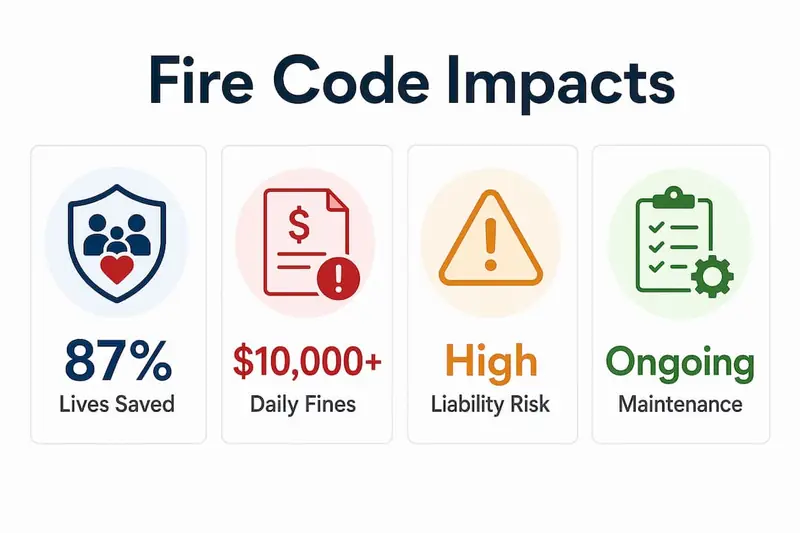
Fire codes save lives in measurable, documented ways. Automatic sprinklers reduce the civilian death rate by 87%, and 70% of home fire deaths occur in buildings without working smoke alarms. Those two numbers alone explain why fire safety regulations exist and why enforcement matters.
Fire codes mandate specific life safety features: clear egress paths, rated fire doors, sprinkler systems, alarm systems, and emergency lighting. Each requirement traces back to a real event. The 1911 Triangle Shirtwaist Factory fire killed 146 workers because exits were locked. The 2003 Station nightclub fire in Rhode Island killed 100 people because of inadequate exits and flammable wall materials. Fire codes arise from tragedies like these, turning preventable disasters into enforceable standards.
Fire inspections turn lessons from tragedies into enforceable action. Every code requirement has a body count behind it.
Regular inspections are the enforcement mechanism that makes codes real. An inspector who finds a blocked exit or a disabled alarm is not being bureaucratic. That inspector is applying a lesson learned from a fire that killed people. Without inspections, code requirements become suggestions, and suggestions do not stop fires.
The financial case for compliance is equally clear. Buildings with functioning sprinkler and alarm systems suffer dramatically lower property losses when fires do occur. Insurance carriers recognize this. Underwriters routinely offer lower premiums for code-compliant properties. The cost of installing and maintaining fire protection systems is almost always lower than the cost of a single serious fire event.

How fire code enforcement works across jurisdictions
Fire code compliance is not a single national standard applied uniformly. It is a layered system where federal guidelines, state adoptions, county rules, and city ordinances all interact. 43 states have adopted NFPA 101 statewide, while others rely on the International Fire Code or local amendments. The rule is simple: the strictest applicable code governs.
The Authority Having Jurisdiction, known as the AHJ, is the local body responsible for interpreting and enforcing fire codes. This is typically the local fire marshal or fire department. The AHJ has significant discretion. They can require stricter measures than the state baseline and can approve variances when rigid compliance is impractical.
Local jurisdictions often adopt stricter provisions than state baselines. A Houston commercial property owner, for example, must satisfy Texas state fire code requirements and any additional City of Houston fire marshal requirements. If those two conflict, the stricter standard applies.
Here is what you need to verify for your specific property:
- The state fire code in effect for your building type and occupancy class
- Any county or municipal amendments adopted on top of the state code
- The specific AHJ responsible for your address and their contact information
- Whether your building falls under NFPA 101, the International Fire Code, or a local equivalent
- Any special occupancy requirements for your use type, such as assembly, healthcare, or education
Pro Tip: Contact your local fire marshal’s office directly and ask which edition of which code applies to your specific address and occupancy type. Do not assume the state baseline is the final word.
Compliance requires understanding the most stringent requirement from all applicable authority levels. Local fire marshals often impose stricter rules than state or federal baselines, and that is the version you must meet.
What are the legal and financial consequences of non-compliance?
Non-compliance with fire safety regulations carries consequences that go well beyond a warning letter. OSHA penalties for fire safety violations can exceed $165,000 per incident. Daily operational fines for ongoing violations can exceed $10,000. Those numbers accumulate fast for a property with multiple deficiencies.
The legal exposure extends beyond fines. A fire that injures or kills occupants in a non-compliant building creates significant civil liability for the property owner. Prosecutors have pursued criminal charges in cases where negligent code violations contributed to deaths. The burden of proof in these cases often falls on the property owner to demonstrate that required systems were installed, tested, and maintained.
Forced closure is another real consequence. Fire marshals have the authority to issue stop-use orders for buildings with serious violations. A restaurant, warehouse, or office building can be shut down until deficiencies are corrected. The revenue loss from even a short closure typically dwarfs the cost of the original fix.
Here is the sequence of consequences that typically follows a serious inspection failure:
- Written notice of violation with a correction deadline
- Re-inspection to verify corrections
- Escalating fines for uncorrected violations, potentially exceeding $10,000 per day
- Stop-use or closure order for life-safety deficiencies
- Civil litigation if occupants are harmed during the violation period
- Criminal referral in cases involving gross negligence or repeat violations
One option many property owners overlook is the formal variance process. Formal variance or appeals processes allow you to demonstrate equivalent safety to the AHJ when rigid code compliance is impractical. This is not a loophole. It is a legitimate path that requires documented evidence of alternative safety measures that meet the intent of the code.
How to maintain ongoing fire code compliance
Fire code compliance is a continuous system involving physical conformity, documentation, and ongoing maintenance. Passing an initial inspection does not mean you are done. Codes evolve, tenants change, and systems age. Compliance must be actively managed.
Documentation is as critical as the physical equipment. Missing or outdated inspection tags, test records, and drill logs are frequently cited during inspections alongside physical system violations. An inspector who finds a functioning sprinkler system but no test records will still issue a citation. Your paperwork must match your physical systems.
Buildings with certificates of occupancy are not automatically exempt from evolving requirements. Grandfathering does not exempt buildings from evolving codes, and life safety features cannot be removed or degraded below the original code level. If you renovate, add occupants, or change the use of a space, you may trigger a full code review under current standards.
Common mistakes property managers make include:
- Assuming the initial certificate of occupancy covers all future compliance
- Failing to schedule annual or semi-annual system tests and inspections
- Letting fire extinguisher tags, sprinkler test records, or alarm inspection reports lapse
- Blocking exits or storage areas without realizing it triggers a code violation
- Not updating emergency evacuation plans when floor layouts or occupancy changes
Pro Tip: Build a compliance calendar with scheduled dates for every required test, inspection, and drill. Treat it the same way you treat rent collection. Missing a date has real consequences.
Ongoing maintenance, inspection, and documentation form a continuous compliance requirement far beyond initial certification. The fire system maintenance process should be treated as a core operational function, not an afterthought. A fire compliance checklist for your property type is a practical starting point for building that routine.
Key Takeaways
Fire codes are a continuous legal obligation that protects lives, limits liability, and determines whether your property stays open for business.
| Point | Details |
|---|---|
| Codes save lives with data | Sprinklers reduce civilian death rates by 87%; smoke alarm absence drives 70% of home fire deaths. |
| Strictest jurisdiction governs | Federal, state, county, and city codes all apply; the most stringent requirement is the one you must meet. |
| Non-compliance is costly | OSHA fines can exceed $165,000 per incident; daily violations can cost over $10,000 per day. |
| Documentation is compliance | Missing inspection tags or test records result in citations even when physical systems are functional. |
| Compliance never stops | Grandfathering rarely exempts life safety systems; codes evolve and must be actively tracked. |
Fire codes are written in blood, and enforcement is not optional
Every fire code requirement I have seen enforced traces back to a specific failure. Locked exits. Disabled alarms. Sprinkler systems that were never tested. These are not hypothetical risks. They are documented causes of mass casualties that regulators turned into law.
What frustrates me most about how property owners approach fire code compliance is the checkbox mentality. They pass an inspection, file the certificate, and move on. Three years later, a tenant blocks a fire door with a storage rack, an alarm battery dies and nobody replaces it, and the sprinkler test record from 2022 is the most recent one in the file. That building is not compliant. It is a liability waiting to materialize.
The harder truth is that enforcement is inconsistent. Some jurisdictions inspect aggressively. Others are understaffed and rely on complaint-driven inspections. A property owner who has not been inspected in five years should not take that as a sign they are compliant. They should take it as a warning that they have been operating without accountability.
Proactive compliance is not about fear of inspectors. It is about recognizing that fire codes represent the minimum acceptable standard for protecting the people inside your building. Meeting that standard consistently, documenting it thoroughly, and updating it as codes evolve is what separates a well-managed property from a liability.
— Reliable-fire-protection
How Reliable-fire-protection can help you stay compliant
Fire code compliance requires the right systems, properly installed, regularly tested, and thoroughly documented. Reliable-fire-protection serves Houston property owners and business managers with exactly that.
From fire alarm system installation to sprinkler system compliance workflows, Reliable-fire-protection covers every layer of what inspectors look for. The team handles installation, testing, inspection support, and the documentation that keeps your records clean. Whether you manage a single commercial property or a portfolio of buildings across Houston, Reliable-fire-protection provides the expertise and local knowledge to keep you on the right side of your AHJ. Contact Reliable-fire-protection for a free quote and a clear picture of where your property stands.
FAQ
What is fire code compliance?
Fire code compliance means your building meets all applicable fire safety regulations set by federal, state, and local authorities. It includes physical systems like sprinklers and alarms, plus documentation such as inspection records and drill logs.
Why does the importance of local fire codes vary by location?
Local jurisdictions can adopt stricter fire code provisions than state baselines, so the requirements for a Houston property may differ from those in another Texas city. Always verify with your local fire marshal which edition and amendments apply to your specific address.
What happens if you fail a fire code inspection?
Violations result in written notices, escalating fines that can exceed $10,000 per day, and potential closure orders for serious life-safety deficiencies. Civil and criminal liability follows if occupants are harmed during a violation period.
Does a certificate of occupancy mean a building is always compliant?
No. A certificate of occupancy confirms the building met code at the time of approval. Codes evolve, and grandfathering rarely exempts life safety systems from updated requirements, especially after renovations or occupancy changes.
Can you appeal a fire code violation?
Yes. A formal variance or appeals process allows property owners to demonstrate equivalent safety to the AHJ when strict compliance is not practical. This requires documented evidence that alternative measures meet the intent of the code.