

TL;DR:
- Wireless fire detection systems use radio signals to communicate smoke, heat, and alarm devices without cables. They meet same standards as wired systems and are ideal for retrofit, heritage, and occupied buildings where quick installation is needed. Maintenance requires regular battery checks and signal testing to ensure ongoing reliability and compliance.
Wireless fire detection is a fire safety system that detects smoke, heat, or flames and communicates alarms using radio frequency signals instead of physical cables. Modern wireless fire detection systems meet the same stringent performance standards as wired systems, including NFPA 72 and UL 864 in the United States, making them a fully code-compliant fire safety solution. Technologies like Siemens SWING and mesh network protocols have moved wireless systems from a niche workaround to a frontline option for property owners, facility managers, and safety officers managing retrofit projects, heritage buildings, and occupied commercial spaces.
What is wireless fire detection and how does it work?
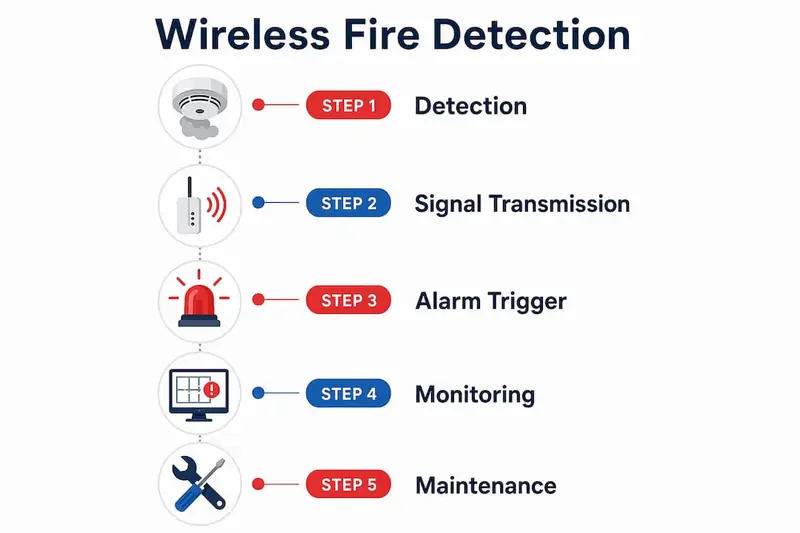
Wireless fire detection is defined as a network of fire safety devices that communicate through radio frequency (RF) signals rather than hardwired cable runs. Each device, whether a smoke detector, heat detector, or manual call point, transmits status signals to a central control panel without a physical connection. The control panel monitors every device continuously and triggers an alarm the moment a sensor detects a hazard.

The most reliable wireless systems today use mesh network architecture. In a mesh network, each device acts as both a sensor and a signal relay. If one communication path fails, the system automatically reroutes signals through another device, eliminating single points of failure. This self-healing capability is what separates modern wireless systems from older, less dependable star network designs.
Core components of a wireless fire detection system
A complete wireless fire detection system includes these key devices:
- Smoke detectors: Optical or ionization sensors that detect airborne combustion particles and transmit alerts via RF signal.
- Heat detectors: Trigger when ambient temperature rises above a set threshold, useful in kitchens or dusty environments where smoke detectors would false alarm.
- Manual call points: Wall-mounted break-glass units that let occupants trigger the alarm manually without needing a wired connection.
- Wireless sounders and strobes: Alert occupants audibly and visually when an alarm is triggered.
- Control panel: The central hub that receives all device signals, processes alarm conditions, and communicates with monitoring centers.
Wireless smoke detectors use lithium batteries, typically with a 10-year battery lifespan, and operate completely independently of a building’s internet or Wi-Fi infrastructure. Encrypted two-way communication between devices and the panel prevents signal interference and unauthorized access. The system also sends real-time alerts to building occupants and emergency responders through monitored communication channels, so property managers receive notifications even when they are offsite.
What are the key benefits of wireless fire alarm systems?
The advantages of wireless fire detection go well beyond convenience. For facility managers dealing with occupied buildings or complex retrofit projects, these benefits translate directly into cost savings, reduced disruption, and faster compliance.
- Faster installation. Wireless fire detection installation takes a fraction of the time required for wired systems. There is no cable routing, no drilling through walls or floors, and no fire-stopping work to repair afterward. For an occupied office building or a hotel that cannot close for weeks, this speed is a decisive advantage.
- Lower overall project cost. Labor savings from no cabling offset the higher hardware costs of wireless devices. When you factor in reduced downtime and avoided structural repairs, wireless systems frequently deliver a lower total project cost than wired alternatives.
- Preserved building fabric. Heritage and listed buildings cannot tolerate the physical damage that cable runs cause. Wireless systems install without chasing cables into walls or drilling through historic masonry, protecting the building’s architectural integrity.
- Eliminated Waking Watch costs. In residential retrofits and heritage properties, wireless systems can remove the need for costly Waking Watch services. Waking Watch, where staff physically patrol a building around the clock until a fire alarm is installed, is expensive and disruptive. Wireless systems can be deployed fast enough to end that requirement quickly.
- Mesh network reliability. Mesh architecture means the system has no single point of failure. Signal rerouting happens automatically, so a device going offline does not compromise the whole network.
Pro Tip: Ask your installer whether the wireless system uses mesh or star network topology. Mesh networks are significantly more reliable for large or complex buildings.
Wireless vs. wired fire alarm systems: which is right for your building?
The choice between wireless and wired fire detection depends on your building type, project timeline, and device count requirements. Neither system is universally superior. Each has clear strengths and specific limitations.
| Factor | Wireless | Wired |
|---|---|---|
| Installation speed | Fast, minimal disruption | Slower, requires cable runs |
| Installation cost | Higher hardware, lower labor | Lower hardware, higher labor |
| Building disruption | Minimal | Significant |
| Device capacity | Limited, can exceed 50% fewer devices | High capacity for large buildings |
| Compliance standard | NFPA 72, UL 864, BS EN 54-25 | NFPA 72, UL 864 |
| Best use case | Retrofits, heritage, occupied buildings | New builds, large commercial |
| Maintenance | Battery monitoring required | Minimal cabling maintenance |
Wired systems remain the preferred choice for large-scale new construction where device counts are high and cable installation is planned from the start. Wireless systems can reduce overall device capacity by more than 50% compared to wired setups, which makes them impractical as a full replacement in very large or dense commercial environments.
The strongest approach for many properties is a hybrid system. Industry professionals recommend combining wireless technology with existing wired infrastructure, particularly in phased upgrade projects. A hybrid design lets you extend coverage into hard-to-wire areas without replacing a functioning wired backbone.
Pro Tip: For a Houston property undergoing phased renovation, a hybrid approach lets you maintain code compliance in occupied zones while wired infrastructure is installed in newly built sections. Review the Houston installation guide for local code specifics.
When is wireless fire detection the best choice for your property?
Wireless fire detection delivers the greatest value in specific scenarios. Knowing those scenarios helps you make a confident decision rather than defaulting to the more familiar wired option.
Wireless is the clear winner in these situations:
- Heritage and listed buildings: Drilling and cable routing can cause irreversible damage to historic structures. Wireless deployments in heritage properties avoid costly fire-stopping work and lengthy disruptions, offering major savings compared to wired solutions.
- Occupied retrofit projects: Schools, hospitals, hotels, and apartment buildings cannot shut down for a full wired installation. Wireless systems install room by room without displacing occupants.
- Sites with difficult cabling access: Buildings with concrete floors, asbestos-containing materials, or complex structural layouts make cable routing expensive and hazardous. Wireless eliminates that problem entirely.
- Rapid deployment requirements: Emergency situations or temporary facilities where fire protection is needed quickly benefit from wireless systems that can be operational within days.
- Extending existing wired systems: Adding wireless devices to cover a new wing or a previously unprotected area is faster and cheaper than running new cable back to the main panel.
Wireless is not the right fit in these situations:
- Very large commercial buildings with hundreds of devices, where capacity constraints become a compliance risk.
- Environments with significant RF interference from industrial equipment or dense electronic infrastructure.
- New construction where cabling is planned from the design stage and wired systems offer better long-term value.
Maintenance is a real commitment with wireless systems. Battery monitoring and signal testing are ongoing requirements, not optional extras. Simulated fire tests and signal strength checks must happen on a regular schedule to maintain compliance. This is not a reason to avoid wireless systems, but it is a responsibility that facility managers need to plan for from day one.
Pro Tip: Schedule battery checks and signal strength audits into your annual fire alarm maintenance plan from the moment the system goes live. Reactive maintenance on wireless systems is far more costly than preventive care.
Key Takeaways
Wireless fire detection is a fully code-compliant, practical alternative to wired systems that delivers the greatest value in retrofit, heritage, and occupied building projects where installation speed and minimal disruption are priorities.
| Point | Details |
|---|---|
| Compliance is equal | Wireless systems meet NFPA 72 and UL 864, the same standards as wired systems. |
| Mesh networks prevent failure | Automatic signal rerouting eliminates single points of failure in modern wireless systems. |
| Cost savings come from labor | Lower installation labor offsets higher hardware costs in most retrofit projects. |
| Capacity limits exist | Wireless systems can support significantly fewer devices than wired, limiting use in large buildings. |
| Maintenance is non-negotiable | Battery monitoring and regular signal testing are required to maintain compliance and performance. |
Why wireless fire detection deserves a second look from every facility manager
Fire safety experts confirm that wireless systems are no longer second-tier. That shift happened because mesh networking solved the reliability problem that plagued earlier wireless designs. I have seen too many facility managers dismiss wireless outright because of outdated assumptions, and that instinct costs them time and money on projects where wireless would have been the faster, cheaper, and equally safe choice.
The most underused application is the hybrid system. Property managers running phased renovations often default to extending their existing wired panel into new areas, even when a wireless zone would be faster and less disruptive. Combining both technologies is not a compromise. It is good engineering.
The maintenance requirement is the one area where wireless demands more discipline than wired. Battery health and signal integrity need scheduled attention. Buildings that treat wireless systems like set-and-forget infrastructure will eventually face compliance failures. The technology is reliable. The discipline around it has to match.
Looking ahead, wireless capacity is increasing as RF protocols improve and device miniaturization continues. Integration with building management systems and smart controls is already happening in newer installations. The gap between wireless and wired capability is narrowing every year. For property owners planning upgrades now, wireless or hybrid designs are worth serious evaluation, not just as a workaround, but as the primary solution.
— Reliable-fire-protection
Reliable-fire-protection: expert wireless fire alarm services in Houston
Reliable-fire-protection specializes in wireless and hybrid fire detection systems for residential and commercial properties across Houston. Whether you manage a historic building, an occupied apartment complex, or a commercial facility due for a code-compliant upgrade, the team delivers fast, professional installations with minimal disruption to your operations.

Reliable fire protection’s certified technicians assess your building’s layout, device requirements, and compliance obligations before recommending a system. They handle everything from initial planning through installation and ongoing maintenance. For property owners and facility managers ready to take the next step, start with a full review of how fire alarm systems work and then contact Reliable-fire-protection for a free consultation and project quote.
FAQ
What is wireless fire detection?
Wireless fire detection is a fire safety system that connects smoke detectors, heat detectors, manual call points, and sounders to a central control panel using radio frequency signals instead of physical cables. It meets the same compliance standards as wired systems, including NFPA 72 and UL 864.
How does wireless fire detection work?
Each device transmits encrypted RF signals to the control panel, which monitors all devices continuously and triggers an alarm when a hazard is detected. Mesh network systems automatically reroute signals if one communication path fails, maintaining system integrity.
Are wireless fire alarms as reliable as wired systems?
Yes. Modern wireless fire alarm systems meet NFPA 72, UL 864, and BS EN 54-25 standards, confirming they are functionally equivalent to wired systems in life safety performance when properly installed and maintained.
Do wireless smoke detectors need Wi-Fi to work?
No. Wireless smoke detectors communicate via dedicated radio frequency signals and operate independently of a building’s internet or Wi-Fi infrastructure. They use lithium batteries, typically rated for a 10-year lifespan.
What are the main limitations of wireless fire detection systems?
The primary limitation is device capacity. Wireless systems can support significantly fewer devices than wired setups, making them less practical for very large or dense commercial buildings. They also require ongoing battery monitoring and scheduled signal testing to maintain compliance.