
TL;DR:
- NFPA compliance ensures your fire safety systems meet local standards, but enforcement depends on jurisdiction adoption.
- Property managers should verify AHJ-adopted editions, keep inspection records, and schedule all required tests to avoid violations.
NFPA compliance means your building’s fire and life-safety systems meet the consensus standards published by the National Fire Protection Association, as adopted by your Authority Having Jurisdiction (AHJ) or required by your insurer. Those standards do not automatically carry the force of law until a local or state AHJ adopts them, OSHA incorporates them by reference, or your insurance policy or lease references them directly.
Three things to do right now:
- Check your AHJ’s adopted editions. Call your local fire marshal or building department and ask which edition of each relevant NFPA standard they currently enforce. Auditing to the wrong edition is one of the most common compliance gaps.
- Pull your inspection and test records. Gather the last three to five years of reports for your fire alarm, sprinkler, fire doors, and extinguishers. Missing records are cited alongside the underlying safety deficiency in enforcement actions.
- Schedule any overdue inspections. If records are missing or expired, contact a certified fire protection contractor and book the required tests before your next AHJ inspection.
Standards to check first: NFPA 13 (sprinklers), NFPA 25 (sprinkler inspection and testing), NFPA 72 (fire alarms), NFPA 80 (fire doors), NFPA 101 (Life Safety Code), NFPA 10 (extinguishers), NFPA 30 (flammable and combustible liquids).
Table of Contents
- What the NFPA is and how its standards actually work
- Key NFPA standards every property manager should know
- How NFPA standards become enforceable and who enforces them
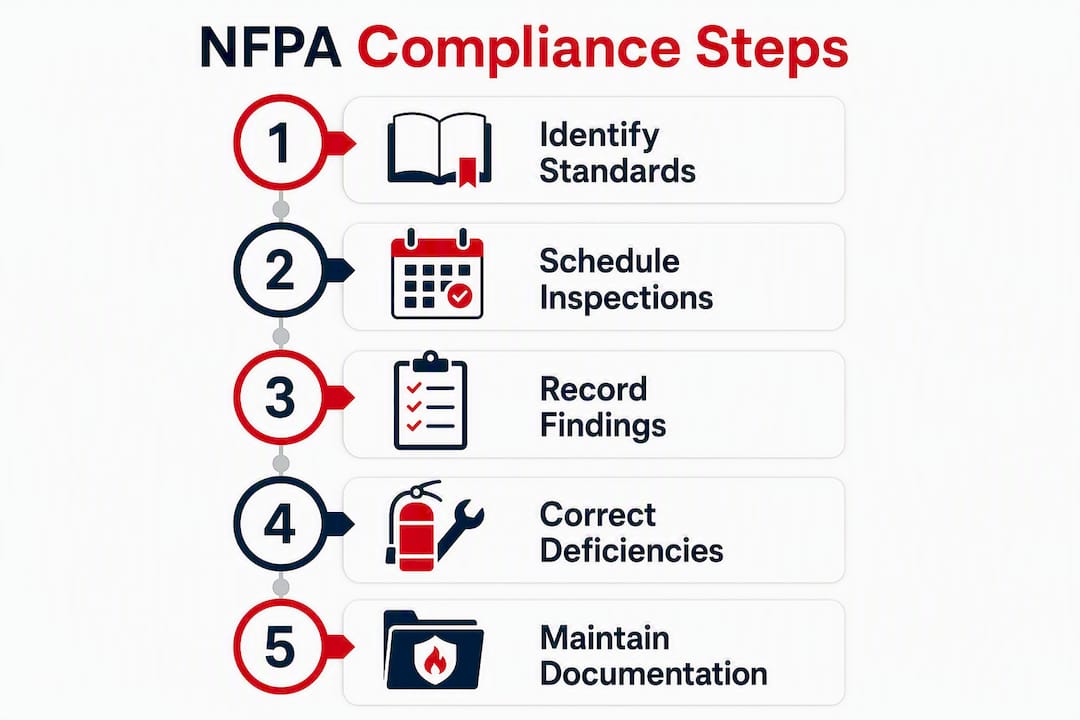
- How to achieve NFPA compliance: a practical step-by-step checklist
- Inspection timelines and what compliance actually costs
- What happens when you fall out of compliance
- Where to find official standards and how to contact your AHJ
- How Reliable-fire-protection helps property managers stay compliant
- Key Takeaways
- The compliance gaps that actually cost managers the most
- Ready to close your compliance gaps? Start with a free audit
- Authoritative sources and further reading
What the NFPA is and how its standards actually work
The National Fire Protection Association is a U.S.-based nonprofit that has published safety codes and standards for more than 130 years. Today it publishes over 300 consensus codes and standards, developed by many technical committees accredited by the American National Standards Institute (ANSI). Volunteers from industry, government, insurance, and academia write and vote on every revision, which is why the documents carry the label “consensus standard.”
Two document types matter most for property managers. Model codes like NFPA 1 (Fire Code) and NFPA 101 (Life Safety Code) are designed to be adopted wholesale by a jurisdiction. Technical standards like NFPA 13, NFPA 25, and NFPA 72 specify how particular systems must be designed, installed, inspected, and tested. A model code often references the technical standards, pulling them into legal force when the code is adopted.
Here is the practical nuance: an NFPA document sitting on a shelf has no legal teeth. It becomes enforceable when your AHJ adopts it, when a state or federal regulation incorporates it by reference, or when your insurance carrier or lease agreement requires compliance with it. That distinction matters because the edition adopted locally may lag the current NFPA edition by several years, and the differences can affect inspection schedules and accepted procedures.
Pro Tip: Prioritize the systems that most commonly trigger AHJ citations and insurance exposure: sprinklers, fire alarms, fire doors, and portable extinguishers. Getting those four right covers the majority of enforcement risk for most commercial and multifamily properties.
Key NFPA standards every property manager should know
The seven standards below cover the systems inspectors check most often. Each entry names the system it governs, the situations that trigger it, and the immediate action you should take.
- NFPA 13 governs the design and installation of automatic sprinkler systems. Any new or substantially modified sprinkler system in a commercial or multifamily building must meet it.
- NFPA 25 covers inspection, testing, and maintenance of water-based fire protection systems, including sprinklers and standpipes. This is the standard that drives your recurring sprinkler inspection schedule.
- NFPA 72 sets requirements for fire alarm and detection systems, from device placement to acceptance testing and ongoing inspection intervals.
- NFPA 80 applies to fire doors, fire windows, and other opening protectives. Any rated door assembly in your building falls under it.
- NFPA 101 (Life Safety Code) addresses means of egress, occupancy loads, exit signage, and emergency lighting across virtually every building type.
- NFPA 10 covers portable fire extinguishers: placement, signage, inspection frequency, and service intervals.
- NFPA 30 regulates the storage, handling, and use of flammable and combustible liquids. It applies to parking garages, maintenance shops, and any facility storing fuel or solvents.
The table below summarizes each standard’s scope, typical inspection frequencies, and the immediate manager action.
| Standard | Systems governed | Typical inspection/test frequency | Manager action |
|---|---|---|---|
| NFPA 13 | Sprinkler system design and installation | At installation/modification; acceptance test required | Verify acceptance test report on file |
| NFPA 25 | Sprinkler and water-based system ITM | Monthly visual; annual internal inspection; 5-year main drain test | Pull last inspection report; schedule overdue tests |
| NFPA 72 | Fire alarm and detection systems | Monthly visual check; annual full-function test | Confirm annual test certificate is current |
| NFPA 80 | Fire doors and opening protectives | Annual inspection | Check door hardware and self-closing function; retain records 3 years minimum |
| NFPA 101 | Life safety, egress, occupancy | Tied to occupancy permit and AHJ inspection cycle | Walk egress paths; verify exit signs and emergency lighting |
| NFPA 10 | Portable fire extinguishers | Monthly visual; annual maintenance | Tag and log each unit; schedule annual service |
| NFPA 30 | Flammable and combustible liquid storage | Periodic per storage class and quantity | Audit storage areas; verify ventilation and containment |
Always verify which edition your AHJ has adopted for each standard. Required edition affects inspection schedules and accepted procedures, and the locally adopted edition may differ from the current NFPA publication.
How NFPA standards become enforceable and who enforces them
Three pathways turn a voluntary NFPA document into a requirement you must meet.

Local AHJ adoption. Your fire marshal or building official adopts a model fire code, which in turn references NFPA technical standards. Some states adopt NFPA 1 as their primary fire code; most states adopt the International Fire Code (IFC), which still references NFPA standards like NFPA 25 and NFPA 72 for technical detail. Either way, the AHJ is the primary enforcement authority on your property.
OSHA incorporation by reference. OSHA does not enforce NFPA standards directly, but it incorporates certain NFPA documents into its own regulations and may use NFPA standards as evidence under the General Duty Clause when an employer ignores a recognized hazard. Failing to follow NFPA guidance can support an OSHA citation even when no specific OSHA rule addresses the exact condition.
Contractual and insurance obligations. Your property insurance policy, a tenant lease, or a lender covenant may independently require NFPA compliance. These obligations exist regardless of what the AHJ enforces.
When federal OSHA, a state plan, and a local fire code all apply, you must meet the strictest applicable requirement. Local AHJs frequently adopt more recent NFPA editions than OSHA references, so defaulting to the most protective standard is the safest posture.
Enforcement actions typically involve:
- Written citations from the fire marshal or building official
- Orders to correct deficiencies within a specified timeframe
- Requests for inspection reports, maintenance logs, and test certificates
- Stop-use or occupancy-restriction orders for serious violations
- Referral to OSHA when workplace safety hazards are involved
Pro Tip: Always verify which edition the AHJ has adopted before changing your inspection practices or vendor contracts. Auditing to the newest NFPA edition without confirming local adoption is a common and costly mistake.
How to achieve NFPA compliance: a practical step-by-step checklist
Initial gap analysis
- Obtain your AHJ’s adopted editions. Contact the local fire marshal or building department. Ask for the adopted edition of each NFPA standard that applies to your occupancy type.
- Compile current inspection and test records. Gather reports for sprinklers, alarms, fire doors, and extinguishers. Note the date, the standard tested to, and the technician’s certification.
- Map systems to the relevant NFPA standards. Match each system in your building to the standard that governs it, using the table in the previous section as a starting point.
- Identify overdue items. Compare the last test date against the required frequency. Flag anything past due or with no record on file.
- Schedule required inspections and repairs. Prioritize life-safety systems first: sprinklers, alarms, and egress paths. Book a certified contractor and confirm they will test to the AHJ-adopted edition.
Ongoing compliance actions
- Conduct documented monthly walk-throughs covering extinguisher visibility, exit sign function, and fire door self-closing hardware.
- Schedule certified annual inspections per NFPA 25, NFPA 72, NFPA 10, and NFPA 80 with a qualified contractor.
- Maintain a preventive maintenance calendar that staggers tests across the year to avoid inspection bottlenecks.
- Retain inspection reports, acceptance test certificates, maintenance logs, and training records. NFPA 80 requires a minimum three-year retention for fire door records, while retaining five years of records is the general practice for most other fire protection systems to survive multi-year audits.
Documentation inspectors typically request
- Sprinkler system inspection and test reports (NFPA 25)
- Fire alarm acceptance test reports and annual inspection certificates (NFPA 72)
- Fire door annual inspection records (NFPA 80)
- Extinguisher monthly visual logs and annual service tags (NFPA 10)
- Training records for staff who perform monthly checks
Questions to ask vendors and inspectors
- Are you certified by a recognized body (NICET, state license) for this system type?
- Which edition of the NFPA standard did you test to?
- Will you provide a written test report and tag the device per NFPA requirements?
- Does your report identify any deficiencies and recommended corrective actions?
A fire compliance checklist built around these questions gives you a consistent framework for every vendor engagement.

Inspection timelines and what compliance actually costs
The table below shows typical recurring frequencies drawn from NFPA standards. Actual schedules may vary based on occupancy type, system age, and AHJ requirements.
| System / Standard | Frequency | Key test types |
|---|---|---|
| Sprinklers (NFPA 25) | Monthly visual; annual internal inspection; 5-year main drain and obstruction investigation | Flow tests, pressure gauges, valve checks |
| Fire alarms (NFPA 72) | Monthly visual check; annual full-function test | Device activation, notification appliances, panel functions |
| Extinguishers (NFPA 10) | Monthly visual; annual maintenance | Pressure, condition, accessibility |
| Fire doors (NFPA 80) | Annual inspection | Latching, self-closing, gap clearances, hardware condition |
| Flammable liquid storage (NFPA 30) | Periodic per storage class | Containment, ventilation, signage |
Cost drivers vary widely, but the line items to budget for are inspection labor, testing equipment fees, replacement parts (heads, batteries, door hardware), permit and AHJ fees for acceptance tests, and emergency callout charges when a deficiency requires immediate repair.
A few practical budgeting notes. System size and complexity are the biggest cost variables: a 10-story office building with a zoned addressable alarm system costs far more to test annually than a single-story retail strip. Equipment age matters too. Older sprinkler heads, corroded valves, and obsolete alarm panels often generate repair costs on top of inspection fees. Staggering tests across the calendar year, rather than scheduling everything in the same quarter, smooths cash flow and avoids contractor availability crunches. For facility-level scheduling ideas, the 10 ways to improve facility fire safety resource covers seasonal planning in more detail.
What happens when you fall out of compliance
Non-compliance is not just a paperwork problem. The consequences are financial, operational, and reputational.
- AHJ citations and fines. Fire marshals can issue written citations with correction deadlines and monetary penalties. Repeat or willful violations carry higher fines.
- Insurance impacts. Carriers may increase premiums, exclude fire-related claims, or deny coverage outright when inspections are overdue or records are missing. A single denied claim on a major loss can far exceed years of inspection costs.
- Building shutdowns. Serious deficiencies, particularly in sprinkler or alarm systems, can result in occupancy restrictions or full closure orders until corrected.
- Liability exposure. In the event of a fire, missing inspection records and deferred maintenance become evidence in litigation. Investigators and OSHA inspectors use consensus standards as evidence that a recognized hazard was known and ignored.
- Tenant and lease consequences. Inspection failures can trigger lease default clauses, delay renewals, and damage your reputation with prospective tenants.
Missing or incomplete records are frequently cited alongside the underlying safety deficiency, which means a documentation gap doubles your exposure. Keeping records current is not administrative overhead; it is your first line of defense in any enforcement or litigation scenario.
Poor maintenance also increases insurance exposure directly. Managers who treat compliance as a lifecycle process rather than a one-time fix consistently see fewer citations and more favorable renewal conversations with insurers. For a breakdown of the violations that most often trigger enforcement, the fire code violations guide covers the most common gaps by system type.
Where to find official standards and how to contact your AHJ
Primary sources for NFPA standards:
- NFPA.org publishes the full catalog of codes and standards, interpretive statements, and free access to many documents through its online reader.
- Your AHJ’s website (fire marshal, building department, or state fire office) typically lists the adopted edition and any local amendments.
- OSHA’s standards pages at osha.gov identify which NFPA documents are incorporated by reference into federal regulations.
How to verify the adopted edition locally:
- Check your state or municipal code adoption documents, often posted on the state fire marshal’s website.
- Contact the permit office directly and ask: “Which edition of NFPA [standard number] has your jurisdiction adopted, and are there local amendments?”
- For Houston-area properties, the fire safety regulations guide for Houston property managers walks through local AHJ contacts and adoption specifics.
What to have ready when you contact your AHJ:
- Site address and occupancy classification
- System types on the property (sprinkler, alarm, suppression, etc.)
- Most recent inspection reports for each system
- Any open citations or prior enforcement correspondence
Submitting a written inquiry rather than relying on a phone call creates a record of the AHJ’s response, which can be useful if an interpretation question comes up during a future inspection.
How Reliable-fire-protection helps property managers stay compliant
Reliable-fire-protection offers the full range of services that map directly to NFPA compliance requirements for commercial, multifamily, industrial, healthcare, and educational properties.
Core compliance services:
- NFPA-based compliance audits that identify gaps against the AHJ-adopted edition
- Scheduled inspection programs for fire alarms (NFPA 72), sprinkler systems (NFPA 13 and NFPA 25), fire extinguishers (NFPA 10), and fire doors (NFPA 80)
- Installation and replacement of fire alarm systems, sprinkler systems, suppression systems, extinguishers, and backflow preventers
- Certification-ready inspection reports and documentation packages formatted for AHJ submission
- 24/7 emergency repair response for deficiencies that require immediate correction
- Fire safety equipment training for facility staff who conduct monthly visual checks
Every inspection report Reliable-fire-protection produces identifies the standard and edition tested to, lists any deficiencies with recommended corrective actions, and is formatted for AHJ review. That documentation trail is what protects you when an enforcement action or insurance claim arises.
To request a compliance audit or a free quote, contact Reliable-fire-protection directly through the website. The team serves Houston and surrounding neighborhoods and can confirm which AHJ-adopted editions apply to your specific property before the first visit.
Key Takeaways
NFPA compliance is an ongoing operational commitment: verify your AHJ’s adopted editions, keep inspection records current, and treat documentation as your primary defense against enforcement and insurance exposure.
| Point | Details |
|---|---|
| Verify AHJ editions first | Confirm which NFPA edition your local fire marshal enforces before scheduling any inspection or changing vendor practices. |
| Retain records for at least 3–5 years | NFPA 80 requires a minimum three-year retention for fire door inspection records; for most other fire protection systems, five years is standard retention practice. |
| Follow the inspection cadence | NFPA 25, 72, 10, and 80 each specify monthly visual checks and annual certified inspections at minimum. |
| Ask vendors the right questions | Confirm certification, the edition tested to, and that a written report with deficiency notes will be provided. |
| Reliable-fire-protection | Provides NFPA-based audits, scheduled inspections, and certification-ready documentation for Houston-area properties. |
The compliance gaps that actually cost managers the most
The pattern that shows up most often in the field is not a dramatic system failure. It is three quieter problems compounding each other: the wrong edition, incomplete records, and no scheduled maintenance cadence.
A manager inherits a building, assumes the previous owner’s inspection vendor was testing to the current standard, and never asks which edition the AHJ actually adopted. The vendor has been testing to a newer edition for two years. The AHJ arrives, cites the discrepancy, and the manager now has both a documentation gap and a procedural violation to correct simultaneously.
The fix is straightforward but requires discipline. Start with an audit that maps every system to the AHJ-adopted edition. Prioritize repairs by life-safety impact, not by cost. Get a written test report for every corrective action, and file it with the original inspection record. That four-step workflow, audit to prioritized repairs to test report to AHJ-ready documentation, closes most gaps within a single inspection cycle and gives you a defensible paper trail from day one.
The managers who handle compliance best treat it the way they treat lease renewals: a recurring calendar item with a defined owner, a checklist, and a deadline. The ones who struggle treat it as a one-time fix.
Ready to close your compliance gaps? Start with a free audit
Staying ahead of NFPA requirements is straightforward when you have the right inspection partner. Reliable-fire-protection delivers compliance audits, scheduled inspection programs, and certified repair services for commercial and multifamily properties across Houston. The team identifies which AHJ-adopted editions apply to your property, tests every system to the correct standard, and hands you documentation that is ready for your fire marshal on day one.
What you get:
- A full compliance audit mapped to your AHJ-adopted NFPA editions
- Scheduled inspection programs for fire alarm systems, sprinklers, extinguishers, and fire doors
- Corrective repairs and replacement with certified technicians
- Certification-ready reports and a documentation package formatted for AHJ submission
Request a free quote at reliable-fire-protection.com and a member of the team will confirm your property’s compliance status and next inspection dates.
Authoritative sources and further reading
Use these primary sources to verify adopted editions, request official interpretations, and stay current on regulatory changes.
- NFPA.org: Full catalog of codes and standards, free online reader access, interpretive statements, and technical committee documents. Start here to confirm the current edition of any NFPA standard.
- OSHA.gov standards pages: Lists NFPA documents incorporated by reference into federal regulations and provides official OSHA interpretations of how consensus standards interact with OSHA enforcement.
- State fire marshal websites: Each state posts its adopted fire code edition and any local amendments. Search “[your state] fire marshal adopted codes” to find the current adoption document.
- Local fire marshal or building department: The AHJ for your property. Contact them directly to confirm the adopted edition, ask about local amendments, and request clarification on enforcement priorities before your next inspection.
- NFPA 101 (Life Safety Code), NFPA 13, NFPA 25, NFPA 72, NFPA 80, NFPA 10, NFPA 30: The seven standards covered in this article. Access each through the NFPA online reader; confirm the edition your AHJ enforces before using the document as your compliance reference.
To request an official interpretation from your AHJ, submit a written inquiry with your site address, occupancy classification, system descriptions, and the specific code question. Written responses create a record you can reference if the interpretation is disputed during a future inspection.