
TL;DR:
- Upgrading fire systems improves safety, reduces insurance costs, and minimizes operational disruptions.
- Integrated detection and suppression systems offer faster response and greater performance benefits.
- Proper maintenance and documentation are essential to maximize the long-term ROI of fire system investments.
Most Houston business owners and property managers see fire system upgrades as an unavoidable expense, something you do to keep the inspectors happy. That framing costs you money. A well-planned upgrade is one of the smartest risk management moves a property owner can make, delivering measurable returns through lower insurance costs, reduced liability exposure, and fewer operational disruptions. This guide breaks down the real financial and safety benefits of upgrading your fire protection systems, what the data says about performance improvements, and the practical steps Houston property owners can take to make smart, strategic decisions.
Table of Contents
- The case for upgrading: Why modern fire systems matter
- ROI of system upgrades: Cost vs. long-term savings
- Compliance and liability: Meeting Houston’s fire safety standards
- Choosing and maintaining the right upgrades
- Real talk: What most experts don’t tell you about fire system upgrades
- Upgrade your fire protection with Houston’s trusted experts
- Frequently asked questions
Key Takeaways
| Point | Details |
|---|---|
| Serious injury and property risk drops | Upgraded, compliant fire systems can cut injuries by up to 52% and property loss by over 50%. |
| ROI beyond compliance | Modern fire protection upgrades deliver major savings in downtime, insurance, and avoided penalties. |
| Maintenance is critical | Only rigorously maintained systems provide ongoing protection and reliability. |
| Paired systems work best | Detection and suppression together offer more protection than either alone. |
The case for upgrading: Why modern fire systems matter
Fire protection technology has changed dramatically over the past two decades. If your building is running on systems installed before 2010, you are likely operating with detection speeds, suppression coverage, and monitoring capabilities that fall well short of what today’s technology delivers. This is not a compliance technicality. It is a measurable gap in how quickly a fire gets detected, how effectively it gets suppressed, and how much damage your business absorbs before emergency responders arrive.
Modern upgrades prioritize early detection and rapid suppression as paired functions, not separate systems operating in silos. When smoke detectors communicate with suppression systems in real time, the response window shrinks dramatically. That shrinking window is where lives and property are saved.
The research backs this up clearly. NFPA-compliant systems with structured ITM (inspection, testing, and maintenance) reduce injuries by 35 to 52%, cut property loss by 38 to 55%, and reduce operational downtime by approximately 36%. Facilities using paired detection and suppression together consistently outperform those relying on either system alone. Those are not marginal improvements. They represent the difference between a minor incident and a catastrophic one.
Here is what modern fire system upgrades typically deliver beyond the baseline:
- Faster detection through advanced smoke and heat sensors that reduce false alarm rates
- Integrated suppression that activates before a fire fully develops
- Remote monitoring that alerts you and emergency services simultaneously
- Detailed reporting that supports compliance documentation and insurance claims
- Reduced liability exposure from documented system performance
“Compliance is the floor, not the ceiling. The real return on a fire system upgrade comes from what you protect: your people, your assets, and your ability to keep operating.”
Pro Tip: Two of the most common fire system failures in commercial buildings are hydraulic calculation errors in sprinkler systems and neglected valve maintenance. Make sure your contractor verifies hydraulic calculations during any upgrade project, and schedule fire system maintenance on a fixed calendar, not just when something breaks. Pairing this discipline with advanced fire detectors gives you the strongest combined performance.
The takeaway here is straightforward: compliance tells you the minimum you must do. Upgrading tells you the minimum you should do to actually protect your business.
ROI of system upgrades: Cost vs. long-term savings
Numbers make the case better than any argument. Let’s look at what fire system upgrades actually cost in Houston and what they return over time.
Typical retrofit costs vary by system type and building size. Based on current industry data, sprinkler retrofit costs range from $3 to $15 per square foot, depending on building age, pipe configuration, and access complexity. A 22,000 square foot commercial alarm upgrade runs approximately $52,000, and that same system yields around $12,900 in annual savings through reduced insurance premiums, lower energy costs, and fewer false alarm penalties. The math is straightforward: upgrades like that pay for themselves in roughly four years.

The Marco Polo high-rise retrofit project is a well-documented real-world example. That project came in at $7.79 per square foot total, covering a full suppression and alarm integration in an older residential building. That figure includes planning, installation, and commissioning, which is a useful benchmark for Houston property managers evaluating similar projects.
Here is a cost and savings comparison table to put it in perspective:
| Upgrade type | Typical cost range | Estimated annual savings | Payback period |
|---|---|---|---|
| Sprinkler retrofit | $3–$15/sq ft | Varies by property size | 3–6 years |
| Fire alarm upgrade (22k sq ft) | ~$52,000 | ~$12,900/year | ~4 years |
| Full system integration | Project-specific | Highest combined savings | 4–7 years |
Beyond the direct cost recovery, property owners consistently underestimate the indirect savings that upgraded systems generate:
- Insurance premium reductions through documented system performance and compliance (explore how lowering insurance premiums works in practice)
- Reduced downtime after incidents because modern suppression systems contain fires faster and with less water damage
- Avoided repair costs from early detection catching electrical or mechanical issues before they escalate
- Fewer false alarm fees because modern detectors generate far fewer nuisance activations
- Lower long-term maintenance costs because new components are less prone to corrosion and failure
One point that often surprises property managers: timely fire system repairs between major upgrades also compound your savings. Letting small issues accumulate leads to emergency service calls, which cost three to five times more than scheduled maintenance visits. Upgrading and then maintaining consistently is where the real financial discipline pays off.
The bottom line is that fire system upgrades are capital investments with quantifiable returns, not sunk costs. Framing them as expenses is the reason so many properties stay on aging systems longer than they should.
Compliance and liability: Meeting Houston’s fire safety standards
Houston operates under strict fire codes aligned with NFPA standards, and the gap between meeting code minimums and running a genuinely modern system carries real legal and financial risk. Upgrading your system is not just about passing an inspection. It is about insulating your business from liability, protecting your tenants or employees, and keeping your operations running when an incident occurs.
The NFPA clearly establishes that upgrading fire systems prioritizes life safety through early detection and suppression while delivering measurable ROI through compliance cost avoidance, insurance savings, and reduced downtime. That is the standard Houston properties are held to, and regulators are increasingly sophisticated about distinguishing properties that genuinely meet intent versus those that technically meet the letter of older codes.
What happens when a property falls short?
- Legal exposure: If a fire results in injury or property damage and your system is found to be outdated or improperly maintained, your liability increases substantially in litigation.
- Insurance consequences: Carriers can deny claims or cancel policies on properties with systems that don’t meet current standards.
- Operational shutdown: Fire marshals can issue stop-work orders or occupancy denials for non-compliant systems, shutting down your business until corrections are made.
- Fines and penalties: Houston Fire Code violations carry financial penalties that compound with each failed reinspection.
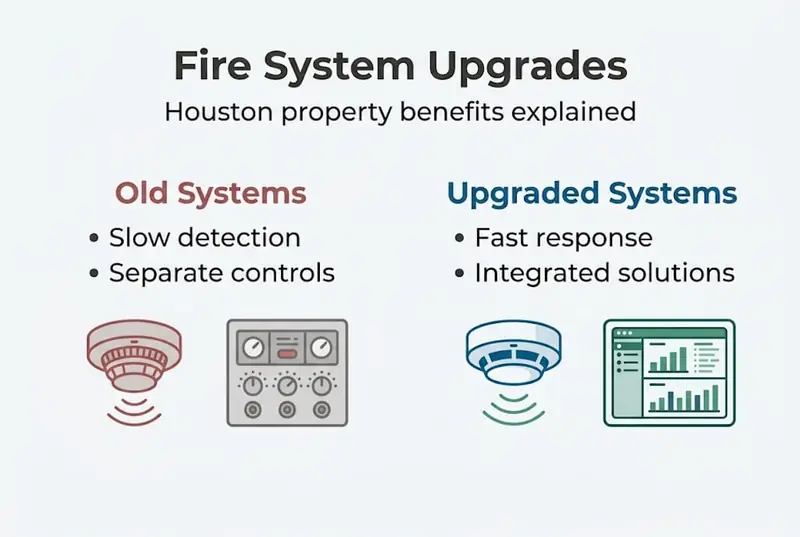
Here is how an upgraded system compares to a code-minimum older system:
| Feature | Old code-minimum system | Modern upgraded system |
|---|---|---|
| Detection speed | Slower, zone-based | Faster, addressable per device |
| False alarm rate | Higher | Significantly lower |
| Suppression integration | Often separate | Integrated, automated |
| Monitoring capability | Basic or local only | Remote, real-time alerts |
| Compliance documentation | Manual logs | Automated, auditable records |
| Insurance standing | Standard | Premium eligible |
Staying current with Houston compliance standards requires more than a one-time upgrade. It requires a structured approach to ongoing compliance.
How upgraded systems simplify your compliance process:
- Schedule annual system testing with a licensed contractor who documents results formally.
- Use addressable alarm panels that log every activation, test, and fault with timestamps.
- Integrate detection and suppression under one monitoring platform so you have a single compliance record.
- Train staff on system operation and emergency procedures so human behavior does not undermine system performance.
- Keep maintenance logs organized by system component and date, ready to present during any inspection.
Pro Tip: Compliance documentation is your legal shield. If your property is ever involved in a fire incident or inspection dispute, a rigorous, well-organized maintenance record is the fastest way to demonstrate that you acted in good faith and met your obligations. Keep digital backups of every service report.
Choosing and maintaining the right upgrades
Knowing that upgrades deliver value is one thing. Knowing which upgrades are right for your specific property is another. Not every building needs the same solution, and making the wrong choice wastes money while leaving gaps in your protection.
Start by assessing your current system against these criteria:
Signs your system is overdue for an upgrade:
- Your fire alarm panel is more than 15 years old with no major component updates
- Your sprinkler system shows visible corrosion, mineral deposits, or has never had a full hydraulic recalculation
- You are experiencing frequent false alarms that disrupt operations and generate response fees
- Your system lacks remote monitoring or digital reporting capabilities
- You have undergone significant building renovations without a corresponding system review
- Your maintenance provider flags recurring component failures or parts availability issues
Once you have identified the gap, the next decision is whether you need a detection upgrade, a suppression upgrade, or a full integrated system overhaul. Detection-only upgrades make sense when your suppression infrastructure is solid but your sensors are outdated. Suppression upgrades are appropriate when your sprinkler coverage has gaps or your system lacks the density modern codes require. Full integration is the strongest investment and typically the best long-term value for buildings over 20,000 square feet. You can follow a clear upgrade workflow to move through these decisions systematically without missing critical steps.
The integration of detection and suppression is worth emphasizing. Standalone systems create communication gaps. When your smoke detectors and your sprinklers operate on separate platforms without real-time coordination, you lose the performance advantage that makes modern fire protection so much more effective than older approaches.
Pro Tip: Use the NFPA’s recommended inspection, testing, and maintenance (ITM) schedule as your baseline calendar, not a suggestion. Research confirms that upgrades only deliver results if they are rigorously maintained to avoid failures like corrosion, stuck valves, and obstructed heads. Schedule ongoing maintenance quarterly at a minimum for commercial properties with significant occupancy loads.
The selection and maintenance phase is where most businesses either maximize or waste their upgrade investment. Getting the install right is half the job. Keeping it performing as designed is the other half.
Real talk: What most experts don’t tell you about fire system upgrades
Here is the honest version of the upgrade conversation, shaped by years of working with Houston businesses across every property type.
Most fire system failures do not happen because the technology was wrong. They happen because the maintenance was skipped, the components were mismatched, or the hydraulic calculations were never properly verified after a building renovation changed the layout. The technology has never been better. The discipline around maintaining it has not kept pace.
Property managers who get the best results from upgrades treat the system the way they treat their HVAC equipment: scheduled service, documented performance, and prompt attention to any anomaly. Those who treat it as a set-and-forget installation are the ones who discover the problems during an emergency.
There is also a strategic dimension that most people miss. Modern, well-maintained fire systems reposition your property in the insurance market. Carriers notice documented compliance histories. Underwriters apply credits to properties with verified inspection records and modern integrated systems. We have seen Houston businesses meaningfully reduce their annual premiums specifically because they could demonstrate system performance over a multi-year maintenance record. That is money back in your pocket every year. Explore commercial fire detection options that give you the documented reliability insurers respond to.
The principle worth internalizing: it is not just what you install, but how you maintain it that protects your business and your bottom line.
Upgrade your fire protection with Houston’s trusted experts
Ready to stop treating fire system upgrades as an expense and start treating them as the strategic investment they are?
At Reliable Fire Protection, we work with Houston business owners and property managers to assess their current systems, identify the right upgrades, and deliver certified installations that meet both current code and real-world performance standards. Whether you want to understand how fire alarm systems work before committing, need a contractor to install fire sprinklers in an existing building, or want to browse the full range of fire protection products we carry, we are here to help you make the right call for your property. Contact us today for a free consultation and let us show you exactly what your building needs.
Frequently asked questions
How much does a typical fire system upgrade cost in Houston?
Sprinkler retrofits typically run $3 to $15 per square foot, while a large commercial alarm upgrade for a 22,000 square foot building averages around $52,000 with annual savings of approximately $12,900.
What are the proven benefits of pairing fire detection with suppression systems?
Paired detection and suppression reduce injuries by up to 52% and property loss by as much as 55%, consistently outperforming either system operating independently.
How do fire system upgrades affect insurance premiums?
Modern, properly maintained fire systems with documented compliance records give insurers confidence, which typically translates into lower premiums and better policy terms for your property.
What is the biggest risk of skipping routine maintenance after upgrading?
Skipping maintenance leads to failures like corrosion, inoperable valves, and obstructed sprinkler heads, which can completely negate the safety and financial benefits your upgrade was designed to deliver.
When should a Houston property owner consider a full system overhaul versus a partial upgrade?
A full overhaul makes the most sense when your alarm panel is over 15 years old, your building has undergone major renovations without a system review, or when component failures are recurring and parts are becoming difficult to source.