
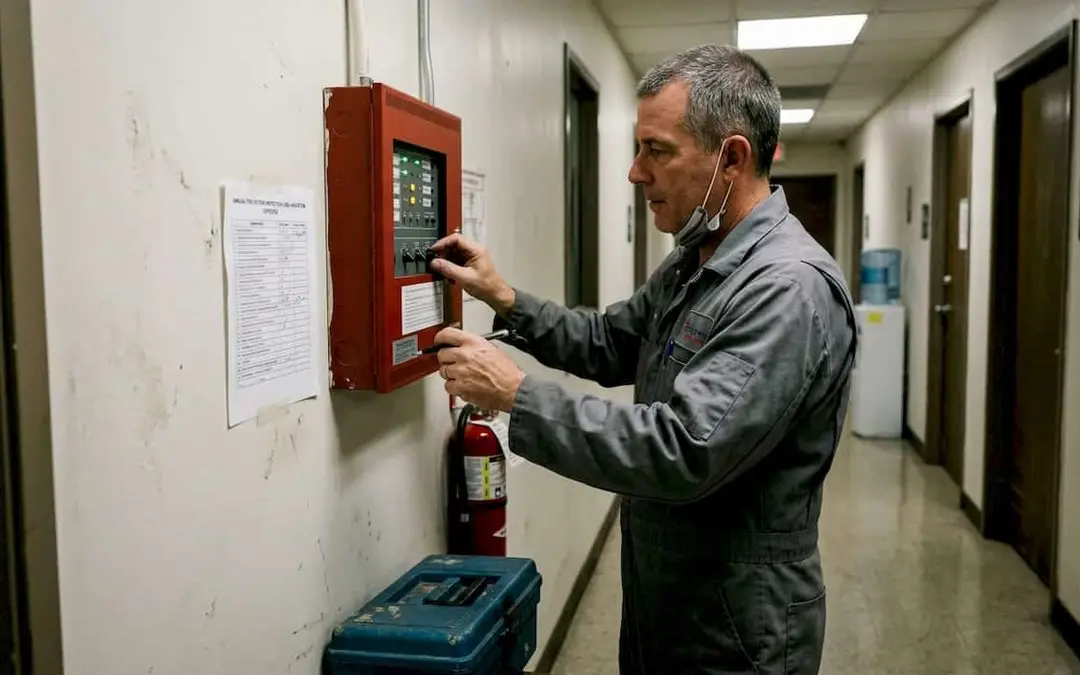
Fire systems don’t protect your property the moment they’re installed. They protect it only when they work, and the only way to know they’ll work is to test them every year. Many Houston business owners and property managers treat fire sprinklers and alarms as permanent fixtures, assuming installation equals protection. That assumption is wrong, and it can cost you your insurance coverage, your occupancy permit, or worse. Annual fire system testing is a legal requirement under both NFPA 25 standards and City of Houston enforcement, and skipping even one cycle puts your property, your tenants, and your business at serious risk.
Table of Contents
- What annual fire system testing involves
- Legal requirements and compliance risks in Houston
- Hidden dangers: What annual testing actually prevents
- Special cases and advanced testing nuances
- Why preventive testing beats playing the odds
- Stay protected and compliant with expert fire system support
- Frequently asked questions
Key Takeaways
| Point | Details |
|---|---|
| Annual testing required | Houston businesses must test fire systems every year to comply with NFPA 25 and city rules. |
| Non-compliance is costly | Skipping tests risks fines, insurance loss, and legal liability for property owners. |
| Testing uncovers hidden risks | Annual inspections detect corrosion, blockages, and other dangers before they result in failure. |
| No system is exempt | All fire systems, new or old, must meet today’s inspection and testing protocols. |
| Documentation protects owners | Proper records from annual tests help prove due diligence and shield against lawsuits after a fire. |
What annual fire system testing involves
Annual fire system testing is not a quick walk-through. It’s a structured inspection process that follows NFPA 25, the national standard for the inspection, testing, and maintenance (ITM) of water-based fire protection systems. Every component of your system gets evaluated against specific performance criteria.
Here’s what a certified inspector covers during a standard annual visit:
- Sprinkler heads: Each head is checked for corrosion, physical damage, paint overspray, and improper orientation. A painted or corroded head can fail to activate during a fire.
- Pipes and fittings: Inspectors look for leaks, mechanical damage, and signs of corrosion along all visible piping.
- Control valves: Every valve is checked to confirm it’s in the correct open or closed position and that it moves freely.
- Main drain test: Water is flowed through the main drain to verify system pressure and identify any blockages.
- Fire department connections (FDC): These are checked for accessibility, visible damage, and proper caps.
- Gauges: Pressure gauges are tested for accuracy against known benchmarks.
- Alarm devices: Waterflow alarms, supervisory signals, and notification devices are all triggered and verified. You can review a full fire alarm checklist to see how alarm testing integrates with sprinkler inspections.
Fire pump testing is one of the most demanding parts of the annual process. NFPA 25 requires fire pump flow tests at three conditions: 0% (churn/shutoff), 100% (rated flow), and 150% of rated capacity, with pressure readings verified at each point. At rated flow, the pump must deliver at least 95% of its rated pressure. These tests confirm the pump can actually deliver water under real fire conditions.
For alarm systems specifically, the alarm inspection steps include testing each initiating device, notification appliance, and control panel function. Nothing is assumed to be working without a verified test.
One important point: Houston properties built decades ago are not exempt. There is no grandfathering provision. Every system, regardless of when it was installed, must meet the current NFPA 25 requirements. The sprinkler system workflow follows the same updated standards for both new and legacy installations.
| System type | Key annual tests required |
|---|---|
| Wet pipe sprinkler | Head inspection, valve check, main drain test, gauge test |
| Fire alarm | Device activation, panel function, notification appliance test |
| Fire pump | Flow test at 0%, 100%, 150% capacity; pressure verification |
| Dry pipe sprinkler | Air pressure check, trip test, valve inspection |
Legal requirements and compliance risks in Houston
Knowing the process is only part of the equation. Understanding the law and Houston’s strict enforcement is equally important.
The City of Houston enforces fire system compliance through the Houston Fire Marshal’s Office. Inspectors can visit your property unannounced, and if your records don’t show current ITM documentation, you face immediate consequences. Your Houston compliance guide outlines exactly what documentation the city expects to see on file.
As a property owner or manager, your legal responsibilities include:
- Scheduling annual testing with a licensed fire protection contractor
- Keeping written records of every inspection, test, and maintenance action
- Making records available to the Fire Marshal upon request
- Correcting deficiencies identified during inspections within required timeframes
The risks of falling short are real and layered. Here’s what non-compliance can trigger:
- City fines: Houston can issue citations for each violation found during a Fire Marshal inspection.
- Loss of occupancy permit: A property with a non-compliant fire system can be ordered to close until corrections are made.
- Insurance denial: Insurers review ITM records after a fire. If your documentation is missing or expired, your claim can be denied outright.
- Legal liability: If a fire causes injury or property damage and you lacked current testing records, you face personal and business liability in civil court.
“Property owners are responsible for scheduling and documenting ITM. Non-compliance leads to fines, insurance denial, and liability, and Houston enforces these requirements through active Fire Marshal inspections.”
The Texas inspection steps follow a documented process that satisfies both state and city requirements. Staying current with that process is also one of the most direct ways to qualify for insurance savings, since many carriers offer premium reductions for properties with verified fire protection programs.
Hidden dangers: What annual testing actually prevents
The consequences of skipping annual testing aren’t always obvious. Here’s what thorough inspections actually prevent.
Most people assume fire systems fail because of manufacturing defects or faulty equipment. That’s rarely true. Testing detects hidden issues like corrosion and obstructions before they cause failure, and it’s lapsed maintenance, not system defects, that drives the overwhelming majority of real-world failures.
Here are four critical risks that annual testing catches before they become disasters:
- Corroded or painted sprinkler heads: A head coated with paint or corroded at the fusible link will not activate at the correct temperature. It may not activate at all.
- Obstructed pipes: Mineral deposits, biological growth, and debris can partially or fully block water flow. A system that looks intact can deliver a fraction of its rated output during a fire.
- Closed or damaged valves: A single closed control valve can take an entire zone of sprinklers offline. These failures are silent and invisible without a physical inspection.
- Faulty alarm devices: A waterflow alarm that doesn’t signal the monitoring center defeats the purpose of having a monitored system. Annual testing verifies every signal path.
The financial stakes are significant. Fire-related property losses run into the hundreds of thousands for commercial buildings, and business interruption adds costs that dwarf the price of testing. Annual testing for most Houston commercial properties costs between $150 and over $1,000 depending on system size, which is a fraction of the liability exposure from a single missed cycle.

For more detail on what the city specifically requires, the safety testing requirements page covers Houston’s current enforcement priorities.
Pro Tip: Keep a physical and digital copy of every ITM report. If a fire occurs and your insurer or an attorney requests documentation, having organized records from every testing cycle is your strongest protection against denied claims and legal exposure.
Special cases and advanced testing nuances
Basic annual checks aren’t the whole story. Houston properties with specialized systems or older installations need to know about extra requirements.
NFPA 25 includes several testing intervals beyond the annual cycle, and missing these can put you out of compliance even if your annual inspections are current. The advanced inspection guide breaks down how these extended requirements apply to different system types.
Here’s what goes beyond the standard annual test:
- Internal pipe assessments: Wet pipe systems require internal inspection every 5 years (alternating between systems if you have more than one). These assessments check for corrosion, scale buildup, and biological growth that external inspections can’t detect.
- Dry and pre-action systems: These require internal inspections every 3 to 5 years, with additional attention to low points where water can collect and cause corrosion.
- Obstruction investigations: NFPA 25 identifies 16 specific conditions that trigger a mandatory obstruction investigation, including evidence of corrosion, reports of low flow at a fire, and the presence of certain water supplies. These aren’t optional.
- Freezer and cold storage pipes: Pipes in freezer environments require annual checks for ice plug formation, which can block flow entirely.
- Sprinkler head sample testing: Standard sprinkler heads must be submitted for laboratory testing at 50 years of age, then every 10 years after that. Fast-response heads have a 20-year threshold.
| Advanced test | Frequency | System type |
|---|---|---|
| Internal pipe assessment | Every 5 years | Wet pipe |
| Internal inspection | Every 3 to 5 years | Dry/pre-action |
| Obstruction investigation | Triggered by 16 conditions | All types |
| Sprinkler head sample test | At 50 years, then every 10 years | Standard heads |
Remember: no system is grandfathered out of these requirements. A 30-year-old system in a Houston warehouse must meet the same current NFPA 25 standards as a system installed last year.
Pro Tip: Create a maintenance log that includes the installation date and model of every major system component. Age-triggered requirements like sample head testing can sneak up on you if you don’t track system history from day one.
Why preventive testing beats playing the odds
After understanding all the requirements and risks, it’s worth asking: is annual testing really worth it in practice?
We think the answer is obvious, but the reasoning matters. The cost of annual testing ranges from $150 to over $1,000 depending on your property’s size and system complexity. That’s a predictable, manageable expense. A single fire incident, even one your system partially controls, can mean hundreds of thousands in property damage, months of business interruption, and years of legal proceedings.
What we’ve seen consistently is that fire system failures are almost never equipment failures. They’re maintenance failures. A system that hasn’t been tested in two years has unknown status. Valves may have been closed for a repair and never reopened. Heads may have been painted during a renovation. Pipes may be partially blocked. None of that is visible from the outside.
Houston’s climate adds another layer of risk. Humidity accelerates corrosion. Temperature swings stress pipe joints. These are real factors that make annual testing more valuable here than in drier climates.
Property owners who maintain documented long-term maintenance records are in a fundamentally different legal and financial position than those who don’t. Testing isn’t just about keeping your system functional. It’s about proving you took reasonable steps to protect people and property. That documentation is your defense if anything ever goes wrong.
Stay protected and compliant with expert fire system support
Annual fire system testing is manageable when you have the right partner handling the details. Working with a certified fire protection contractor eliminates the guesswork around scheduling, documentation, and code compliance, so you can focus on running your business instead of tracking NFPA deadlines.
Reliable Fire Protection serves Houston businesses with licensed inspections, maintenance, and installation across all fire system types. Whether you need sprinkler inspection guidance, want to browse our fire safety products, or simply want to understand how fire alarm systems work before your next inspection, we’re here to help. Contact us today to schedule your annual inspection and keep your property fully protected and compliant.
Frequently asked questions
What is checked during annual fire system testing?
Inspectors check sprinkler heads for corrosion or damage, valves, pipes, alarm devices, and test fire pump performance in line with NFPA 25 standards, including flow tests at 0%, 100%, and 150% of rated capacity.
What are the risks of missing annual testing?
Missed annual tests can result in city fines, insurance denial, legal liability, and even property closure. Non-compliance with ITM requirements is actively enforced through Houston Fire Marshal inspections.
Are older fire systems exempt from new testing rules?
No. Houston follows NFPA 25 with no grandfathering provision, meaning all systems regardless of age must meet current standards.
How often are advanced fire system tests needed?
While annual testing is required, internal pipe inspections and certain advanced checks are due every 3 to 5 years, depending on system type and age milestones.