

TL;DR:
- Houston enforces the 2021 IFC with amendments, requiring strict compliance for fire safety systems.
- Regular inspections, proper documentation, and proactive upgrades are essential to avoid penalties.
- Building owners should maintain comprehensive records and stay ahead of evolving fire code requirements.
One overlooked fire code detail can jeopardize your business license or put your tenants in danger. In Houston, regulations tightened significantly heading into 2026, and the window to catch up is narrowing. Whether you manage a downtown office tower, a restaurant row strip, or a warehouse facility, the stakes are the same: fines, shutdowns, and real physical risk. This guide walks you through exactly which codes apply to your property, what systems you need, how to maintain them, and how to prove compliance when the fire marshal comes knocking. No generic advice. Just what Houston commercial property owners actually need right now.
Table of Contents
- Know your local and national fire safety codes
- prepare your required systems and inspections
- Step-by-step: implement and maintain your fire protection
- verify compliance and avoid common mistakes
- Our take: what most Houston property owners miss about fire safety compliance
- Houston fire safety support is a call away
- frequently asked questions
Key Takeaways
| Point | Details |
|---|---|
| Houston adopts strict local amendments | Houston businesses must comply with the 2021 IFC and additional local requirements effective 2025. |
| NFPA 25 and 72 updates matter | New codes require advanced maintenance, documentation, and system upgrades—no exemptions for older buildings. |
| Regular ITM is non-negotiable | Weekly to 5-year tests are essential for sprinklers, alarms, and more to avoid penalties. |
| Proactive checks prevent costly mistakes | Routine self-assessments and third-party audits help avoid the most common compliance errors. |
Know your local and national fire safety codes
With the urgency established, let’s clarify exactly which rules apply to your property right now.
Harris County operates under the 2021 IFC with amendments that took effect on January 1 and October 1, 2025. These amendments are not minor tweaks. They affect notification requirements, kitchen suppression standards, egress provisions, and how hazardous occupancies are classified. If you updated your compliance program before 2025 but haven’t reviewed it since, your building may already be out of step with current enforcement.
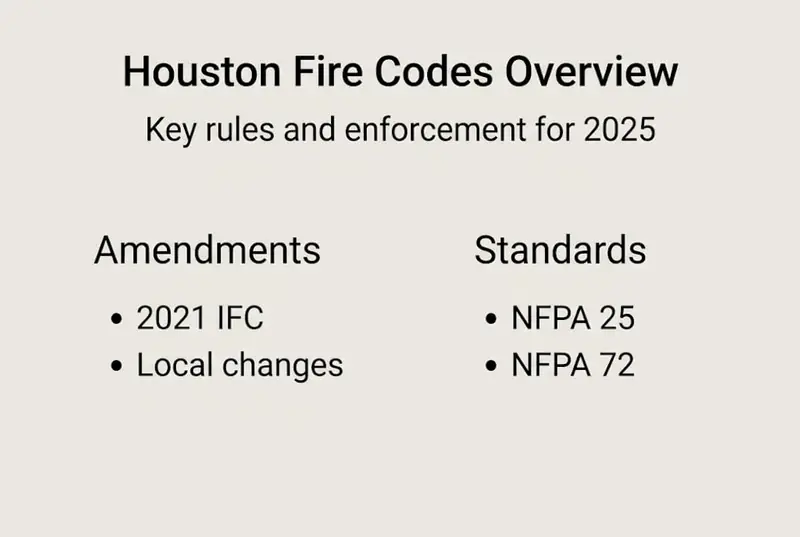
At the national level, two standards anchor most local fire codes. The 2025 edition of National Fire Protection Association 72 covers fire alarm and signaling systems, while National Fire Protection Association 25 governs inspection, testing, and maintenance (ITM) of water-based suppression systems. Houston’s local amendments reference both, but local rules often exceed national minimums. That gap is where most compliance failures happen.
Here’s a quick breakdown of the systems each standard covers:
| Code/Standard | Systems covered | Key Houston requirement** ** ** ** ** ** ** ** ** ** ** ** ** ** ** ** ** ** ** ** ** ** ** |
|---|---|---|
| 2021 IFC (amended) | All fire protection systems, egress, access | Local amendments effective 2025 apply |
| National Fire Protection Association 72 (2025) | Fire alarms, signaling, cybersecurity | Enhanced recordkeeping and detector specs |
| National Fire Protection Association 25 | Water-based systems (sprinklers, standpipes) | ITM schedules strictly enforced |
What changes most between national standards and Houston’s local amendments:
- Kitchen and restaurant occupancies face stricter suppression and inspection rules locally
- High-rise buildings must meet additional egress lighting and alarm notification tiers
- Emergency access routes require documentation that satisfies both IFC and local fire marshal standards
- Documentation must be available on-site and match AHJ (Authority Having Jurisdiction) records
The Authority Having Jurisdiction is the local enforcement body, most often the Harris County Fire Marshal’s office. They interpret the code, grant variances, and conduct inspections. Always confirm your specific occupancy requirements directly with them. What applies to a 10,000-square-foot retail center differs from what applies to a food processing plant.
You can find a solid overview of Houston regulations for property managers, along with specifics on zoning requirements that affect which systems your building must install.
Pro tip: Houston has historically adopted code amendments ahead of the national enforcement schedule. Never assume that because a national standard hasn’t changed, your local obligations haven’t either. Check the Harris County Fire Code Hub at least twice a year.
prepare your required systems and inspections
Once you know which codes apply, it’s time to map out what your building must have, and when it must be checked.
Every Houston commercial property operating under the 2025 amendments must maintain these core systems in working order:
- Fire sprinkler system (wet, dry, or pre-action depending on occupancy and risk)
- Fire alarm and notification system meeting National Fire Protection Association 72 (2025) specs
- Fire extinguishers in type, number, and placement per International Fire Code table requirements
- Emergency exit signs and lighting that function independently of primary power
- Kitchen hood suppression system (if any commercial cooking equipment is present)
- Clear egress pathways documented in your floor plan and kept unobstructed at all times
Inspection and testing frequency is where most owners fall short. National Fire Protection Association 25 mandates a layered ITM schedule that looks like this:
| System | Weekly | Monthly | Annual | Every 5 years |
|---|---|---|---|---|
| Fire sprinkler control valves | Check position | Visual | Full inspection | Internal inspection |
| Water flow devices | No | No | Test | Replace/overhaul |
| Fire pumps | Run test | No | Full test | No |
| Fire alarms | No | Visual | Full test | No |
| Fire extinguishers | No | Visual | Full inspection | No |
Special occupancies carry added requirements. Harris County requires permits for any hazardous material storage, restaurant hood operations, and high-piled storage. Missing a permit is treated as a code violation, not a paperwork issue.
Permitting steps for new or altered systems:
- Submit design drawings to the AHJ for plan review
- Schedule a pre-construction meeting with the fire marshal if the project is complex
- Complete installation with a licensed fire protection contractor
- Request a rough-in inspection before closing walls or ceilings
- Schedule the final acceptance test with the AHJ present
- File all documentation on-site and with your contractor’s records
Need a clear walkthrough of what each step involves? The annual inspection process and the applicable testing requirements for Houston properties are covered in detail if you want to go deeper.
“A lapse in proper ITM is not just a compliance risk. It can void your commercial property insurance and trigger emergency intervention by the AHJ without prior notice.”
Pro tip: Keep a binder or digital folder organized by system type, with the most recent inspection reports on top. Fire marshals appreciate organized documentation and it signals that your facility takes compliance seriously.

Step-by-step: implement and maintain your fire protection
Now that you know what’s required and have identified inspections, here’s how to execute each step and keep your protection up to standard.
Installation and upgrade process:
- Assessment: Have a licensed fire protection company evaluate your current systems against 2025 code requirements
- Design: Get engineered drawings prepared and submitted to the AHJ for approval
- Installation scheduling: Set timelines that account for AHJ review periods (often 2 to 4 weeks in Harris County)
- Fire watch: If any system is taken offline during work, notify the AHJ immediately and arrange a fire watch per code
- Final acceptance: Pass the acceptance test and receive a certificate of compliance before reopening affected areas
Ongoing maintenance must be assigned to specific people. Weekly checks can be handled by trained facility staff. Monthly, annual, and 5-year testing must be performed by licensed contractors. Use a custom fire safety checklist to assign and track responsibilities by role.
National Fire Protection Association 72 (2025) requires enhanced maintenance records, and some networked alarm systems now fall under cybersecurity standards. If your alarm panel connects to a monitoring network or the internet, it needs documented security protocols. This is new territory for many Houston building owners and easy to miss.
Common maintenance errors that trigger violations:
- Missing scheduled tests without notifying the AHJ first
- Using outdated inspection forms that don’t reflect 2025 code language
- Installing replacement parts that aren’t listed for the specific system
- Not documenting corrective actions after a failed component is replaced
- Storage blocking sprinkler heads, reducing coverage below minimum standards
- Testing suppression systems without notifying the monitoring company first
Use the fire prevention checklist designed for Houston properties to build a maintenance calendar that catches these issues before an inspector does.
Pro tip: Never assume your system is “grandfathered” because it was installed years ago. If the AHJ deems it non-functional or non-compliant during an inspection, you’ll be required to upgrade, regardless of when it was originally installed.
verify compliance and avoid common mistakes
Following through with checks ensures you’re not only equipped and maintained but can prove it at inspection time.
The most frequent noncompliance pitfalls we see in Houston commercial buildings:
- Missing or incomplete maintenance logs for sprinklers, alarms, or extinguishers
- No record of AHJ notification when systems were impaired or out of service
- Wrong suppression agent in a kitchen system after a hood or cooking equipment change
- Exit signage not tested during the required periods, even if lights appear to work
- Plans not updated after a tenant improvement that rerouted walls or changed occupancy type
- No fire marshal pre-approval for hazardous material changes, even minor reclassifications
When preparing for a local fire marshal inspection, pull every inspection report from the past three years. Line them up against the ITM schedule and confirm no required test was skipped. If a test was missed, document why and show corrective action. A proactive explanation is far better than silence.
Houston enforcement is typically stricter than what you’d encounter in jurisdictions that only follow the national baseline. The local AHJ has authority to require upgrades that exceed International Fire Code minimums, and they use it.
Warning: No grandfathering exists under National Fire Protection Association 25 for older water-based systems. Any system found to be nonfunctional, improperly maintained, or non-compliant must be upgraded or replaced, regardless of its installation date. This is not negotiable with the AHJ.
You can access specific fire safety compliance tips for Houston buildings and learn more about protecting your commercial property against the most common code failures.
Pro tip: Schedule a third-party fire safety audit six to eight weeks before any planned inspection. It gives you enough time to correct deficiencies without the pressure of an impending deadline.
Our take: what most Houston property owners miss about fire safety compliance
After years in Houston fire protection, we’ve noticed a consistent pattern. Most property owners focus on passing inspections. They do the minimum required to check a box, and then they move on. That approach works right up until it doesn’t.
Real compliance isn’t about getting through an inspection. It’s about building a culture where safety is maintained between inspections. The buildings that suffer the most disruption during code enforcement cycles are usually the ones that only engage a fire protection contractor when something is flagged.
The hidden business costs of superficial compliance are real. Insurance premiums increase after violations. Staff turnover rises when employees feel unsafe. And reputational damage after a code-related incident is harder to recover from than most owners expect.
What consistently protects businesses more than anything else is early investment in regular training, honest documentation, and digital recordkeeping. Not because it looks good to the inspector, but because it actually works. If you want to understand the fire safety basics that separate compliant buildings from vulnerable ones, start there.
Staying ahead of code changes, not waiting for the AHJ to enforce them, is the clearest competitive and safety advantage a Houston property owner can have in 2026.
Houston fire safety support is a call away
Navigating 2025 amendments, National Fire Protection Association standards, and AHJ expectations is a lot to manage alongside running a business. That’s where a dedicated fire protection partner makes the difference.
At Reliable Fire Protection, we assess, design, install, and maintain fire protection systems for Houston commercial properties of every size and occupancy type. Whether you need to understand how fire alarm systems work, follow a sprinkler compliance workflow, or get a full audit of your current setup, our local team is ready. Browse our fire safety services or reach out today for a no-obligation assessment and get ahead of your next inspection with confidence.
frequently asked questions
Which fire code does Houston enforce for commercial buildings in 2026?
Houston and Harris County enforce the 2021 International Fire Code with local amendments that took effect in January and October 2025 for all commercial properties.
How often are commercial fire sprinklers in Houston required to be inspected?
Sprinklers must undergo weekly, monthly, quarterly, annual, and 5-year tests per National Fire Protection Association 25, and Houston’s local AHJ enforces these schedules strictly.
What’s new in the 2025 National Fire Protection Association 72 fire alarm code update?
The 2025 National Fire Protection Association 72 updates introduce cybersecurity requirements for networked alarm systems, upgraded detector specifications, and more detailed recordkeeping mandates.
Are old fire systems grandfathered under Houston’s code?
No. National Fire Protection Association 25 prohibits grandfathering, and all commercial fire systems must comply with current code regardless of when they were originally installed.
What are the penalties for noncompliance with Houston fire codes?
Penalties under Harris County fire code can include monetary fines, revocation of your certificate of occupancy, or a complete business shutdown until violations are corrected.
Recommended
- Government fire safety tips for Houston managers 2026
- Top fire prevention tips for Houston property owners
- 7 Essential Fire Safety Compliance Tips for Houston Buildings
- Fire Protection Standards 2025: Houston Compliance Impact
- Fire Alarm System University Place TX
- Fire Alarm System Services in Bellaire, TX