
TL;DR:
- Most property managers overlook the multi-stage nature of fire detection response time, which affects evacuation speed and property damage. Each stage, from sensor decision to emergency dispatch, can introduce delays that compromise safety, especially if unexamined. Regular testing, system audits, and comprehensive understanding of the entire response chain are essential for effective fire protection.
Most property managers assume fire detection response time is simply how fast an alarm sounds when smoke fills a room. That assumption is dangerously incomplete. Fire-safety response time is a multi-stage process that spans everything from the moment heat or smoke is generated to the point where occupants receive notification and emergency dispatch begins. Each stage introduces potential delays. Understanding the full timeline is not a technical exercise reserved for engineers. It is a practical management responsibility that directly affects how quickly people evacuate and how much damage your property sustains.
Table of Contents
- What fire detection response time really means
- Breaking down the fire response timeline: Step by step
- The role of notification appliances and the importance of regular testing
- Distinguishing building system response from fire department arrival
- Why focusing only on fast sensors misses the real risk
- Enhance your property’s fire response with certified systems and expert support
- Frequently asked questions
Key Takeaways
| Point | Details |
|---|---|
| End-to-end timing matters | Fire response speed is the result of several sequential processes, not just sensor speed. |
| Notification testing is critical | Annual tests of horns and strobes keep evacuation times and code compliance under control. |
| Monitor bottlenecks | Delays often lurk in panel processing or notification systems rather than the sensors themselves. |
| Distinguish benchmarks | Building response and fire department response times are separate; measure and improve both wisely. |
| Regular event reviews | Assess system logs and appliance tests to verify your property’s true performance. |
What fire detection response time really means
There is a meaningful difference between a detector sensing smoke and your building’s occupants actually being warned and help being dispatched. Yet most owners and facility managers focus only on the first part. They upgrade sensors, feel confident, and move on. The remaining stages receive far less attention, and that is where real-world failures tend to happen.
Response time is not a single number. It is the end-to-end sequence from heat or smoke generation all the way through detector decision, fire alarm control panel processing and annunciation, and then notification and dispatch actions. Each one of those stages is a link in a chain. A weak link anywhere disrupts the entire outcome.
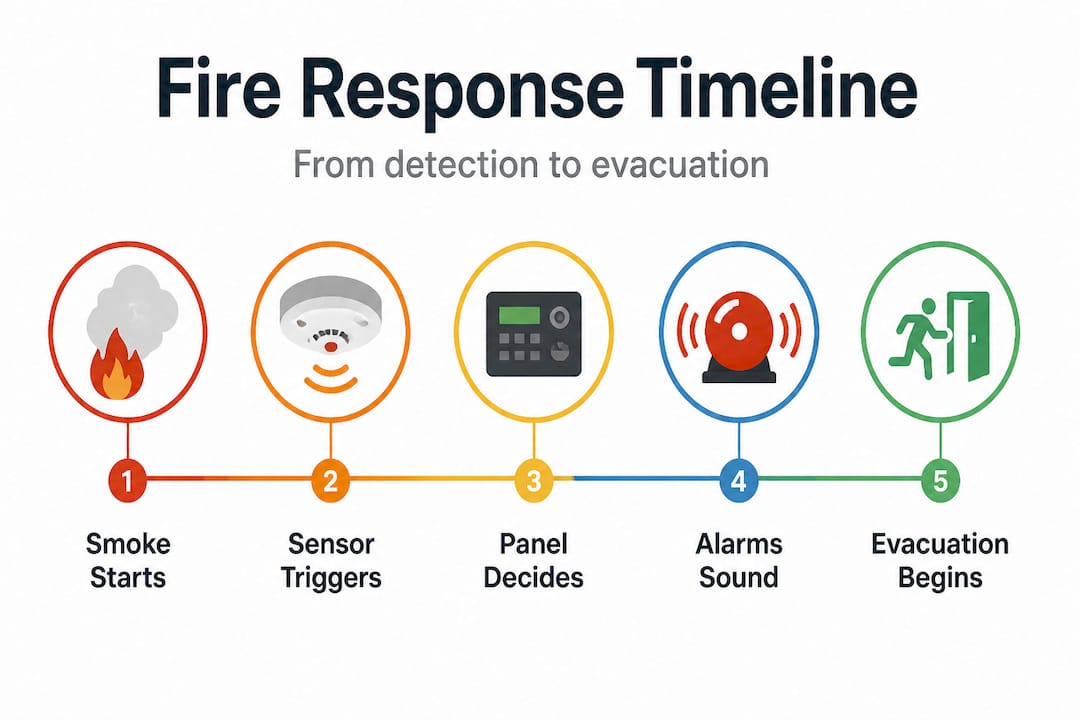
Here is a breakdown of the key stages involved in a complete fire detection response:
| Stage | What happens | Common delay cause |
|---|---|---|
| Sensor decision | Detector analyzes smoke, heat, or gas | Dirty sensors, wrong detector type |
| Signal transmission | Signal travels to fire alarm control panel | Network congestion, wiring faults |
| Panel processing | Panel interprets signal and activates outputs | Outdated firmware, programming errors |
| Annunciation | Horns and strobes activate in the building | Failed devices, coverage gaps |
| Monitoring dispatch | Central station contacts fire department | Communication path failure, slow protocols |
Most facility managers who review their fire systems only look at whether the alarm sounded. They rarely audit the time gap between each stage. That gap is where lives are at risk.
“Fire-safety response time is not a single number; it’s the end-to-end time from heat and smoke generation through detector decision, fire alarm control panel processing and annunciation, and notification and dispatch actions.”
Understanding what slows down each stage is the first step toward a well-performing system. Your fire detection system setup determines how many of these stages are built for speed versus convenience. Older or poorly designed systems often accumulate delays across multiple stages simultaneously.
Key factors that commonly create bottlenecks across the full response timeline include:
- Sensor placement errors that force detectors to wait longer for smoke or heat to reach them
- Network congestion on addressable panels where many devices share communication bandwidth
- Unmonitored notification zones where coverage was assumed but never confirmed
- Monitoring contracts that rely on outdated dialup or cellular paths with poor reliability
- Lack of documentation so no one knows the baseline timing to measure against
Investing in advanced fire detectors addresses the first stage, but without equal investment in the stages that follow, you are optimizing one link while leaving the rest of the chain fragile.
Breaking down the fire response timeline: Step by step
With a clear definition established, let’s carefully examine each stage in turn to see how response time adds up in practice.
A fire event unfolds through a predictable but often underestimated sequence. Even if every individual component in your system is technically performing within spec, latency accumulates across multiple links, including sensor decision, signaling to the panel, panel processing, and output activation. Each second added at one stage multiplies pressure on the stages that follow.
Here is a step-by-step look at how the timeline builds:
- Fire starts: Combustion begins, generating heat, smoke, or both
- Sensor detects: The detector reaches its threshold and triggers an alert signal
- Signal travels to panel: The alert moves across the wiring or network to the fire alarm control panel
- Panel processes the event: The panel confirms the signal, checks zone rules, and activates outputs
- Horns and strobes activate: Notification appliances sound and flash in the affected zones
- Monitoring station receives alert: The central monitoring station receives the signal and verifies
- Dispatch begins: Emergency services are contacted and units are sent
Now compare what typical timing looks like versus what slow or degraded systems produce:
| Timeline stage | Typical fast system | Degraded or slow system |
|---|---|---|
| Sensor decision | 5 to 30 seconds | 60 to 120 seconds |
| Signal to panel | Under 1 second | 5 to 15 seconds |
| Panel processing | 1 to 3 seconds | 10 to 30 seconds |
| Notification appliance activation | Immediate | Delayed or absent |
| Monitoring dispatch | 30 to 90 seconds | 3 to 10 minutes |
Those gaps are not theoretical. In real Houston commercial buildings, outdated panels, neglected maintenance, and poorly tested notification zones create compounding delays that can cost precious minutes during an actual fire.
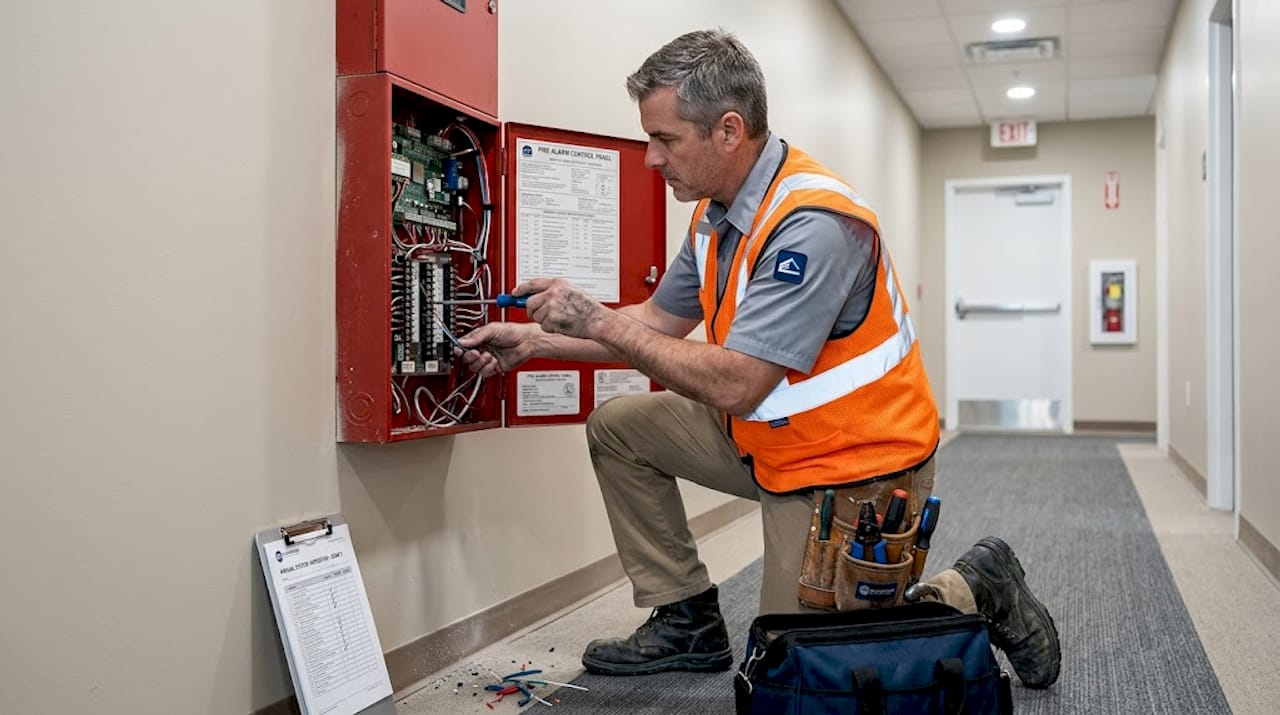
Pro Tip: Ask your fire alarm service provider to pull event log reports showing time-stamped records from your last inspection or drill. If those logs do not exist or cannot be accessed, that is itself a red flag about your system’s auditability.
Reviewing your fire alarm installation sequence is a practical starting point. How the system was originally designed and installed shapes every stage of the timeline. Poor zoning decisions, undersized panels, or communication paths that were never tested under load all create predictable slowdowns.
Using a fire alarm system checklist as a routine management tool helps you track not just whether alarms activate, but how quickly each stage in this chain performs over time. Consistent documentation reveals trends before they become emergencies.
The role of notification appliances and the importance of regular testing
Understanding the time it takes to alert people is vital. Notification appliances, meaning the horns, strobes, and speaker systems inside your building, are a commonly underestimated weak point in the entire fire response chain. These devices are the direct interface between your fire alarm system and the people it is designed to protect.
A detection system can perform flawlessly up to the notification stage and still fail to protect occupants if the horns are inaudible in a noisy environment or the strobes cannot be seen from key evacuation routes. Notification appliance performance directly shapes response outcomes, because occupants must receive alarms quickly. NFPA 72 requires annual functional testing of notification appliances such as horns and strobes.
Many Houston property managers treat notification devices as a set-it-and-forget-it component. That is a critical error. Here is what can degrade notification appliance performance over time:
- Battery and power supply degradation that reduces horn volume or strobe brightness
- Physical obstructions added after original installation, like new walls, shelving, or equipment
- Ambient noise increases from expanded operations that make horns insufficient without upgrades
- Device corrosion in humid or industrial environments
- Firmware incompatibility after panel upgrades that leaves older appliances miscommunicated
- Missing devices in areas that were renovated or expanded since original installation
Each of these failure modes adds invisible seconds or minutes to evacuation response. Occupants who do not hear or see the alarm cannot begin moving toward exits.
Statistic callout: Studies show that delayed occupant notification is one of the leading contributors to fire-related injuries in commercial buildings. When a horn fails or a strobe is blocked, the people nearest that zone lose their only warning.
Annual testing ensures your fire alarm testing requirements are met and that every device is performing at the decibel and candela levels required by code. It also gives you documented proof of compliance, which matters for insurance purposes and code inspections.
Pro Tip: During your next walkthrough, put yourself in the position of someone working in each room or zone. Can you clearly hear the horn from every workstation? Can you see a strobe from every point in the space? If the answer is no, you have a notification gap that needs addressing before the next inspection.
Reviewing your property against established fire safety testing requirements helps confirm that your notification system meets the intent of the code, not just the minimum letter of it.
Distinguishing building system response from fire department arrival
We’ve focused on internal system timing. Now let’s clear up a common confusion about emergency responder benchmarks versus building response times. Many property owners conflate two completely different measurements, and that confusion leads to poor investment decisions and false confidence.
NFPA 1710 defines fire department response time objectives, including turnout time, travel time, and full alarm assignment arrival, as benchmarks for emergency services planning. These are not building system metrics. They describe how fast fire departments are expected to mobilize and arrive at a scene.
Here is what each NFPA 1710 benchmark actually measures:
- Turnout time: The time from dispatch notification to the fire unit leaving the station, typically targeted at 60 to 80 seconds
- Travel time: The time from station departure to arrival at the property
- Full assignment: The time by which a full complement of personnel and apparatus are on scene
None of these benchmarks have anything to do with how fast your building’s detectors sense smoke, how quickly your panel processes the signal, or how rapidly your horns alert occupants.
“NFPA 1710 defines fire department response time objectives, including turnout, travel, and full alarm assignment, as benchmarks distinct from building detector-to-annunciation timing.”
Confusing these two sets of metrics causes facility managers to make flawed assumptions. A property manager who knows the local fire station is four minutes away might feel that four minutes is the total response envelope. In reality, four minutes starts from when dispatch receives the call, and by that point, your building’s occupants may already have been exposed to smoke and heat for two minutes or more if internal system delays were present.
The most productive approach is to track both, but to prioritize improvement efforts on the factors you can actually control, which are entirely within your building’s systems. A thorough review of your fire systems comparison options can reveal where technology upgrades deliver the fastest return in terms of reducing your internal response timeline.
Why focusing only on fast sensors misses the real risk
Here is an uncomfortable truth we see regularly in Houston commercial properties: owners invest significantly in upgraded sensors and then assume the job is done. They get the most sensitive smoke detectors available, install them at proper spacing, and feel confident their building is protected. Then they skip annual notification testing, allow monitoring contracts to lapse onto outdated communication paths, and never pull a single event log to verify actual annunciation timing.
A fast sensor can still yield slow outcomes if annunciation, notification, or monitoring dispatch is degraded. The only reliable way to assess your building’s actual performance is to use recorded event data and communication-path supervision reports. Without those, you are guessing.
We have seen this pattern repeatedly. A sensor detects a genuine alarm event in under ten seconds, which is excellent. But the panel takes an extra 25 seconds due to outdated firmware. The monitoring station communication path runs through a cellular module that was never confirmed operational. The first responders receive the call nearly four minutes after smoke was first detected. That is four minutes of potential injury and property damage that could have been substantially reduced with a full-chain review.
The real risk management strategy is to treat your fire protection system as an end-to-end process, not a collection of individual devices. Review your response logs, not just your inspection stickers. Confirm that your maintenance plan covers communication path supervision and notification appliance testing, not just detector cleaning and sensitivity checks.
Upgrading your commercial fire detection advantages means upgrading every link in the chain with the same discipline and documentation standards you would apply to any other critical building system.
Enhance your property’s fire response with certified systems and expert support
Understanding the full fire detection timeline is one thing. Building and maintaining a system that performs well across every stage is another.
At Reliable Fire Protection, we work with Houston business owners and property managers to design, install, and service fire alarm systems that are built for real-world performance, not just code compliance on paper. We test notification appliances to verify audibility and visibility in your actual environment. We pull event logs to confirm annunciation timing. We review monitoring communication paths to make sure they perform when it matters most. If you want to understand how fire alarm systems work and how yours measures up, we can walk you through a practical assessment. Whether you manage a warehouse in the Energy Corridor or a mixed-use building with a fire alarm system in Midtown Houston, we bring the same rigorous approach to every property we protect.
Frequently asked questions
What is the most common bottleneck in fire detection response time?
Notification and annunciation delays are often the biggest bottleneck, because latency accumulates across multiple links including panel processing and output activation even when individual sensors are fast.
How often does NFPA require notification appliances to be tested?
NFPA 72 requires annual testing of horns, strobes, and other notification appliances to verify that they function correctly and meet audibility and visibility standards.
Are fire department response times part of my building’s detection system performance?
No. NFPA 1710 response benchmarks cover fire department turnout and travel times, which are entirely separate from your building’s internal detector-to-annunciation timing.
How can I measure my property’s actual fire response time?
Use your fire alarm control panel’s event logs and test documentation to track timestamps at each stage, since end-to-end timing assessment requires recorded events and communication-path supervision data, not just visual inspections.
What’s the benefit of regular appliance testing beyond compliance?
Annual notification testing verifies audibility and visibility at every occupied location, preventing degraded alerts that could delay evacuation and expose occupants to unnecessary risk during an actual fire event.