

TL;DR:
- Early fire detection in Houston buildings enables faster emergency response, reducing property damage and saving lives. Modern systems, including aspirating detectors, address high-ceiling challenges and ensure code compliance, ultimately protecting business continuity. Investing in quality, regularly tested fire alarms offers measurable long-term safety and financial benefits.
Fire moves fast. A small electrical fault in a Houston warehouse can turn into a full structural fire in under four minutes, and buildings with functioning smoke alarms show substantially lower fatality rates than buildings without working alarm systems. For business owners and property managers across Houston, fire detection isn’t just a line item on a safety checklist. It’s the variable that separates a minor incident from a catastrophic loss. This article breaks down seven concrete advantages of early fire detection and compares today’s best technology options so you can make a confident, informed decision for your property.
Table of Contents
- Why early fire detection matters
- Top 7 advantages of early fire detection systems
- How advanced detectors address real-world challenges
- Comparing detection methods: Which is right for your property?
- The inconvenient truth about fire detection investments
- Protect your Houston property with advanced fire detection
- Frequently asked questions
Key Takeaways
| Point | Details |
|---|---|
| Superior safety | Early fire detection greatly reduces fatality risk and keeps occupants safer. |
| Reduced property loss | Quick alerts help contain fires sooner, minimizing damage and costly repairs. |
| Code compliance simplified | Detection systems make it easier to meet Houston regulations and insurance requirements. |
| Technology matches every building | Advanced and traditional systems can be matched to any property, even those with complex architecture. |
| Business continuity protected | Faster detection reduces operational downtime and avoids extended business interruption. |
Why early fire detection matters
Early fire detection means identifying a fire at its incipient stage, which is the very first phase when heat, smoke particles, or combustion gases begin to form before visible flames or heavy smoke appear. Catching a fire at this stage gives your team, your occupants, and first responders a critical window to act. Missing that window shrinks your options fast.
The consequences of late detection are well documented. Higher injury rates, greater property destruction, longer business closures, and increased liability all follow when alarms fail or respond too slowly. The data is hard to ignore: the death rate per 100 fires was 2.23 times higher in buildings with no working smoke alarm compared to buildings where alarms functioned properly, recording 1.18 deaths per 100 fires versus just 0.53.
Understanding the commercial fire detection advantages for your specific property type is the first step toward building a system that actually protects you. The core benefits of a properly installed, code-compliant early detection system include:
- Faster emergency response from the Houston Fire Department
- More time for safe evacuation of staff, customers, and tenants
- Reduced property damage through faster suppression activation
- Lower insurance premiums from certified system installations
- Regulatory compliance with city codes and insurer requirements
- Reduced operational downtime after an incident
- Smarter building integration with modern fire alarm infrastructure
Each of these benefits connects directly to the bottom line. Understanding the true importance of fire alarms goes beyond safety; it’s a business resilience issue that every Houston property owner needs to take seriously.
Top 7 advantages of early fire detection systems
Now that we’ve outlined the reasons, here’s a detailed breakdown of the most impactful benefits.
- Faster emergency response. Every second a fire burns unchecked, it roughly doubles in size. Early detection systems alert the Houston Fire Department automatically, cutting response time dramatically. That speed directly limits how far fire and smoke spread before suppression begins.
- Significant reduction in injury and fatality risk. Earlier warning gives people more time to exit safely. This is especially critical in multi-story commercial buildings, restaurants with crowded dining rooms, and hotels where occupants may be asleep. The math is straightforward: more warning time equals more lives protected.
- Major financial savings on property damage. A fire caught in its early stage may cause a few thousand dollars in damage. The same fire, detected five minutes later, can cause hundreds of thousands in structural loss, equipment replacement, and inventory destruction. Early detection is one of the highest-return investments a property owner can make.
- Code and insurance compliance. Houston city ordinances and many commercial insurance policies require functioning, tested fire detection systems. Non-compliance can void your coverage or trigger fines. Installing systems that meet current codes protects you legally and financially.
- Minimized operational downtime. A contained incident means your business reopens in hours, not weeks. Extended closure after a serious fire costs not just in repairs but in lost revenue, displaced staff, and damaged client relationships. Speed of detection directly compresses that recovery window.
- Enhanced reputation and occupant trust. Customers, employees, and tenants notice when a building takes safety seriously. Visible, well-maintained detection systems signal professionalism and care. In competitive Houston markets, that perception matters.
- Smarter building management through system integration. Modern advanced fire detectors connect with HVAC, access control, and building management systems. When a detector triggers, the system can automatically shut down air handling units (to stop smoke spread), lock certain doors, and notify facility managers via mobile alerts, all without manual intervention.
By the numbers: Smoke alarms operated 86% of the time when a fire was large enough to activate them, according to NFPA data. That reliability depends entirely on proper installation, regular testing, and choosing the right system for your building type.
Pro Tip: Test your fire detection system at least quarterly. Many Houston businesses only test annually, which leaves months of potential malfunction undetected. A quarterly schedule keeps you reliable, compliant, and ready.
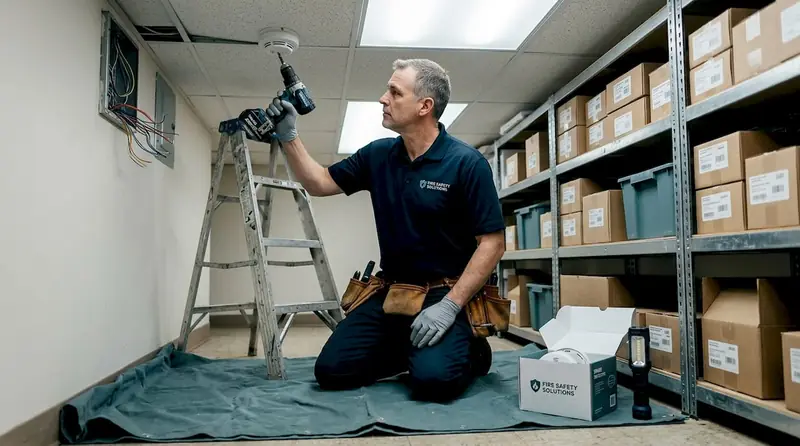
When choosing a fire alarm system for your Houston property, factor in occupancy type, ceiling height, square footage, and any unique architectural features. These variables heavily influence which technology delivers the fastest, most reliable detection for your specific space.
How advanced detectors address real-world challenges
Not all buildings have straightforward layouts. Here’s how modern detection tackles common architectural hurdles in Houston.
Traditional point detectors, the kind mounted on standard 9-foot ceilings, work well in typical office spaces and retail environments. But Houston’s commercial landscape includes warehouses with 40-foot ceilings, hotel atriums, convention spaces, and open-plan industrial facilities where standard detectors simply can’t perform reliably. Smoke rises and diffuses before it reaches a ceiling-mounted device, which means detection is slow or may not happen at all.
This is where aspirating or air-sampling detection systems change the equation. These systems actively draw air from the protected space through a network of pipes and sample it continuously for smoke particles. They can detect fire at concentrations far below what a standard point detector would respond to.
A real-world example illustrates this well. Very-early aspirating air-sampling systems were used to address the architectural challenges of a major redeveloped shopping center atrium, where just four aspirating detectors covered an entire large-format atrium space. Standard detectors would have required dozens of units and still delivered slower response times in that environment.
Here’s how the two approaches compare across key factors:
| Feature | Standard point detectors | Aspirating air-sampling systems |
|---|---|---|
| Response speed | Moderate | Very early (pre-smoke stage) |
| High-ceiling coverage | Limited | Excellent |
| Installation flexibility | Moderate | High (pipe network adapts to space) |
| Maintenance complexity | Low | Moderate |
| Upfront cost | Lower | Higher |
| Best fit | Offices, retail, standard spaces | Warehouses, atriums, clean rooms |
Pro Tip: If your Houston property has ceilings above 20 feet, inaccessible roof areas, or open industrial floors, an air-sampling system will almost always outperform a traditional point detector setup. The investment difference is far smaller than the cost of a missed detection event.
Staying current with the latest fire detection technologies is worth doing annually. Detection technology has advanced rapidly, and older systems installed five or more years ago may no longer represent the most effective solution for your building layout. A proper fire detection setup guide tailored to your property can reveal coverage gaps you didn’t know existed.
Comparing detection methods: Which is right for your property?
With all the benefits and technology options in mind, let’s compare detection types so you can make an informed decision.
There are three primary detector technologies used in commercial properties across Houston:
- Ionization detectors respond quickly to fast-flaming fires with small particles. They work well in environments where rapid combustion is the main risk, such as paper storage or dry goods warehouses. However, they are more prone to nuisance alarms from cooking or steam.
- Photoelectric detectors use a light beam to detect larger smoke particles typical of slow-smoldering fires. They perform better in environments where smoldering is more likely, such as upholstered furniture, electrical wiring, or dense insulation. They generate fewer false alarms in occupied commercial spaces.
- Aspirating (air-sampling) systems continuously draw air samples through piping networks for real-time analysis. They detect fire at concentrations far too low for point detectors to register, making them ideal for high-value or hard-to-access areas.
The right choice depends on your property type. Here’s a practical comparison to guide your selection:
| Property type | Recommended detector | Key reason |
|---|---|---|
| Office building | Photoelectric | Low false alarm rate, smoldering risk |
| Warehouse (high ceiling) | Aspirating system | Coverage range, early detection |
| Restaurant/kitchen | Heat detector + photoelectric | Resists cooking fume false alarms |
| Hotel (guest floors) | Photoelectric | Slower fires, human-occupied spaces |
| Retail store | Photoelectric or dual-sensor | Balance of sensitivity and reliability |
| Data center or clean room | Aspirating system | Extremely early detection, minimal damage tolerance |
Reviewing a thorough fire detection systems comparison helps narrow down which technology matches your occupancy, risk profile, and budget. It’s also worth understanding the specific differences between smoke vs heat detectors before finalizing a system, since each technology serves a distinct role in a layered protection strategy.
A layered approach, combining the right detector type with properly zoned alarm panels and monitoring, consistently outperforms single-technology installations. No one detector type catches every fire scenario. The best systems use complementary technologies matched to the unique risks within each zone of your building.
The inconvenient truth about fire detection investments
Here’s an honest perspective most fire safety articles won’t give you: the majority of Houston business owners who underinvest in detection don’t do so because they don’t care about safety. They do it because they’re only looking at the upfront cost, not the full cost picture.
When a property manager sees a quote for a detection system upgrade, they see hardware, labor, and maybe an annual inspection fee. What they don’t see is the uninsured portion of a fire loss, the deductible, the weeks of closed operations, the staff turnover that follows a traumatic incident, and the customers who simply don’t come back after a major fire disruption. Those costs are real, they’re large, and they’re rarely fully covered by a standard commercial policy.
Here’s what a decade of working with Houston properties has taught us: a detection upgrade that costs a few thousand dollars almost always costs less than the deductible on a single moderate fire claim. Even a contained sprinkler activation, triggered quickly by an early detection system, results in far less water damage than a delayed response requiring fire department hose lines.
The importance of fire alarms isn’t abstract. It shows up in real dollar figures when something goes wrong. Proactive investment in detection is genuinely one of the few safety expenditures where the return on investment is measurable, consistent, and often immediate.
Long-term thinking matters more than brand loyalty or initial price when selecting a system. A cheaper system that requires frequent replacement or generates constant false alarms will cost you more in the long run, and it may leave you exposed when a real fire starts. Regular upgrades, quarterly testing, and a relationship with a certified local provider are worth far more than buying the cheapest solution and hoping it performs when it counts.
Protect your Houston property with advanced fire detection
Taking action on fire detection doesn’t have to feel overwhelming. Understanding how fire alarm systems work is the first step, and from there, it’s about matching the right technology to your building’s specific needs.
At Reliable Fire Protection, we work with Houston business owners and property managers to assess existing systems, identify coverage gaps, and recommend the most effective, code-compliant solutions for each property. Whether you’re managing a high-ceiling warehouse in the Energy Corridor, a multi-tenant retail center in Katy, or a hospitality property in Midtown, our certified team designs and installs advanced fire protection solutions built for your layout and occupancy type. Reach out today for a complimentary property assessment and let’s make sure your detection system is truly ready to protect what you’ve built.
Frequently asked questions
How much can early fire detection reduce business interruption?
Prompt fire detection can shorten disruption from weeks to hours by limiting fire spread and damage before it becomes structural. Properties with functioning detection systems recover significantly faster because the fire is smaller, and higher fatality and damage rates consistently follow delayed alarm activation.
What fire detection method is best for high-ceiling buildings?
Aspirating air-sampling systems are the top choice for large or uniquely shaped spaces with high ceilings. As demonstrated in real-world installations, aspirating systems address edge cases where standard point detectors fall short due to smoke diffusion at height.
Are there regulatory requirements for early detection in Houston?
Yes. Houston’s commercial building codes and most commercial insurance policies require functioning, regularly tested fire detection systems as a baseline condition for occupancy and coverage.
Does early detection impact insurance premiums?
Most commercial insurers offer measurable premium reductions when certified early fire detection and alarm systems are installed, tested regularly, and documented through service records.
How often should fire alarm systems be tested?
Test your fire detection system at least once per quarter. Annual testing alone leaves too long a gap between checks and may cause compliance issues with Houston city requirements and insurer conditions.
Recommended
- 7 Key Advantages of Fire Detection for Houston Hotels
- Top advantages of commercial fire detection for Houston
- 7 Must-Have Fire Safety Equipment Tips for Houston Managers
- Fire Detection Basics Explained for Houston Businesses
- Fire Alarm System University Place TX
- Fire Alarm System Services in Bellaire, TX