
TL;DR:
- The master fire alarm panel is the central brain that processes signals from detectors and coordinates building safety responses. Proper installation, maintenance, and understanding of its components are crucial for compliance, safety, and effective emergency responses. Regular inspections, correct zoning, and accessible control points ensure the system functions reliably during real emergencies.
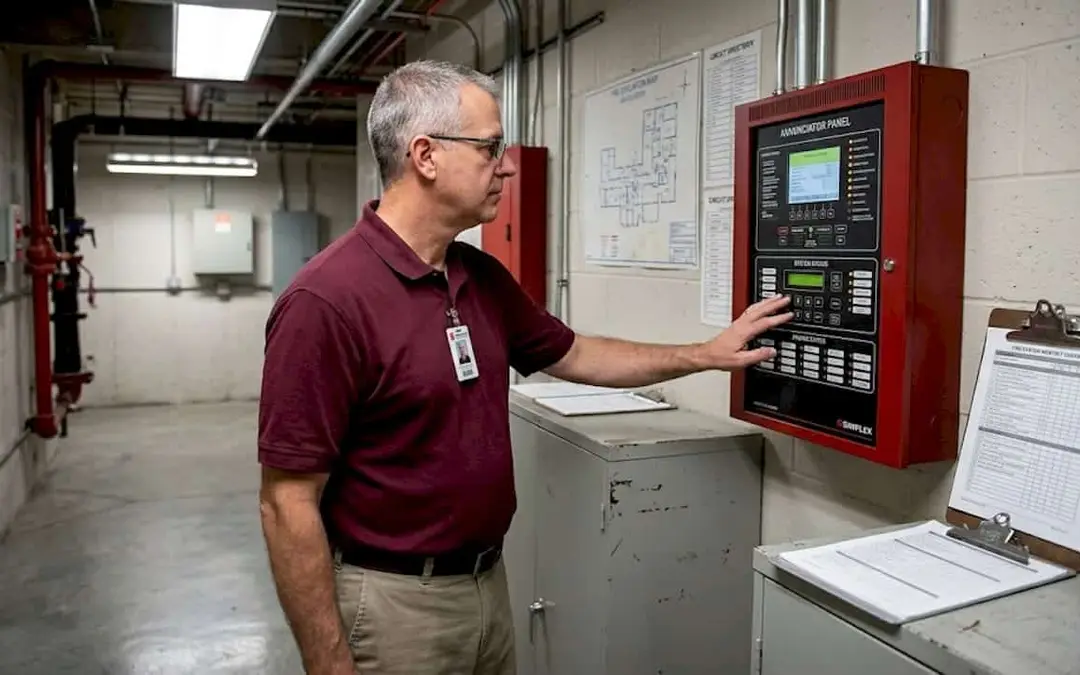
That box on the wall of your mechanical room is not a simple control switch. The master fire alarm panel is the primary Fire Alarm Control Panel (FACP), the central brain that receives signals from every detector in your building, processes them, and triggers the right response within seconds. For Houston property managers and business owners, understanding how it works is not optional. It directly determines whether your building passes inspection, responds correctly during an emergency, and keeps your tenants safe when every second matters.
Table of Contents
- What is a master fire alarm panel?
- Core components and how they work
- Common challenges and modern safety features
- Campus and multi-building properties: Panel networking and access
- What most experts miss about master panels in Houston
- Protect your property with expert Houston fire alarm solutions
- Frequently asked questions
Key Takeaways
| Point | Details |
|---|---|
| Central control hub | The master fire alarm panel (FACP) is the system’s main brain for detection and alerts. |
| Backup power is mandated | NFPA 72 requires panels to function for 24 hours on backup batteries plus 5 minutes of alarm. |
| Modern features cut false alarms | Advanced panels use verification and smart detection to reduce nuisance alarms and boost reliability. |
| Multi-building systems require networking | Each building needs its own panel, but they can be coordinated for large properties. |
| Maintenance ensures compliance | Ongoing testing and expert maintenance are key to meeting Houston’s fire safety codes. |
What is a master fire alarm panel?
The terms “master fire alarm panel” and “Fire Alarm Control Panel” are used interchangeably in the industry. Both describe the same device: the central hub that ties every smoke detector, heat sensor, pull station, and notification device in your building into a single, coordinated system.
Think of it as the air traffic control tower for your fire safety network. Every incoming signal from how fire alarm systems work throughout the building passes through this panel first. When a smoke detector in your third-floor conference room activates, the panel does not just sound a horn. It identifies the exact zone, logs the event with a timestamp, initiates the notification sequence, and in many buildings, transmits a signal directly to the monitoring station or fire department.
“The master fire alarm panel refers to the primary Fire Alarm Control Panel (FACP), the central ‘brain’ of the fire detection and notification system.”
Here is why this distinction matters for property managers:
- Life safety compliance: Houston building codes require a properly installed and tested FACP in nearly all commercial properties. A missing or non-functional panel is a code violation.
- Fast incident response: Fire crews entering your building will look for the panel first to identify which zone is affected and what type of alarm is active.
- System coordination: Without the panel, smoke detectors and alarms operate as isolated devices. The panel makes them a unified, intelligent system.
- Documentation: Modern panels log every alarm, supervisory event, and system fault. That log can be critical during an insurance claim or code inspection.
Many property managers assume that as long as the alarms go off, the system is working. That is a dangerous oversimplification. The panel determines how alarms activate, which zones they affect, and what gets communicated to emergency services. Skipping a detailed review of your fire alarm installation guide when setting up or upgrading a system is one of the most common and costly mistakes we see.
Core components and how they work
Understanding the panel’s anatomy helps you have smarter conversations with your fire alarm contractor and catch problems before they become code violations. Let’s break down the essential parts of a standard FACP and what each one does.
- Power supply: The panel runs on primary 120V AC power from your building’s electrical system. However, backup batteries are required by NFPA 72, the National Fire Alarm and Signaling Code. Sealed lead-acid batteries must provide at least 24 hours of standby power plus 5 minutes of full alarm operation. In Houston, where severe storms can knock out power for extended periods, this backup requirement is not just code. It is common sense.
- Detection loops and zones: These are the circuits that connect to your smoke detectors, heat sensors, and manual pull stations. Zones divide your building into labeled areas so the panel can pinpoint exactly where trouble is occurring. A single-story restaurant might have two or three zones, while a multi-floor office building might have dozens.
- Notification appliance circuits (NACs): These circuits power your horns, strobes, and speakers. The panel activates them in a specific sequence based on what type of alarm is triggered. In some buildings, this includes pre-recorded voice evacuation messages.
- Control modules: These allow the panel to communicate with other building systems, such as elevator recall, magnetic door holders, HVAC shutdown, and sprinkler monitoring.
- User interface: This is the part most people interact with, including LED indicators, a display screen, a keypad, and annunciator lights. It lets authorized personnel silence alarms, run tests, and review event logs.
Setting up your fire detection system correctly from the start is the foundation for all of this to work reliably. The panel is only as good as the zones it monitors and the devices connected to it.
Pro Tip: Walk up to your panel during a non-emergency moment and look at the status indicators. All zones should show normal (usually green). Any amber or yellow supervisory light means a non-emergency fault that still needs attention, such as a low battery or a device that is slightly out of position. Catching these early prevents bigger problems during a real inspection, and your fire alarm maintenance records should document every supervisory event.
Common challenges and modern safety features
Even well-installed systems cause problems when property managers do not understand the operational realities. The two biggest day-to-day issues are nuisance alarms and maintenance gaps, and both can lead to serious consequences for Houston commercial properties.
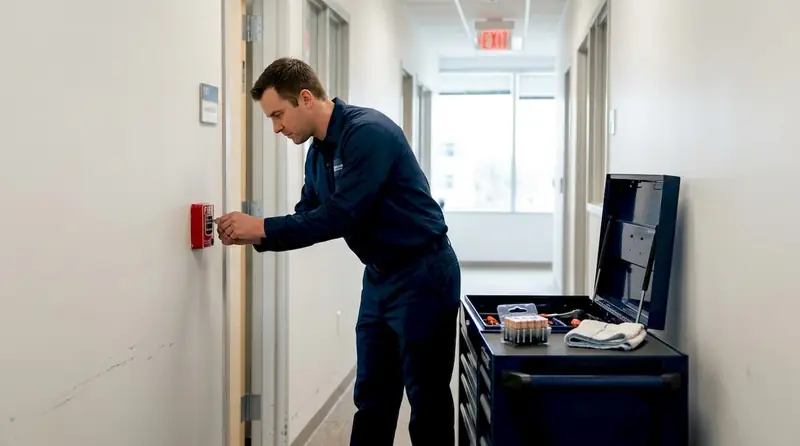
A nuisance alarm (also called a false alarm) is when the panel triggers a full alarm without an actual fire threat. Common causes include dusty detectors, cooking fumes near a sensor, steam from HVAC equipment, or a door left open during painting work. In Houston, the fire marshal can issue fines for repeated false alarms, and tenants quickly start ignoring alarms they assume are false, which is exactly when a real emergency becomes deadly.
Modern panels address this with smart mitigation techniques. According to NFPA 72 pathway survivability standards, nuisance alarms can be reduced through verification delays of 30 to 60 seconds, dual-trigger logic (requiring two detectors to activate before alarming), and intelligent signal analysis that distinguishes gradual smoke buildup from sudden particulate spikes. These are not optional upgrades for Houston commercial buildings. They are increasingly expected under current code interpretations.
To understand what separates older traditional panels from modern systems, here is a direct comparison:
| Feature | Traditional panels | Modern smart panels |
|---|---|---|
| Nuisance alarm reduction | Minimal, single-trigger activation | Verification delays, dual-trigger logic, signal analysis |
| Pathway survivability | Basic Class A or B wiring only | Levels 0 to 3, survivable under fire conditions |
| Remote monitoring | Requires add-on modules | Often built-in, cloud-capable |
| Event logging | Paper printout or basic log | Digital timestamped records |
| Zone granularity | Broad zones | Device-level identification |
| Code compliance updates | Manual firmware/hardware swap | Software-updatable in many models |
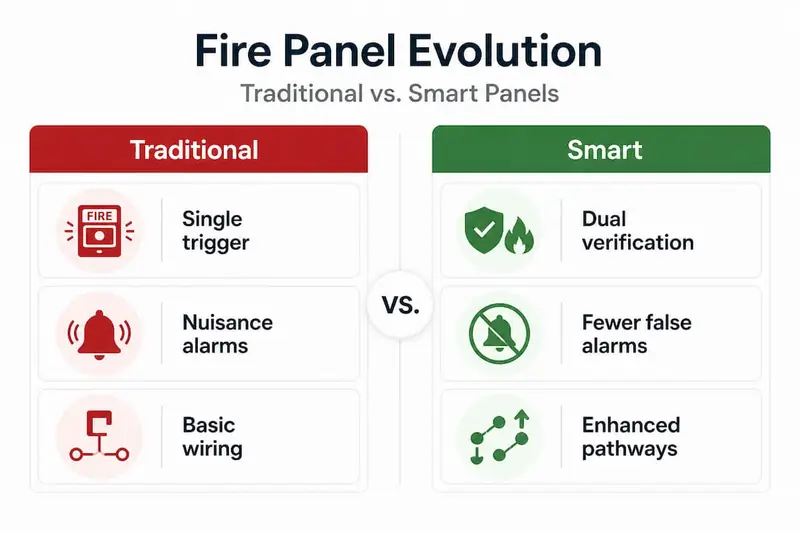
Pathway survivability is a term that often confuses property managers. In simple terms, it means the ability of the wiring and circuit pathways to keep operating even if part of the system is exposed to fire. NFPA 72 Chapter 12 defines survivability levels from 0 (no requirement) to 3 (the most robust, required in the most critical installations like hospitals). For most Houston commercial buildings, Level 1 or 2 is the relevant benchmark.
Understanding what causes false fire alarms in your specific property type is the first step toward choosing the right panel and detector combination to minimize disruption while maximizing real detection accuracy.
Pro Tip: Ask your fire alarm contractor specifically about dual-detector verification if your building has a commercial kitchen, a manufacturing floor, or high-traffic areas near smoke-producing equipment. The incremental cost of this feature is almost always less than the first false-alarm fine from Houston Fire.
Campus and multi-building properties: Panel networking and access
This is where many Houston property owners get things wrong. When someone asks about the “master panel” for a campus with multiple buildings, they often imagine a single central unit that controls everything across the entire property. That is not how code works, and attempting to set it up that way creates major compliance gaps.
UFGS industry standards are clear: in multi-building and campus setups, each building typically needs its own dedicated FACP. Those individual panels can be networked using communication modules (such as a Network Communications Module, or NCM) to allow a central monitoring point to see the status of all buildings simultaneously. But each building’s panel operates independently and is zoned separately.
Here is how the key elements of a campus fire alarm network typically break down:
| Network element | Purpose | Code requirement |
|---|---|---|
| Individual building FACP | Controls all devices in that specific structure | Required per building, per NFPA 72 |
| NCM (Network Communications Module) | Links multiple FACPs for central monitoring | Varies by system design |
| Remote annunciator panel | Displays zone/alarm data at a secondary location | Often required at building entry |
| Central monitoring station | Off-site 24/7 monitoring and dispatch | Required for most commercial properties |
| Graphic annunciator | Visual floor plan display of alarm locations | High-rises and complex properties |
Remote annunciators are particularly important for large Houston commercial campuses. These secondary display panels are installed at building entrances, security desks, or lobby areas where fire crews can quickly access alarm information without hunting for the main panel room. In multi-tenant buildings, this is often not optional. It is a design requirement.
When meeting with a fire alarm contractor for a campus or multi-building setup, use this checklist to guide the conversation:
- Does every building have its own dedicated FACP?
- How will individual panels be networked or monitored centrally?
- Where will remote annunciators be located for fire crew access?
- How are zones labeled to quickly identify the specific area of an alarm?
- What are the backup power requirements for each individual panel?
- How does the system handle an alarm in one building without evacuating the entire campus?
Reviewing a fire alarm system checklist designed for commercial properties will help you prepare for these conversations with confidence and avoid surprises during your next inspection.
What most experts miss about master panels in Houston
Here is something most technical guides skip entirely: passing inspection and actually being safe are not the same thing. We have walked into properties with freshly installed, fully code-compliant panels that would have failed in a real emergency because nobody addressed the three factors that technical specs alone cannot fix.
The first is access. Houston Fire Department crews enter a burning building and need to reach the FACP within seconds to determine what zone is active and whether suppression systems have engaged. If your panel is locked in a basement utility room with no exterior-accessible annunciator, first responders lose critical time. Fire alarm standards from agencies like Santa Clara County Fire are explicit about placing annunciators at locations accessible from the exterior, a requirement that is often overlooked by contractors focused on the technical install but not the operational reality of firefighting.
The second is zoning logic. Many property managers assume that if the panel is installed and the detectors work, the zoning is fine. In practice, zones are often labeled generically (“Zone 1,” “Zone 2”) rather than descriptively (“Third floor east wing,” “Kitchen exhaust area”). During a real alarm at 2 a.m., generic zone labels slow down response and put lives at risk.
The third is ongoing maintenance best practices. A panel installed five years ago without a single documented test or battery replacement is not a compliant system. It is a liability. Houston’s code environment requires regular inspection, testing, and documentation. What your last installer probably did not tell you:
- Annual inspections are a floor, not a ceiling. High-traffic buildings benefit from quarterly device checks.
- Panel software and firmware age just like hardware. Modern panels may need updates to stay compatible with monitoring services.
- Battery replacement schedules are not suggestions. Sealed lead-acid batteries typically need replacement every three to five years regardless of apparent condition.
- Zone labels should be reviewed every time the building layout changes. A renovation that moves a wall does not automatically update your panel’s zone map.
The hard truth is that most fire alarm problems in Houston commercial buildings are not installation failures. They are maintenance and planning failures. A panel that was perfect on day one becomes a compliance gap through neglect and changing building conditions.
Protect your property with expert Houston fire alarm solutions
You now understand what a master fire alarm panel actually does, how its core components work, and what separates a truly compliant system from one that just looks the part during inspection.
Reliable Fire Protection brings certified expertise to every fire alarm installation, inspection, and upgrade across Houston and surrounding neighborhoods. Whether you manage a single commercial building or a multi-structure campus, our team designs systems that meet NFPA 72 standards, satisfy Houston Fire Department requirements, and are set up for long-term reliability. We cover everything from understanding how fire alarm systems work at the design stage to hands-on Houston fire alarm system services and scheduled fire alarm maintenance to keep your documentation clean and your system ready. Contact us today for a free quote and let’s make sure your panel is actually protecting your property.
Frequently asked questions
Is the master fire alarm panel the same as the fire alarm control panel (FACP)?
Yes, both terms describe the same device. The FACP is the central hub that manages all fire detection and notification functions for your building.
How long should the master fire alarm panel operate on backup power?
NFPA 72 requires backup batteries to support at least 24 hours of standby operation followed by 5 minutes of full alarm mode. This ensures the system stays active during power outages.
Can one master panel control all buildings on a large campus?
No. Each building requires its own dedicated FACP, though individual panels can be networked using communication modules to allow centralized monitoring across a campus.
How do modern panels reduce nuisance or false alarms?
Modern panels use verification delays and dual-trigger logic to confirm a real alarm condition before activating full notification, significantly reducing disruptions from false activations while maintaining genuine detection accuracy.
Recommended
- Fire Alarm Installation Guide for Houston Property Managers
- Fire Alarm Inspection Guide for Safe Houston Properties
- Fire Alarm Zoning Explained: Boost Houston Property Safety
- How to choose fire alarms for Houston properties: 5 steps
- Fire Alarm System University Place TX
- Fire Alarm System Services in Bellaire, TX