

TL;DR:
- A fire safety violation at Houston hotels often results from missing or outdated documentation, not equipment failure. Strict NFPA standards enforce regular inspections by licensed professionals to prevent citations, fines, and closures. Implementing disciplined, risk-focused inspections and maintaining thorough records are essential for ensuring compliance and safety.
A fire safety violation at your Houston hotel doesn’t have to involve a broken sprinkler or a faulty alarm. In most cases, the system works fine but the paperwork is missing, the tag is outdated, or the test was never logged. That single oversight can trigger citations, fines, forced closures, and the kind of reputational damage that follows a property for years. Houston hotels operate under strict NFPA standards enforced by local fire marshals, and the gap between a passing inspection and a costly violation is often just a matter of knowing exactly what to check, when to check it, and how to document it properly.
Table of Contents
- Fire safety fundamentals for Houston hotels
- Core hotel fire safety checklist: What, when, and how
- Critical inspection steps and common violations
- Documentation: The compliance blind spot
- Why checklist culture risks your hotel (and how to fix it)
- Next steps for complete hotel fire safety
- Frequently asked questions
Key Takeaways
| Point | Details |
|---|---|
| Know local standards | Houston fire safety compliance relies on NFPA codes and inspection by the local fire marshal. |
| Track inspection frequencies | Every system—sprinklers, alarms, extinguishers—has its own mandated inspection interval. |
| Document everything | Retain inspection and testing records onsite for at least 1-3 years to pass compliance checks. |
| Spot common oversights | Most violations are caused by propped fire doors, missed trouble signals, or paperwork errors. |
| Move beyond checklists | Risk audits, guest flow mapping, and staff drills uncover threats that standard checklists miss. |
Fire safety fundamentals for Houston hotels
Before you can build an effective safety program, you need to know who sets the rules and what they actually require. Houston hotels answer to a layered authority structure that combines national standards with local enforcement.
The Texas State Fire Marshal uses NFPA 101 (Life Safety Code) and NFPA 1 (Fire Code) as the primary inspection standards, and defers to local Authorities Having Jurisdiction (AHJs) like the Houston Fire Marshal for inspections within their service areas. Licensed professionals are required for certain critical system tests, which means you cannot assign a maintenance employee to handle alarm verification or sprinkler flow testing and expect it to count toward compliance.
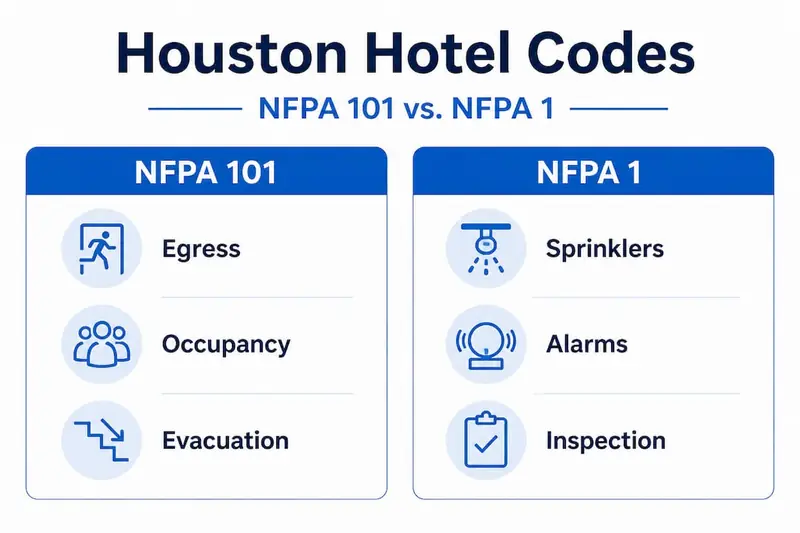
Understanding the difference between these two foundational codes matters for your planning:
| Standard | Focus area | Key hotel requirement |
|---|---|---|
| NFPA 101 | Life Safety Code | Egress, occupancy loads, emergency lighting |
| NFPA 1 | Fire Code | Equipment installation, maintenance schedules |
| NFPA 72 | Fire Alarm Code | Alarm system testing and documentation |
| NFPA 25 | Sprinkler Systems | Inspection, testing, and maintenance of water systems |
| NFPA 10 | Portable Extinguishers | Service intervals, placement, labeling |
Houston’s fire marshal inspectors carry real authority to cite violations, issue fines, or shut down portions of your property. Staying current with the Houston fire inspection checklist helps you map local requirements directly to your facility’s specific configuration, whether you operate a boutique property or a large convention hotel.
Key compliance requirements that trip up Houston hotel managers include:
- All alarm and sprinkler system tests must be performed by licensed fire protection professionals
- Inspection records must be available on-site for fire marshal review
- Any deficiency found during inspection must be corrected within a mandated timeframe
- Notification requirements apply when systems are taken offline for maintenance
Core hotel fire safety checklist: What, when, and how
Knowing the rules is one thing. Executing them on a schedule across every system in your building is the real operational challenge. Below is a structured overview of inspection frequencies drawn from current NFPA standards, so your team knows exactly when each task must happen.
Hotel fire safety inspection schedule
| System | Frequency | Governing standard |
|---|---|---|
| Sprinkler gauges | Weekly | NFPA 25 |
| Sprinkler waterflow test | Quarterly | NFPA 25 |
| Fire alarm supervisory | Quarterly | NFPA 72 |
| Elevator detectors | Semi-annual | NFPA 72 |
| Full fire alarm test | Annual | NFPA 72 |
| Extinguisher visual check | Monthly | NFPA 10 |
| Extinguisher full service | Annual | NFPA 10 |
| Emergency lighting (30-sec test) | Monthly | NFPA 101 |
| Emergency lighting (90-min test) | Annual | NFPA 101 |
| Fire doors | Monthly | NFPA 80 |
| Kitchen suppression system | Semi-annual | NFPA 96 |
These inspection frequencies represent the minimums under current NFPA codes. Your specific AHJ or building occupancy classification may require more frequent checks, so always verify with the Houston Fire Marshal for your property type.
Here is a practical numbered approach to executing your monthly inspection cycle:
- Walk every floor and inspect each fire extinguisher for visible damage, correct pressure, intact pin, and a current inspection tag
- Test emergency lighting in all corridors, stairwells, and exit paths using the 30-second function test
- Physically check all fire doors for self-closing function, proper latching, and absence of wedges or props
- Review the Fire Alarm Control Panel (FACP) for any active trouble signals
- Confirm that sprinkler heads are unobstructed and gauge pressure readings are within normal range
- Log every check with date, staff member, and outcome in your records system
For extinguisher placement and spacing rules specific to hotel layouts, review the Houston extinguisher inspection guide to make sure your coverage is complete.
Pro Tip: Assign monthly inspection duties to a specific named person, not a general “maintenance team.” When an inspector asks who performed the check and when, a named signature with a date is far more defensible than a shared log entry.
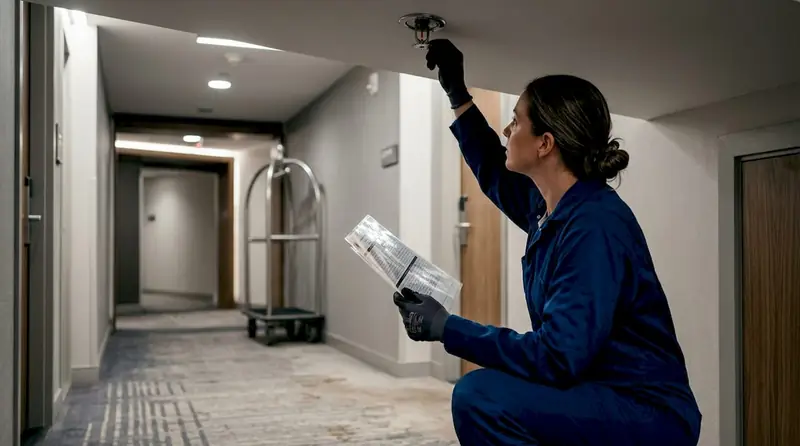
Understanding the different hotel sprinkler types in your building also matters here. Wet, dry, and pre-action systems have different testing protocols, and mixing up procedures is a surprisingly common source of documentation errors during audits.
Critical inspection steps and common violations
Running through a checklist on paper is not the same as knowing what to actually look for during a physical walk-through. Some of the most expensive violations come from items that pass a quick visual but fail under real scrutiny.
Here is a step-by-step breakdown of the most critical inspection tasks:
- At the FACP, check for any trouble, supervisory, or alarm signals. A silenced trouble signal that was never cleared is still a violation.
- Measure clearance below sprinkler heads. There must be at least 18 inches of clear space between the deflector and any stored materials or furniture.
- Confirm all sprinkler control valves are fully open and locked or sealed as required.
- Inspect every portable extinguisher for a charged gauge, intact pull pin, legible label, and a tag showing the most recent annual service date.
- Test each fire door by allowing it to close from a fully open position. It must latch completely without assistance.
- Measure egress path widths. Primary corridors must maintain a minimum of 44 inches of clear, unobstructed width.
- Verify that smoke detectors have no paint, dust, or sticker residue covering the sensing chamber.
Critical violations that generate the most citations in Houston hotels: Propped fire doors with wedges or housekeeping carts; sprinkler heads painted over or obstructed by new ceiling tiles; FACP trouble signals that were silenced but not resolved; exit signs with burned-out backup batteries; kitchen suppression nozzles blocked by grease buildup; and egress paths narrowed by stored equipment or furniture.
These critical checks are the exact items Houston fire marshal inspectors flag most often. The good news is that every single one of them is preventable through a disciplined inspection routine.
There are also several edge cases that catch experienced managers off guard. Battery degradation in emergency lighting units can allow a 30-second test to pass while the battery cannot actually sustain the required 90-minute discharge during a real outage. Battery degradation is one of the most frequently overlooked risks in emergency lighting systems. Grease accumulation in commercial kitchen suppression nozzles is another. The system may appear intact visually, but blocked nozzles cannot discharge agent effectively. Proper hotel kitchen maintenance protocols that include hood and duct cleaning directly support your suppression system’s effectiveness.
Pro Tip: Walk your inspection route the same way a guest would move through the building during an emergency, from their room toward the nearest stairwell exit. This perspective reveals propped doors, blocked egress paths, and missing signage that a facilities-focused walk often misses.
Pair your physical walk-throughs with solid alarm maintenance tips to make sure your detection systems stay in top condition between professional service visits. For the extinguisher side of your compliance program, a documented extinguisher inspection workflow gives your team a repeatable process that holds up under scrutiny.
Documentation: The compliance blind spot
Here is a number that should get your attention: 72% of hotel fire code violations are documentation failures, not equipment defects. The sprinkler worked. The alarm tested correctly. But no one kept the record, or the sensitivity test results were never filed, or the service tag expired without a replacement.
Documentation is where compliant hotels get cited. This is the area that requires the same level of discipline as the physical inspections themselves.
What you need to maintain and where:
- Sprinkler test records: Waterflow test results, gauge readings, and valve inspection logs retained for at least 3 years
- Fire alarm records: All test dates, results, and technician certifications including sensitivity test reports for smoke detectors
- Extinguisher service tags: Physical tags on each unit plus corresponding paper or digital service records
- Emergency lighting logs: Both the monthly 30-second test and the annual 90-minute test results
- Fire door inspections: Monthly check logs showing condition, closing function, and any deficiencies noted
- Kitchen suppression records: Semi-annual service reports from your licensed contractor
All of these records must be retained on-site for a minimum of 1 to 3 years depending on the system, and they must be available immediately when an inspector arrives. Sending someone to retrieve files from a remote location or a personal computer during an inspection visit is not acceptable.
Pro Tip: Use a digital inspection platform that attaches timestamped photo evidence to each checklist entry. When an inspector questions whether a task was performed, a photo with GPS coordinates and a date stamp is far stronger proof than a signature in a paper log.
Reviewing the extinguisher checklist steps helps your team understand exactly what documentation must accompany each service visit and monthly visual check, which is one of the most commonly incomplete record sets during Houston hotel inspections.
Why checklist culture risks your hotel (and how to fix it)
We work with hotel managers across Houston who run tight operations, check every box on schedule, and still get cited during inspections. The pattern is almost always the same. The checklist became a ritual instead of a tool.
When compliance becomes purely about checking boxes, the team stops asking why each item matters. A fire door gets logged as “checked” because it closed, not because someone verified the latch engaged fully and the gap seal was intact. An extinguisher gets initialed because it is still on the wall, not because someone actually verified the gauge pressure, inspected the hose, and confirmed the tag is current. This is the hidden risk in well-run programs.
The real approach we advocate is shifting from compliance audits to risk-focused inspections. That means using digital tools that require photo proof, auto-schedule recurring tasks, and track each asset’s full service history so nothing falls through the cracks. It also means conducting guest flow mapping, which involves physically walking the path every guest category would take during an actual evacuation, including mobility-impaired guests, guests with children, and guests on upper floors during elevator lockdown.
Regular drills with debriefs are another non-negotiable in our view. A drill that ends without a structured conversation about what went wrong teaches nothing. The debrief is where you find the real gaps: the stairwell door that guests hesitated to open because it looked alarmed, the assembly area that staff couldn’t find in the dark, or the housekeeping team that didn’t know their radio channel.
The Houston fire prevention checklist is a strong starting point for redesigning your inspection program around actual risk rather than minimum compliance. True safety culture in a hotel is built from the top down, and it starts with managers who ask harder questions than any fire marshal will.
Next steps for complete hotel fire safety
Your fire safety program is only as strong as the systems backing it up and the team maintaining them. If your last full audit revealed gaps in documentation, aging equipment, or incomplete records, the time to address them is before the next inspection visit.
At Reliable Fire Protection, we work specifically with Houston hotels to audit, service, and certify every critical fire safety system under one roof. From understanding how alarm systems work at the technical level to scheduling your next extinguisher inspection, our licensed technicians bring the documentation, credentials, and local knowledge your property requires. Whether you need a full compliance review or targeted system upgrades, start with our Houston fire safety checklist and then reach out for a free on-site assessment tailored to your hotel’s specific risk profile.
Frequently asked questions
How often should hotel fire safety inspections be performed in Houston?
Inspection frequencies range from weekly sprinkler gauge checks to annual full alarm tests, depending on the system, following NFPA standards enforced by the Houston Fire Marshal.
What documents must be onsite for fire code compliance?
Hotels must keep current inspection records, sensitivity test results, alarm tags, and service records retained for 1 to 3 years on-site and available immediately upon inspector request.
Who can legally inspect and test hotel fire protection systems?
Licensed fire protection professionals are required for all critical system tests including alarms, sprinklers, and extinguishers in Houston, and self-performed tests do not meet compliance requirements.
What are the common causes of hotel fire safety violations?
Most violations come from missing documentation and overlooked egress issues such as propped fire doors, blocked corridors, and expired service tags rather than actual equipment failure.
How can hotels avoid overlooked fire risks?
Risk audits and guest flow mapping, combined with structured post-drill debriefs, identify hidden hazards that routine checklist inspections consistently miss.
Recommended
- Fire prevention checklist for Houston properties 2026
- Creating Fire Safety Checklist for Houston Properties
- Fire Safety Inspection Checklist 2026 for Houston
- 7 Fire Safety Best Practices for Houston Property Managers
- How to conduct a site inspection for safe fire performances
- Fire Alarm System University Place TX
- Fire Alarm System Services in Bellaire, TX