
TL;DR:
- Creating a comprehensive fire safety plan involves mapping escape routes, practicing drills, and maintaining safety equipment to ensure quick evacuation within two minutes.
- Houston homeowners must consider specific risks like shared walls, older construction, and household changes that influence fire escape strategies.
Home fires allow less than 2 minutes to escape safely after a smoke alarm sounds. That is not enough time to figure out a route you have never thought about before. For Houston homeowners and property managers, knowing how to create a fire safety plan is not a box-checking exercise. It is the difference between getting everyone out and a tragedy. This guide walks you through every step, from mapping your home to running realistic drills to maintaining the equipment that buys you those critical seconds.
Table of Contents
- Prepare your home and family for fire safety planning
- Create your fire safety plan step-by-step
- Practice your fire safety plan effectively
- Maintain safety equipment and understand emergency response
- Why traditional fire safety wisdom needs updating for Houston homes
- How Reliable Fire Protection helps Houston homeowners with fire safety plans
- Frequently asked questions
Prepare your home and family for fire safety planning
Before you draw a single escape route, you need the right foundation. Skipping this step is why most household fire plans fail when it matters.
A house fire can spread in as little as two minutes, which means every second of confusion during an emergency is a second you cannot recover. Houston homes come with specific risks worth acknowledging upfront: attached dwellings and townhouses in neighborhoods like Midtown and Montrose share walls that accelerate fire spread between units. Older bungalows common in the Heights often have narrow hallways and single stairwells. Humidity-driven wood rot can compromise window frames, making them harder to push open under stress.
Gather these materials before you start:
- A blank sheet of paper or printed floor plan for each level of your home
- Colored markers (use red for exits, blue for smoke alarms, green for fire extinguisher locations)
- A tape measure if you need accurate room dimensions
- A notepad for recording smoke alarm locations and battery replacement dates
Involve every household member in this initial walkthrough, including children old enough to understand and elderly relatives who may need assisted escape. People follow plans they helped create. If you manage a rental property in Houston, involve your tenants directly. A plan posted on the refrigerator that tenants helped design gets followed. One slid under the door gets ignored.
Review a fire safety checklist for Houston homes to confirm you are not missing any property-specific risks before you begin.
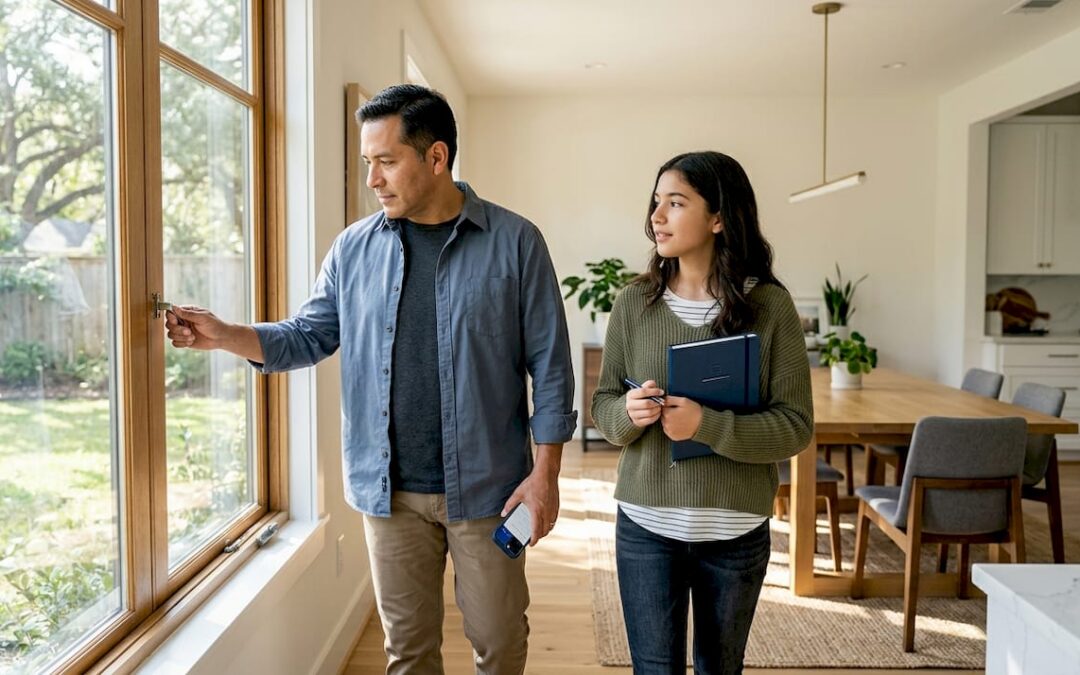
Pro Tip: Walk every room in your home and physically touch every window and door. If a window sticks, fix it before your plan relies on it as an escape route. Do not assume it will open under pressure.
For a broader look at what essential residential fire safety looks like in Houston, make sure your baseline equipment is in place before the plan-building process starts.
Create your fire safety plan step-by-step
With your home and family prepared, here is how to build a plan that actually works during an emergency, not just on paper.
The five core steps
- Draw a detailed floor map. Sketch each floor separately. Mark all doors, windows, hallways, and staircases. Include the garage if it connects to the living space. This does not need to be an architect’s drawing. Clear and readable matters more than precise.
- Identify two exits from every room. Every room needs two exits, typically a door and a window, and both must be accessible. Check that window locks open easily and that there are no obstacles blocking either route. For second-floor bedrooms, consider a collapsible escape ladder stored near the window.
- Choose one fixed meeting place outside. Pick a spot that is far enough from the house to be safe but close enough for everyone to reach quickly. A specific mailbox, a neighbor’s driveway, or a large tree works well. The key word is fixed. Everyone must know it without being told during the emergency.
- Assign responsibilities to each household member. Designate who helps children, who assists elderly or disabled members, and who calls 911. Responsibilities should be named, not assumed. If your plan says “someone will help Grandma,” that is not a plan.
- Teach stop, drop, and roll. Practice this with children until it is reflexive. If clothing catches fire, stopping prevents fanning the flames, dropping removes the upright position that lets fire climb toward the face, and rolling smothers the fire.
Your fire prevention checklist for Houston properties can help you verify that your exits are not blocked by storage, overgrown shrubs, or locked security doors.
Escape route comparison table
| Feature | Good escape route | Common pitfall |
|---|---|---|
| Door clearance | Fully unobstructed, opens inward easily | Blocked by furniture or seasonal storage |
| Window access | Opens fully within 5 seconds | Painted shut or rusted lock |
| Second-floor window | Ladder stored next to window | No ladder, drop too high to attempt safely |
| Outdoor path | Clear path to meeting place | Fenced yard with gate that requires a key |
| Night visibility | Clearly navigable in the dark | No lighting, unfamiliar layout at night |
Pro Tip: Post your completed floor map on the inside of a kitchen cabinet door, not on the front of the refrigerator where it becomes wallpaper. Cabinet placement means it gets seen when someone actively looks for it.
Practice your fire safety plan effectively
After creating your fire safety plan, practicing it regularly ensures everyone can follow it confidently under stress, not just in theory.
Fire safety experts recommend conducting fire escape drills at least twice a year, including one nighttime drill. Most fatal home fires occur at night when people are asleep. A plan that only gets tested on a Saturday afternoon does not prepare your household for the real scenario.
How to run an effective fire drill
- Set the scene without warning. Sound the alarm without telling family members in advance. Real emergencies do not come with a heads-up.
- Time the escape. Your household should be outside at the meeting place within two minutes. If it takes longer, identify the bottleneck and address it.
- Block the primary exit. During at least one drill per year, place a sign or close the door on the main route to force everyone to use the secondary exit. This is the drill that exposes weaknesses.
- Practice low crawling. Smoke rises. Air near the floor is cooler and has more oxygen. Teach everyone to crawl under smoke rather than stand and run through it.
- Verify children wake up. Many children sleep through smoke alarms. The nighttime drill confirms whether yours do. If they do not wake up, that is critical information you need before an emergency, not during one.
Additional practices to reinforce:
- Feel doors with the back of your hand before opening. A hot door means fire on the other side.
- Never re-enter a burning home for any reason, including pets or belongings. Call that information in to firefighters.
- Confirm your meeting spot again verbally after every drill.
Never go back in. Firefighters report that re-entry is one of the leading causes of residential fire fatalities. Once you are out, you stay out.
Pair your drills with a reliable detection setup. A reviewed fire detection setup guide for Houston properties can help you confirm alarms are positioned to maximize early warning time.
Pro Tip: Film one of your nighttime drills on your phone. Watching it back shows you exactly where hesitation, confusion, or delay happened. Most families are surprised by what they see.
Maintain safety equipment and understand emergency response
A practiced plan and well-maintained equipment work together. One without the other leaves gaps.
Smoke alarms in every bedroom, hallway, and living area save lives by providing early warning. Test them monthly by pressing the test button, and replace them every 10 years. In Houston’s humid climate, dust and humidity can degrade sensor sensitivity faster than in drier regions. Replace batteries at minimum once a year, or switch to 10-year sealed battery models to remove the guesswork.
Key placement reminders:
- Install alarms on the ceiling or high on the wall, at least 4 inches from a corner
- Place alarms away from kitchens and bathrooms to reduce false alarms from cooking steam
- Use interconnected alarms so that when one triggers, all of them sound simultaneously
Understanding the importance of fire alarms in your specific layout helps you make smarter placement decisions, especially in multi-level homes.
Safety device comparison
| Device | Primary role | Maintenance interval |
|---|---|---|
| Smoke alarm | Early warning detection | Test monthly, replace every 10 years |
| Carbon monoxide detector | Detects CO buildup | Test monthly, replace every 5-7 years |
| Fire extinguisher | Suppress small, contained fires | Inspect annually, recharge after any use |
| Escape ladder | Secondary exit for upper floors | Inspect annually for corrosion or wear |
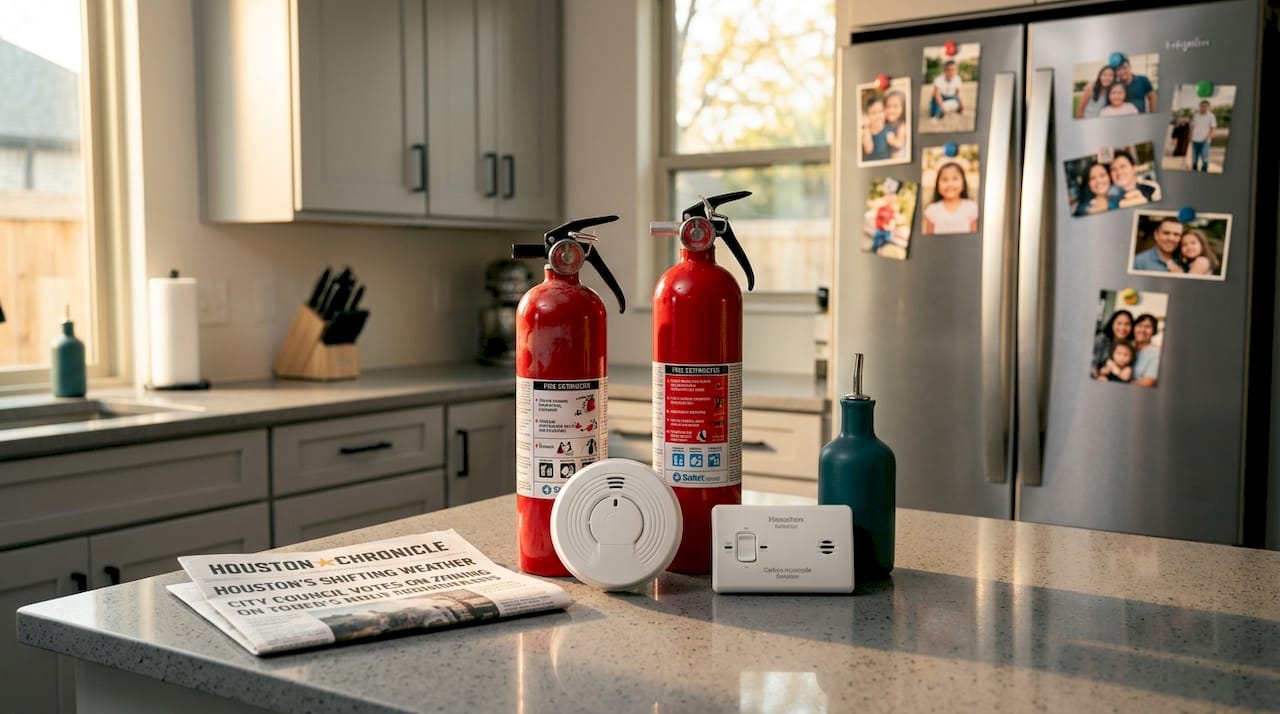
For fire extinguishers, knowing the difference between an ABC extinguisher (for common household fires) and a Class K extinguisher (for kitchen grease fires) matters. Using the wrong type can make a fire worse. Review the fire extinguisher types available for residential use before purchasing.
On calling 911: call after you are safely outside. Your address, the type of fire if you know it, and whether anyone is still inside are the three things dispatchers need first. Do not delay your escape to gather more information.
Pro Tip: Write your property address in large print on the inside of your front door. In a panic, people sometimes cannot recall their own address. Guests or babysitters definitely may not know it.
Why traditional fire safety wisdom needs updating for Houston homes
Most fire safety advice treats every home the same. It does not. And in Houston, that gap matters.
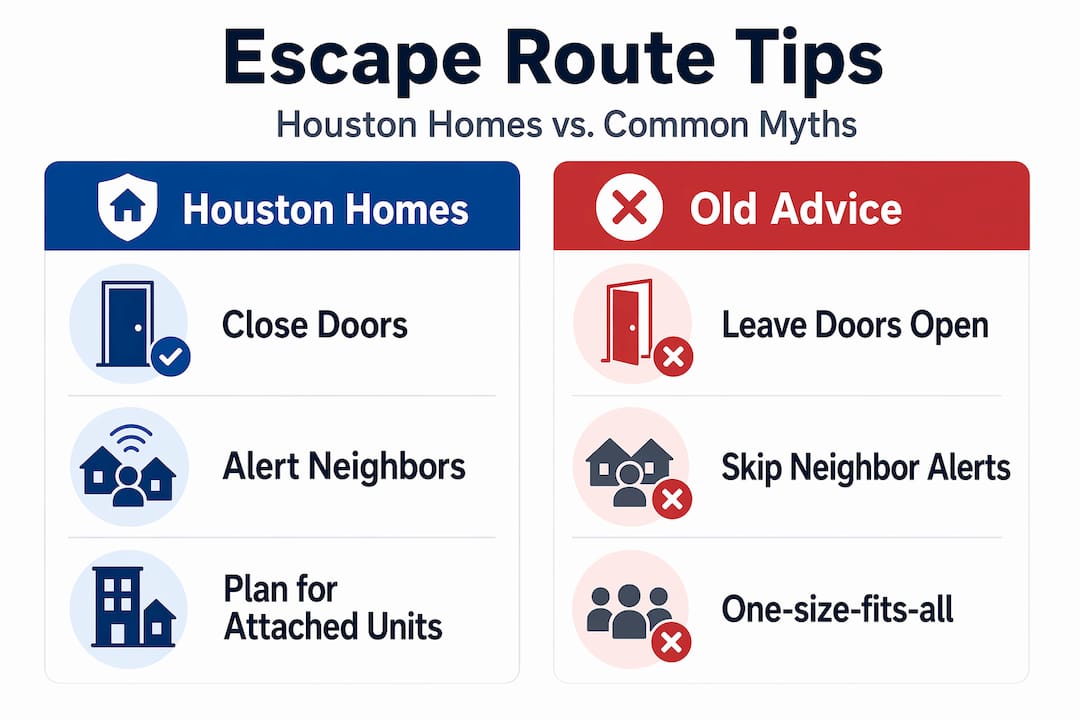
The advice to “get out fast and leave doors open for airflow” is genuinely dangerous. Closing doors during escape slows fire and smoke spread significantly. A closed door can hold back lethal heat and gases for several additional minutes, which is enough time for others to escape or for firefighters to get inside. This is one of the most under-taught tactics in household fire planning.
Houston’s attached home inventory creates a compounding risk that standalone home advice ignores. In a townhouse or row house, a fire in your neighbor’s unit can breach your shared wall in minutes, depending on construction type and fire suppression status. Your fire safety checklist should account for which walls you share and whether those units have working smoke alarms.
Two more things fire professionals see overlooked regularly. First, older wood-frame construction burns faster than newer steel-and-concrete construction. If your Houston home was built before 1980, your escape window during a fire is shorter than the two-minute standard suggests. Plan accordingly. Second, families change. People move in, children grow older, elderly relatives join the household. A plan created two years ago may not reflect who is sleeping in which room tonight. Review it whenever your household changes, not just on a calendar schedule.
Coordinate with immediate neighbors if you live in attached housing. A simple conversation about whether you have working alarms, how your exits overlap, and who might need help evacuating is free and potentially life-saving.
How Reliable Fire Protection helps Houston homeowners with fire safety plans
With a solid plan and the right knowledge in place, working with certified professionals ensures your fire safety measures are reliable and code-compliant across Houston.

At Reliable Fire Protection, we install and maintain fire alarm systems that are properly positioned and interconnected for your specific home layout, giving your escape plan the early warning it depends on. We carry the full range of residential safety equipment and can match fire extinguisher systems to your home’s fire risks. Our team is Houston-based, certified, and understands the local construction and regulatory landscape. Whether you need new smoke alarm placement, system upgrades, or a full equipment review, we are ready to support your fire safety plan with real hardware that performs when it counts. Contact us for a free consultation.
Frequently asked questions
How often should I practice my home fire safety plan?
You should practice your fire safety plan at least twice a year, including one nighttime drill to simulate real emergency conditions when most fatal fires occur.
What is the best meeting place after escaping a fire?
Choose a fixed, safe location outside your home like a specific tree, mailbox, or neighbor’s driveway that everyone knows by memory to prevent anyone from re-entering the building.
Should doors be left open or closed when escaping a fire?
Always close doors behind you when escaping to slow the spread of fire and smoke, which can protect adjacent rooms or units for several additional minutes.
What if a child doesn’t wake up from the smoke alarm during a fire?
Many children sleep through standard smoke alarms, so nighttime drills are essential to confirm their responsiveness. If they do not wake up, consider specialized alarms with voice alerts or assign an adult to wake them as part of the plan.