
TL;DR:
- A fire risk assessment systematically identifies hazards, evaluates risks, and plans controls to protect people and property. It requires proper tools, competent assessors, and regular reviews to remain effective and compliant. Documenting findings and vulnerable occupant needs ensures ongoing safety and legal adherence.
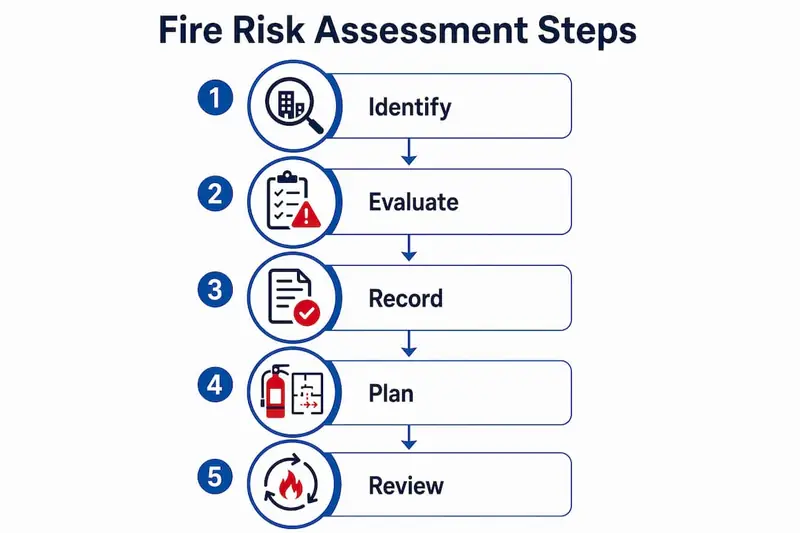
A fire risk assessment is the systematic process of identifying fire hazards, determining who is at risk, evaluating existing safety measures, and implementing controls to protect life and property. Knowing how to conduct a fire risk assessment is a legal requirement for most workplaces and a practical necessity for any residential property manager. The legally recognized framework follows five structured steps: identify hazards, identify people at risk, evaluate and act, record and plan, and review. This guide walks through each step with the depth and specificity you need to do it right the first time.
How to conduct a fire risk assessment: prerequisites and tools
Before you walk through a building with a clipboard, you need the right foundation. A fire risk assessment requires access to building blueprints or floor plans, a hazard identification checklist, records of any previous assessments, and knowledge of the occupant profile. Without these, you will miss hazards that are not visible during a walkthrough.

The person conducting the assessment must be competent. The Responsible Person holds the legal duty for fire safety and is legally accountable if the assessment is inadequate. Competency requirements have increased significantly following the Building Safety Act 2022 and post-Grenfell reforms, particularly for complex or higher-risk residential buildings.
| Requirement | Why it matters |
|---|---|
| Building floor plans | Identifies escape routes and compartmentation |
| Occupant profile records | Flags vulnerable individuals needing special arrangements |
| Previous assessment records | Shows what has changed since the last review |
| Hazard identification checklist | Prevents gaps in the walkthrough |
| Access to all areas | Ensures no hazard zones are missed |
Pro Tip: Use a printed fire safety checklist during your walkthrough. A digital form on a tablet works too, but paper does not run out of battery mid-inspection.
How do you identify fire hazards in a property or workplace?
Hazard identification is the foundation of the entire fire risk assessment process. The fire triangle defines the three elements every fire needs: an ignition source, a fuel source, and oxygen. Your job is to find every place in the building where these three elements can combine.
Common ignition sources
- Electrical equipment and faulty wiring
- Heating systems and portable heaters
- Hot work such as welding or cutting
- Smoking areas near combustible materials
- Cooking equipment left unattended
Common fuel sources
- Combustible materials like paper, cardboard, and wood
- Flammable liquids and chemicals
- Upholstered furniture and soft furnishings
- Accumulated waste and poor housekeeping
- Packaging materials stored near heat sources
Oxygen sources
Open windows, ventilation systems, and air conditioning units all feed a fire. Oxygen is rarely the limiting factor in a building, which is why controlling ignition and fuel sources matters most.
Two hazards that assessors consistently overlook are faulty wiring inside walls and poor housekeeping in storage rooms. A cluttered storage area next to an electrical panel is one of the most common fire setups in commercial buildings. For a deeper breakdown of specific hazards by property type, the guide on identifying fire hazards covers residential and commercial scenarios in detail.
Pro Tip: Walk the building at different times of day. Hazards like propped-open fire doors or overloaded extension cords often appear only during busy operating hours.
Who is at risk? Identifying people in your assessment
Every person in or near the building must be accounted for. The fire risk assessment process requires you to identify employees, visitors, contractors, and members of the public who may be present. Each group has different levels of familiarity with the building and different abilities to respond to an alarm.
Vulnerable individuals require specific documentation. Ignoring the special needs of vulnerable occupants during evacuation planning is one of the most common compliance failures. The groups that need individual evacuation plans include:
- People with mobility impairments who cannot use stairs
- Individuals with hearing or visual impairments who may not detect alarms
- Elderly residents in care settings
- Children in schools or daycare facilities
- Workers in isolated areas who may not hear an alarm quickly
For each vulnerable person, document their location, their specific limitation, and the evacuation method assigned to them. A Personal Emergency Evacuation Plan (PEEP) is the standard format for this documentation. Occupancy type changes everything. A warehouse with ten workers during the day may have zero occupants at night, which changes the risk profile entirely.
Pro Tip: Interview staff who work with vulnerable occupants. They know details about mobility aids, medication schedules, and behavioral responses to alarms that no floor plan will show you.
How to evaluate risks and implement control measures
Risk evaluation means judging how likely a fire is to start and how severe the consequences would be. A qualitative risk matrix with categories such as low, medium, and high is the standard tool for this step. You assign a rating to each hazard based on the probability of ignition and the potential impact on occupants.
Once you have a risk rating, you select control measures. The hierarchy of controls applies directly to fire risk management:
| Control type | Example in fire safety |
|---|---|
| Elimination | Remove flammable materials from the building entirely |
| Substitution | Replace a flammable solvent with a water-based alternative |
| Engineering controls | Install fire doors, sprinkler systems, and compartmentation |
| Administrative controls | Enforce no-smoking policies and hot work permit systems |
| Personal protective equipment | Provide fire-resistant clothing for workers near heat sources |
Fire detection and suppression equipment, safe escape routes, and structural fire protections are the most commonly implemented controls. These measures reduce both the likelihood of fire spreading and the time occupants need to evacuate safely. Prioritize controls at the top of the hierarchy first. Eliminating a hazard is always more reliable than training people to manage it.
Pro Tip: Do not treat fire extinguishers as your primary control measure. They are a last resort. If your risk evaluation relies heavily on occupants using extinguishers, your engineering controls are insufficient.
What documentation and training must follow the assessment?
Recording your findings is a legal requirement. Written records are legally required for premises with five or more employees and are strongly recommended for all other premises. The record must be specific enough that a third party could understand what was found and what was done about it.
A complete fire risk assessment record includes:
- A description of the premises and its use
- A list of identified hazards and their locations
- A list of people at risk, including vulnerable individuals and their PEEPs
- The risk rating assigned to each hazard
- Control measures already in place and their condition
- An action plan with specific tasks, responsible persons, and deadlines
- The date of the assessment and the assessor’s name and qualifications
The action plan is the most critical output. An effective assessment produces a prioritized action plan with realistic deadlines, not a list of observations that sits in a filing cabinet. Assign each action to a named person and set a completion date.
Training must follow the assessment. Fire safety awareness training covers all staff. Fire wardens need additional training on evacuation procedures, alarm systems, and their specific responsibilities during an emergency. Training records should be stored alongside the assessment document.
How and when should you review your fire risk assessment?
A fire risk assessment is not a one-time event. Reviews must happen at least annually for moderate and high-risk premises, and every one to three years for low-risk premises. These are minimums, not targets.
Certain events trigger an immediate review regardless of schedule:
- Structural changes to the building such as new walls, doors, or extensions
- Changes in occupancy, such as a new tenant type or increased capacity
- A fire or near-miss incident on the premises
- Introduction of new processes, equipment, or hazardous materials
- Changes in relevant fire safety legislation
Annual reviews provide a safety net even when no obvious changes have occurred. Gradual drift in housekeeping standards, staff turnover, and equipment aging all create new risks that only a fresh walkthrough will catch.
Pro Tip: Set a calendar reminder for your annual review at the same time you complete the current assessment. Scheduling it immediately removes the risk of it being pushed back indefinitely.
Key Takeaways
A fire risk assessment is only effective when it produces documented controls, a prioritized action plan, and a scheduled review cycle that keeps pace with changes in the premises.
| Point | Details |
|---|---|
| Five-step framework | Follow the identify, evaluate, record, plan, and review cycle for every assessment. |
| Competent assessor required | The Responsible Person must be qualified; complex buildings require certified professionals. |
| Vulnerable occupants need PEEPs | Document individual evacuation plans for every person with a mobility or sensory limitation. |
| Written records are mandatory | Premises with five or more employees must record findings in writing; all others should too. |
| Annual review is the minimum | Review at least once a year and immediately after any significant change or incident. |
What most assessments get wrong
The biggest mistake I see is treating the fire risk assessment as a document to produce rather than a process to run. A completed form filed away in a drawer does nothing. The assessment only works if the action plan gets executed, the controls get maintained, and someone checks back in regularly.
The second most common failure is underestimating vulnerable occupants. Most assessors account for the general population in a building but do not dig into who specifically cannot self-evacuate. That gap is where legal non-compliance and real harm both live. Specific documentation of vulnerable occupant arrangements is mandatory for adequacy, yet it is routinely missing from assessments I review.
Competency is the third issue. Post-Grenfell reforms and the Building Safety Act 2022 raised the bar significantly. For a standard office or retail space, a well-trained in-house assessor may be sufficient. For a multi-story residential building or a facility with complex processes, you need a qualified external assessor. The legal and human cost of getting this wrong is not worth the savings on assessment fees.
The best assessors I know treat the fire risk assessment process the same way a good doctor treats a patient checkup. They look for what has changed, they ask questions the paperwork does not prompt, and they follow up. That mindset is what separates a compliant assessment from a genuinely safe building.
— Results
How Reliable-fire-protection supports your fire safety needs
A thorough fire risk assessment tells you what controls you need. Getting those controls installed and maintained correctly is a separate challenge.
Reliable fire protection works with residential and commercial property managers across Houston to install and maintain the fire alarm systems, sprinkler systems, and suppression systems that your assessment identifies as necessary. Understanding how fire alarm systems work is the first step toward choosing the right detection setup for your building’s specific risk profile. Reliable-fire-protection’s certified team can review your assessment findings and recommend the right equipment to close any gaps. Contact Reliable-fire-protection for a consultation and get the controls your assessment requires installed by professionals who know Houston fire safety regulations.
FAQ
What is a fire risk assessment?
A fire risk assessment is a systematic examination of a premises to identify fire hazards, determine who is at risk, and evaluate what controls are needed to protect occupants and property.
How often should a fire risk assessment be reviewed?
Moderate and high-risk premises require an annual review at minimum. Low-risk premises should be reviewed every one to three years, and any significant change to the building or occupancy triggers an immediate review.
Who is legally responsible for the fire risk assessment?
The Responsible Person holds the legal duty for fire safety in a premises. In a workplace, this is typically the employer or building owner; in a multi-occupancy residential building, it may be the landlord or managing agent.
Do I need a written fire risk assessment?
Written records are legally required for premises with five or more employees. Written documentation is strongly recommended for all other premises regardless of size.
What happens if a fire risk assessment is inadequate?
Failing to conduct a suitable fire risk assessment can result in unlimited fines and imprisonment under applicable fire safety legislation. Inadequate assessments also expose the Responsible Person to civil liability if a fire causes injury or death.