TL;DR: Water-based sprinklers can destroy server equipment as thoroughly as fire itself. Clean agent suppression systems discharge a gaseous agent within seconds, extinguish fires without residue, and keep servers online — making them the code-preferred choice under NFPA 2001 and NFPA 75 for Houston data centers, colocation facilities, and enterprise server rooms.
Houston is one of the fastest-growing data center markets in the country. The Houston data center market was valued at 88.56 MW and is projected to grow at a compound annual growth rate of 4.7%, reaching 123.02 MW. Known as the ‘Energy Capital of the World,’ Houston’s business leaders have spent decades building a multifaceted economy — and digital infrastructure is now a cornerstone of it. Cloud providers, colocation facilities, and data-storage solutions serve industries ranging from oil and gas to healthcare and finance across greater Houston.
All that computing power comes with a serious fire risk. And when a fire breaks out in a server room, the wrong suppression system can be just as devastating as the fire itself.
Why Standard Sprinklers Are the Wrong Tool for a Data Center
Traditional water-based sprinkler systems present a serious problem for data centers. Water and sensitive electronic equipment simply do not mix — a sprinkler activation that successfully extinguishes a small fire can simultaneously destroy servers and networking equipment worth far more than the fire itself would have damaged.
In a server room, even minor water exposure can lead to cascading outages — unlike an office where a sprinkler discharge is mainly an inconvenience. Traditional fire suppression methods can often cause as much damage to sensitive equipment as the fire itself. Even brief exposure to smoke can corrode components and lead to data loss.
Server rooms contain a high concentration of electrical equipment, generate constant heat, and are susceptible to electrical malfunctions — all factors that increase fire risk. Combustion may occur from a faulty hard drive, an electrical short, or malfunctioning overhead lights. In the subfloors below, electrical malfunction from a cable or wire can cause a fire in the space and subsequently spread into the server room above.
What Is a Clean Agent Fire Suppression System?
Clean agent fire suppression systems utilize gaseous agents that extinguish fires through heat absorption, oxygen displacement, or chemical flame interruption. Unlike water sprinklers, these systems leave no residue and cause no secondary damage to electronic equipment.
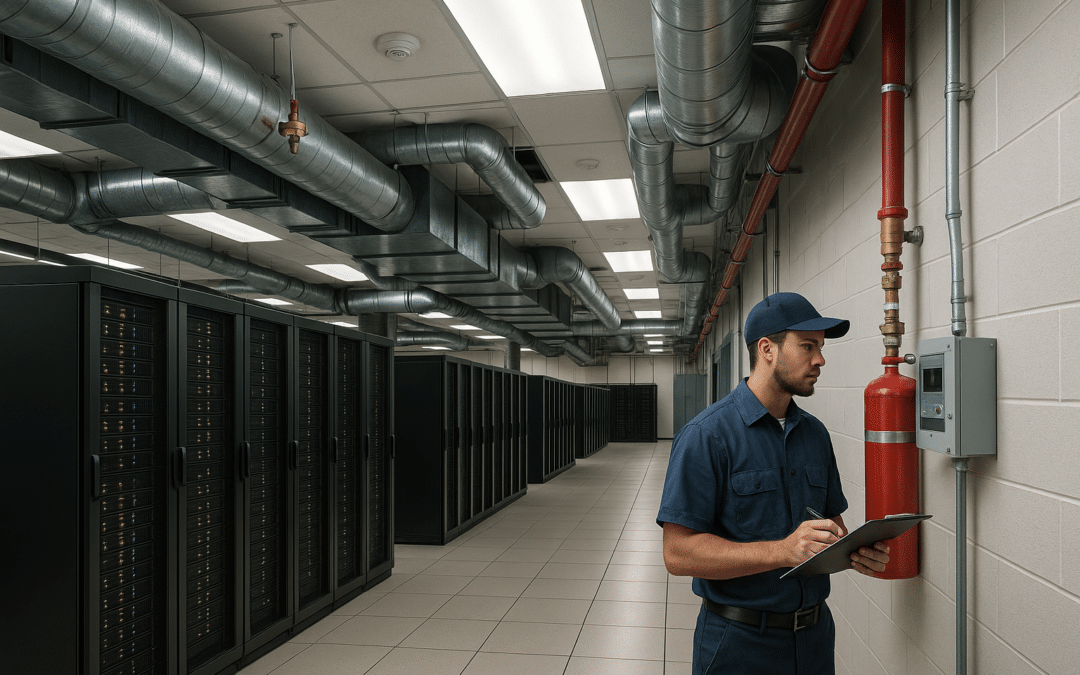
These systems work by flooding the protected space with a clean agent that removes one or more elements of the fire tetrahedron: heat, fuel, oxygen, or the chemical chain reaction. The agent is stored in pressurized cylinders and distributed through a network of piping and nozzles designed to achieve uniform concentration throughout the protected area within seconds of activation.
Modern data centers have largely moved toward clean agent suppression systems. FM-200 and Novec 1230 are among the most widely adopted solutions, as both gases work by absorbing heat energy faster than the fire can generate it. Inert gas options like IG-541 (Inergen) take a different approach: they lower oxygen levels in the room enough to stop combustion without putting people at risk, and suit large enclosed spaces where agent storage volume is less of a concern.
Key Benefits at a Glance
- No residue: Gaseous agents disperse cleanly, leaving no water or debris behind.
- Fast activation: A clean agent system in a data center or telecom switch room suppresses fire within 10 seconds (NFPA 2001 §5.4.2.1) without destroying the equipment it protects.
- Safe for electronics: These agents are non-conductive, leave no residue, and are safe for use around electronics and occupied spaces.
- Environmentally responsible: Many modern clean agents are designed to have zero ozone depletion potential and minimal global warming impact.
- Minimal downtime: Clean agent systems are one of the most common solutions for data centers because they protect equipment without water damage and allow for fast fire suppression.
The Codes That Govern Clean Agent Systems in Houston
If you operate a data center, colocation suite, enterprise server room, or network operations center in the Houston area, two NFPA standards are central to your compliance obligations.
NFPA 2001 — Clean Agent Fire Extinguishing Systems
NFPA 2001 is the national standard for the design, installation, inspection, testing, and maintenance of total-flooding clean agent fire suppression systems. Its scope covers every system that uses gaseous halocarbon or inert agents to suppress fires in enclosed spaces without leaving residue or requiring post-discharge cleanup.
NFPA 2001 becomes enforceable law when jurisdictions adopt the International Fire Code. IFC §904.10 references NFPA 2001 directly — once a state or city adopts the IFC, the authority having jurisdiction (AHJ) gains the power to inspect, cite, and penalize non-compliance. Houston-area facilities should confirm current adoption status and any local amendments with Harris County and the applicable municipal AHJ.
NFPA 75 — Fire Protection of Information Technology Equipment
NFPA 75 covers the requirements for the protection of IT equipment from fire damage. It sets fire protection requirements for facilities and parts of facilities that contain information technology equipment, applying to traditional computer rooms, data halls in hyperscale and colocation facilities, enterprise data centers, and any other space whose primary function is processing, storing, or transmitting data.
Common elements required under NFPA 75 include Very Early Warning Fire Detection (VEWFD) systems — typically air-sampling smoke detection — and clean-agent gaseous suppression per NFPA 2001 for rooms where water discharge would damage critical equipment.
Three levels of fire protection are required to protect data centers, workers, and equipment:
- Building level — sprinklers and extinguishers protecting occupants and the structure.
- Room level — clean agent suppression protecting the server hall or computer room itself.
- Rack level — targeted detection and suppression at the individual rack or row.
In many jurisdictions, data centers must have both systems. Many facilities use both sprinklers and clean agents for layered protection — sprinklers address building-level fire requirements, while clean agents specifically protect the data hall, control rooms, and other high-value or mission-critical spaces.
For Houston facilities that also carry fire alarm systems integrated with their suppression controls, understanding your NFPA 72 fire alarm testing requirements is equally important — your detection and releasing circuits must be tested together as a single integrated system.
What the Inspection Schedule Looks Like
Owning a clean agent system is not a set-it-and-forget-it proposition. NFPA 2001 Chapter 8 mandates five inspection tiers: monthly visual, semi-annual cylinder weighing, annual functional test, 5-year hydrostatic retest, and enclosure integrity testing after any room modification.
Here is what each tier involves in practice:
- Monthly visual: Required under both NFPA 2001 and NFPA 72, these checks confirm that control panels are in normal supervisory mode, that no active trouble or supervisory signals are present, that agent storage containers are properly positioned, and that no visible physical changes to protected spaces have occurred since the last inspection.
- Semi-annual: Cylinder weight and pressure verification to confirm adequate agent charge.
- Annual functional test: The annual inspection is a functional test of an engineered life-safety system — not a visual walk-through. It requires coordinating your fire protection contractor and your facilities mechanical team to verify that detection, releasing logic, HVAC interlocks, and enclosure integrity work as a single integrated system under NFPA 2001 §8.6.
- HVAC interlock verification: Annual functional testing must physically confirm HVAC interlock shutdown of every CRAC/CRAH unit — documenting only the releasing panel output signal is non-compliant.
- Enclosure integrity testing: Required after any room modification to confirm agent concentration will hold at design levels.
For facilities that rely on central station fire alarm monitoring, your monitoring provider should receive alarm and supervisory signals from the clean agent releasing panel as part of a fully integrated 24/7 response strategy.
The Real Cost of Getting It Wrong
According to the Uptime Institute, nearly 60% of data center outages cost over $100,000, and fire-related incidents are among the leading preventable causes of downtime. Downtime costs accumulate fast: according to Emerson Network Power, the average data center loses approximately $7,300 every minute due to a fire, and when it is a catastrophic event, losses could total $600,000 or more.
Recovery time after a fire incident averages 25 hours for real fires and 17 hours for false alarm fire suppression incidents. For a Houston energy company, healthcare network, financial services firm, or any organization running 24/7 operations, that kind of downtime is simply not acceptable.
Dense GPU clusters draw far more power than traditional servers, and that power turns into heat fast. High rack density leaves less room for airflow, which raises the chance of electrical faults and thermal stress. As AI workloads push Houston data centers toward higher rack densities, the fire risk profile is only increasing — making a properly engineered clean agent system more important now than ever.
Choosing and Installing a Clean Agent System in Houston: What to Look For
Not every fire protection contractor has the specialized experience that a data center clean agent project demands. Here is what facility managers and data center operators should require:
- NFPA 2001 and NFPA 75 expertise: Your contractor must design to both standards and be familiar with how Harris County AHJ interprets them locally.
- Room integrity testing: The enclosure must be tested to confirm it will hold agent concentration for the required holding period — typically 10 minutes minimum.
- VESDA / air-sampling detection integration: Due to high airflow and spacious environments in server rooms, air-sampling smoke detection (such as VESDA) is recommended to quickly identify smoke particles resulting from combustion. For smaller server rooms, basic spot detection may be used.
- Non-proprietary equipment: Avoid systems that lock you into a single vendor for refills, parts, or service. Reliable Fire Protection uses non-proprietary equipment so you always have options.
- Pre-discharge alarm sequencing: The releasing panel must demonstrate cross-zoned activation per NFPA 72 §21.3 — two detectors on separate circuits both confirming alarm before the system arms.
- Documented inspection records: Detailed records demonstrate adherence to NFPA 75 and local codes. In the event of an incident, that paper trail becomes invaluable.
Reliable Fire Protection Serves Houston Data Centers and Server Rooms
Reliable Fire Protection is a state-licensed, family-owned fire protection company based in Houston, TX. We design, install, inspect, repair, and monitor clean agent fire suppression systems for data centers, colocation facilities, enterprise server rooms, network operations centers, and mission-critical spaces across the Greater Houston area — from the Energy Corridor and Downtown to Katy, Sugar Land, Pasadena, and Cypress.
Every project is built around NFPA 2001, NFPA 75, and Harris County Fire Code compliance, with non-proprietary equipment, transparent pricing, and our 24-month satisfaction guarantee covering all parts, materials, and labor. We offer free quotes and 24/7 emergency response.
If you are building out a new data hall, expanding an existing facility, or are unsure whether your current system meets today’s inspection standards, contact Reliable Fire Protection for a free on-site assessment.
Recommended Reads
- TCEQ Backflow Preventer Testing Requirements Every Houston Property Owner Should Know
- NFPA 72 Fire Alarm Testing Requirements Explained for Houston Commercial Properties
- How Much Does a Commercial Fire Alarm System Cost in Houston?