
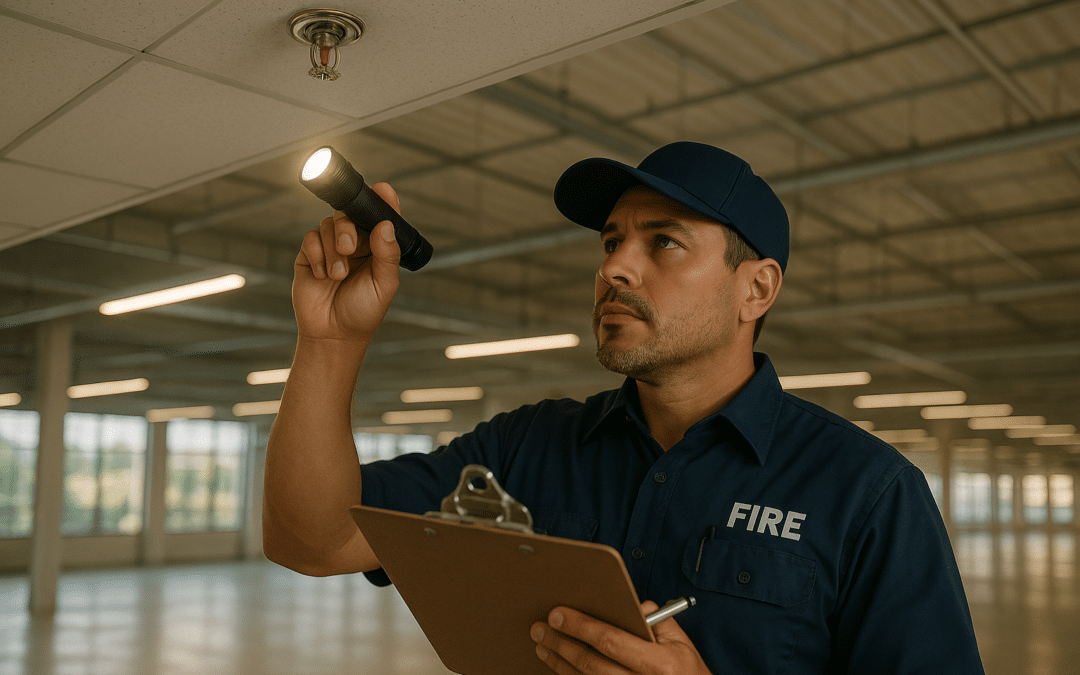
TL;DR: NFPA 25 requires fire sprinkler inspections on a tiered schedule ranging from weekly gauge checks to five-year internal pipe assessments — and an annual visit alone does not meet the standard. In Houston, commercial property owners bear full legal responsibility for compliance, and skipping any interval can trigger fire code violations, insurance claim denials, and personal liability. This guide breaks down every required interval, what each covers, and what Houston facility managers need to know.
If you manage a commercial building in Greater Houston, you have almost certainly seen the phrase NFPA 25 on an inspection report or a fire marshal notice. What it means in practice — and what it actually requires of you — is often less clear.
This guide covers every inspection interval the standard mandates, how Houston and Texas enforce those requirements, what happens when you miss one, and what to look for in a qualified contractor.
What Is NFPA 25?
NFPA 25 — the Standard for the Inspection, Testing, and Maintenance of Water-Based Fire Protection Systems — is published by the National Fire Protection Association and establishes the minimum requirements for maintaining the reliability of fire sprinkler systems and other water-based fire protection equipment. Its core objective is to detect system issues before a fire starts, so that sprinklers function when lives are at risk.
The standard applies to a wide range of systems, including wet pipe, dry pipe, pre-action, deluge, fire pumps, standpipes, and water storage tanks. It was first issued in 1992 and has since become the industry benchmark for inspection and maintenance practices.
NFPA 25 is updated on a three-year cycle. Always confirm with your local fire marshal which edition your Authority Having Jurisdiction (AHJ) has adopted, as the enforced edition may differ from the most recently published one.
Is NFPA 25 Legally Required in Houston?
Yes. Houston follows the International Fire Code (IFC) as its primary standard, with local amendments, and references NFPA standards — including NFPA 25 for sprinklers — to govern specific systems. Every commercial property in Texas is required to follow fire sprinkler system inspection requirements as outlined by NFPA 25.
At the state level, Texas Administrative Code Title 28, Chapter 36 adopts NFPA 25 for commercial sprinkler systems and requires that inspection, testing, and maintenance be performed by a licensed sprinkler contractor. The Houston Fire Marshal’s Office has the authority to issue notices of violation, conduct site visits, and demand corrective actions.
One critical point many owners overlook: NFPA 25 places ultimate responsibility on the property owner — not the contractor, not the inspector. If you hire a contractor and the system fails, you are still accountable for whether it was properly maintained.
Also notable: unlike most NFPA installation standards, NFPA 25 contains no grandfathering clause. Even older fire protection systems must comply with current NFPA 25 requirements — systems are not exempt simply because they were installed under an earlier edition.
The Full NFPA 25 Inspection Schedule
This is where most property managers are caught off guard. Annual sprinkler inspection alone does not satisfy NFPA 25. The standard requires inspections, testing, and maintenance across multiple tiers, each covering different components at different intervals.
Weekly
Weekly inspections target the highest-risk components — specifically control valves and gauges for pre-action, deluge, and dry sprinkler systems. A shut-off valve is the single most common reason a sprinkler system fails to operate, making routine valve checks the highest-value inspection item on the entire schedule. These visual checks can generally be performed by trained facility staff.
Monthly
Monthly requirements focus on gauges and alarm valves of wet pipe sprinkler systems. Wet-pipe buildings — the most common type in Houston commercial properties — should be confirming gauge readings and looking for visible alarm valve problems every 30 days.
Quarterly
Quarterly inspections cover the components most likely to be physically compromised between annual visits. Per NFPA 25, these include:
- Water flow alarm devices
- Valve alarm devices and supervisory signals
- Control valves
- Hydraulic nameplates
- Fire department connections (FDC)
Quarterly testing also includes main drain and mechanical alarm device testing. These tasks generally require a licensed fire protection contractor.
Semi-Annual
Semi-annual requirements include testing of vane- and pressure-switch-type waterflow devices. Dry-pipe and pre-action systems add semi-annual inspections of accelerators, air-maintenance devices, and low-point drain condition.
Annual
The annual inspection is the most comprehensive tier. It should cover:
- All sprinkler heads (visual inspection for leaks, corrosion, physical damage, loading, and unauthorized paint)
- Pipework, fittings, and hangers/seismic bracing
- Main drain flow test to assess water supply performance
- Control valve operation and exercise
- Backflow prevention assemblies
- Spare sprinkler supply (minimum two sprinklers of each type and temperature rating, plus a sprinkler wrench)
- Information signage
- Anti-freeze solution concentration (where applicable)
Annual inspections and testing verify that the system will actually perform under demand conditions — something a visual check alone can never confirm. Because of their complexity and Texas state law requirements, annual inspections must be performed by a licensed sprinkler contractor.
Every 5 Years
The five-year inspection addresses the structural integrity of the piping system itself. It requires an internal inspection of sprinkler pipes to check for obstructions, corrosion, and blockages that cannot be detected from the outside. Sprinkler system gauges must also be tested or replaced at this interval.
Long-Cycle Sprinkler Head Testing (10–50 Years)
Sprinkler heads themselves have long-cycle testing requirements that depend on head type and age:
- Standard sprinklers in service 50 years: sample testing or replacement required, then every 10 years
- Fast-response sprinklers: sample testing begins at 25 years (per the 2023 edition, raised from 20)
- Dry sprinklers: initial testing at 20 years (per the 2023 edition, raised from 15), then every 10 years
- Corrosion-resistant sprinklers in harsh environments: initial testing at 10 years, then every 5 years
- High-temperature or harsh-environment sprinklers: tested every 5 years
Houston’s petrochemical and industrial facilities in areas like the Energy Corridor and Pasadena should pay particular attention to the harsh-environment thresholds — corrosive atmospheres accelerate head degradation.
System-Type Differences That Matter in Houston
Not all sprinkler systems carry the same inspection burden. Here is a quick comparison:
- Wet-pipe systems: The most common type. Need quarterly valve inspections and an annual main-drain test and full control-valve exercise.
- Dry-pipe and pre-action systems: Add semi-annual accelerator and air-maintenance inspections. Dry-pipe valves require an annual partial trip test plus a full-flow trip test every three years — not an annual full trip, which is a common misconception.
- Deluge systems: Require annual operational testing of the deluge valve and deluge nozzle coverage.
- Anti-freeze systems: The 2023 edition added a requirement for annual concentration testing.
What Happens If You Miss an Inspection Interval?
Non-compliance with NFPA 25 carries real financial and legal consequences — not just a warning letter.
Fire Code Violations and Fines
Failure to maintain documented NFPA 25 compliance is the leading reason Texas AHJs issue compliance orders against commercial building owners. Consequences can include fines, violation notices, and potential loss of occupancy permits — which can completely disrupt business operations.
Mandatory Fire Watch
If inspections reveal the system is non-functional, fire departments commonly require a 24/7 fire watch — hiring personnel to patrol the building at the property owner’s expense — until the system is restored to compliance.
Insurance Claim Denials
This is the consequence that surprises owners most. In one documented case, an insurer discovered the owner had skipped required NFPA 25 inspections after a fire — and denied approximately $350,000 of the fire damage claim, citing the owner’s non-compliance with NFPA 25 and local codes. A judge upheld the decision. Some insurance carriers may also cancel coverage or raise premiums if they learn a sprinkler system is not being properly maintained.
Personal Liability
In the worst-case scenario — a fire in a non-compliant building — the property owner can face personal liability for injuries or fatalities resulting from a non-functional fire protection system.
Documentation: What You Must Keep on File
NFPA 25 requires written records for every inspection, test, and maintenance activity performed. Missing records can complicate insurance claim investigations and make it harder to demonstrate that required work was completed. Retention timelines run on a rolling schedule tied to each inspection’s frequency.
A proper inspection report should include NFPA 25 section references, deficiency classifications (critical, non-critical, or observation), corrective action documentation, and waterflow alarm test verification with activation time. Always keep your own copies — do not rely solely on your contractor’s file.
Who Can Perform NFPA 25 Inspections in Texas?
Texas law requires that annual inspections and tests be performed by a licensed fire sprinkler contractor. Weekly and monthly visual checks can generally be performed by qualified, trained facility staff. Quarterly, semi-annual, annual, and five-year work — which involves taking systems temporarily out of service or flowing water through them — requires a licensed professional.
When vetting a contractor, ask about NICET certification in Inspection and Testing of Water-Based Systems (the industry benchmark), their state license status, and how deficiencies are communicated and tracked. Ask what documentation you will receive and in what format — inspection reports that satisfy an AHJ and an insurance carrier require specific detail.
The most common compliance failure is not a bad inspection — it is a forgotten interval. Look for a provider who actively manages your compliance calendar, not just one who shows up when called.
How Reliable Fire Protection Keeps Houston Properties Compliant
At Reliable Fire Protection, we design, install, inspect, repair, and monitor fire sprinkler systems for commercial, industrial, institutional, and multi-family properties across Greater Houston — from Downtown and Midtown to the Energy Corridor, Katy, Sugar Land, Cypress, Tomball, Pasadena, and 24 more neighborhoods and suburbs.
We perform the full NFPA 25 inspection, testing, and maintenance schedule — weekly through five-year — for wet-pipe, dry-pipe, pre-action, and deluge systems. Every inspection produces a documented deficiency report with NFPA 25 section references and severity classification so you know exactly where you stand with your AHJ.
We use non-proprietary equipment, provide transparent pricing, offer same-day service and 24/7 emergency response, and back all parts, materials, and labor with a 24-month satisfaction guarantee. Free quotes, no pressure.
Because sprinkler systems do not work in isolation, we also handle the interconnected systems your building depends on. If you want to understand how fire alarm testing requirements fit alongside your sprinkler obligations, see our guide to NFPA 72 fire alarm testing requirements for Houston commercial properties. And if your sprinkler system is tied to a backflow preventer — as most are — our guide on TCEQ backflow preventer testing requirements explains what Texas law requires on that front.
Ready to confirm where your property stands? Contact Reliable Fire Protection at 3522 Bolin Rd, Houston, TX for a free inspection assessment. We will review your current records, identify any missed intervals, and build a compliance calendar your AHJ and insurer will accept.
Recommended Reads
- NFPA 72 Fire Alarm Testing Requirements Explained for Houston Commercial Properties
- TCEQ Backflow Preventer Testing Requirements Every Houston Property Owner Should Know
- How to Get Your Backflow Preventer Certified in Texas (Step-by-Step)