TL;DR: Wet pipe systems deliver water instantly and cost less to install, making them the right choice for most heated Houston commercial spaces. Dry pipe systems keep pressurized air in the pipes instead of water, making them essential for unheated warehouses, parking structures, and cold-storage areas. Your building’s temperature profile, occupancy type, and budget determine which system—or combination—belongs in your facility.
If you manage a commercial building in Greater Houston, choosing between a wet pipe and a dry pipe fire sprinkler system is one of the most consequential fire protection decisions you will make. Get it wrong and you risk NFPA 13 non-compliance, pipe freeze failures, or a slower response time when a fire breaks out.
This guide breaks down exactly how each system works, where each belongs, what each costs, and what Houston-specific conditions should drive your decision.
How a Wet Pipe Sprinkler System Works
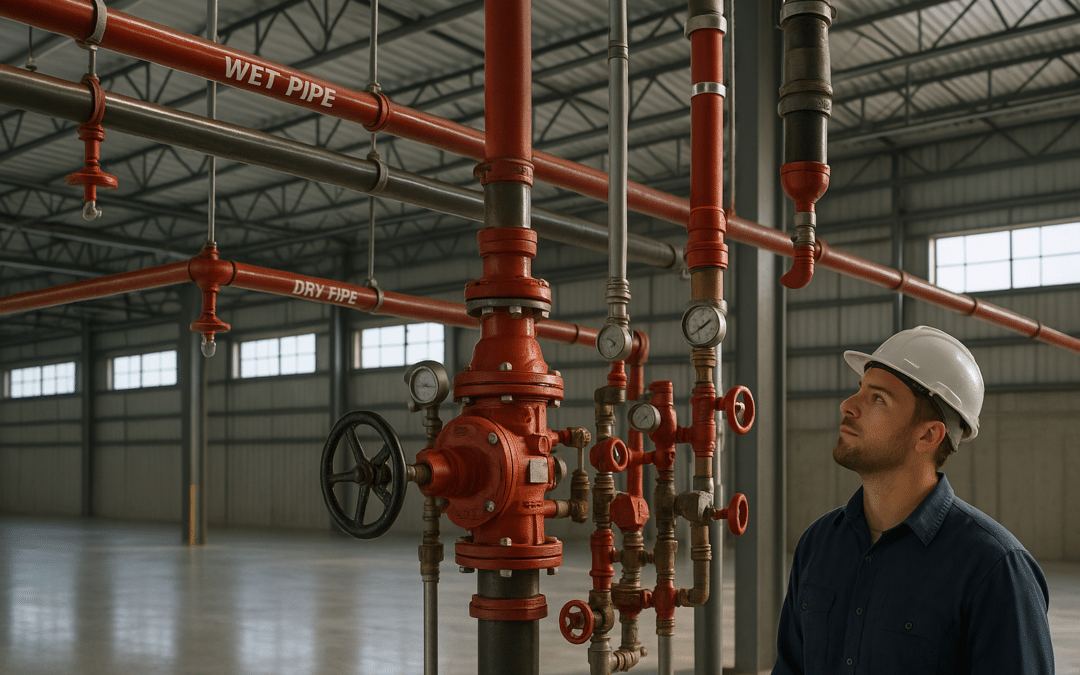
A wet pipe sprinkler system is the simplest type. The pipes are filled with water, and when heat from a fire activates the sprinklers, water is released immediately.
There are no valves to trip, no air to exhaust, and no compressors to maintain. Wet pipe systems maintain constant water pressure in pipes and respond within 10–20 seconds, making them ideal for temperature-stable environments.
Wet pipe systems are the most common and traditional type of fire sprinkler system. The materials used include carbon steel and chlorinated polyvinyl chloride (CPVC).
Where Wet Pipe Systems Are Used
Wet systems are ideal for heated spaces such as offices, schools, hospitals, and retail stores where freezing temperatures are not a concern.
The key limitation: NFPA 13 generally requires wet pipe sprinkler systems to be installed in areas where ambient temperatures can be reliably maintained at or above 40°F (4°C). If temperatures fall below this level, water inside the piping may freeze, potentially blocking water flow or causing pipe damage.
How a Dry Pipe Sprinkler System Works
Unlike wet systems, dry systems use pressurized air or nitrogen in the pipes. When a sprinkler is activated, the air is released, allowing water to flow into the pipes and out through the sprinkler to combat the fire.
A compressor is essential for a dry pipe sprinkler system, as it supplies the pressurized air needed to keep the dry valve closed until a fire triggers the sprinkler heads. According to NFPA 13 standards, this pressurized air must be continuously maintained by a dedicated compressor equipped with an air maintenance device (AMD).
The critical trade-off is timing. Dry systems delay 30 to 60 seconds while air exhausts before water reaches the open sprinkler head. NFPA 13 requires water to reach the most remote sprinkler within 60 seconds, and system size is limited to ensure this timing requirement.
Quick-opening devices can help. These devices sense rapid air pressure drop and mechanically speed dry pipe valve operation. Accelerators or exhausters can reduce water delivery time from 60 seconds to 30 or 40 seconds.
Where Dry Pipe Systems Are Used
The use of pressurized air prevents water from being in the pipes until needed, thus avoiding the risk of freezing. Dry systems are used in unheated buildings or sections of buildings, such as warehouses, loading docks, and attics.
Per the National Fire Sprinkler Association (NFSA), sprinklered areas that cannot be maintained at 40°F or above are usually protected with a dry pipe or antifreeze system.
Why This Matters Specifically in Houston
Houston’s climate is mostly mild, but it is not freeze-proof—and the consequences for unprepared buildings can be severe.
On February 13, 2021, a Winter Storm Warning went into effect for Houston. Throughout central Texas, including Austin and Waco, six to nine consecutive days of freezing temperatures broke records for the longest freezing streak in the state’s recorded history.
Sprinkler systems took the brunt of the damage from the most recent Houston freeze events, according to local experts, with other exposed outdoor fixtures such as main shut-off valves, ball valves, and hose bibs among the most impacted.
This is directly relevant to system selection. Most of Houston’s commercial interior spaces—office towers, retail centers, hotels, restaurants, hospitals—can reliably maintain temperatures above 40°F and are excellent candidates for wet pipe systems. But the following spaces commonly found throughout Greater Houston almost always require dry pipe:
- Unheated parking garages (Downtown, Midtown, Medical Center)
- Industrial warehouses and distribution centers (Energy Corridor, Pasadena, Deer Park)
- Loading docks and covered exterior walkways
- Cold-storage and refrigerated facilities
- Unheated attic spaces in multi-family and institutional buildings
- Covered outdoor entertainment or event venues
The Texas State Fire Marshal’s Office reinforces NFPA 13’s temperature requirements in its guidance to licensees: the exterior ambient exposure temperature selected must consider the historical low temperature for the area where the sprinkler system is being installed. Interior temperature must be maintained at or above the selected exposure temperature, but never less than 40°F.
Wet Pipe vs. Dry Pipe: Side-by-Side Comparison
| Factor | Wet Pipe | Dry Pipe |
|---|---|---|
| Pipe contents | Pressurized water at all times | Pressurized air or nitrogen |
| Response time | Immediate (10–20 sec) | Delayed (30–60 sec) |
| Install cost (new construction) | $1.50–$3.50/sq ft | $2.50–$4.50/sq ft |
| Freeze protection | Requires temp ≥ 40°F | Safe in freezing areas |
| Maintenance complexity | Low | Higher (compressor, drains, air dryers) |
| Corrosion risk | Lower (oxygen-depleted water) | Higher (moisture condensation in air) |
| Best for | Offices, schools, retail, hotels, healthcare | Warehouses, loading docks, cold storage, parking garages |
Cost Differences: What to Budget
Wet pipe systems are almost always the more affordable choice upfront. Wet pipe systems cost $1.50–$3.50 per square foot, while dry pipe costs $2.50–$4.50 per square foot.
Looking at the premium another way: dry pipe systems cost 20–40% more due to the need for air compressors and specialized dry pipe valves.
Ongoing maintenance costs are also higher for dry systems. Budget 1–3% of the original installation cost per year for inspection, testing, and upkeep across both system types—but dry pipe systems require additional attention to compressors, auxiliary drains, and corrosion checks that wet systems do not.
For NFPA 25 inspection and testing requirements that apply to both system types, see our complete guide to NFPA 25 fire sprinkler inspection requirements for Houston properties.
The Corrosion Problem in Dry Pipe Systems
One often-overlooked drawback of dry pipe systems is internal pipe corrosion. In actual application, water collection is a problem in dry pipe systems. There are two primary sources: condensation from moist air that collects at system low points, and water that gets trapped in the system during flow testing.
If there is a pool of stagnant water surrounded by air, the effective corrosion rates can be very high. Through-wall pitting is a common failure mode in dry pipe systems.
To manage this, air-maintenance devices maintain adequate pressure in the sprinkler piping by adding air when a small pressure loss is detected, and air dryers remove the moisture inside the sprinkler piping that can lead to corrosion.
The purpose of auxiliary drains is to provide a means for removing water from the system after testing or collected through condensation. NFPA 25 section 13.4.5.3.2 requires these drains to be exercised after dry pipe or preaction valve operation, both inadvertent and intentionally through testing, before the onset of freezing conditions and as needed thereafter.
Can You Have Both in the Same Building?
Yes—and this is very common in Houston commercial and industrial properties. A mixed system is the practical answer when a building has both conditioned and unconditioned spaces.
For example, a Katy distribution center might use a wet pipe system throughout its climate-controlled office wing and switch to dry pipe for the unheated warehouse floor and loading dock. A Midtown hotel might run wet pipe throughout guest rooms and corridors, with dry pipe protecting an unheated parking deck on the same property.
Your licensed fire protection contractor and the local Authority Having Jurisdiction (AHJ)—whether that is Houston Fire Department, Harris County, or a suburban municipality—will review your plans and confirm which system is required zone by zone.
What About Pre-Action Systems?
Pre-action systems are a hybrid option worth knowing about. Data centers, museums, and clean rooms use pre-action systems instead of dry pipe. Pre-action costs even more than dry pipe but eliminates accidental discharge risk while minimizing response delay.
If your Houston facility houses sensitive electronics, irreplaceable records, or high-value equipment, ask your fire protection contractor whether pre-action is worth the added investment over a standard dry pipe system.
NFPA 13 Compliance: The Non-Negotiable Standard
Both wet and dry pipe systems installed in Houston commercial properties must comply with NFPA 13, Standard for the Installation of Sprinkler Systems. While NFPA 13 outlines various types—such as wet, dry, preaction, and deluge—wet and dry systems are the two most commonly used.
NFPA research shows sprinklers reduce civilian fire death rates by 90% and confine fire to the room of origin 94% of the time, compared to just 70% without sprinklers. The system only delivers those outcomes if it is properly designed, installed, and maintained to code.
Once your system is in service, ongoing inspection and testing under NFPA 25 is required. This includes quarterly, annual, and five-year inspections of valves, gauges, sprinkler heads, and—for dry systems—compressors and auxiliary drains. Our NFPA 25 inspection guide for Houston covers every required interval in detail.
How to Choose the Right System for Your Houston Property
Follow this decision framework:
- Map your temperature zones. Identify every space in your building that could drop below 40°F—even seasonally. Those spaces need dry pipe or an equivalent freeze-protection solution under NFPA 13.
- Identify your occupancy type. Under NFPA 13, spaces are rated as light hazard (offices, schools), ordinary hazard (retail, manufacturing), or extra hazard (chemical storage, paint booths). Your hazard class affects system design and density requirements.
- Consider water sensitivity. If accidental discharge would destroy inventory or equipment, discuss pre-action or dry pipe with your contractor—even in heated spaces.
- Get AHJ sign-off early. Submit plans to your local Houston-area AHJ before installation begins. Requirements can vary between Houston Fire Department, Harris County, and suburban fire marshals in Katy, Sugar Land, Tomball, and Cypress.
- Factor in total cost of ownership. A dry pipe system’s higher installation, maintenance, and inspection costs are justified when freeze protection is genuinely needed—but should never be installed just as a default.
Reliable Fire Protection designs and installs both wet pipe and dry pipe systems across Greater Houston—from Downtown high-rises to Pasadena industrial plants. We use non-proprietary equipment, provide free quotes, and back every installation with a 24-month satisfaction guarantee on all parts, materials, and labor. Call us or request a free site assessment to determine which system is right for your property.
Recommended Reads
- NFPA 25 Fire Sprinkler Inspection Requirements: A Complete Guide for Houston Properties
- TCEQ Backflow Preventer Testing Requirements Every Houston Property Owner Should Know
- How to Get Your Backflow Preventer Certified in Texas (Step-by-Step)