TL;DR: Oxygen trapped inside fire sprinkler pipes is the primary driver of internal corrosion, causing pinhole leaks and premature pipe failure — a particular risk in Houston’s high-humidity environment. Nitrogen inerting replaces that oxygen with inert nitrogen gas, dramatically slowing corrosion in both dry-pipe and wet-pipe systems. NFPA 13 (2022 edition) now formally recognizes nitrogen generators as a corrosion-control method, making this the right time for Houston facility managers to evaluate whether their systems qualify.
Fire sprinkler systems are built to protect your building. But left unchecked, they quietly destroy themselves from the inside out — one corroded pinhole at a time.
If you manage a commercial, industrial, or multi-family property in Greater Houston, internal pipe corrosion is not a distant risk. Houston’s subtropical heat and humidity accelerate the very conditions that corrode sprinkler piping. Nitrogen inerting is the most effective engineering solution available today — and it is now formally recognized in national fire codes.
This guide explains what nitrogen inerting is, how it works, what NFPA says about it, and how to decide whether your Houston property needs it.
What Is Sprinkler Pipe Corrosion — and Why Does It Happen?
Steel sprinkler pipe corrodes when metal, water, and oxygen occupy the same space. Potter Electric Signal, a leading fire protection equipment manufacturer, notes that fire sprinkler systems are the perfect environment for corrosion precisely because they contain all three ingredients simultaneously.
There are two main corrosion types:
- Oxygen (generalized) corrosion: Oxygen-related corrosion is by far the most prevalent, accounting for up to 90% of all corrosion failures. It is a straightforward electrochemical reaction — oxygen dissolves into trapped water at the air-water interface and reacts with the iron pipe wall.
- Microbiologically Influenced Corrosion (MIC): Bacteria colonize pipe walls and accelerate metal loss. Studies cited in the Automatic Sprinkler Systems Handbook estimate that MIC is present in 40–60% of sprinkler system leaks. However, field analysis by corrosion specialists shows that the vast majority of corrosion-related leaks are caused by oxygen, while bacteria in fire sprinkler systems result in less than 5% of the leaks that occur.
The practical takeaway: remove the oxygen and you eliminate the dominant cause of pipe failure.
Why Houston Properties Face Elevated Risk
Houston’s climate makes a bad situation worse. The city’s high humidity and occasional heavy rains can accelerate corrosion within piping and valves if not properly maintained — and diverse building types ranging from older commercial warehouses to modern high-rise offices require tailored fire protection strategies.
Houston’s warm, humid climate accelerates corrosion and wear on piping, valves, and sprinkler heads. Coastal proximity exposes some properties to salt air, increasing the risk of equipment degradation. These environmental factors mean fire sprinkler systems in Houston face accelerated aging compared to drier regions.
In dry-pipe and pre-action systems — common in parking garages, cold storage, unheated warehouses, and large industrial plants across the Energy Corridor, Pasadena, and Katy — an air compressor continuously replenishes the supervisory air inside pipes. The air compressor provides what is essentially an unlimited supply of oxygen gas (21% of the air); oxygen gas quickly dissolves into the water at the air/water interface, and the oxygen-water mixture reacts with the iron or zinc at the pipe wall adjacent to the air/water interface — this reaction takes place in minutes.
What Is Nitrogen Inerting?
Nitrogen inerting is the process of replacing the oxygen-containing air inside sprinkler piping with high-purity nitrogen gas — typically 98% concentration or higher. Nitrogen gas is an inert diatomic molecule used in a wide variety of applications because of its availability and unique properties — one key attribute is its general inability to react with metals, meaning it does not drive the electrochemical corrosion process.
There are two primary applications:
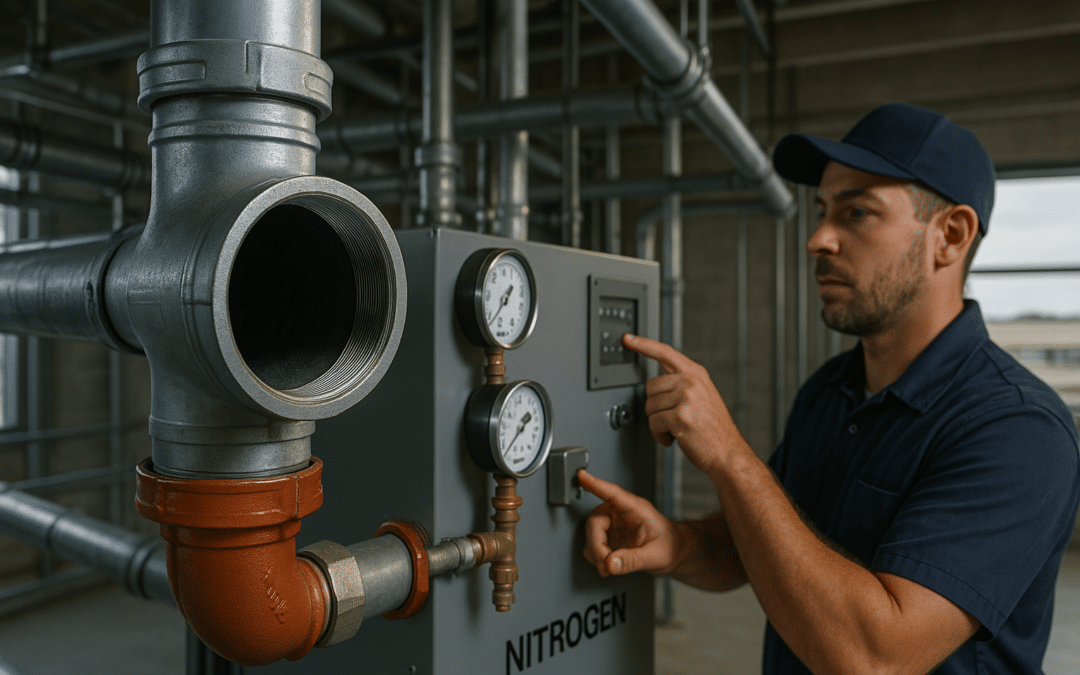
- Dry Pipe Nitrogen Inerting (DPNI): Used in dry-pipe and pre-action systems. The goal of DPNI is to first purge the oxygen-rich air from the piping and second to eliminate the future introduction of oxygen gas into the system piping. A nitrogen generator or cylinder supply replaces the traditional air compressor as the supervisory gas source.
- Wet Pipe Nitrogen Inerting (WPNI): Used in wet-pipe systems where water fills the pipes. WPNI actively displaces the oxygen-rich air trapped in sprinkler piping with high-purity nitrogen gas. Because corrosion begins primarily at the water/air interface in a wet pipe fire sprinkler system and little oxygen is present in the high nitrogen environment, corrosion formation is inhibited.
To understand which system type is most common in your building and why it matters for corrosion risk, see our guide on wet pipe vs. dry pipe fire sprinkler systems for Houston properties.
How the Process Works — Step by Step
- Purge: High-purity nitrogen is introduced into the pipe network under pressure, pushing oxygen-laden air out through vents. By choosing a nitrogen source of concentration between 98% and 99.9% and filling and purging the piping network at approximately 50 PSIG for four cycles, a concentration of nitrogen between 97.8% and 99.7% can be theoretically achieved.
- Inerting: Once the oxygen level drops below corrosive thresholds, the system is considered inerted. In wet-pipe systems, a purpose-built vent device is installed at a high point. Installed at a high point in the system, the vent allows efficient venting of both oxygen and moisture, completing the conversion from an oxygen-filled to a nitrogen-inerted environment.
- Maintenance: A permanently installed nitrogen generator or cylinder supply replenishes any nitrogen that escapes through normal system leakage, maintaining the inert atmosphere continuously.
- Verification: Gas sampling confirms that oxygen concentration remains below the corrosive threshold. The nitrogen must be from a listed and permanently installed nitrogen generator capable of providing 98% nitrogen concentration throughout a system at a minimum leakage rate of 1.5 pounds per square inch per hour, with a visual means of verifying the actual nitrogen concentration — per NFPA 13 (2022) requirements for systems seeking the hydraulic C-factor benefit.
The Proven Benefits
Dramatically Slower Corrosion Rate
FM Global states in Data Sheet 2-1 that fire sprinkler piping containing air corrodes 14–20 times faster than piping with nitrogen. That is a remarkable difference in long-term pipe life — and translates directly to fewer emergency repairs and pipe replacements.
Better Hydraulic Performance
Beyond corrosion control, nitrogen provides measurable hydraulic advantages. As corrosion is minimized, pipe interiors remain smoother, preserving a Hazen-Williams C-factor that is 30% higher than without nitrogen — as recognized by both NFPA 13 and FM. A higher C-factor means better water flow when a sprinkler activates — the moment it matters most.
Extended System Life and Lower Lifecycle Costs
Traditional mitigation methods like galvanized piping or frequent pipe replacements have proven only partially effective and often expensive in the long run. Nitrogen-based corrosion prevention solutions are shifting the paradigm: by displacing the oxygen that fuels rust, high-purity nitrogen gas can dramatically slow down or even stop the corrosion process inside sprinkler pipes — resulting in a longer-lasting system with fewer leaks and lower lifetime costs.
Cold Storage and Freezer Applications
Cold storage facilities face a unique threat of ice formation inside the sprinkler piping. Moisture entering the system can condense and freeze — nitrogen inerting eliminates oxygen and significantly reduces moisture, preventing internal freezing, especially at freezer entry points where temperature transitions are severe. Houston’s many cold-chain logistics and food-processing facilities in areas like Westchase and Pasadena stand to benefit significantly.
What NFPA Standards Say About Nitrogen Inerting
Nitrogen inerting is no longer a fringe practice. It has been formally incorporated into the primary national installation standard.
Significant changes to the 2022 edition of NFPA 13, Standard for the Installation of Sprinkler Systems, include new supplementary requirements for nitrogen generators. These provisions, explained by Consulting-Specifying Engineer, outline exactly how nitrogen must be supplied and verified for systems seeking enhanced hydraulic credit:
- NFPA 13 Chapter 8.2.6.9, in conjunction with Table 28.2.4.8.1, now allows the Hazen-Williams C-factor to be increased to 120 for dry systems using nitrogen with either black or galvanized steel piping.
- Traditional compressed air injects a mix of moisture with warm compressed air and fosters an environment that allows for corrosion — this addition to the standard provides a reasonable step forward in the nitrogen approach that is rapidly becoming more mainstream for the installation of dry pipe sprinkler systems.
NFPA 25, the inspection and maintenance standard, also factors in. As FM Global and NFPA standards evolve to support nitrogen inerting, failing to keep up can result in more than just system inefficiencies — it can mean regulatory penalties, insurance headaches, and increased liability. Routine NFPA 25 compliance inspections are the right time to evaluate whether corrosion remediation is needed. For a detailed breakdown of those requirements, see our NFPA 25 fire sprinkler inspection guide for Houston properties.
Is Nitrogen Inerting Right for Your Houston Property?
Best Candidates
- Dry-pipe and pre-action systems — highest oxygen exposure due to constant air compressor operation; the single best use case for DPNI
- Buildings with a history of pinhole leaks or discolored water at drain points
- Cold storage and refrigerated warehouses — eliminates both corrosion and ice-plug risk
- Industrial and petrochemical facilities in Pasadena, La Porte, and the Energy Corridor — high-value assets where water damage from a failed pipe is catastrophic
- Multi-family high-rises and hotels — large pipe networks with difficult access for emergency repairs
- Healthcare and assisted living facilities — system downtime during repairs creates compliance and safety risk
- Systems older than 10–15 years that have never had a corrosion assessment
Considerations and Limitations
- Upfront cost: Installing a listed nitrogen generator or cylinder supply requires capital investment. However, the cost is generally offset over time by reduced pipe replacement, fewer emergency service calls, and extended system life.
- Nitrogen does not reverse existing damage: If severe pitting or through-wall leaks are already present, pipe sections must be replaced before inerting is effective. A corrosion assessment should precede any inerting project.
- MIC is not fully addressed: The goal of DPNI is to purge oxygen-rich air and eliminate future oxygen introduction — the goal is NOT to prevent all forms of corrosion. Bacterial (MIC) corrosion requires separate treatment if confirmed.
- Ongoing maintenance required: The nitrogen supply system must be inspected and maintained. Leak rates must be monitored to ensure the supervisory gas concentration stays at or above 98%.
Nitrogen Inerting vs. Other Corrosion Control Methods
| Method | Addresses Oxygen Corrosion? | Ongoing Cost | NFPA Recognized? |
|---|---|---|---|
| Nitrogen inerting (DPNI/WPNI) | Yes — directly eliminates O₂ | Low (generator) / moderate (cylinders) | Yes — NFPA 13 (2022) |
| Galvanized pipe | Partially — zinc coating depletes | None ongoing; high replacement cost | Yes |
| Chemical inhibitors | Partially | Recurring treatment cost | Yes — must be listed |
| Pipe replacement | No — addresses damage, not cause | High and recurring | N/A |
| Air venting | Minimal — reduces, does not eliminate | Low | Yes |
What to Expect from a Nitrogen Inerting Assessment in Houston
A qualified fire protection contractor should walk through the following steps before recommending or installing a nitrogen inerting system:
- System type review — confirm whether you have a wet-pipe, dry-pipe, or pre-action system, and document the pipe material (black steel vs. galvanized)
- Corrosion inspection — internal video scoping or pipe sampling at key low points to evaluate existing corrosion severity
- Water quality analysis — Houston municipal water can carry dissolved oxygen levels that influence corrosion rate; some supplies may accelerate the process
- Nitrogen supply selection — permanently installed on-site generator vs. cylinder supply, based on system volume and leak rate
- AHJ coordination — the Houston Fire Department and Harris County Fire Marshal’s Office may require submittal of nitrogen generator specifications as part of system modification permits
- Ongoing monitoring plan — establish gas sampling schedules and pressure-trend logging to verify continued nitrogen concentration above 98%
At Reliable Fire Protection, we serve commercial, industrial, institutional, and multi-family properties across Greater Houston — from Downtown and Midtown to Sugar Land, Katy, Cypress, Tomball, and Pasadena. Our licensed technicians perform corrosion assessments, recommend appropriately sized nitrogen solutions, handle AHJ permitting, and provide 24/7 emergency response if a corroded pipe fails before mitigation is in place. All parts, materials, and labor come backed by our 24-month satisfaction guarantee.
Ready to find out if nitrogen inerting is right for your system? Contact Reliable Fire Protection for a free, no-obligation consultation.
Recommended Reads
- NFPA 25 Fire Sprinkler Inspection Requirements: A Complete Guide for Houston Properties
- Wet Pipe vs. Dry Pipe Fire Sprinkler Systems: Which Is Right for Your Houston Property?
- TCEQ Backflow Preventer Testing Requirements Every Houston Property Owner Should Know