TL;DR: Most commercial fire alarm control panels have a useful lifespan of 10–15 years. If your Houston business is seeing chronic false alarms, recurring trouble signals, discontinued parts, failed inspections, or a building renovation that changes occupancy, it’s time for a professional panel assessment — not another band-aid repair.
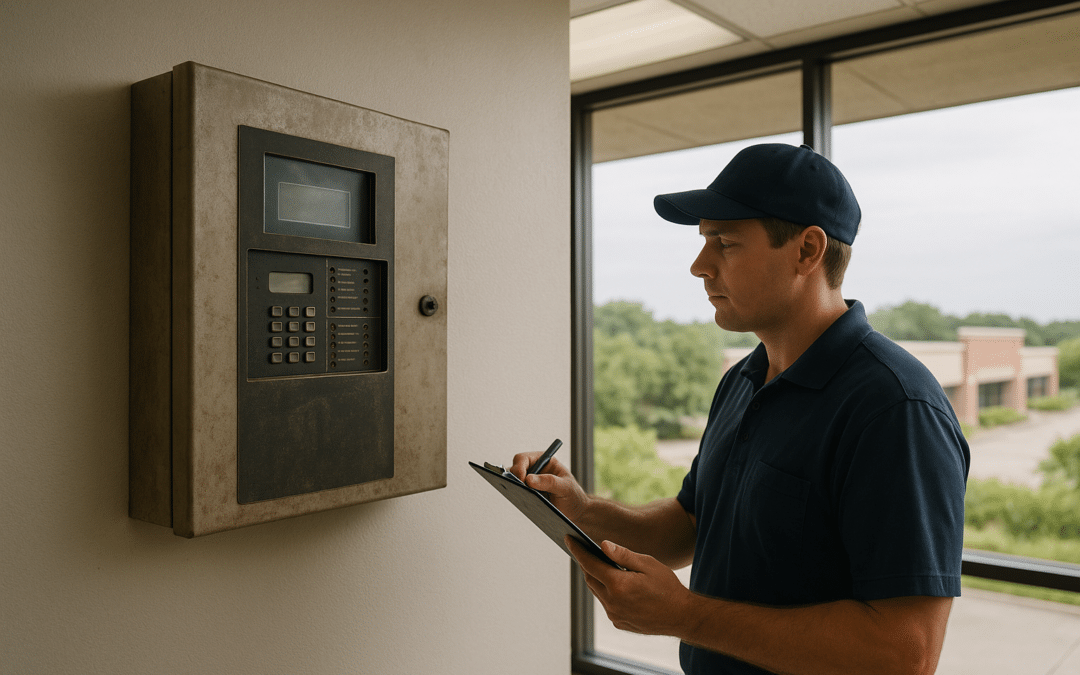
Your fire alarm control panel (FACP) is the brain of your building’s entire life-safety system. When it starts to fail, everything downstream — detectors, notification devices, central station monitoring, even your compliance record — fails with it.
The problem is that panel degradation rarely looks dramatic. It shows up as a nuisance alarm here, a trouble signal there, a part your technician can’t source anymore. By the time it’s obvious, you may already be facing an AHJ violation, an insurance headache, or a system that simply won’t perform in a real fire.
Here are five concrete signs that your Houston commercial property needs a fire alarm panel replacement — not just another service call.
1. Chronic False Alarms That Won’t Stop
An occasional false alarm can happen. A pattern of them is a red flag that your panel — or the aging sensors it’s reading — has lost reliability.
NFPA data cited by industry researchers shows that false fire alarms cost the U.S. fire service over $1.8 billion annually in unnecessary responses. For Houston building owners, that cost trickles down fast. Many jurisdictions now impose fines starting at the third or fourth false alarm per year — $200 to $2,000+ per incident.
For building owners, false alarms mean disrupted operations, evacuated tenants, fines, and eventually a fire department that deprioritizes responses to their address. That last consequence is especially serious: if your building develops a reputation for nuisance activations, emergency response times can suffer when a real fire occurs.
Older panels are a primary driver. Systems that use older-style sensors are more prone to errors. When a panel can no longer accurately interpret analog sensor data or filter environmental noise, false dispatches become the norm. If your service technician has been resetting the same zones repeatedly without a lasting fix, the panel itself is likely the issue — not just the individual detectors.
What to do: Request a panel-level diagnostic, not just a device swap. If the panel can’t be recalibrated to eliminate the pattern, replacement is the right call.
2. Recurring Trouble Signals and Repairs That Don’t Hold
Trouble signals are the panel’s way of telling you something is wrong — a supervision fault, a failed module, a low battery, a wiring issue. One or two per year is normal. If your panel is generating trouble conditions weekly, or if repairs keep coming undone, the system is telling you it’s exhausted.
Replacement deserves serious review when the manufacturer no longer supports the panel or approved parts are hard to source. Frequent trouble signals, repeated service visits, and failed repairs also point toward a wider system problem.
This is especially true when the root cause is the panel’s own internal components. An aging system can create compliance concerns when required devices fail and exact replacements are unavailable, and trouble signals become frequent or difficult to clear.
Repeated service calls also add up financially. A planned panel replacement is almost always less expensive than years of emergency repairs on a system that’s degrading. A planned upgrade is often easier to manage than an urgent response after another fault.
What to do: Pull your service history for the past 24 months. If you’re seeing more than 3–4 trouble-related callouts per year on the same panel, get a replacement assessment.
3. Your Panel Is End-of-Life or Parts Are No Longer Available
Manufacturers eventually stop supporting older panel models — no more firmware updates, no more replacement boards, no more technical support. When that happens, you’re running a system with no safety net.
A panel that can no longer be supported is a hard stop. If the manufacturer won’t provide firmware patches and no third-party support exists, you’re running a system with no path to repair when the next major failure occurs.
The Fire Alarm Control Panel is the central hub. The electronic components inside typically have a lifespan of 10 to 15 years. After this point, finding replacement parts can become difficult and costly, and newer technology often offers superior features and reliability.
For Houston facility managers, parts availability has direct compliance implications. System changes cannot be programmed or verified properly, and inspection deficiencies remain open because parts cannot be sourced — both are conditions that can trigger an AHJ deficiency notice from the City of Houston Fire Prevention Bureau or the Harris County Fire Marshal’s Office.
A panel may still operate while its service path is closing. Warning signs include discontinued control boards, scarce replacement modules, or software that current service tools cannot support. Long repair delays can leave a building exposed to avoidable risk.
What to do: Look up your panel’s model number and check the manufacturer’s website for end-of-life status. If it’s listed as discontinued or unsupported, schedule a replacement assessment now — before the next failure forces an emergency project.
4. Your Panel Has Failed Inspection or Received AHJ Deficiency Notices
Annual fire alarm inspections aren’t optional in Texas. Annual fire alarm inspection under NFPA 72 is required for all Houston office buildings with a fire alarm system. The inspection must be performed by a contractor licensed by the Texas State Fire Marshal’s Office under the Texas Occupations Code Chapter 6002.
The Houston Fire Department’s Fire Prevention Bureau is the authority having jurisdiction (AHJ) for properties within city limits; properties in unincorporated Harris County fall under the Harris County Fire Marshal. Both agencies can — and do — issue deficiency notices that require corrective action within a fixed timeframe.
A single failed test on one device is a repair issue. Repeated panel-level deficiencies across multiple inspections are a replacement issue. A failed inspection typically results in a notice of violation from the AHJ requiring corrective action within a specified timeframe. Uncorrected violations can lead to fines, increased liability exposure, and in severe cases, a stop-work order or occupancy restriction.
There’s also an insurance dimension. Carriers treat NFPA 72 ITM documentation as a policy condition. Lapsed certifications can void fire loss coverage entirely. If your panel can’t produce a clean inspection record, you may be putting your coverage at risk on top of your compliance standing.
For a deeper look at what Houston AHJs actually test during annual visits, see our guide on NFPA 72 fire alarm testing requirements for Houston commercial properties.
What to do: Review your last two inspection reports. If you have open panel-level deficiencies that couldn’t be corrected through repairs, a replacement conversation is overdue.
5. Your Building Has Been Renovated or Changed Occupancy
A renovation, expansion, change of use, or increase in occupant load can push an older panel beyond its design capacity — and straight into a code violation.
An older panel may work today but lack space for added devices, new zones, or better diagnostics. Converting a warehouse into a multi-tenant office, adding a commercial kitchen to a hotel, or expanding a healthcare facility’s footprint all create new detection requirements that a 15-year-old panel with a fixed zone count simply cannot accommodate.
Fire alarm upgrades are often necessary to meet evolving safety standards and regulations. Systems must comply with NFPA 72, local fire codes, and ADA requirements to ensure proper performance. In Houston, the Houston Fire Code states that companies must install and maintain fire alarm systems per NFPA 72. A fire alarm company licensed in the State of Texas must regularly test, inspect, and maintain these systems, and all installed systems must have a permit and be accepted by the Houston Fire Department.
Major renovations also offer a practical opportunity: replacing a panel during planned construction is far less disruptive than doing it as a standalone project. Consider your building’s renovation timeline — replacement during a planned renovation is far less disruptive.
What to do: Before pulling any renovation permit in Houston, have a licensed fire alarm contractor assess whether your existing panel can support the new occupancy configuration — or whether a replacement should be part of the project scope.
What Happens After the Panel Is Replaced?
A new panel isn’t just a compliance checkbox. Modern addressable panels offer self-diagnostics, device-level event logging, and seamless integration with central station monitoring — capabilities that aging conventional systems simply can’t match.
Upgrading to newer fire alarm technology provides better reliability, reduced false alarms, enhanced self-checking diagnostics, and improved compliance with current safety standards, which can also lead to cost savings in maintenance and insurance premiums.
A new panel also makes your ongoing monitoring more effective. When every device has an address and the panel can pinpoint the exact location of an alarm or trouble condition, your central station and responding crews can act faster. Learn more about how that monitoring layer works in our guide to central station fire alarm monitoring for Houston businesses.
If you’re weighing the total cost of a panel replacement against continued repairs, our breakdown of commercial fire alarm system costs in Houston gives you a realistic starting point for budgeting.
Get a Free Panel Assessment From Reliable Fire Protection
Reliable Fire Protection is a state-licensed, family-owned fire protection company serving commercial, industrial, multi-family, and institutional properties across Greater Houston — from Downtown and Midtown to the Energy Corridor, Katy, Sugar Land, Cypress, Tomball, and Pasadena.
We design, install, inspect, and repair fire alarm systems using non-proprietary equipment, with transparent pricing and a 24-month satisfaction guarantee on all parts, materials, and labor. If your panel is aging, failing inspection, or simply due for an honest evaluation, call us for a free on-site assessment. We offer 24/7 emergency response and same-day service for urgent issues.
Call Reliable Fire Protection at (713) 936-9828 or request a free quote online.
Recommended Reads
- NFPA 72 Fire Alarm Testing Requirements Explained for Houston Commercial Properties
- How Much Does a Commercial Fire Alarm System Cost in Houston?
- Central Station Fire Alarm Monitoring: What It Is and Why Houston Businesses Need It