
TL;DR:
- Integrating fire alarms with building management systems enhances operational monitoring but must maintain fire alarm autonomy. All interfaces require UL 864-listed components approved by AHJ, with the fire alarm system remaining the primary life-safety controller. Proper design, clear documentation, and regular testing ensure compliance and reliable emergency response.
Yes, you can integrate a fire alarm system with a building management system for centralized monitoring and coordinated control sequences. The fire alarm must remain the autonomous life-safety controller at all times. The BMS is an information consumer and secondary coordinator, not a decision-maker for life-safety functions.
The single most important constraint before any wiring starts: every interface between the fire alarm control panel (FACP) and the BMS must use UL 864-listed components, and you must obtain Authority Having Jurisdiction (AHJ) approval before allowing the BMS to issue any life-safety commands. NFPA 72 (National Fire Alarm and Signaling Code) governs how fire alarm systems may interface with other building systems and requires that fire alarm functions take precedence over all non-fire-alarm operations.
Your immediate next steps:
- Identify every desired interface point: common alarm, per-zone alarm, common trouble, AC power fail, battery trouble, and any smoke-control inputs.
- Flag which points require UL 864-listed gateways or UUKL 864-listed outputs versus simple supervised dry contacts.
- Confirm with your AHJ which edition of NFPA 72 is locally adopted and what documentation they require before acceptance.
- Engage a licensed fire alarm contractor early. Reliable-fire-protection can help verify local AHJ practice and specify the correct listed interface hardware for your building.
Pro Tip: Never assume a monitor-only interface is automatically compliant. Even a dry-contact relay must be listed and suitable for the intended purpose under NFPA 72. Confirm listing status on every component before ordering.
Table of Contents
- What is the difference between a fire alarm system and a BMS?
- Why integrate, and what are the real limits?
- What hardware interfaces connect a fire alarm to a BMS?
- Which protocols and gateways work best for BMS integration?
- What are the most common integration use cases?
- Which codes and standards govern the integration?
- How should you design an integrated fire alarm and BMS architecture?
- How do you commission and maintain an integrated system?
- What cybersecurity and change-management risks come with integration?
- How Reliable-fire-protection handles BMS–fire alarm integrations
- Key Takeaways
- The integration pitfalls facility managers keep repeating
- Reliable-fire-protection: your integration partner from design to annual maintenance
- Useful sources for deeper reading
What is the difference between a fire alarm system and a BMS?
A protected-premises fire alarm system consists of a fire alarm control panel (FACP), initiating devices (smoke detectors, heat detectors, manual pull stations, duct detectors), notification appliances (horns, strobes, speakers), and supervised signaling circuits. Every circuit is continuously monitored for opens, shorts, and ground faults. The system is listed as a stand-alone life-safety product, designed to operate independently of any other building system. That independence is the point.

A building management system (BMS), sometimes called a building automation system (BAS), supervises HVAC, lighting, access control, and energy management through direct digital controllers (DDCs) connected to a supervisory network. BMS platforms prioritize availability and operational efficiency. They are not designed or listed to the same reliability and supervision standards as a fire alarm system, which is why the two systems serve fundamentally different roles even after integration.
After integration, the division of authority is clear: the FACP detects, decides, and commands life-safety outputs. The BMS receives status information and coordinates secondary responses like HVAC damper positioning, occupant notification displays, and energy management adjustments. The one code-recognized exception is smoke control: under NFPA 92 and with UUKL 864-listed BAS equipment, the BAS may issue smoke-control commands to DDCs, but only when the FACP initiates the sequence. The role of addressable alarms in providing point-level zone data makes this kind of precise, zone-specific coordination possible.
Why integrate, and what are the real limits?
Operational benefits worth pursuing
Fire alarm integration with building management systems delivers measurable gains when scoped correctly:
- Centralized alarm visibility: Operators at a single workstation see fire alarm status alongside HVAC, access, and energy data, reducing response time on multi-building campuses and in hospitals.
- Automated HVAC coordination: A common alarm signal triggers fan shutdowns and damper closures without manual intervention, limiting smoke spread before firefighters arrive.
- Integrated event logging: Timestamped alarm and fault records from both systems support post-incident investigations and insurance documentation.
- Remote diagnostics: Facility teams can monitor panel trouble conditions from a central operations platform, catching AC power failures or battery faults before they become compliance issues.
- Improved egress management: Door release, elevator recall, and emergency lighting sequences can be coordinated through a single operator interface.
Field reports from hospitals and multi-building campuses confirm that gateways connecting panels to central operations platforms produce real gains in visibility and coordinated response.
Limits you cannot negotiate around
Integration increases maintenance burden. Every BMS firmware patch, panel software update, or sequence change requires retesting of the integration to confirm it still operates as designed. That is not optional guidance; it is a professional engineering expectation backed by NFPA guidance.
Critical limits to plan around:
- The BMS cannot initiate life-safety commands unless the interface uses UUKL 864-listed equipment and the sequence is AHJ-approved.
- Listed interface hardware is required even for monitor-only connections. Unlisted relays are a code violation.
- AHJ requirements vary significantly by jurisdiction. What passes in one city may require additional documentation or hardware in another.
- Lifecycle maintenance costs rise with integration complexity. A monitor-only architecture is simpler to maintain than a full smoke-control command chain.
Pro Tip: Involve the AHJ at the design stage, not at the acceptance inspection. A pre-submittal meeting to review your proposed sequence of operations can prevent costly redesigns.
Stakeholders to engage before design is finalized: fire alarm contractor, controls contractor, commissioning agent, IT/security team, and the AHJ. Missing any one of them at the start typically shows up as a failed acceptance test.
What hardware interfaces connect a fire alarm to a BMS?
Monitor-only interfaces
The safest and most common approach uses supervised dry contacts and UL-listed monitor relays to export panel status to the BMS without giving the BMS any path back into the fire alarm’s signaling circuits. Standard monitored points include:
- Common alarm (building-wide alarm state)
- Per-zone alarm (zone-level granularity for large facilities)
- Common trouble
- AC power fail
- Battery trouble
Each relay output must be listed and must operate within the voltage and current limitations of the FACP. The BMS reads these as binary inputs. No BMS command can influence the FACP through this path.
Control interfaces for permitted sequences
Where code and listings allow the BMS to command equipment, the interface uses listed relays and UUKL 864-listed outputs. Elevator recall and smoke-control sequences fall into this category. Fail-safe wiring is mandatory: determine whether the safe state for each output is de-energized or energized, then wire accordingly. A smoke-control damper that fails to its safe position on loss of power is a design requirement, not an option.

Cabling and segregation
BMS LAN conduit must be physically separate from fire-alarm signaling conductors and low-voltage power. Bundling them in the same conduit introduces interference risk and creates a code violation. Where high-speed data is required, use S/FTP Cat 6A with proper bonding at distribution points.
Pro Tip: Label every fire-alarm conductor and every BMS conductor at both ends and at every junction box. Unlabeled mixed wiring is one of the most common causes of failed AHJ inspections and post-maintenance faults.
Supervision and circuit integrity
Never parallel the BMS into a fire alarm signaling line circuit (SLC) or share an SLC path with BMS wiring. Any shared signaling path requires listed isolators and careful design review to preserve panel supervision. Unsupervised contacts are not acceptable for fire alarm interface points. Fire alarm circuit supervision principles apply to every conductor in the interface, not just the FACP’s internal circuits.
Which protocols and gateways work best for BMS integration?
BACnet: the preferred protocol where available
BACnet (ANSI/ASHRAE Standard 135) is the most widely adopted protocol for integrating fire alarm systems with building automation platforms. BACnet/IP runs over standard Ethernet infrastructure; BACnet MS/TP runs over RS-485 at lower cost. Fire panel manufacturers increasingly offer native BACnet gateways that expose panel points as BACnet objects, giving the BMS read access to zone status, device status, and trouble conditions without custom programming.
Protocol gateways for retrofit projects
When a panel does not support BACnet natively, a protocol gateway translates dry-contact or serial panel outputs into BACnet/IP or Modbus TCP objects. Gateways with configurable edge logic are often the safest retrofit option because they let facility teams filter and map only approved signals into the BMS, and they provide an auditable timestamped log for incident review. Edge logic at the gateway also filters transient non-fire telemetry so it does not trigger operator action.
Gateway behavior, including point mapping, filtering logic, and fail-safe states, must be documented in the Record of Completion. If the gateway is part of a smoke-control command chain, it must carry a UUKL 864 listing.
Protocol comparison
| Protocol | Typical use | Approximate latency | Suitability for life-safety points |
|---|---|---|---|
| BACnet/IP | BMS supervisory integration, monitor and approved command | Low (LAN-speed) | Monitor: yes. Command: with listed gateway |
| Modbus TCP | Retrofit panel-to-BMS data export | Low (LAN-speed) | Monitor only; not for command chains |
| OPC-UA | Enterprise/SCADA data aggregation | Medium | Monitor only; not for direct life-safety command |
| SNMP | Network device monitoring, fault alerting | Medium | Ancillary monitoring only |
LonWorks remains in service in older installations but is rarely specified for new projects. Secure MQTT and cloud brokers are emerging for remote monitoring but carry additional cybersecurity requirements and are not appropriate for direct life-safety command paths.
What are the most common integration use cases?
HVAC fan and damper shutdown
Trigger: Duct smoke detector alarm on the FACP.
Monitored point: Per-zone alarm relay to BMS binary input.
BMS response: Operator notification; BMS may command AHU shutdown if the sequence is documented and AHJ-approved.
Fail-safe: AHU defaults to off on loss of signal.
Smoke control (the exception case)
Trigger: FACP detects alarm in a designated smoke zone.
Interface: FACP sends command via UUKL 864-listed gateway to BAS.
BAS response: Issues smoke-control commands to UUKL 864-listed DDCs controlling dampers and fans per the approved cause-and-effect matrix.
Fail-safe: All dampers return to their code-required safe positions on loss of power or signal.
A minimal smoke-control sequence of operation:
- Smoke detector activates in Zone 3.
- FACP confirms alarm and initiates smoke-control sequence.
- Listed gateway passes command to BAS.
- BAS commands supply fan off, exhaust fan on, and smoke dampers to approved positions for Zone 3 scenario.
- All other zones maintain normal positions unless a second alarm changes the scenario.
- On panel reset or loss of gateway signal, all devices return to fail-safe positions.
Elevator recall
Trigger: Smoke detector alarm on the floor serving the elevator lobby.
Interface: Listed relay output from FACP to elevator controller.
Response: Elevator returns to designated recall floor and doors open.
BMS role: Monitor only. The FACP commands the recall directly.
Door release
Trigger: General alarm on FACP.
Interface: Listed relay releases magnetic door holders.
BMS role: Monitor and log. Doors release on loss of power (fail-safe open).
Emergency lighting and egress signage
Trigger: General alarm or power failure.
Interface: Listed relay or direct FACP output.
BMS role: Monitor status; log activation times for compliance records.
Centralized annunciation
Trigger: Any alarm, trouble, or supervisory condition on FACP.
Interface: BACnet gateway or supervised relay to BMS workstation.
BMS role: Display alarm location, zone, and device type to operators. The FACP remains the primary annunciator of record.
The NFPA guidance on emergency control functions covers elevator recall, HVAC shutdown, door release, and exit marking notification systems in detail. Use it as the baseline for your cause-and-effect matrix.
Which codes and standards govern the integration?
Every integration project in the United States must reference these primary standards:
- NFPA 72 (National Fire Alarm and Signaling Code): Governs fire alarm system design, installation, testing, and maintenance. Requires that fire alarm functions take precedence over all non-fire-alarm functions. Specifies requirements for combination systems, relay listings, and fire safety functions including elevator recall, HVAC shutdown, and door release. Always confirm the locally adopted edition with your AHJ.
- UL 864 (Standard for Control Units and Accessories for Fire Alarm Systems): Defines listing requirements for fire alarm control equipment and accessories. Interface modules used in life-safety command paths must carry this listing.
- UUKL 864: The specific UL category for BAS equipment used in smoke-control command chains. If the BAS issues smoke-control commands, the DDCs and gateway must carry this listing.
- NFPA 92 (Standard for Smoke Control Systems): Governs smoke control system design and the integration of BAS into smoke-control sequences.
- IBC (International Building Code) smoke control sections: Adopted by most jurisdictions; coordinates with NFPA 92 for smoke-control requirements in high-rise and atrium buildings.
- NFPA 70 (National Electrical Code): Governs wiring methods, conduit fill, and circuit separation for fire alarm and BMS conductors.
AHJ documentation checklist
Before submitting for permit or acceptance, prepare:
- Documented sequence of operations (cause-and-effect matrix) for every integrated function.
- Record of Completion per NFPA 72, including interface logic, fail-safe descriptions, gateway configuration, and test results.
- Evidence of UL listing for every interface module and gateway in the life-safety path.
- Approved shop drawings showing conduit routing, point lists, and network topology.
- Commissioning test reports signed by the fire alarm contractor and controls contractor.
Specifying clear acceptance testing requirements aligned with NFPA 3 and NFPA 4 reduces the risk of a failed integrated installation at the AHJ witness inspection.
How should you design an integrated fire alarm and BMS architecture?
Choose your architecture first
Three tiers of integration exist, and the right choice depends on your objectives and risk tolerance:
- Monitor-only: BMS receives status signals via supervised relays or a BACnet gateway. No BMS commands affect the fire alarm or life-safety equipment. Lowest risk, simplest maintenance.
- Combination system: BMS coordinates secondary building functions (HVAC, lighting, access) based on fire alarm status. Listed relays and documented sequences required. Moderate complexity.
- Smoke-control integrated chain: BAS issues smoke-control commands to UUKL 864-listed DDCs on FACP initiation. Highest complexity, strictest listing and AHJ requirements.
Early design decisions on protocol, cable segregation, point list structure, and cybersecurity boundaries determine the majority of lifecycle cost and maintenance burden. Getting these right in the first 10% of the project prevents expensive rework.
Network and physical segregation
- Run fire-alarm signaling conductors in dedicated conduit, separate from BMS LAN and low-voltage power.
- Use listed isolators at every gateway connection point to preserve FACP supervision integrity.
- Never share conduit between fire-alarm SLC wiring and BMS data cables.
- For BMS data runs requiring high-speed transmission, specify S/FTP Cat 6A with proper bonding.
Point list and documentation requirements
| Documentation item | Minimum content |
|---|---|
| Point list | Device address, point type, normal state, alarm state, supervision method |
| Cause-and-effect matrix | Input event, output response, fail-safe state, listed interface reference |
| Record of Completion | Interface logic, gateway config, test results, change log |
| O&M manual | Component descriptions, sequence narratives, maintenance intervals |
A complete Record of Completion is not optional. Without it, the installation can be judged non-compliant even if it operates correctly. Include the gateway configuration file version, firmware version, and a change log with dated entries.
Numbered design steps
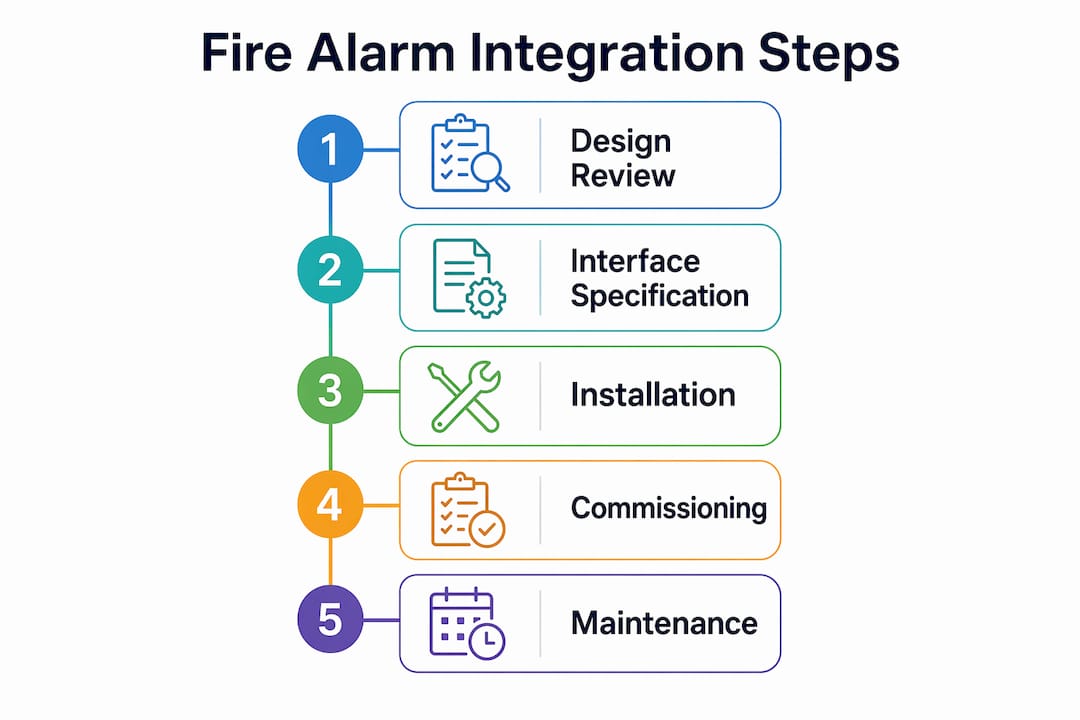
- Define integration objectives and select architecture tier (monitor-only, combination, or smoke-control).
- Develop the point list with supervision semantics for every exported signal.
- Write the cause-and-effect matrix and get AHJ pre-approval on the sequence of operations.
- Specify listed interface hardware and confirm UUKL 864 listings where required.
- Design conduit routing with physical segregation from fire-alarm signaling paths.
- Define cybersecurity boundaries: VLANs, firewall rules, and remote-access authentication.
- Assign contractor responsibilities in writing before mobilization.
The fire alarm installation guide for Houston property managers covers contractor qualifications and installation checklists that align with these design steps.
How do you commission and maintain an integrated system?
Commissioning tasks
Commissioning an integrated fire alarm and BMS is not a single-trade job. It requires coordinated witness testing across the fire alarm contractor, controls contractor, and commissioning agent.
Pre-installation coordination checklist:
- Confirm point list matches FACP programming and BMS object mapping.
- Verify listed status of every interface module and gateway.
- Confirm conduit segregation is complete before pulling wire.
- Review cause-and-effect matrix with all contractors present.
Acceptance testing checklist:
- Activate each initiating device type and verify the correct BMS response for every documented sequence.
- Simulate trouble conditions (open circuit, ground fault) and confirm BMS receives trouble signal without affecting FACP operation.
- Test fail-safe states by removing power from each interface component and confirming safe-state behavior.
- Verify gateway timestamping and event logging accuracy.
- Conduct AHJ witness test with all documentation present.
Ongoing maintenance cadence
Integration sequences require periodic re-verification after any BMS or FACP firmware update, software patch, or sequence change. A one-time acceptance test does not satisfy compliance for the system’s lifetime.
- Monthly: Verify BMS is receiving live status from the FACP (no stale data or lost communication alarms).
- Quarterly: Test a sample of cause-and-effect sequences, rotating through all sequences annually.
- Annually: Full re-verification of all integration sequences per NFPA 72 testing requirements; update the Record of Completion with test results.
- After any update: Retest every sequence affected by the firmware or software change before returning the system to service.
Pro Tip: Keep a dedicated integration test log separate from the standard fire alarm inspection report. When the AHJ asks for evidence of post-update retesting, a clean log with dated entries and technician signatures resolves the question immediately.
Routine fire alarm maintenance practices for property managers align directly with these integration maintenance requirements.
What cybersecurity and change-management risks come with integration?
The attack surface you are creating
Connecting a fire alarm system to a BMS network introduces a new attack surface. A compromised BMS could, in a poorly designed integration, send unauthorized commands to building equipment or suppress alarm notifications at the operator workstation. The fire alarm panel itself should never be reachable from the BMS network for command purposes unless the interface is explicitly listed and AHJ-approved.
Practical mitigations
- Network segmentation: Place the fire alarm gateway on a dedicated VLAN with firewall rules that permit only outbound status data to the BMS. No inbound commands from the BMS network to the fire alarm gateway.
- Strong authentication: Require multi-factor authentication for any remote access to the BMS or gateway management interface.
- Immutable logging: Configure the gateway to write timestamped event logs to a write-once or append-only store. This log is your evidence trail for both incident investigation and AHJ compliance.
- Limit command paths: If the integration is monitor-only, enforce that at the network layer, not just in software configuration. A firewall rule is harder to accidentally override than a software setting.
Change-management policy
Maintain a configuration ledger that records every firmware version, software patch, point-list change, and sequence modification with the date, technician, and reason. Any change to a sequence that affects a life-safety function requires AHJ notification and retesting before the change goes live. This is not bureaucratic overhead. It is what prevents a routine BMS patch from silently breaking a smoke-control sequence.
Pro Tip: Use edge logic at the gateway to filter and prioritize events. Transient non-fire telemetry, like a brief HVAC sensor dropout, should never reach the operator alarm queue. Filtering at the gateway keeps the BMS workstation focused on actionable fire-related events.
How Reliable-fire-protection handles BMS–fire alarm integrations
Reliable-fire-protection approaches every integration project with a structured process that covers scoping through post-install maintenance, with AHJ coordination built in at every stage.
The service model includes:
- Scoping and design support: Reviewing your building’s existing fire alarm system, BMS platform, and desired integration points to recommend the correct architecture tier and listed interface hardware.
- AHJ coordination: Preparing and submitting the sequence of operations and Record of Completion documentation for AHJ pre-approval, reducing the risk of failed inspections.
- Listed gateway installation: Specifying and installing UL 864-listed interface modules and UUKL 864-listed gateways where smoke-control command chains are required.
- Wiring segregation oversight: Supervising conduit routing to confirm physical separation of fire-alarm signaling and BMS data conductors.
- Commissioning and acceptance testing: Conducting witnessed cause-and-effect testing across all integration sequences, with signed test reports for the Record of Completion.
- Post-install maintenance contracts: Annual re-verification of integration sequences, post-update retesting, and ongoing inspection services.
Reliable-fire-protection holds the certification credentials and field experience to serve as the lead fire alarm contractor on integrated projects, coordinating with controls contractors and commissioning agents to deliver a compliant, documented installation.
Pro Tip: Ask your fire alarm contractor for a sample Record of Completion from a comparable integration project before signing a contract. A contractor who cannot produce one has likely not completed a properly documented integration before.
Contact Reliable-fire-protection for a site review or free quote. The team can assess your current fire alarm system, identify the right interface points, and outline the AHJ documentation your project will require.
Key Takeaways
Fire alarm integration with building management systems is achievable and operationally valuable, but only when the fire alarm retains autonomous life-safety control and every interface uses listed hardware approved by the AHJ.
| Point | Details |
|---|---|
| Fire alarm retains precedence | The FACP must remain the primary life-safety controller; the BMS is a monitor and secondary coordinator only. |
| Listed interfaces are mandatory | Every interface component, including monitor-only relays, must carry a UL 864 listing suitable for its intended purpose. |
| Segregate cabling | BMS LAN conductors must run in separate conduit from fire-alarm signaling wiring to meet code and prevent interference. |
| Retest after every update | Any BMS or FACP firmware change requires retesting of all affected integration sequences before returning to service. |
| Reliable-fire-protection | Provides end-to-end integration services including AHJ coordination, listed gateway installation, commissioning, and annual maintenance. |
The integration pitfalls facility managers keep repeating
The most persistent mistake in BMS–fire alarm integration is treating the BMS as a peer controller rather than a downstream observer. Facility managers who inherit an integrated system often discover that a previous contractor wired the BMS to issue HVAC commands based on fire alarm status without ever documenting the sequence, obtaining AHJ approval, or verifying the relay listing. The system works until it does not, and when it fails during an actual event, the liability question is immediate.
A second pattern worth calling out: bundling fire-alarm conductors with BMS LAN cables in the same conduit because “they’re both low voltage.” They are not the same. Fire-alarm signaling circuits carry supervision requirements that BMS data cables do not. Mixing them compromises supervision integrity and creates a code violation that an AHJ inspector will flag on the first visit.
Skipping the AHJ consultation at design stage is the third recurring problem. The AHJ is not an obstacle; they are a resource. A pre-submittal meeting where you walk through the proposed cause-and-effect matrix takes a few hours and can prevent months of redesign. Most AHJs will tell you exactly what documentation they need to approve the integration. Ask them.
Finally, the post-update retest gap. A BMS vendor pushes a firmware update, the controls contractor applies it, and nobody retests the fire alarm integration sequences because “it’s just a BMS update.” Three months later, a smoke-control damper sequence fails silently. The fix is a written change-management policy that requires retesting of any integration sequence after any software or firmware change to either system.
For each of these, the corrective action is achievable within 30–90 days: audit your existing interface documentation, pull the relay listing data sheets, schedule an AHJ pre-submittal meeting, and add integration retesting to your post-update checklist. None of these require capital expenditure. They require process.
Reliable-fire-protection: your integration partner from design to annual maintenance
Getting a fire alarm integration right the first time means having a fire alarm contractor who understands both the life-safety code requirements and the practical realities of BMS coordination. Reliable-fire-protection brings both to every project in Houston and the surrounding area.
The team handles the full scope: design review, listed gateway specification, conduit segregation oversight, AHJ documentation, commissioning, and the annual retesting that keeps your integration compliant after every system update. Whether you are adding BMS visibility to an existing fire alarm system or designing a full smoke-control command chain for a new facility, Reliable-fire-protection can scope the work, coordinate with your controls contractor, and deliver a signed Record of Completion your AHJ will accept.
Ready to confirm your integration scope and get AHJ-ready documentation? Request a free site review or explore the full range of fire protection services Reliable-fire-protection offers across Houston.
Useful sources for deeper reading
The following primary references support AHJ conversations, gateway procurement, and sequence design for integrated fire alarm and BMS projects:
- NFPA — Fire Alarm Emergency Control Functions: NFPA’s authoritative overview of elevator recall, HVAC shutdown, door release, and other emergency control functions governed by NFPA 72. Use this in AHJ pre-submittal meetings to align on code intent.
- BACnet.org — Fire Alarm Systems with BACnet (FPE-7-01): The primary technical guidance document for BACnet integration with fire alarm systems. Covers monitor-only interfaces, supervised contacts, gateway approaches, and ongoing maintenance requirements. Essential for protocol selection and gateway specification.
- Consulting-Specifying Engineer — Integrating Fire Alarm Systems: Detailed professional engineering guidance on hardware and software integration approaches, combination systems, smoke-control sequences, and commissioning. Useful for developing the cause-and-effect matrix and specifying acceptance testing requirements.
- Consulting-Specifying Engineer — How to properly integrate fire alarm systems and HVAC systems: Covers contractor coordination, NFPA 3 and NFPA 4 acceptance testing, and training requirements. Use this when defining contractor responsibilities and commissioning scope.
- FieldServer Blog — Fire Panel Integration Made Easy with Protocol Gateways: Practical guidance on gateway-based retrofit strategies, edge logic configuration, and timestamped logging. Useful for selecting and configuring protocol gateways for existing panels.
- Industrial Monitor Direct — BMS Protocol and Architecture Guide: Covers BMS protocol selection, cable segregation requirements, and lifecycle cost implications of early design decisions. Use for network architecture planning and conduit specification.