
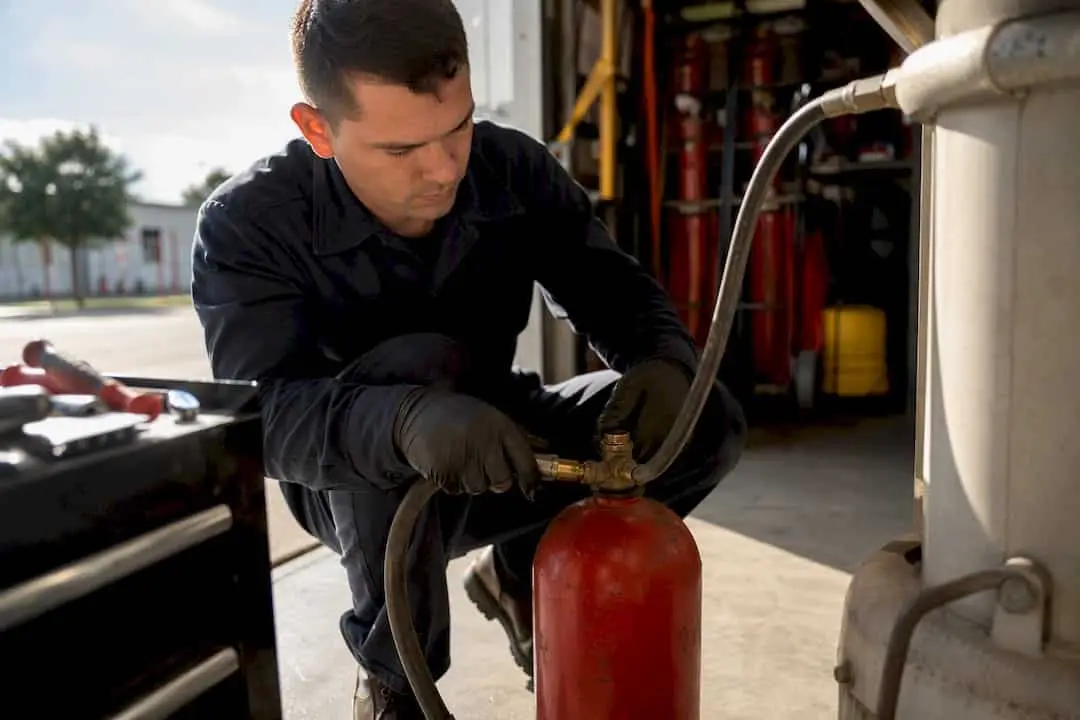
Recharging a standard 5-lb ABC fire extinguisher typically costs $25 to $70, while a 10-lb unit runs $40 to $110, with specialty agents like CO2 and wet chemical priced higher. The rule of thumb: recharge if the unit is within its service life and the cost stays well below a replacement’s price, but replace once it hits the 12-year hydrostatic testing mark or shows damage. Either way, only a certified technician should handle the job.
TL;DR:
- Recharging a 5-pound ABC extinguisher generally costs between $25 and $70, with larger or specialty units costing proportionally more.
- Hydrostatic testing is required at 12 years of age, and the cost for this service can approach or exceed the price of a new extinguisher, making replacement often preferable.
- On-site recharge services are more expensive due to travel fees and handling of larger or specialized units, while drop-off options are typically cheaper.
- Always request a detailed written quote with itemized costs, including agent, labor, parts, trip fees, and testing, to avoid overpaying.
- For safety, a certified technician should handle all recharge and inspection work, and documented, compliant tags are vital for fire code and insurance purposes.
Table of Contents
- How Much Does It Cost to Recharge a Fire Extinguisher?
- When Should You Recharge vs. Replace a Fire Extinguisher?
- Where Can You Get a Fire Extinguisher Recharged?
- What Should You Ask For When Getting a Recharge Quote?
- How Reliable Fire Protection Handles Recharge and Compliance
- What Actually Matters When Pricing a Recharge
- Ready to Schedule a Recharge or Inspection in Houston?
- Sources
How Much Does It Cost to Recharge a Fire Extinguisher?
The price you pay depends on three things: the extinguisher’s size, the type of agent inside it, and who’s doing the work. A small dry chemical unit at a drop-off counter costs far less than an on-site recharge of a large CO2 cylinder, and that spread explains most of the confusion people run into when they start pricing this out.
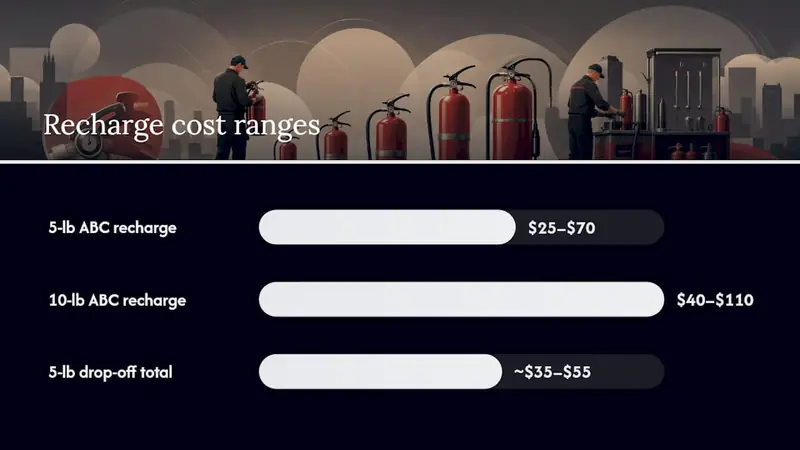
Dry chemical ABC extinguishers are the most common type in homes, offices, and retail spaces, and they’re also the cheapest to service. A 5-lb ABC recharge generally falls in the $25 to $70 range, while a 10-lb unit moves up to $40 to $110 depending on labor rates and whether the shop charges a flat fee or bills by the pound of agent used.
Specialty agents cost more because they require different handling, storage, and equipment. CO2 extinguishers need pressurized gas refilling that most general shops aren’t set up to do. Wet chemical units, the kind you’ll find mounted in commercial kitchens for Class K grease fires, use a specific liquid agent that costs more per pound than dry chemical powder, and proper compliance with Class K fire extinguisher signage is essential for safety. Clean agent extinguishers, common in server rooms and labs, sit at the top of the price range because the agent itself is expensive and the equipment used to recharge it is specialized. Industry pricing data consistently puts these specialty units in a higher cost band than standard ABC dry chemical.
Here’s a general breakdown of what to expect by size and agent type:
Prices vary by region, technician availability, and whether your extinguisher needs new seals, a valve replacement, or a fresh inspection tag on top of the actual recharge.
A recharge bill usually breaks down into a few distinct line items, and understanding them helps you spot a fair quote from an inflated one:
- Agent cost per pound. Dry chemical powder is cheap; CO2 and clean agents cost significantly more per pound.
- Labor. Technicians depressurize the cylinder, inspect it internally, and refill it to manufacturer spec, work that takes real time and certification.
- Trip or service fee. On-site visits almost always carry a flat fee separate from the recharge itself.
- New seals, o-rings, or valve components. These are inexpensive individually but add up if your unit needs several replaced.
- Hydrostatic testing, when applicable. Only required at certain age milestones, but it adds a meaningful chunk to the bill when it applies.
Two quick scenarios show how this plays out in practice. A homeowner drops off a 5-lb ABC extinguisher at a local fire equipment shop. No trip fee applies, the technician swaps the valve seal and refills the agent, and the total lands around $35 to $55. Compare that to a restaurant owner who needs a 10-lb CO2 unit serviced on-site because it’s mounted in a walk-in cooler area. The technician has to travel, the CO2 agent costs more per pound, and the trip fee gets added, pushing the total to $100 or more. Same basic service, very different invoice, all because of size, agent type, and location of the work.
When Should You Recharge vs. Replace a Fire Extinguisher?
Two maintenance milestones drive almost every recharge-or-replace decision: the 6-year internal maintenance requirement and the 12-year hydrostatic test. Missing either context means you’re guessing at a number instead of making an informed call.

At the 6-year mark, most rechargeable extinguishers need an internal inspection under NFPA 10, the National Fire Protection Association standard that governs portable extinguisher maintenance. A technician fully empties the cylinder, checks the internal components for corrosion or wear, replaces seals and o-rings, and recharges the unit. This service typically costs a bit more than a standard recharge because of the added inspection labor, but it’s still usually cheaper than buying new.
The 12-year mark is where the math often flips. Stored-pressure cylinders generally require hydrostatic testing at this point, a pressure test that verifies the cylinder can safely hold its rated pressure. Hydro testing is a specialized service, and combining it with the recharge itself often pushes the total cost close to or above the price of a new extinguisher. For smaller units especially, replacement frequently wins out once you’re staring down a hydro test bill.
A few red flags mean replacement is the right call regardless of age:
- The cylinder failed hydrostatic testing or shows visible corrosion, dents, or rust.
- The unit has lost pressure repeatedly, suggesting a slow leak the technician can’t easily trace.
- The valve or handle assembly is cracked, bent, or otherwise damaged.
- The extinguisher is missing its manufacture date, making it impossible to verify service history.
One thing worth knowing if you’re buying new instead: a brand-new extinguisher purchased at a retail store often still needs professional inspection and tagging to satisfy local fire code or insurance documentation, so “new” doesn’t always mean “compliant and ready” the moment it leaves the shelf.
Where Can You Get a Fire Extinguisher Recharged?
Recharging a fire extinguisher requires depressurizing the cylinder, inspecting it internally, replacing worn seals, and refilling to exact manufacturer specifications, work that demands certification and specialized equipment most general retailers simply don’t have.
- Dedicated fire equipment service companies. These businesses specialize in inspection, recharge, and hydrostatic testing, and they carry the certifications required to do the job safely and legally.
- Certified local contractors. Many regions have independent technicians who service extinguishers as part of broader fire protection work, often at competitive rates with faster turnaround.
- Manufacturer-authorized refill centers. Some extinguisher brands maintain networks of approved service centers that guarantee factory-spec recharges.
Service models generally split into two categories. Shop drop-off tends to be the cheaper option since there’s no trip fee, but turnaround can take a few days depending on the shop’s workload. On-site service costs more upfront because of the added trip fee, but it saves you the hassle of removing wall-mounted units or coordinating a business closure, and many providers offer same-day or next-day appointments for standard units.
If you’ve wondered whether big-box retailers recharge extinguishers, the answer is usually no. Stores like Home Depot generally don’t offer recharge services because the work requires certified technicians, pressurized equipment, and liability coverage that retail staff and store locations aren’t set up to provide. They sell new units, but for recharging an existing one, you’ll need a dedicated service provider.
What Should You Ask For When Getting a Recharge Quote?
A vague verbal estimate over the phone tells you almost nothing. An itemized written quote tells you exactly what you’re paying for and gives you something to compare against other providers.
Ask for these line items before agreeing to service:
- Agent and materials cost, broken out separately from labor.
- Labor charge, which should reflect the size and complexity of the unit.
- Trip or service fee, if the work happens on-site.
- Hydrostatic testing cost, clearly listed if your unit is due for one.
- Replacement parts, such as valves, hoses, or seals, priced individually rather than bundled into a mystery total.
Before handing over your extinguisher, confirm the technician is certified and ask to see documentation of past work if you’re dealing with a new provider. A completed job should come with a dated inspection tag attached to the unit and a written invoice you can keep on file for compliance records. Skip any provider who won’t put pricing in writing or who can’t produce a visible certification.
Pro Tip: If you have multiple extinguishers needing service, ask about bundled pricing. Providers often drop the per-unit trip fee when they’re servicing five or six units at the same location, which can cut your total cost noticeably compared to scheduling them one at a time.
How Reliable Fire Protection Handles Recharge and Compliance
Reliable Fire Protection services fire extinguishers throughout Houston and nearby neighborhoods, handling recharges, 6-year internal maintenance, and 12-year hydrostatic testing with certified technicians. Every job comes with an itemized quote, a dated inspection tag, and paperwork documenting the service for insurance or fire code records. That workflow matters for property managers juggling multiple units across a building, since missing tags or undocumented work are common findings during fire marshal walkthroughs.
What Actually Matters When Pricing a Recharge
Most pricing guides treat recharge cost like a single number you can look up and move on. It isn’t. The number that matters isn’t “what does a recharge cost” but “what does a recharge cost at this extinguisher’s age,” because the 6-year and 12-year milestones change the equation entirely.
Where conventional advice falls short is in treating replacement as the “safe default” for anything older than a few years. That’s backwards for larger, metal-valve units still within service life. A 20-lb ABC extinguisher that’s 4 years old is almost always worth recharging. A 5-lb unit that’s about to hit its 12-year hydro test is a different story entirely.
If you take one thing from this guide, make it this: get the itemized quote before you decide anything. The line items tell you whether you’re paying for a simple refill or a full teardown with hydro testing, and that distinction is what actually determines whether recharging makes sense.
— Results
Ready to Schedule a Recharge or Inspection in Houston?
Reliable-fire-protection gives Houston property owners something most fire equipment shops don’t: a single certified team handling your extinguisher recharge, 6-year maintenance, and 12-year hydrostatic testing alongside your broader fire alarm and sprinkler compliance needs, with itemized quotes and documentation for every visit.
That matters if you’ve ever tried piecing together separate vendors for extinguishers, alarms, and sprinkler inspections just to keep your paperwork straight for an insurance audit or fire marshal visit. Reliable-fire-protection’s technicians are certified to handle recharge, tagging, and hydro testing in one appointment, and every job comes with a written invoice showing materials, labor, and any trip fees, so you know exactly what you’re paying for before work starts. The company serves Houston and surrounding neighborhoods with prompt scheduling for both routine maintenance and urgent compliance needs.
If your extinguishers are due for service or you’re not sure when they were last tagged, request a free quote through Reliable-fire-protection’s contact page and get a straight answer on what your units need next.
Sources
Pricing ranges and decision rules in this guide draw from Current Cost’s U.S. buyer pricing data, ServicedFireEquipment’s compliance and hydro-testing guide, USA Today’s consumer cost reporting, and M&M Fire’s specialty-agent pricing breakdown.
- Fire Extinguisher Recharge Cost and Price Guide for U.S. Buyers 2026 – Current Cost
- Fire Extinguisher Refilling vs Replacement | Cost & Compliance Guide
- Cost to Recharge Fire Extinguisher: 2026 Pricing – M&M Fire