
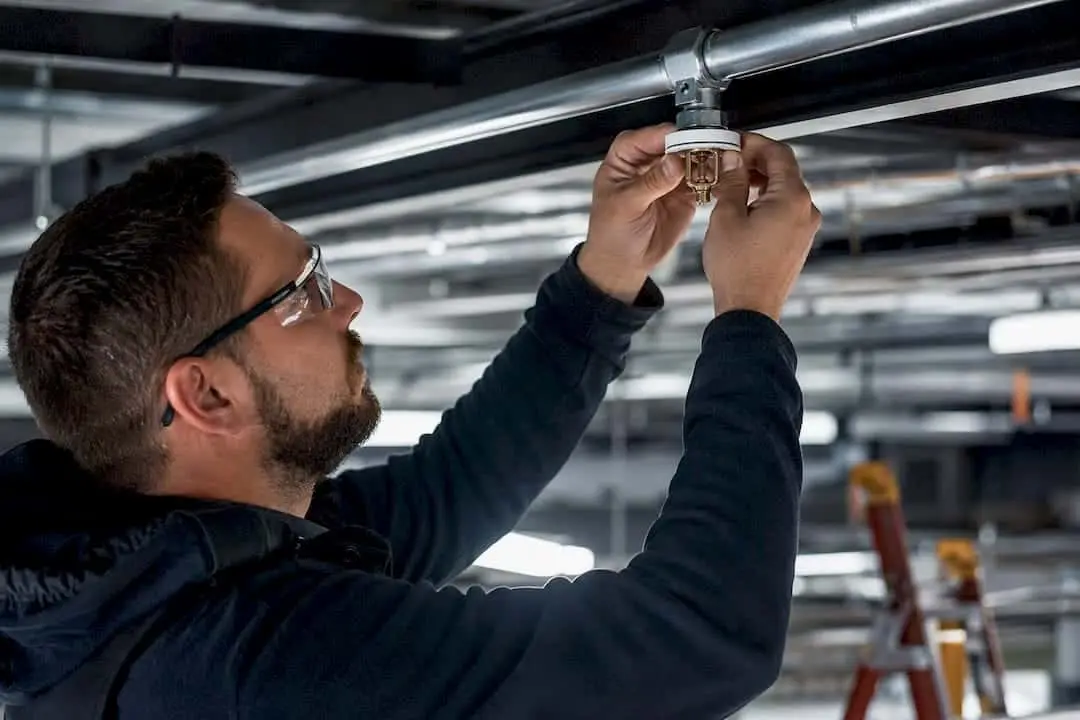
A single sprinkler head replacement typically runs $150 to $400 all in, though the head itself costs $2 to $50. Small multi-head jobs land in the $400 to $1,200 range, and sampling-driven replacements on larger systems can push well past that once lab testing and impairment coordination enter the bill. Labor and system-impairment fees, not the hardware, drive most of that spread. Before calling anyone, check your NFPA-required spare cabinet and line up a licensed contractor for an on-site assessment.
TL;DR:
- Replacing a sprinkler head costs between $150 and $400 per event, mainly due to labor and system impairment fees rather than parts.
- Access difficulty, environment, system type, and replacement quantity significantly influence the overall job cost.
- NFPA standards require mandatory replacement if heads are corroded, painted, leaking, or improperly installed, with sampling intervals varying by head type.
- Batching multiple head replacements into one scheduled outage reduces impairment and testing costs compared to individual emergency calls.
- Accurate, itemized quotes depend on pre-assembled system data, and proper planning can prevent surprise expenses and ensure compliance.
Table of Contents
- What Does Sprinkler Head Replacement Cost, Exactly?
- What Makes One Sprinkler Job More Expensive Than Another?
- When Does NFPA Require Replacement Instead of Testing?
- What Happens On-Site During a Replacement?
- What Do Real Replacement Scenarios Cost?
- How Do You Get an Accurate, Comparable Quote?
- Why Reliable-Fire-Protection Treats Replacement as a Compliance Decision, Not Just a Repair
- Get a Straight Answer on Your Replacement Costs
- The Numbers That Matter for Your Budget
- Sources
What Does Sprinkler Head Replacement Cost, Exactly?
The head itself is the cheapest part of the invoice. Standard pendent and upright heads run $2 to $15, while specialty types like concealed, ESFR, or corrosion-resistant heads climb toward $50 or more per unit, depending on finish and response rating.
Labor is where the real money moves. A licensed contractor’s full event, covering system impairment, monitoring notification, the physical swap, a pressure test, and reinstatement typically costs $150 to $400 for a single head. That gap between a $10 part and a $300 invoice surprises a lot of property owners the first time they see it.
On a typical commercial job, expect these components:
- Head cost: $2 to $50 depending on type and finish
- Contractor labor per event: $150 to $400 for a single head
- System impairment planning and monitoring notification: often bundled into the labor rate, sometimes billed separately
- Pressure or flow testing after the swap: an added line item on most commercial bids
- Documentation and AHJ filing fees: common on jobs tied to insurance or code inspections
Pro Tip: Keep a stocked spare-sprinkler cabinet on site and train a maintenance staffer to swap non-code-critical heads under a licensed supervisor’s sign-off. It won’t eliminate contractor visits, but it cuts how often you pay the full $150 to $400 event fee for routine, one-off replacements.
Commercial projects often carry fixed-fee components that residential jobs skip entirely. Draining and re-pressurizing a system, scheduling mandatory testing, and filing certification paperwork with local authorities all add cost that a simple single-family swap never sees. If your building has a fire watch requirement during impairment, factor that into the quote too. Maintaining accurate spare inventory is the single cheapest lever you have against repeat contractor calls.
What Makes One Sprinkler Job More Expensive Than Another?
Four variables push a quote up or down more than anything else: how hard the heads are to reach, what environment they sit in, what kind of system feeds them, and how many you’re replacing at once.
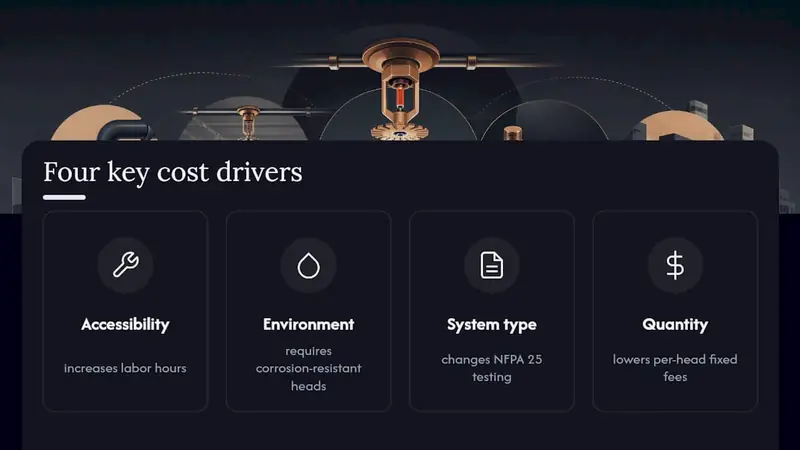
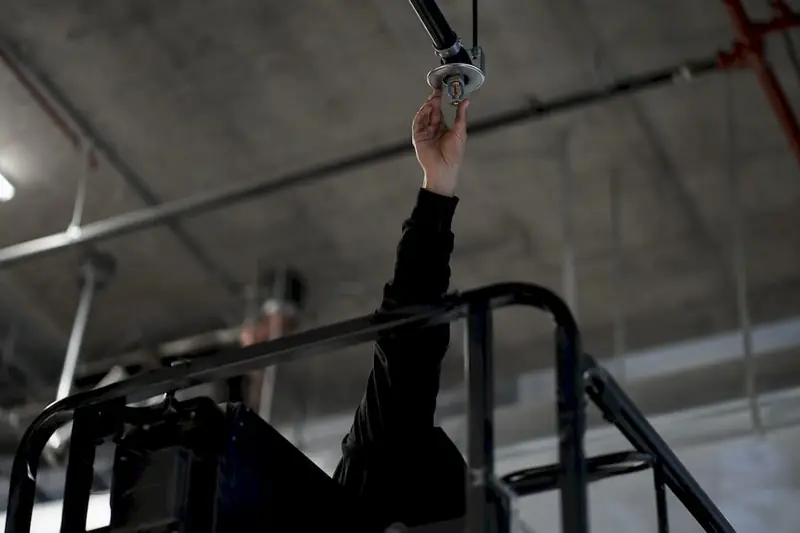
Accessibility tops the list. Heads behind a concealed ceiling grid, above a 20-foot warehouse floor requiring a scissor lift, or embedded in decorative tile all add labor hours before a wrench ever touches the sprinkler.
Environment matters just as much. Kitchens, parking garages, and coastal-humidity buildings accelerate corrosion, which shortens the useful life of standard heads and pushes facilities toward corrosion-resistant models that cost more upfront but replace less often.
System type changes the compliance math. Dry systems, ESFR heads, and legacy O-ring designs carry different sampling schedules under NFPA 25, which affects whether you’re paying for testing, replacement, or both.
Quantity works in your favor. Replacing 40 heads during one planned outage spreads the fixed impairment and testing costs across the whole job, so the per-head price drops sharply compared to 40 separate single-head service calls.
Pro Tip: If you know several heads are aging out around the same time, batch them into one scheduled outage instead of calling for emergency swaps as each one fails. You’ll pay one impairment fee instead of a dozen.
When Does NFPA Require Replacement Instead of Testing?
NFPA 25 sets the rules that decide whether you replace a head or send it out for sample testing, and NFPA 13 governs how the system is designed and stocked in the first place. Both standards shape your cost more than any single contractor decision.
Spare stocking requirements scale with system size: systems with fewer than 300 installed sprinklers need at least six spares on hand, 300 to 1,000 sprinklers require 12, and systems over 1,000 need 24, with the count and a wrench posted at the cabinet. Replacement is mandatory, not optional, for any head that’s been painted, shows corrosion beyond acceptable limits, has a leaking bulb, or is installed in the wrong orientation.
Sample testing intervals vary by head type under NFPA 25, ranging from roughly 50 years for standard sprinklers down to 10 years for certain corrosion-resistant models, and if a pulled sample fails, every sprinkler represented by that sample has to be replaced, not just the failed unit.
That single-sample-fails-all-replaced rule is why testing sometimes costs more than replacing outright. Lab fees, retest scheduling, and documentation add up, and a failed sample forces the replacement anyway, on top of what you already paid to test.
What Happens On-Site During a Replacement?
A licensed crew follows a predictable sequence, whether they’re swapping one head or forty.
- Inspection and scope confirmation — the contractor verifies head type, quantity, and access conditions against the quote.
- Isolation — the affected system or zone is shut down and drained, or a sectional valve isolates just the working area on larger systems.
- Removal and replacement — old heads come out, new ones go in, matched for temperature rating and orientation.
- Pressure testing — the repaired section gets tested before anyone signs off.
- Monitoring notification and AHJ coordination — the fire alarm monitoring company and, on commercial jobs, the local authority having jurisdiction get notified before and after impairment.
- Return to service — the system is restored, documented, and the paperwork filed.
A single head might take a couple of hours start to finish. Sample-testing projects or multi-head retrofits can run a full day or more, especially if fire watch coverage has to be arranged for the impairment window.
Pro Tip: Ask your contractor for a written impairment window before work starts. Insurance carriers and some municipalities want documented start and end times, not a verbal estimate.
What Do Real Replacement Scenarios Cost?
Numbers land differently depending on scope. Here’s how three common situations typically shake out.
| Scenario | Parts Cost | Labor / Event Cost | Total Estimated Range |
|---|---|---|---|
| Single standard head, easy access | $2–$15 | $150–$400 | $150–$400 |
| Small cluster (5 heads), one difficult-access point | $20–$150 | $400–$1,200 | $400–$1,200 |
| Sample-driven or mass replacement (large commercial system) | Varies by count | Scales with quantity and testing | Often exceeds $1,200, but per-head cost drops with batch scheduling |
A single head with clean ceiling access sits at the low end of the $150 to $400 contractor event range. Add a scissor lift, a concealed grid, or a tile ceiling that needs patching, and that same job can double. Large-system sample testing can increase costs quickly as retesting and documentation requirements add up, and past a certain point, wholesale replacement of the affected group is the more economical call than repeated testing cycles. Treat every figure here as a planning range. Your actual bid depends on local labor rates and your specific system.
How Do You Get an Accurate, Comparable Quote?
Before you call anyone, gather three things: a head inventory (type, count, age), system drawings if you have them, and photos of any visible damage or corrosion. That prep alone eliminates most of the back-and-forth that delays a bid.
Require every quote to itemize:
- Parts cost, broken out by head type and quantity
- Labor for the impairment, replacement, and testing sequence
- Any lab testing or certification fees tied to sampling
- AHJ filing or permit costs
- Site restoration, such as ceiling tile or drywall repair
Ask bidders directly:
- Are you licensed to perform fire sprinkler work in your state, and can you show proof of insurance?
- How familiar is your team with NFPA 25 sampling protocols?
- What’s your realistic timeline, including any fire-watch coordination?
- Does the replacement carry a warranty on parts or workmanship?
A quote with a single lump-sum number and no line items is the biggest red flag. It hides whether you’re paying fair labor rates or covering someone else’s margin on parts.
Why Reliable-Fire-Protection Treats Replacement as a Compliance Decision, Not Just a Repair
We’ve watched too many facility managers get hit with surprise costs because nobody checked the spare cabinet or coordinated the impairment window in advance. Documented workflows and a properly stocked inventory catch most of that before it becomes an emergency call. Our crews work directly with local authorities across the Houston area, which speeds up filing and cuts the delays that turn a two-hour job into a two-day one. Reach out and we’ll check your on-site spare inventory and build you a free, itemized quote before anything gets touched.
— Results
Get a Straight Answer on Your Replacement Costs
You don’t have to guess at your number or wait for a surprise invoice. Reliable-fire-protection handles the full replacement process in-house: inspection, head replacement, impairment planning, testing coordination, documentation, and 24/7 emergency response when a head fails outside business hours.
As a family-owned, certified Houston contractor, we build every quote around the documented workflows that keep your building compliant with NFPA 25 and NFPA 13, not around a lump-sum guess. If your system also feeds a backflow preventer or your maintenance plan needs a second look, our sprinkler maintenance workflow page walks through how ongoing service agreements keep future replacement costs predictable. For properties coordinating water-side upgrades alongside fire protection work, LeakSense’s installation services are worth a look too. Request a free itemized quote and on-site spare check through our sprinkler system services page and we’ll have a licensed technician out to assess your system.
The Numbers That Matter for Your Budget
- Single head: $150 to $400 total, parts $2 to $50, labor dominates the bill.
- NFPA compliance: spare stocking rules and sampling failures can escalate scope fast.
- Next steps: check spares, photograph damage, gather your head inventory, then request itemized quotes.
Sources
- Fire Sprinkler Head Cost Guide: Prices, Variables & How to Buy Smart | CA-Fire
- Fire Sprinkler Head Replacement Cost — HomeGuide
- NFPA 13 March — NFPA Journal
- Testing or Replacing Sprinklers – Dyne USA (July 2024)