
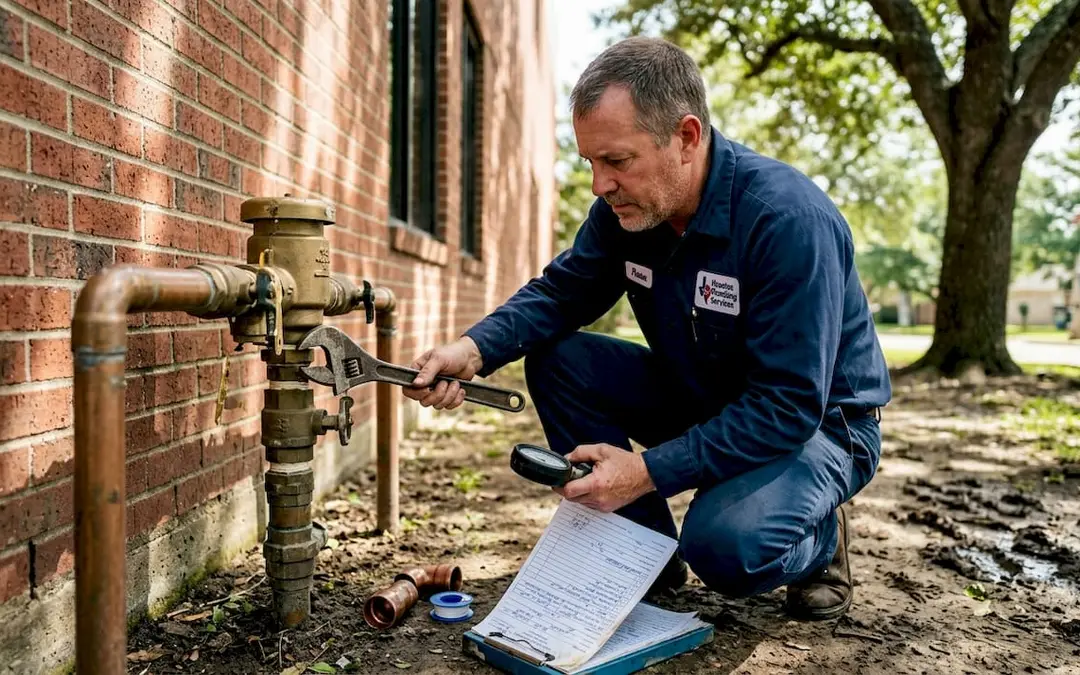
TL;DR:
- Backflow prevention devices protect public water supply from harmful contamination caused by reverse flow.
- Proper device selection, installation, and annual testing ensure compliance and safety for Houston facilities.
- Ongoing maintenance and proactive risk assessment are critical for long-term backflow prevention effectiveness.
Most commercial property owners in Houston invest heavily in fire sprinkler systems, yet overlook one critical component that sits right at the connection point between that system and the public water supply. Backflow, the reversal of water flow that can push stagnant, bacteria-laden water from your fire system back into the potable supply, is a real and underregulated hazard. Backflow prevention devices stop this reverse flow, protecting public health and keeping your facility compliant with Texas and municipal codes. This guide walks you through everything you need to know, from device types to annual testing requirements.
Table of Contents
- Understanding backflow and its risks
- Types of backflow prevention devices and their applications
- Installation and compliance essentials for Houston facilities
- Testing, maintenance, and ongoing management
- Why the real value of backflow devices is often underestimated
- Enhance your fire safety and compliance with expert help
- Frequently asked questions
Key Takeaways
| Point | Details |
|---|---|
| Essential health protection | Backflow prevention devices stop contaminated water from threatening your building and community health. |
| Compliance made simple | The right device and annual testing keep your property compliant with Houston fire and water codes. |
| Choose the right device | Selecting the correct backflow prevention method depends on your property’s hazard risk and use case. |
| Maintenance is non-negotiable | Routine inspection and timely repairs are vital for ongoing safety and regulatory compliance. |
| Expert support pays off | Relying on specialists helps you avoid costly mistakes, fines, and liability headaches. |
Understanding backflow and its risks
Backflow happens when pressure in a water system drops or reverses, pulling water backward through pipes instead of forward. In a commercial building, this can occur during a sudden pressure drop from a water main break, a heavy fire suppression event, or even a nearby construction project. The result is that water from your fire sprinkler system, irrigation lines, or chemical processes can flow back into the city’s drinking water supply.
Fire sprinkler systems are a particularly sneaky source of backflow risk. Water inside those pipes often sits stagnant for months or even years between activations. That standing water can harbor bacteria, rust, and chemical residue from antifreeze additives used in cold-weather systems. When backflow occurs, all of that contamination travels backward into the potable supply.
As the TCEQ and EPA emphasize, contamination incidents in commercial properties are a documented concern, and stagnant water in fire systems represents one of the most overlooked cross-connection hazards in urban settings.
Here is a quick look at the most common backflow sources in commercial facilities:
- Fire sprinkler systems with stagnant or chemically treated water
- Irrigation systems connected to fertilizer injection equipment
- Boilers and cooling towers with chemical treatment programs
- Medical or laboratory equipment with fluid connections
- Car washes and industrial cleaning systems
Who is responsible? In Texas, the property owner is legally responsible for preventing cross-connections on their side of the water meter. The utility is responsible up to the meter. That means if contamination originates from your building’s fire system, the liability lands on you.
Understanding this ownership boundary matters. Many facility managers assume the utility handles backflow protection, but that assumption can lead to code violations and serious legal exposure. Pairing your fire protection systems with properly selected and maintained backflow devices is not optional. It is a fundamental part of responsible property management in Houston.
Types of backflow prevention devices and their applications
Not all backflow preventers are created equal, and choosing the wrong one is not just a minor mistake. It can result in a code violation, a failed inspection, and real contamination risk. There are three primary device types you need to know.
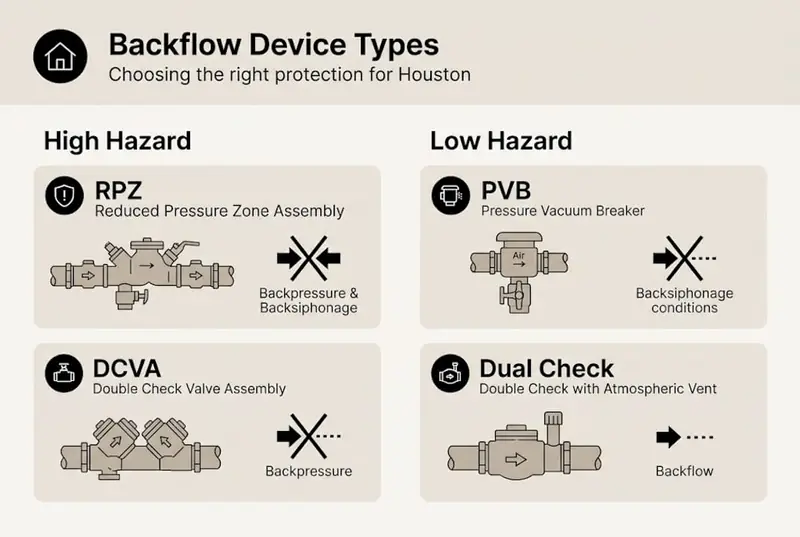
Reduced Pressure Zone (RPZ) assemblies are the gold standard for high-hazard situations. If your fire sprinkler system uses antifreeze, chemical additives, or connects to any system with health-risk contaminants, an RPZ is typically required. It uses two check valves and a relief valve that vents to a drain if either check valve fails, making it the most protective option available.
Double Check Valve Assemblies (DCVA) are appropriate for low to medium hazard applications. For fire sprinkler systems that use only water without chemical additives, a DCVA is often acceptable. They are more compact and can be installed below grade, which makes them practical for Houston facilities with space constraints.
Pressure Vacuum Breakers (PVB) protect only against backsiphonage, not back pressure. They are typically used for irrigation systems and must be installed at least 12 inches above the highest outlet they serve. Using a PVB where an RPZ is required is a code violation risk that can surface during annual inspections.
| Device | Hazard level | Common application | Can install below grade? |
|---|---|---|---|
| RPZ | High | Fire systems with additives, chemical lines | No |
| DCVA | Low to medium | Fire sprinklers (water only), general use | Yes |
| PVB | Low (backsiphonage only) | Irrigation, hose connections | No |
For Texas backflow prevention, the local utility may impose stricter requirements than the building code alone. Always verify with your water provider before finalizing device selection.
Pro Tip: When in doubt about hazard classification, default to the RPZ. Upgrading later is far more expensive than installing the right device from the start, and your utility may require it anyway once they conduct their own cross-connection survey.
If you are sourcing backflow services in Houston, work with a provider who understands both the municipal code and the specific hazard profile of your property type.
Installation and compliance essentials for Houston facilities
Selecting the right device is only half the battle. Improper installation is one of the most common reasons facilities fail their first inspection. Here are the key steps to get it right.
- Determine the correct location. RPZ assemblies must be installed above grade with adequate drainage nearby. They cannot be submerged. DCVA units offer more flexibility and can go below grade in a vault. PVBs require a minimum 12-inch elevation above the highest downstream outlet.
- Ensure proper orientation. Most assemblies must be installed horizontally, though some RPZ models allow vertical installation. Check the manufacturer specs and local code before mounting.
- Provide adequate access. Inspectors and testers need clear access to test cocks and shut-off valves. Blocking access with equipment or building materials is a common pitfall that delays compliance.
- Account for Houston climate factors. Freeze events, though rare, do occur in Houston. RPZ assemblies exposed to outdoor temperatures need insulation or enclosures. Flood-prone locations require elevated installations to protect against submersion.
- Coordinate with your utility. As hazard classification drives device selection, utilities may require a higher-rated device than your building code specifies. Confirm requirements before purchasing equipment.
Key mechanic to understand: Check valves inside backflow preventers maintain a minimum pressure differential of 1 to 2 psi. The RPZ relief valve activates and vents water if either check valve fails, which is why proper drainage at the installation site is non-negotiable.
For facilities navigating a broader fire sprinkler compliance workflow, backflow device installation should be coordinated with your overall sprinkler permitting process to avoid redundant inspections. If you are also installing fire sprinklers in a new build or renovation, this is the ideal time to address backflow prevention in the same project scope.
Pro Tip: Hire a licensed backflow assembly tester to perform a pre-inspection before your official compliance test. Catching a fouled disc or improper installation early costs far less than a failed inspection and reinspection fee.
For broader context on code-driven installation decisions, professional plumbing compliance advice can help clarify where fire system requirements intersect with plumbing code obligations.
Testing, maintenance, and ongoing management
Installing the right device correctly is a one-time win. Keeping it compliant is an ongoing responsibility. Texas requires annual testing of backflow prevention assemblies, and for high-risk businesses like hospitals, chemical plants, and mortuaries, annual testing by licensed testers is mandatory without exception.

Here is what an annual test actually involves. A certified tester connects differential pressure gauges to the test cocks on your assembly and measures how each check valve and relief valve performs under controlled conditions. The entire process takes 30 to 60 minutes. Fouled discs are the most common failure found during testing, often caused by debris or mineral buildup that prevents the valve from seating properly.
| Maintenance task | Frequency | Who performs it |
|---|---|---|
| Full assembly test | Annually | Licensed backflow tester |
| Visual inspection | Quarterly | Facility manager or technician |
| Disc and seat cleaning | As needed (often at annual test) | Licensed tester or plumber |
| Relief valve drain check | After each test | Licensed tester |
| Recordkeeping update | After every service | Facility manager |
Beyond the annual test, watch for these warning signs between inspections:
- Unexplained drops in water pressure throughout the building
- Visible water discharge from the RPZ relief valve port (indicates check valve failure)
- Discolored water at nearby fixtures
- Unusual odors from water outlets near the fire system connection
- Leaks around the assembly body or test cock fittings
Recordkeeping is not optional. Maintain a log of every test, repair, and inspection with dates, tester credentials, and results. Insurance carriers and municipal inspectors will ask for this documentation. Missing records can void coverage or trigger fines even if the device itself is functioning.
For a detailed breakdown of what Houston facilities must track, the backflow testing requirements guide covers the specific documentation standards that keep you audit-ready. Pair this with a consistent sprinkler system maintenance schedule to manage both systems under one compliance calendar.
Why the real value of backflow devices is often underestimated
Passing your annual inspection is not the same as being safe. We see this distinction constantly in our work with Houston commercial properties. A device can pass a test and still be the wrong choice for the actual hazard profile of that building. Facilities that installed a DCVA years ago because it was cheaper sometimes discover their fire system now uses antifreeze, which changes the hazard classification entirely and demands an RPZ upgrade.
The blind spot we encounter most often is skipping downstream risk assessment. Property managers focus on the device itself but rarely ask what happens if it fails at 2 a.m. on a Saturday. Who gets notified? What is the isolation plan? These questions separate reactive compliance from genuine safety leadership.
Properties that invest in the right device, maintain proactive service schedules, and stay in close contact with their utility provider do more than avoid fines. They build a documented record of due diligence that carries real weight with insurers, tenants, and municipal authorities. For detailed Houston backflow safety insights, that proactive posture is what separates the facilities that manage risk from those that simply react to it.
Enhance your fire safety and compliance with expert help
Understanding the rules is one thing. Executing them correctly in a real Houston facility, with its specific climate challenges, municipal requirements, and building configurations, is another entirely. That is where working with a local specialist makes a measurable difference.
At Reliable Fire Protection, we help commercial property owners and facility managers select, install, and test the right backflow prevention assemblies for their specific risk profiles. From initial assessment to annual compliance testing, our certified team handles every step. Explore our Houston backflow service experts page to learn about our offerings, or review the backflow testing guide to understand what your next inspection will require. Our Houston backflow safety guide is also a strong starting point for facilities building a compliance program from scratch.
Frequently asked questions
What is the main purpose of a backflow prevention device?
A backflow device prevents contaminated water from entering the potable water supply, protecting public health and keeping your facility in compliance with local and state codes.
How often must commercial backflow devices be tested in Houston?
Most assemblies require annual testing by licensed testers to remain compliant, with high-risk facilities such as hospitals and chemical plants held to the strictest standards.
Which backflow device should be used for a fire sprinkler system?
For fire sprinklers using only water, a DCVA is often acceptable; if the system uses antifreeze or chemical additives, an RPZ is typically required by code.
What are the signs that a backflow preventer needs repair or replacement?
Watch for drops in water pressure, visible leaks, relief valve discharge, or a failed annual test caused by fouled discs or degraded valve components.
Recommended
- Backflow Prevention: Protecting Houston Water Safety
- Backflow preventer testing guide for Houston managers
- Why sprinkler systems matter for Houston property safety
- Why maintain fire equipment: protect Houston properties
- Fire Alarm System University Place TX
- Fire Alarm System Services in Bellaire, TX