
TL;DR:
- Understanding the fire alarm sequence enhances property safety by ensuring systems operate correctly during emergencies. Regular maintenance, testing, and awareness of failure points like false alarms and wiring issues are vital for reliable performance. Informed property management leads to better decision-making, compliance, and occupant protection during fires.
Most property owners picture a fire alarm as something simple: smoke appears, a bell rings. That’s where the mental model stops. But the actual sequence of events between a sensor detecting danger and your building reaching safety is far more layered than that. For Houston property owners and managers, understanding this sequence isn’t just an interesting detail. It directly affects your compliance standing, the speed of emergency response, and whether your system actually works when it needs to. This article walks you through every stage, covers the common failure points, and gives you practical steps to protect your property with confidence.
Table of Contents
- What is the fire alarm sequence?
- Step-by-step breakdown of the fire alarm sequence
- Common challenges and how to prevent failures
- Practical steps for Houston property owners and managers
- The real impact of understanding your fire alarm sequence
- Next steps: Enhance your property safety with expert help
- Frequently asked questions
Key Takeaways
| Point | Details |
|---|---|
| Understand each alarm stage | Knowing how detection, verification, notification, and reset work helps you spot issues early and ensure compliance. |
| Prevent false alarms proactively | Regular cleaning and modern sensors reduce costly false alarms and lead to safer, smoother operation. |
| Ensure backup and survivability | Battery backup and fire-rated wiring keep your alarms functioning even if disaster strikes the main power or circuit pathways. |
| Follow Houston maintenance practices | Maintenance routines and compliance logs tailored for Houston keep your system running reliably and help pass inspections. |
| Seek professional support | Bringing in experts for installation, inspections, and upgrades ensures your property is protected and meets local safety standards. |
What is the fire alarm sequence?
The fire alarm sequence is the ordered chain of events that occurs from the moment a fire condition is detected to the moment your building is safe and the system is reset. Think of it like a relay race. Each stage hands off responsibility to the next, and if one runner drops the baton, the whole race falls apart.
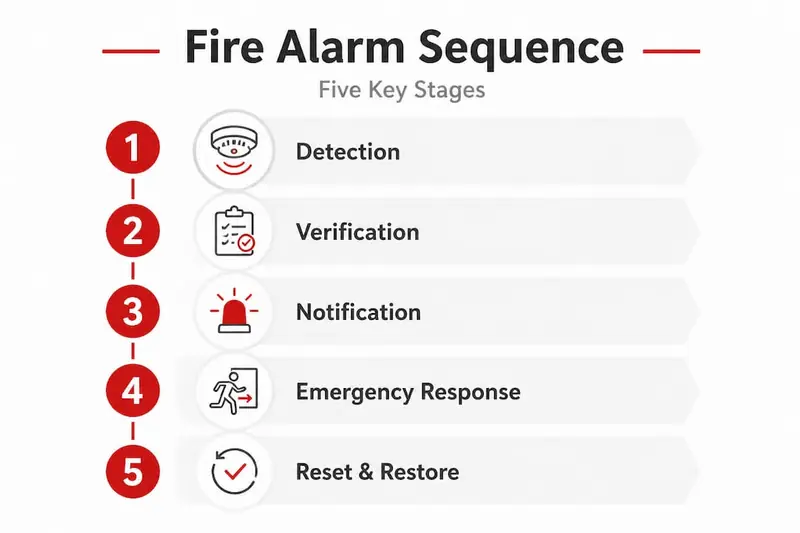
At its core, the sequence covers four primary stages:
- Detection: A sensor or manual device identifies a potential fire condition
- Verification: The control panel checks whether the signal is genuine
- Notification: Audible and visual alarms alert occupants and emergency services
- Response and reset: Evacuation happens, authorities arrive, and the system is restored
The initiating event that kicks this off can be a smoke detector reading particles in the air, a heat sensor registering a rapid temperature rise, or a person pulling a manual pull station on the wall. Each trigger type carries different implications for response time and system behavior.
Understanding how fire alarm systems work reveals that modern panels don’t just pass a signal through blindly. They apply logic to filter noise, prioritize signals, and manage multiple zones simultaneously.
| Stage | Trigger | Typical Time |
|---|---|---|
| Detection | Smoke, heat, manual pull | Immediate |
| Verification | Panel logic processing | 5 to 30 seconds |
| Notification | Alarm activation | Within 1 minute |
| Response | Evacuation and dispatch | 1 to 5 minutes |
| Reset | Manual by authorized person | After clearance |
One often-overlooked part of the sequence involves what happens when edge cases arise. Pathway survivability standards specify that critical alarm circuits should use two-hour fire-rated wiring, and systems must maintain 24-hour standby power plus 5 to 15 minutes of full alarm duration on battery backup alone. Getting a proper fire detection system setup from the start minimizes exposure to these failure points.
Step-by-step breakdown of the fire alarm sequence
Now that you have the overview, let’s get specific. Each stage has real-world nuances that can mean the difference between a controlled evacuation and a chaotic one.
1. Detection and initiation
Sensors are the first responders. Smoke detectors use either ionization technology (better for fast-flaming fires) or photoelectric technology (better for slow, smoldering fires). Many modern systems use both in a single unit. Heat detectors activate when temperature exceeds a fixed threshold or rises at an unusual rate. Manual pull stations give occupants direct control when they see danger before a sensor does.
2. Verification
This is the step most people don’t realize exists. When a sensor trips, the fire alarm control panel (FACP) doesn’t immediately blast every horn in the building. It runs a quick verification cycle. Some panels use a brief delay, checking whether the signal persists. Others cross-reference multiple sensors in the same zone. This process dramatically cuts down on false alarms, which is critical for keeping occupants from ignoring alerts due to “alarm fatigue.”
3. Notification
Once verified, the panel activates notification appliances. These include horns, bells, voice evacuation speakers, and strobe lights for occupants who are hearing impaired. In larger buildings, notification can be zoned, meaning only certain floors or wings are alerted first, allowing for phased evacuation. This is common in high-rise buildings throughout Houston’s medical center and downtown districts.
4. Emergency response
Modern systems are wired or wirelessly connected to a central monitoring station. When the alarm activates, that station contacts the Houston Fire Department automatically. Simultaneously, the system may activate related safety infrastructure like releasing magnetic door holds, pressurizing stairwells, or triggering elevator recall. You can review a complete fire alarm system checklist to confirm your property covers every response layer.
5. Reset and restoration
After the fire department clears the scene, a trained and authorized person resets the system at the FACP. This is not something to rush. The panel must confirm all initiating devices have returned to normal before clearing the alert. If the original cause isn’t resolved, the system will re-alarm immediately.
Pro Tip: Never silence a fire alarm panel without physically investigating the zone that triggered it. Silencing without checking is how small issues become large incidents.
A striking reality: according to pathway survivability guidelines, alarm wiring in many older buildings lacks the fire-rated circuit protection needed to keep the notification stage functioning if fire damages wiring pathways. This is a common but fixable compliance gap in Houston commercial properties.
Good fire alarm maintenance tips will keep each stage of this sequence functioning properly throughout the year. A thorough fire alarm installation guide also ensures your system is built with proper sequencing from day one.
Common challenges and how to prevent failures
Even well-designed systems encounter problems. Knowing the most common failure points puts you ahead of the curve.
False alarms from environmental triggers
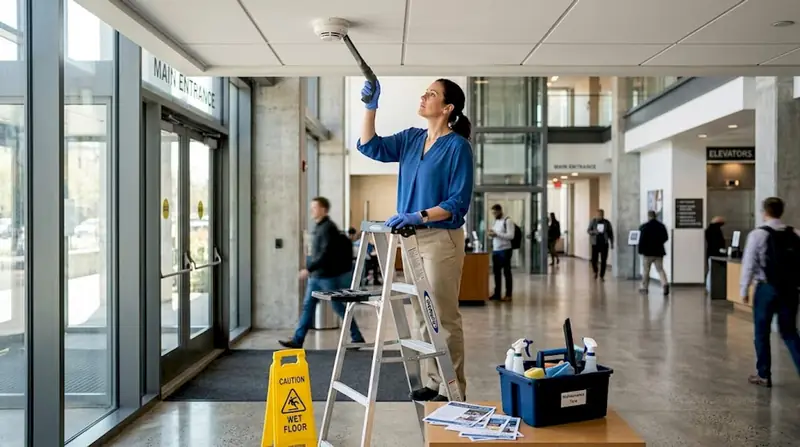
Dust accumulation inside a smoke detector chamber is one of the leading causes of false alarms. In Houston, construction zones and older warehouse conversions are especially vulnerable. Steam from commercial kitchens, bathrooms, and HVAC systems can also trigger photoelectric detectors. The fix isn’t complicated: regular cleaning on a scheduled basis and switching to advanced fire detectors that use multi-criteria sensing.
Multi-sensor detectors combine smoke, heat, and sometimes carbon monoxide detection. They require confirmation from more than one sensor type before initiating an alarm, which filters out most environmental false triggers. According to industry survivability research, switching to multi-sensor detectors is one of the most cost-effective ways to reduce nuisance alarms while keeping true detection accuracy high.
Power failure vulnerabilities
Houston isn’t a stranger to power disruptions, whether from summer storms, grid demand spikes, or infrastructure failures. Your fire alarm system must keep working through all of it. Battery backup requirements mandate that panels operate for 24 hours in standby mode plus a minimum of 5 to 15 minutes of full alarm output on batteries alone. If your system’s backup batteries are old or untested, this capability is likely degraded.
| Failure type | Common cause | Prevention strategy |
|---|---|---|
| False alarms | Dust, steam, insects | Multi-sensor detectors, regular cleaning |
| Power failure | Outages, aging batteries | Test backup batteries quarterly |
| Wiring damage | Fire exposure, age | Two-hour fire-rated circuits |
| Panel malfunction | Outdated firmware, neglect | Annual professional inspection |
| Sensor drift | Age, contamination | Replace sensors per manufacturer schedule |
Pathway survivability gaps
This is the one that surprises most property owners. If fire damages the wiring between your panel and your notification devices, alarms can’t sound even though the panel detected the fire. Two-hour fire-rated circuit protection, as outlined in survivability standards, ensures alarm notification continues even as the building structure is compromised. Many Houston properties built before updated codes took effect have standard wiring where fire-rated circuits are required.
Pro Tip: Pull your system’s as-built drawings and verify which circuits are rated for pathway survivability. If you can’t find those drawings, a professional inspection will document this for you and flag any gaps.
The good news: many of these issues are straightforwardly addressed through proper maintaining fire alarms practices and scheduled professional reviews. The systems that fail unexpectedly are almost always the ones that weren’t looked at until something went wrong.
Practical steps for Houston property owners and managers
Knowing what the sequence is and where it can fail is only useful if it leads to action. Here’s what to actually do.
1. Schedule routine sensor cleaning
Add detector cleaning to your quarterly maintenance calendar. A quick check with a calibrated test aerosol confirms detector sensitivity. Inspectors use specialized equipment to measure whether each sensor is responding at the correct threshold.
2. Document every inspection
Houston fire code requires documented inspection records for commercial properties. Keep a maintenance log that includes the date, technician name, devices tested, results, and any corrective actions taken. This log is your first line of defense during a code inspection.
3. Test battery backups quarterly
Don’t assume the batteries are good because they were replaced last year. Test them under load to confirm they can actually sustain alarm output. A battery that passes a voltage check may still fail under the current draw of full alarm activation.
4. Address false alarm patterns proactively
If your system triggers false alarms more than once a quarter, that’s a pattern worth investigating immediately. Repeated false alarms erode occupant trust and can lead to delayed evacuation responses when a real emergency occurs. Review your fire alarm inspection guide to understand what a thorough audit covers.
5. Bring in professionals for annual certification
Annual professional inspections are the minimum standard. Quarterly checks are strongly recommended for commercial properties in Houston’s more active districts, including Midtown, Montrose, and the Heights. A certified technician will check every stage of the sequence, from sensor sensitivity to panel programming to notification device output levels.
“The value of the importance of fire alarms isn’t in having the equipment. It’s in knowing it will work exactly as designed the moment it’s needed.”
Understanding why testing fire alarms on a regular schedule matters goes beyond code compliance. It builds institutional knowledge about your specific system’s behavior, which is priceless during an actual emergency.
Pro Tip: Create a one-page emergency reference sheet for your building staff that outlines who is authorized to reset the panel, what the reset procedure is, and who to call if the system behaves unexpectedly. Post it at the panel.
The real impact of understanding your fire alarm sequence
Here’s an unpopular opinion in the fire safety industry: most property managers treat code compliance as the finish line. Pass the inspection, file the paperwork, and move on. That mindset is backward.
Code requirements are the floor, not the ceiling. They represent the minimum level of protection needed to keep a building legally occupiable. They are not designed to give you the best possible outcome in an emergency. They’re designed to prevent the worst outcome. That’s a meaningful difference.
In our experience working with Houston properties across industries, the buildings that perform best during actual fire events are not the ones that are technically compliant. They’re the ones where someone actually understands what their system does and why. When a manager knows their panel’s verification delay is set to 20 seconds, they know what to expect. When they know their eastern wing sensors are more prone to steam triggers from the kitchen below, they address it proactively rather than explaining it away.
Modern fire detector solutions have made systems dramatically more intelligent. But technology only goes so far if the humans managing it treat the system as a black box. The deepest benefit of understanding your fire alarm sequence isn’t just avoiding fines or passing inspections. It’s building genuine safety resilience that holds up under pressure, at 2 AM, in a storm, when the power has been out for six hours and your backup batteries are the only thing standing between your occupants and silence.
Property owners who invest time in understanding their systems consistently make better decisions about upgrades, maintenance timing, and emergency response planning. That compounding effect of informed decisions is where the real return on safety investment lives.
Next steps: Enhance your property safety with expert help
If this breakdown has raised questions about your current system, that’s a healthy sign. It means you’re thinking about fire safety the right way: not as a checkbox, but as a living system that needs attention, testing, and periodic upgrades.
At Reliable Fire Protection, we work with property owners and managers across Houston including Midtown, Montrose, University Place, and Houston Heights to assess, install, and maintain fire alarm systems that perform at every stage of the sequence. Whether you need a full system review, want to upgrade to multi-sensor detectors, or simply need your annual inspection scheduled, we’re ready to help. Start with a thorough look at our in-depth fire alarm system overview and then reach out for a free quote tailored to your property’s specific needs. Your system should work flawlessly when it counts. Let’s make sure it does.
Frequently asked questions
What is a fire alarm sequence, and why does it matter for Houston properties?
A fire alarm sequence is the step-by-step process by which a system detects fire, verifies the danger, triggers alerts, and initiates emergency response. Understanding it helps Houston property owners close compliance gaps and ensure the system functions correctly under real conditions, including power and wiring edge cases.
How can false alarms be prevented in fire alarm systems?
False alarms are best prevented through regular sensor cleaning, replacing single-technology detectors with multi-sensor units, and scheduling routine maintenance checks that catch environmental triggers before they become a pattern.
What happens if the power fails during a fire alarm event?
Modern fire alarm systems use battery backups rated for 24-hour standby power plus a minimum of 5 to 15 minutes of full alarm output, giving occupants time to evacuate even during extended outages.
What is pathway survivability in fire alarm systems?
Pathway survivability means the alarm wiring uses two-hour fire-rated circuits that keep notification devices functioning even when fire directly damages the building’s wiring routes.
How often should fire alarm systems be professionally inspected?
Fire alarm systems require at least an annual professional inspection, but commercial Houston properties benefit most from quarterly evaluations that catch sensor drift, battery degradation, and programming issues before they affect system performance.
Recommended
- Fire Alarm Installation Guide for Houston Property Managers
- Fire Alarm Inspection Guide for Safe Houston Properties
- How to Choose Fire Alarm System for Houston Properties
- How to choose fire alarms for Houston properties: 5 steps
- Essential boiler safety tips every homeowner should know
- Fire Alarm System University Place TX
- Fire Alarm System Services in Bellaire, TX