
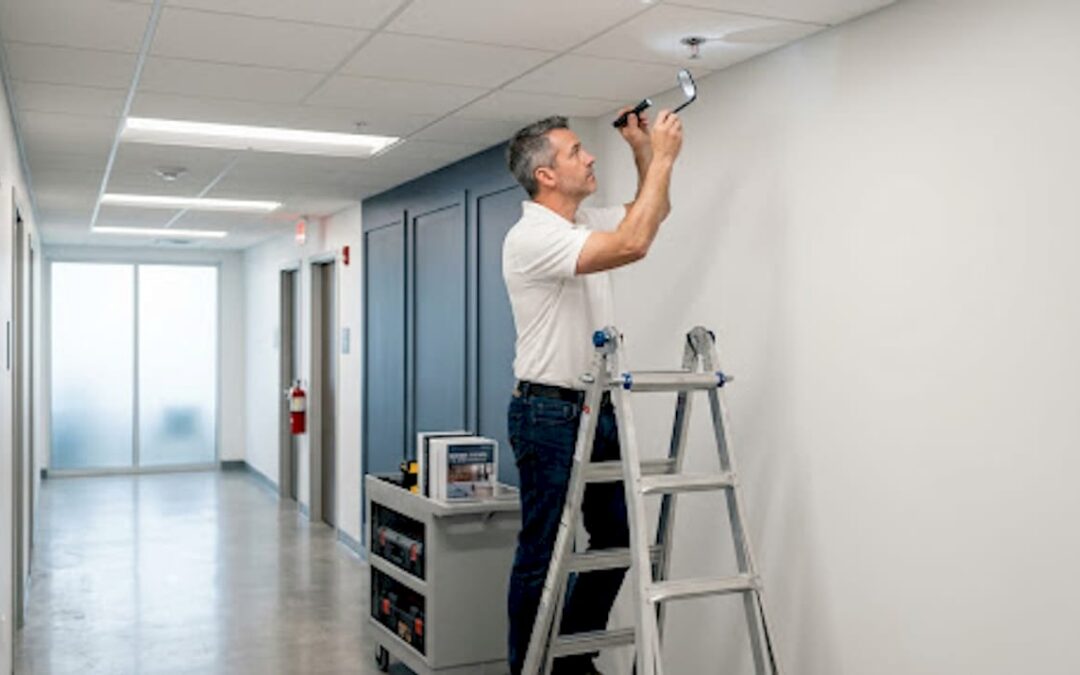
TL;DR:
- Fire sprinkler heads are not interchangeable; choosing the correct type is critical for safety and compliance. Each head type—pendent, upright, sidewall, or concealed—serves specific architectural needs and environmental conditions. Specialized systems like ESFR and clean agent options are essential for high-risk or sensitive environments to ensure effective fire suppression without secondary damage.
Most property owners assume all fire sprinkler heads are interchangeable. They are not. Getting fire sprinkler head types explained properly matters because the wrong head in the wrong space can mean the difference between a contained fire and a total loss. Whether you manage a commercial office, a warehouse, or a residential building, understanding the types of fire sprinkler heads and their specific applications gives you a real advantage in safety planning and code compliance. This guide walks you through each major type, specialized options, and the selection criteria that experienced fire protection professionals use every day.
Table of Contents
- Key takeaways
- Fire sprinkler head types explained
- Specialized heads for high-risk and sensitive environments
- Choosing the right head for your property
- Maintenance and common pitfalls
- My perspective on sprinkler head selection mistakes
- Get the right sprinkler system for your property
- FAQ
Key takeaways
| Point | Details |
|---|---|
| Four core head types | Pendent, upright, sidewall, and concealed heads cover most standard commercial and residential applications. |
| Specialized heads for high-risk spaces | ESFR and clean agent systems exist specifically for warehouses, server rooms, and other hazard-specific environments. |
| Environment drives selection | Ceiling type, obstructions, room use, and risk profile all determine which sprinkler head is appropriate. |
| Certification matters | Only FM Approved or UL Listed heads meet regulatory requirements and perform reliably under real fire conditions. |
| Maintenance is head-specific | Each sprinkler head type has unique inspection criteria that affect system reliability and compliance standing. |
Fire sprinkler head types explained
Understanding how do fire sprinklers work starts with one critical fact: sprinklers activate only near the fire, not across the entire building. Each head contains a heat-sensitive glass bulb or fusible link. When ambient temperature rises to the head’s rated threshold, that element breaks or melts, releasing pressurized water directly onto the fire source. This localized response is what makes sprinklers so effective at limiting damage compared to broad suppression methods.
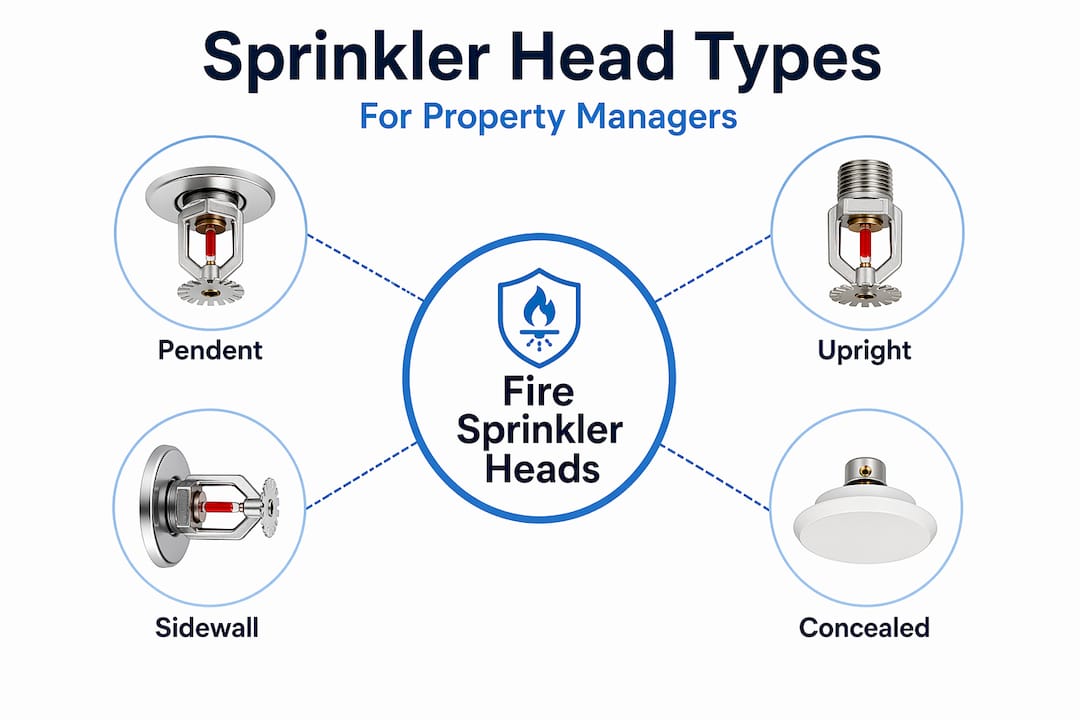
The four primary sprinkler head types are pendent, upright, sidewall, and concealed. Each serves a distinct architectural and operational purpose.
Pendent heads
Pendent sprinkler heads hang downward from the supply pipe and distribute water in a circular, umbrella-like pattern across the floor below. They are the most common type found in commercial spaces, office buildings, and retail environments. The deflector plate at the bottom of the head breaks the water stream into a wide spray pattern, maximizing floor coverage from a single point.
Upright heads
Upright sprinkler heads sit above the supply pipe and spray water upward, letting it deflect off a curved plate and cascade down and outward. You typically find these in mechanical rooms, storage areas, and industrial spaces where exposed piping is acceptable and ceiling obstructions like beams or equipment racks would interfere with downward-facing heads.

Sidewall heads
Sidewall sprinkler heads mount on walls rather than ceilings and project water in a half-circle pattern across the room. They work well in corridors, hotel guest rooms, and spaces where running overhead pipe is architecturally impractical. A standard sidewall head covers a rectangular area, which makes placement geometry more predictable for narrow spaces.
Concealed heads
Concealed sprinkler heads sit flush with the ceiling behind a decorative cover plate. When heat activates the head, the cover drops away and the sprinkler operates normally. These are the preferred choice anywhere aesthetics matter, including lobbies, restaurants, and high-end residential spaces.
Pro Tip: Never paint over a concealed sprinkler cover plate. Paint can bond the plate to the ceiling and delay or prevent the cover from dropping during a fire, which slows activation exactly when you need it most.
Specialized heads for high-risk and sensitive environments
Standard sprinkler heads handle most everyday fire risks. But certain environments demand technologies built specifically for their hazard profile. This is where a solid guide to sprinkler types has to go beyond the basics.
ESFR sprinklers for warehouse applications
Early Suppression Fast Response (ESFR) sprinklers were engineered specifically for high-bay storage environments. ESFR heads release large water droplets at high velocity, driving them through the heat column of a warehouse fire to suppress it at the source rather than just controlling spread. This distinction matters enormously. Standard heads control fire spread but do not suppress outright, which means a fully stocked pallet rack fire can outpace a standard system and result in total loss.
If you manage a distribution center or any facility with rack storage above 12 feet, ESFR heads are not optional. They are the engineered answer to a specific physics problem.
Clean agent and water mist systems for sensitive areas
Server rooms, data centers, and museum collections cannot tolerate the water damage that even a single sprinkler activation causes. Two alternatives exist for these environments.
- Clean agent suppression systems use gases like FM-200 or Novec 1230 to displace oxygen and interrupt the fire’s chemical chain reaction. These systems activate automatically and leave no residue, protecting electronics and archival materials without secondary damage.
- Water mist systems use microscopic droplets to rapidly cool flames. Water mist dramatically reduces water damage compared to conventional sprinklers, making them ideal for data centers, museums, and similar spaces where conventional heads would create a secondary disaster.
- Pre-action systems add an electronic detection trigger before water enters the pipe, providing an extra layer of protection against accidental discharge in areas housing critical assets.
Choosing the right suppression technology for a sensitive environment is not about preference. It is about matching the extinguishing agent to the hazard and the asset at risk. A clean agent system in a server room does not just protect equipment. It protects the data, the business continuity, and the liability exposure of the property owner.
Choosing the right head for your property
Selecting among types of fire sprinkler heads requires evaluating several factors simultaneously. This is where many property owners and facility managers make costly mistakes by defaulting to whatever the original building used rather than reassessing based on current occupancy and risk.
Environmental and architectural factors
| Factor | Consideration | Head Types Affected |
|---|---|---|
| Ceiling type | Exposed, tile, or finished drywall determines mounting options | Concealed preferred for finished ceilings |
| Room dimensions | Narrow corridors limit overhead pipe runs | Sidewall heads often required |
| Obstructions | Beams, storage racks, HVAC ducts interfere with spray patterns | Upright or additional pendent heads |
| Aesthetics | Visible heads may be unacceptable in client-facing spaces | Concealed heads mandatory |
| Storage height | Rack storage above 12 feet changes fire behavior significantly | ESFR required |
Coordinating sprinkler heads with ceiling elements like HVAC diffusers and lighting fixtures is not just a design preference. Obstructed heat-sensitive bulbs delay activation, and even a 30-second delay in a fast-moving fire has measurable consequences. Facility managers should review reflected ceiling plans carefully and work with your fire protection contractor before finalizing any ceiling layout.
Pro Tip: When renovating an existing space, always reassess the sprinkler head type, not just the coverage layout. A change in occupancy from office to light storage can shift your required head classification entirely.
Compliance and risk-based selection
Local codes and the National Fire Protection Association (NFPA) standards set minimum requirements, but minimum is rarely optimal. Choosing heads that align with both building design and risk profile significantly improves protection outcomes and reduces property loss.
For Houston properties specifically, staying current on local fire code amendments alongside NFPA 13 requirements is part of responsible facility management. The fire protection standards for Houston properties are specific enough that generic national guidance will not always get you to full compliance.
Maintenance and common pitfalls
A sprinkler head that has not been inspected regularly is a liability, not an asset. Routine inspection tailored to each head type is the only way to guarantee the system performs when you need it.
Here are the core maintenance practices every property owner and facility manager should follow:
- Inspect concealed heads quarterly for paint buildup, physical damage, and cover plate integrity. A painted or dented cover plate will not drop correctly under heat, defeating the entire mechanism.
- Check pendent and upright heads annually for corrosion, leakage at the fitting, and correct orientation. An upright head installed in a pendent position, or vice versa, will distribute water incorrectly and fail pattern coverage requirements.
- Test sidewall head clearances to confirm no new furniture, shelving, or equipment has been placed within 18 inches of the deflector plate. Obstructed deflectors reduce spray radius significantly.
- Verify certification markings on any replacement heads. FM Approved and UL Listed components are the baseline standard for real-world fire performance and regulatory compliance. Uncertified replacement heads look identical but may fail at the critical moment.
- Integrate sprinkler inspection into your broader fire safety program rather than treating it as a standalone item. Cross-referencing your fire prevention checklist with your sprinkler maintenance schedule closes the gaps that individual inspections miss.
The most common installation mistake in new construction is placing heads too close to high-output lighting or HVAC supply diffusers. The heat from a light or the cold air from a diffuser can skew the thermal environment around the head, either triggering a false activation or delaying a real one. This is an issue that shows up years after installation, long after the original contractor has moved on.
My perspective on sprinkler head selection mistakes
I have seen the consequences of choosing the wrong sprinkler head type in person, and they are not subtle. One common scenario involves a building owner converting a lower-level office space into a storage facility without reassessing the sprinkler system. The pendent heads were perfectly adequate for the original use. Under the new high-density racking, they were dangerously undersized for the fire load.
What I have learned from years working on fire protection projects is that aesthetics routinely override function in the initial design phase. A developer pushes for concealed heads throughout a mixed-use building, including in areas where the ceiling configuration would delay activation by covering the heat-sensitive element with a deep air pocket. The concealed head is the right choice in many situations. It is the wrong choice when the ceiling design creates a thermal barrier.
My honest recommendation is this: bring your fire protection contractor into the conversation at the schematic design stage, not after the ceiling grid is finalized. Professional sprinkler planning for commercial spaces done early costs far less than a system redesign after construction. The technology is proven and the reliability is high. The failures almost always come from misapplication, not from the heads themselves.
— Reliable-fire-protection
Get the right sprinkler system for your property

Understanding fire sprinkler head types is the foundation. Implementing the right system for your specific property takes certified expertise. Reliable-fire-protection works with Houston-area property owners and facility managers to assess occupancy risk, select the correct head types, and install systems that meet both NFPA standards and local code requirements. Whether you are building new, renovating, or auditing an existing system, the team brings the credentials and field experience to get it right the first time. Explore the sprinkler compliance workflow or learn how your sprinklers connect to your fire alarm systems for a fully integrated protection strategy. Contact Reliable-fire-protection for a tailored assessment today.
FAQ
What are the four main types of fire sprinkler heads?
The four primary types are pendent, upright, sidewall, and concealed. Each is designed for specific ceiling configurations, room types, and installation environments.
How do fire sprinklers work when a fire starts?
A heat-sensitive glass bulb or fusible link inside the head breaks when surrounding air reaches the head’s rated temperature, releasing pressurized water directly onto the fire source. Only heads in the immediate fire area activate, which limits water damage to the affected zone.
When are ESFR sprinkler heads required?
ESFR heads are required in high-bay warehouse and industrial storage facilities, particularly where rack storage exceeds 12 feet. Standard heads cannot suppress these fires; they can only slow their spread.
Can you use water-based sprinklers in a server room?
Water-based sprinklers are generally not recommended for server rooms due to the risk of equipment damage. Clean agent suppression systems or water mist systems are preferred because they suppress fire without leaving residue or causing extensive water damage.
How often should fire sprinkler heads be inspected?
Inspection frequency varies by head type, but most systems require at least an annual inspection by a certified technician, with quarterly visual checks for concealed and accessible heads. Local codes and NFPA 25 standards set the minimum schedule.
Recommended
- Fire Sprinkler Systems Explained: Protecting Houston Properties
- Sprinkler System Inspection Guide for Houston Properties
- How to Install Fire Sprinklers for Safe Commercial Spaces
- How Fire Sprinklers Work: Safety for Houston Properties
- Fire Alarm System University Place TX
- Fire Alarm System Services in Bellaire, TX