
TL;DR:
- Advanced fire detection systems provide earlier warnings and reduce false alarms in high-hazard environments. They utilize technologies like aspirating smoke, multi-criteria sensors, flame, gas, and linear heat detection, all compliant with NFPA 72 standards. Proper installation, commissioning, and ongoing maintenance by NICET-certified contractors ensure effective safety and risk mitigation.
Advanced fire detection systems are detectors and integrated alarm/monitoring solutions, including aspirating smoke (VESDA), multi-criteria smoke, flame (UV/IR), linear heat, gas detection, and addressable monitored panels, designed to deliver earlier and more accurate warnings than traditional spot detectors. They are required or strongly recommended for high-consequence and high-hazard spaces: data centers, museums, clean rooms, fuel storage facilities, and chemical processing plants.
Three reasons to consider them now:
- Earlier warning: Aspirating smoke detection can identify incipient smoke minutes or hours before a conventional spot detector responds.
- Fewer nuisance alarms: Multi-criteria detectors with onboard algorithms cut false evacuations, protecting operations and reducing fines.
- Automated building response: Integration with HVAC, elevators, and suppression systems limits smoke spread and supports safe egress automatically.
These systems must comply with NFPA 72 and carry UL or Factory Mutual product listings. Reliable-fire-protection installs and services them across Houston and surrounding areas.
Table of Contents
- What are advanced detection systems, and how does each technology work?
- Why do advanced detection systems reduce risk and downtime?
- What U.S. codes and certifications apply to advanced fire detection?
- How do you select the right advanced detection system?
- What should your installation and maintenance scope of work require?
- How does advanced detection integrate with your building systems?
- What drives cost and how long does installation take?
- When should you bring in a qualified fire-protection contractor?
- Key Takeaways
- The part most facility managers underestimate
- Reliable-fire-protection handles advanced detection from survey to service
- Useful sources and standards references
What are advanced detection systems, and how does each technology work?
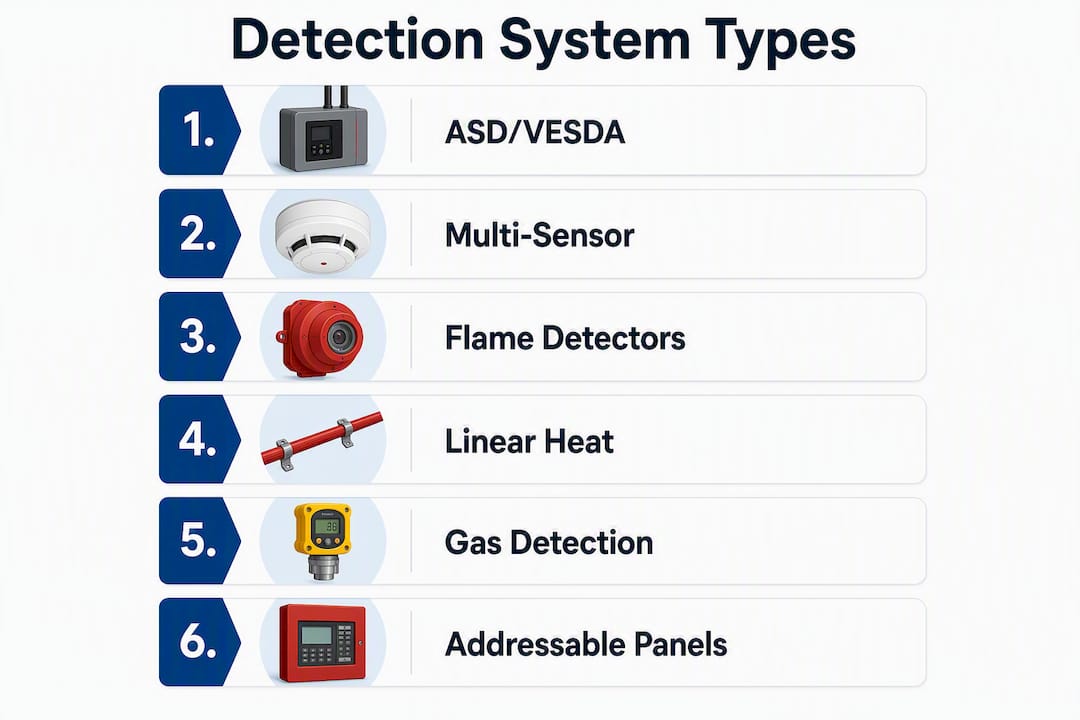
Advanced fire detection covers six core technologies. Each senses fire or hazardous conditions differently, and matching the right one to your site hazard is the whole game.
Aspirating smoke detection (ASD/VESDA)
An ASD system draws air continuously from multiple sample points through a pipe network into a central detection chamber, where laser-based particle analysis identifies smoke at concentrations far below what a ceiling-mounted spot detector can register. The central unit offers multiple programmable alarm thresholds: Alert, Action, Fire 1, and Fire 2. That tiered structure lets staff investigate an overheating server before a full alarm triggers, avoiding unnecessary evacuations and suppression discharges.
Multi-criteria and multi-sensor detectors
These combine smoke, heat, and often CO sensors inside a single housing. Onboard algorithms weigh all three signals before generating an alarm. Facilities switching to multi-sensor technology report 40–50% fewer nuisance alarms, a meaningful operational benefit in occupied buildings.
Flame detectors
UV, IR, UV/IR, and multi-spectrum IR (MSIR) detectors sense radiant energy from open flames rather than smoke or heat. UV detectors can respond within 3–4 milliseconds in controlled environments. MSIR models handle a broader range of fuel types and reject more false triggers from sunlight or hot equipment. These are line-of-sight devices, so placement geometry matters. Learn more about flame detector applications before specifying them.
Linear heat detection
A continuous heat-sensing cable runs along conveyors, cable trays, tunnels, or cold-storage ceilings. When any segment reaches the rated temperature, it triggers an alarm. Spot detectors are impractical in many of these environments; linear heat cable covers the entire run.
Gas detection
Fixed-point combustible or toxic gas sensors identify fuel leaks before ignition. In fire protection systems for facilities with natural gas, hydrogen, or chemical vapors, gas detection is often the first line of defense, triggering ventilation or shutdown before a flame or smoke event occurs.
Addressable panels and device addressing
Every initiating device on an addressable system carries a unique address. The panel interrogates each device every few seconds, enabling precise fault localization, drift compensation to reduce false alarms, and maintenance alerts before a device fails. For medium-to-large facilities, addressable architecture is almost always the right choice.
| Technology | Primary sensing method | Best-fit environments |
|---|---|---|
| ASD/VESDA | Laser particle analysis of sampled air | Data centers, museums, clean rooms |
| Multi-criteria | Combined smoke, heat, CO algorithms | Offices, healthcare, hospitality |
| Flame (UV/IR/MSIR) | Radiant energy from open flames | Fuel storage, chemical plants, hangars |
| Linear heat | Temperature rise along continuous cable | Conveyors, tunnels, cable trays |
| Gas detection | Fixed-point combustible/toxic sensors | Facilities with fuel or chemical vapors |
| Addressable panels | Device-level interrogation and addressing | Medium-to-large commercial/industrial |
Pro Tip: For high-ceiling warehouses above 30 feet, ASD pipe networks or linear heat cable typically outperform spot detectors, which struggle to sense smoke that dilutes before reaching ceiling height.
Why do advanced detection systems reduce risk and downtime?
The core business case is straightforward: detect earlier, respond smarter, and stop paying for false alarms.
ASD systems detect incipient smoke minutes or hours before conventional detectors respond. In a data center, that gap is the difference between powering down a rack and losing an entire server room. In a museum, it is the difference between investigating a humidity anomaly and activating a suppression system over irreplaceable artifacts.
Advanced fire detection systems that reliably differentiate real fires from nuisance sources, such as dust, steam, and aerosols, preserve operations and reduce costly evacuations. The intelligence built into modern multi-criteria and ASD systems is what separates them from conventional technology.
Nuisance alarm reduction is equally important. False alarms carry direct costs: local fire department response fees, tenant disruption, and reputational damage. Facilities that have moved to multi-criteria detectors report 40–50% fewer nuisance alarms. That reduction alone often justifies the upgrade for high-traffic commercial buildings.
Specific use cases where advanced detection materially changes outcomes:
- Data centers and telecom rooms: ASD with multi-level thresholds; early Alert stage gives IT staff time to isolate failing equipment.
- Museums and archives: ASD and multi-criteria detectors protect irreplaceable collections without triggering suppression on a cleaning aerosol.
- Fuel storage and chemical processing: Flame and gas detectors catch ignition-risk conditions in milliseconds.
- High-ceiling warehouses: ASD pipe networks or linear heat cable where spot detectors lose sensitivity.
- Commercial kitchens: Heat detectors and multi-criteria devices tuned to cooking environments reduce steam-triggered false alarms.
What U.S. codes and certifications apply to advanced fire detection?
NFPA 72 is the governing standard for fire alarm and detection system design, installation, testing, and maintenance in the United States. Chapter 17 covers initiating devices, including detector spacing, placement, and sensitivity requirements. For specific occupancies, additional NFPA standards apply: NFPA 409 for aircraft hangars, for example, requires radiant-energy sensing detectors in certain areas.
Every device must carry a UL listing or FM approval. In hazardous locations, equipment must also carry a hazardous-area rating appropriate to the classified zone. Manufacturer datasheets confirm which listings apply to each model.
Pro Tip: Request the UL listing number and the specific UL standard (e.g., UL 268 for smoke detectors, UL 521 for heat detectors) for every device in a proposal. A listing number you can verify beats a vendor’s verbal assurance.
Personnel qualifications matter as much as product listings. Designers and technicians should hold NICET certification in Fire Alarm Systems (Level II minimum for most commercial projects). Factory authorization from the detector manufacturer confirms the installer has received product-specific training. The Authority Having Jurisdiction (AHJ) reviews and approves the design before installation begins and conducts acceptance inspections afterward.
Documentation requirements include:
- Completed acceptance test reports per NFPA 72 Chapter 14
- Device-level as-built drawings with addresses and locations
- Written inspection and maintenance plan with service intervals
- Commissioning report signed by the installing contractor
How do you select the right advanced detection system?
Start with a site risk assessment before evaluating any product.
Site assessment checklist:
- Occupancy type and value at risk (people, equipment, collections, inventory)
- Environmental conditions: temperature extremes, humidity, dust, chemical vapors, airflow patterns
- Ceiling height and structural obstructions
- Existing wiring infrastructure and panel compatibility
- AHJ requirements and any occupancy-specific NFPA standards
Once the site picture is clear, evaluate technical criteria: sensitivity ranges, response times, detection coverage and spacing, line-of-sight constraints for flame detectors, and alarm threshold programmability for ASD systems. For false alarm management specifically, multi-criteria devices and addressable drift compensation are the two most effective tools available.
Operational criteria to weigh alongside technical specs:
- Centralized testing capability (ASD systems allow inspection at the central unit, not at each ceiling point)
- Integration with your building management system and central monitoring station
- Spare parts availability and manufacturer support in your region
- Service agreement terms and response time commitments
Vendor questions to include in your RFP:
- Provide UL/FM listing numbers for every proposed device.
- Describe your commissioning plan and what the acceptance test report will include.
- What is your maintenance SLA, and what does it cover?
- Are your technicians NICET-certified and factory-authorized for this product line?
- What training will you provide to our onsite staff?
- How does this system integrate with our existing BMS?
What should your installation and maintenance scope of work require?
Commissioning and acceptance testing are not optional formalities. NFPA 72 Chapter 14 specifies functional tests, sensitivity verification, detector coverage checks, and documentation requirements. Every test must be recorded in a signed acceptance report before the AHJ signs off.
| Maintenance task | Frequency | Notes |
|---|---|---|
| Functional alarm test | Annual (minimum) | Per NFPA 72; more frequent for high-hazard sites |
| Sensitivity verification | Per NFPA 72 schedule | Required for smoke detectors |
| ASD sample-point inspection | Annual | Check for blockages, pipe integrity |
| Detector cleaning | As needed / per manufacturer | Drift compensation helps extend intervals |
| Supervised circuit check | Quarterly or per monitoring contract | Confirm signal path integrity |
For ASD systems, centralized testing at the detection unit means technicians rarely need to access individual ceiling sample points. That is a significant cost and disruption saver in facilities with high ceilings or secure server rooms.
Maintenance deliverables to require in your service contract:
- Written service report after every visit
- Log of any threshold changes with before/after values
- Spare-part list with recommended on-hand quantities
- Documented inspection cadence tied to NFPA 72 and AHJ requirements
How does advanced detection integrate with your building systems?
Integration is where advanced detection moves from “detector” to “coordinated response platform.” A properly configured system connects to:
- Suppression systems: — Targeted activation based on confirmed detection zone
Integration with building management systems also enables remote monitoring and cloud telemetry for predictive maintenance. Addressable systems with supervised circuits report device status continuously, flagging drift or faults before they become failures.
Test every integrated sequence during commissioning and document the results in the acceptance report. A sequence that works in isolation but fails during a coordinated test is a liability, not a safety feature.
What drives cost and how long does installation take?
Cost varies significantly by detector type, building complexity, and whether you are retrofitting or building new.
Primary cost drivers:
- Detector type: ASD and multi-spectrum IR systems carry higher equipment costs than conventional smoke detectors; addressable panels cost more than conventional panels but deliver more value over the lifecycle.
- Labor: High-ceiling work, secure-area access restrictions, and complex wiring runs add labor hours.
- Integration complexity: BMS tie-ins, suppression interfaces, and EVAC system coordination require additional engineering and testing time.
- AHJ documentation: Design review submissions, permit fees, and acceptance testing add time and cost that are often underestimated.
For retrofits, modern addressable systems can often reuse existing wiring or use approved wireless bridging, reducing both cost and downtime. Phased upgrades, replacing one zone at a time, let occupied facilities avoid full shutdowns.
Rough timeline ranges by project scale:
- Small project (single floor, straightforward occupancy): 4–8 weeks from design to acceptance
- Medium project (multi-floor commercial): 3–5 months
- Large or complex project (industrial, high-hazard, multi-building): 6–12 months or more
Pro Tip: Budget lifecycle costs from day one: annual service contracts, calibration, consumables, and eventual device replacement. First-cost-only budgeting routinely leads to deferred maintenance and compliance gaps.
When should you bring in a qualified fire-protection contractor?
Bring a contractor in at the design stage, not after you have already selected equipment. The design determines AHJ submittal requirements, device placement, wiring topology, and integration scope. Getting it wrong at design costs far more to fix after installation than before.
Specific trigger points for professional involvement:
- Complex or high-hazard occupancies (fuel storage, chemical processing, data centers)
- Retrofits that affect existing life-safety systems
- Facilities without internal NICET-certified staff to manage design review
- Any project requiring AHJ submission and acceptance testing
Minimum contractor credentials to verify:
- NICET certification in Fire Alarm Systems (request copies, not just verbal confirmation)
- Factory authorization letters from the detector and panel manufacturers
- Sample commissioning reports and acceptance test templates from prior projects
- Current state contractor license and liability insurance
Pro Tip: Ask for a sample acceptance test report from a completed project before signing a contract. A contractor who cannot produce one has likely never completed a proper commissioning process.
Service deliverables to require at project close:
- Signed commissioning and acceptance test report
- Device-level as-built drawings with addresses, locations, and zone assignments
- Maintenance schedule tied to NFPA 72 intervals
- Spare-part list with recommended stock quantities
- Onsite staff training on panel operation and alarm response procedures
Reliable-fire-protection provides all of these deliverables as standard on every advanced detection project in the Houston area.
| Contractor qualification | Why it matters |
|---|---|
| NICET certification | Confirms technical competency for design and testing |
| Factory authorization | Ensures product-specific training and warranty support |
| UL/FM familiarity | Required for code-compliant device selection |
| Sample commissioning report | Proves the contractor actually performs documented testing |
| State license and insurance | Protects the facility owner from liability |
Key Takeaways
Advanced fire detection systems deliver earlier warning, fewer false alarms, and automated building responses, but only when specified, installed, and maintained to NFPA 72 by NICET-certified contractors using UL-listed equipment.
| Point | Details |
|---|---|
| Match technology to hazard | ASD for data centers and museums; flame/gas detectors for fuel storage and chemical plants; linear heat for conveyors and tunnels. |
| Verify compliance checkpoints | Every project requires NFPA 72 compliance, UL/FM-listed devices, AHJ approval, and NICET-qualified personnel. |
| Demand documented commissioning | Acceptance test reports, as-built drawings, and a written maintenance schedule are non-negotiable deliverables. |
| Budget for lifecycle costs | Service contracts, calibration, and eventual device replacement belong in the first budget, not a future surprise. |
| Reliable-fire-protection | Provides site surveys, code-compliant design, installation, commissioning, and service contracts for advanced detection systems in Houston. |
The part most facility managers underestimate
The technology conversation tends to dominate advanced detection projects. Facility managers spend weeks comparing ASD sensitivity specs and flame detector response times, then sign a contract with a contractor who has never produced a proper commissioning report. That is where projects actually fail.
NFPA 72 acceptance testing is not a formality. It is the documented proof that every device, every integrated sequence, and every alarm threshold performs as designed. Without it, you have equipment installed in your building with no verified baseline. When something goes wrong, and eventually something always does, you have no record of what the system was supposed to do.
The second underestimated factor is sample-point placement for ASD systems. A pipe network with poorly located sample points can leave dead zones in the very areas you are trying to protect. Placement requires understanding airflow patterns in the protected space, not just running pipe to convenient ceiling locations.
The facilities that get the most out of advanced detection are the ones that treat commissioning and the first annual inspection as seriously as the equipment selection. They ask for test reports, they review threshold settings, and they hold contractors accountable to the maintenance schedule. The technology is genuinely impressive. The process around it is what makes it work.
Reliable-fire-protection handles advanced detection from survey to service
Specifying and installing advanced fire detection correctly requires site-specific engineering, AHJ coordination, and documented commissioning. Reliable-fire-protection delivers all of it, from the initial site survey through annual inspections and emergency response, for facilities across Houston and the surrounding area.
The team includes NICET-certified technicians and factory-authorized installers who work with aspirating smoke detection, multi-criteria detectors, flame and gas detection, addressable panels, and integrated building system connections. Every project closes with a signed acceptance test report, device-level as-built drawings, and a written maintenance schedule. Need to know how fire alarm systems work before requesting a proposal? That resource walks through the fundamentals. Ready to move forward? Contact Reliable-fire-protection for a free site survey and written proposal.
Useful sources and standards references
Standards and regulatory references:
- NFPA 72: National Fire Alarm and Signaling Code — the primary U.S. standard for detection system design, installation, testing, and maintenance
- Very Early Warning Fire Detection Systems white paper (NRC) — technical overview of VEWFD systems and their applications
- Advances in Fire Alarm Technology (SFPE) — covers emerging detection technologies including video-based smoke detection
Technical and manufacturer references:
- VESDA aspirating smoke detection guide — explains ASD sensitivity settings, alarm thresholds, and appropriate applications
- Fire detection system technologies overview — covers UV/IR flame detectors, multi-criteria devices, and nuisance alarm data
- Aspirating smoke detection from Xtralis (Facility Executive) — centralized testing benefits and lifecycle cost considerations
- Fire protection in hazardous locations (Det-Tronics white paper) — guidance on hazardous-area-rated equipment and detector selection
- Addressable vs. conventional fire alarm systems — trade-offs for retrofit and new-construction projects
- VESDA guide with alarm threshold detail (C4Fire) — multi-level threshold programming and nuisance alarm management
Local resource:
- Reliable-fire-protection serves Houston and nearby areas for advanced detection surveys, installation, commissioning, and service. Check AHJ requirements with your local fire marshal before finalizing any system design.