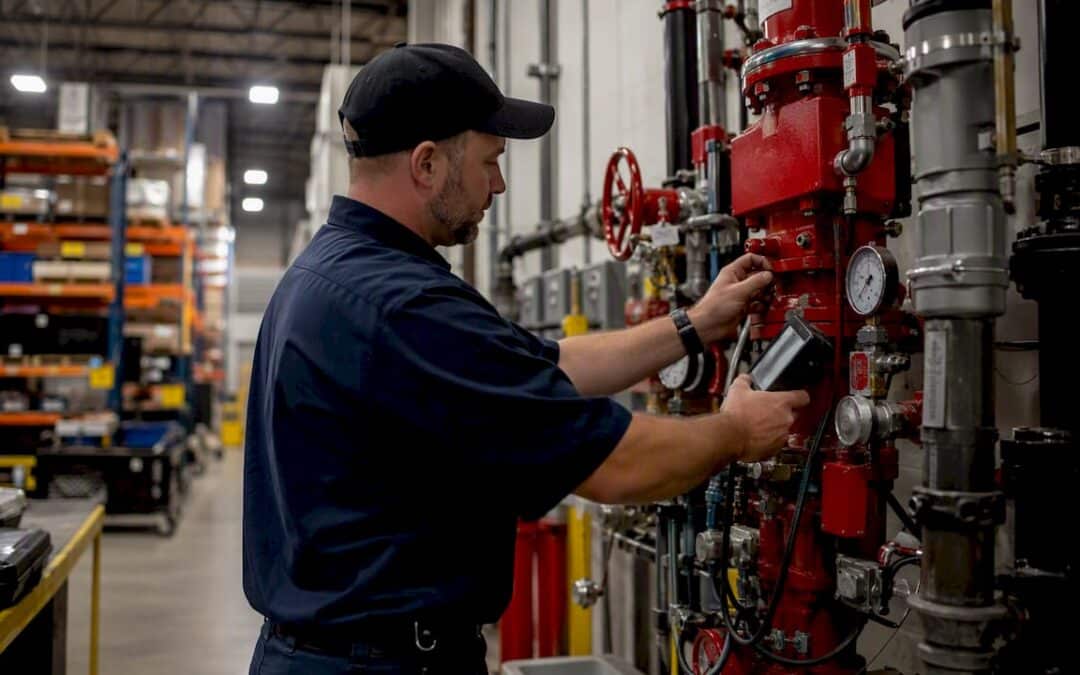
If you manage a building with fire protection equipment, the single most important thing you can do this week is pull your last annual inspection report and confirm it’s signed, dated, and issued by a certified technician. Annual system tests verify that your fire alarms, sprinklers, suppression systems, portable extinguishers, and backflow preventers will actually work when a fire starts, and they satisfy the code requirements set by NFPA 25 and NFPA 72 that your Authority Having Jurisdiction (AHJ) and insurer will ask for after any incident.
Three things to have ready right now:
- The written, dated, signed report from your most recent annual test
- The name and certification number of the technician who performed it (NICET certification or state contractor license)
- Contact information for your local AHJ to confirm any jurisdiction-specific requirements
If any of those are missing, schedule a certified annual test before your next due date. Reliable-fire-protection can help you get that documentation in order.
Key Takeaways
Annual system tests are the single most reliable way to confirm your fire protection equipment will perform under real conditions and satisfy NFPA 25, NFPA 72, and AHJ documentation requirements before an incident occurs.
| Point | Details |
|---|---|
| Verify your last test date | Pull the signed report now; if it’s overdue or unsigned, schedule a certified test immediately. |
| Require certified technicians | Confirm NICET certification and state license before any contractor begins testing. |
| Book 60 days early | Schedule annual tests at least 60 days before the due date to avoid Q4 scheduling bottlenecks. |
| Retain complete records | Keep signed reports, corrective-action logs, and multi-year test records for the life of the system. |
| Reliable-fire-protection | Provides NFPA 25-compliant annual testing in Houston with signed reports and NICET-trained technicians. |
Table of Contents
- Which fire protection systems does an annual test cover?
- What does NFPA 25 actually require for annual tests?
- What do annual tests actually find, and why does it matter?
- Who should perform annual tests, and what credentials should you require?
- What happens during a typical annual test?
- How should you budget for annual tests?
- What are the consequences of skipping annual tests?
- What documentation should you keep, and for how long?
- A practical checklist for facility managers
- How recent NFPA 25 code changes affect your testing obligations
- How to verify a testing contractor’s qualifications
- Why annual testing is the most underrated risk-management tool a facility manager has
- Reliable-fire-protection: schedule your annual test before the Q4 rush
- Sources
Which fire protection systems does an annual test cover?
The scope is broader than most facility managers expect. Inspection timelines under NFPA standards consolidate across every major system category:
- Fire alarm systems (NFPA 72): Annual functional tests of initiating devices, notification appliances, alarm transmission to the monitoring station, and battery capacity under load. Learn more about how fire alarm systems work and what technicians check during each visit.
- Water-based sprinkler systems (NFPA 25): Annual main drain tests, control valve inspections, and alarm valve checks. Five-year obstruction investigations and internal pipe inspections are separate obligations tracked on their own schedule.
- Fire pumps: Annual flow tests at rated capacity, churn pressure, and overload conditions per NFPA 25.
- Standpipe systems: Annual hose-connection inspections and pressure tests.
- Clean-agent and dry-chemical suppression systems: Annual agent-weight or pressure verification, nozzle inspections, and cylinder condition checks.
- Commercial kitchen hood suppression (NFPA 96): Semi-annual service intervals, not annual, so these need their own calendar entry.
- Portable fire extinguishers (NFPA 10): Monthly visual checks by staff, annual maintenance by a certified technician, six-year internal examinations, and 12-year hydrostatic tests depending on type.
- Backflow preventers: Annual testing by a licensed tester to confirm the device prevents contamination of the potable water supply.
Internal examinations and hydrostatic tests for extinguishers occur on extended schedules separate from the annual maintenance cycle. Track them in your records system independently so they don’t get missed.
What does NFPA 25 actually require for annual tests?
NFPA 25 draws a clear line between four activities that facility managers often blur together. Inspection is a visual check confirming a component is in place and undamaged. Testing is a functional verification that the component performs its intended operation. Maintenance is repair or replacement work. Internal pipe inspections and obstruction investigations are separate, scheduled activities with their own triggers and frequencies.
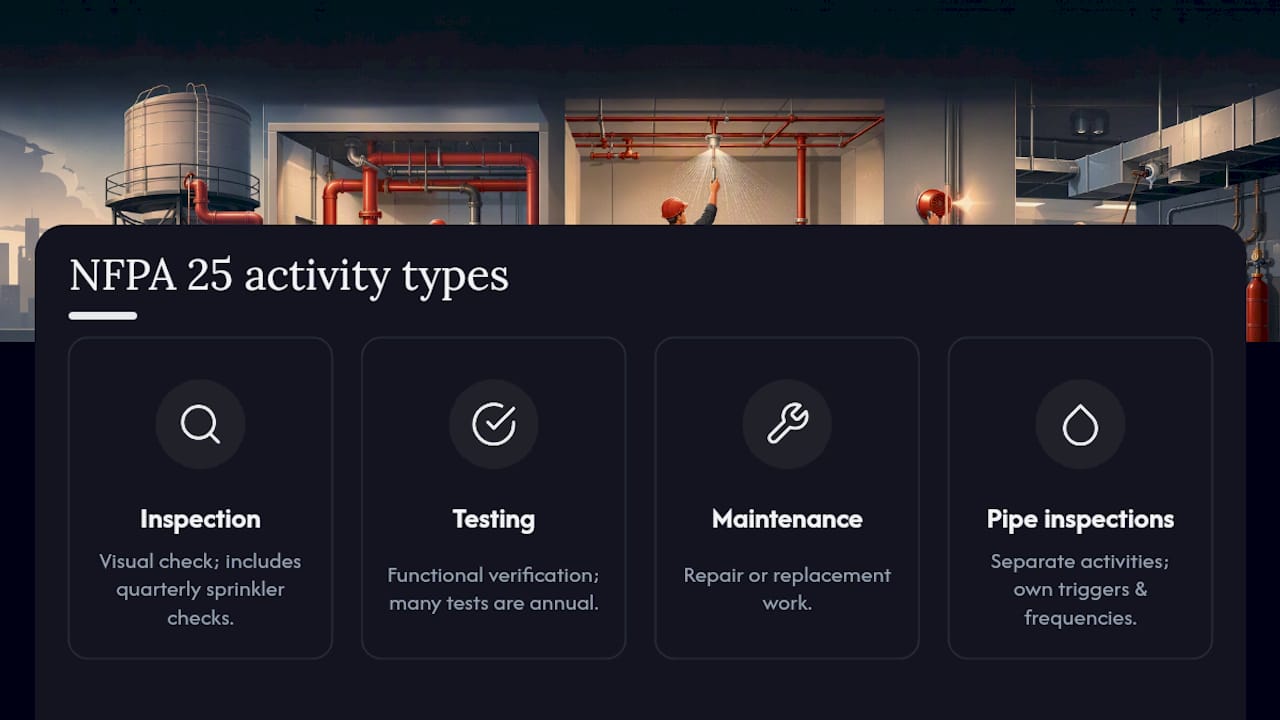
Many annual obligations under NFPA 25 are expressly annual: main drain tests, control valve inspections, alarm valve tests, and fire pump annual flow tests. Others follow different cycles: quarterly sprinkler inspections, five-year obstruction investigations, and the six-year and 12-year extinguisher intervals noted above.
Pro Tip: Always confirm your local AHJ’s interpretation in writing before finalizing your testing schedule. Some jurisdictions add requirements beyond the NFPA baseline or apply internal inspection triggers differently. A brief email exchange with your AHJ creates a paper trail that protects you if questions arise later.
What do annual tests actually find, and why does it matter?
The failures annual tests catch are the ones you’d never see on a routine walkthrough. Corrosion inside a sprinkler pipe, a control valve left partially closed after maintenance, a fire pump that starts but can’t reach rated flow, a notification appliance with a failed speaker driver, a suppression cylinder that’s lost pressure. None of these show up visually. All of them mean the system fails at the worst possible moment.
That claim-denial risk is not theoretical. When a fire occurs, your insurer’s first request is the inspection and testing file. If the records are incomplete or the last test is overdue, the insurer has grounds to dispute the claim. Proper fire damage claim documentation starts with the inspection report, not the incident report.
Who should perform annual tests, and what credentials should you require?
In-house staff can perform routine visual checks between certified visits, but code-required functional testing must be done by a qualified technician. Here’s the credential checklist to run on any contractor before signing a service agreement:
- NICET certification at the appropriate level for the system type (fire alarm, water-based systems, or special hazards)
- Current state contractor license or fire-alarm/fire-suppression service license for your jurisdiction
- Documented manufacturer training for any proprietary system components on your property
- Proof of general liability insurance and bonding
- Ability to provide as-built drawings and tagged, serialized service records after each visit
Red flags that should end the conversation: no written report offered after testing, technician can’t produce a license number on request, no process for tracking deficiencies and corrective-action timelines, and no familiarity with your AHJ’s reporting format.
What happens during a typical annual test?
Before the test: Gather your previous signed reports, as-built drawings, equipment serial numbers, and any occupant-impact constraints. If the test requires shutting down a suppression zone or silencing alarms, coordinate with operations at least two weeks out. Out-of-hours testing costs more but avoids business disruption.
During the test: A certified technician works device by device through initiating devices, notification appliances, main drain and fire pump flow tests, suppression agent verification, and battery load tests. Request live readings during the pump test (flow in GPM, discharge pressure, churn pressure) and battery voltage under load. Confirm that the technician applies a tag to each serviced component.
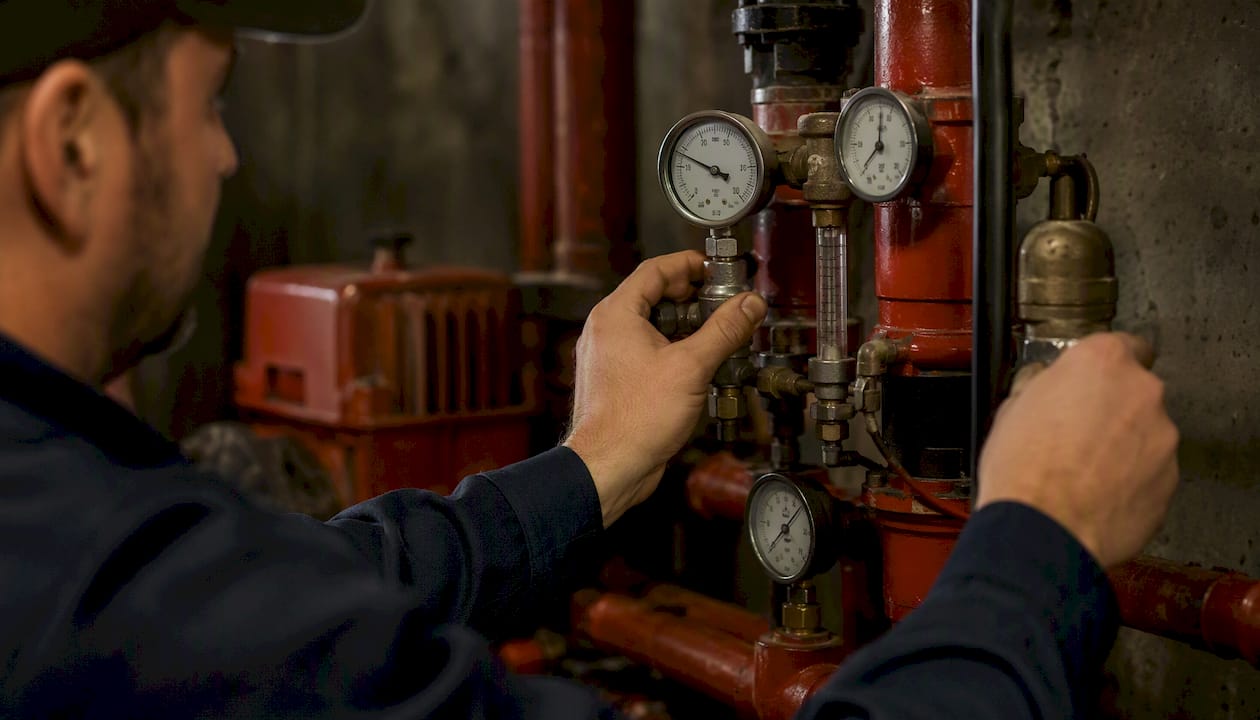
After the test: You receive a written, dated, signed report listing every device tested, any deficiencies found, recommended corrective actions, and the technician’s certification number. Agree on a remediation timeline before the technician leaves. File the report immediately in your retention system. The sprinkler system inspection workflow follows the same structured sequence for water-based systems.
How should you budget for annual tests?
Cost drivers vary significantly by property. The main variables are system complexity, total device count, fire pump flow-test discharge requirements, suppression-agent recharge or cylinder replacement needs, travel and mobilization for remote sites, and the scope of corrective repairs found during testing.
- Build a dedicated annual line item for inspection and testing fees, separate from your general maintenance budget.
- Add a contingency of 15–25% of the testing fee for corrective repairs, since deficiencies are common in older systems.
- Book inspections at least 60 days before the due date to avoid Q4 scheduling bottlenecks and premium labor charges.
- Request itemized quotes that separate testing labor, travel, agent or parts costs, and report preparation.
Annual testing is predictable spend. Emergency repairs after a system failure during an incident are not.
What are the consequences of skipping annual tests?
The risks stack quickly. On the operational side: a system that hasn’t been tested may fail to detect or suppress a fire, leaving occupants with slower notification and reduced suppression effectiveness. On the legal and financial side, missing documentation triggers fines from the AHJ, and expired inspection records give insurers grounds to dispute or deny claims. Civil liability exposure increases substantially when post-incident discovery reveals a pattern of neglected testing.
Consider a scenario that plays out more often than it should: a warehouse sprinkler system passes a visual inspection but hasn’t had a functional main drain test in three years. A fire starts in a storage area. The system activates, but a partially closed control valve left after a plumbing repair two years earlier restricts flow. Suppression is inadequate. The insurer requests the testing file. The last signed report is 38 months old. The claim is disputed, the AHJ issues a violation notice, and the facility manager is named in the subsequent litigation. Every one of those outcomes was preventable with a single annual test.
What documentation should you keep, and for how long?
Signed test reports, inspection tags, corrective-action logs, manufacturer maintenance records, and AHJ correspondence are all required documentation. Written reports must be dated and signed by the technician, with their certification number included.
Retention guidance: keep annual reports for at least one year at minimum, though most risk managers recommend retaining them for the life of the system. Multi-year test records (six-year internal exams, 12-year hydrostatic tests) should be retained until the next cycle of that test is complete and documented.
| Field | What to capture |
|---|---|
| Test date | Exact date of each test or inspection visit |
| System and location | Specific system, zone, or device tested |
| Technician name | Full name as it appears on their license |
| Certification/license number | NICET level and number, or state license number |
| Deficiencies found | Description of each deficiency with device ID |
| Corrective action | Action taken or recommended, with target date |
| Tag/serial number | Tag number affixed to serviced equipment |
| AHJ notification | Date and method of any required AHJ notification |
Insurers and AHJs look for exactly these fields when reviewing a file after an incident. A report missing the technician’s certification number or a corrective-action timeline is a liability, not a compliance asset.
A practical checklist for facility managers
Pre-test (two to four weeks out):
- Confirm the date of the last annual test and pull the signed report.
- Verify AHJ requirements for your jurisdiction and system types.
- Schedule a certified technician with backup availability confirmed.
- Notify building occupants and operations of any system shutdowns or alarm activations.
- Assemble as-built drawings, equipment serial numbers, and previous deficiency logs.
During the test:
- Escort the technician or assign a qualified site contact.
- Request live readings for fire pump flow, battery voltage under load, and any sensitivity test results.
- Confirm tags are applied to every serviced device before the technician leaves.
Post-test:
- Obtain the signed, dated report before the technician departs.
- Agree on remediation timelines for any deficiencies in writing.
- Log all repairs in your corrective-action system and set calendar reminders for follow-up.
- File the report in your retention system and notify your insurer or AHJ if required by your policy or local code.
The fire alarm system checklist from Reliable-fire-protection follows a similar structure and can serve as a model for alarm-specific testing documentation.
How recent NFPA 25 code changes affect your testing obligations
The 2023 edition of NFPA 25 brought several clarifications that affect scheduling decisions. The distinction between internal pipe inspections and obstruction investigations was sharpened: an internal inspection is a scheduled examination of pipe interior condition, while an obstruction investigation is triggered by specific conditions (discolored water, system activation, known MIC risk). Treating these as interchangeable leads to missed obligations or unnecessary work.
The 2023 edition also reinforced documentation requirements, specifying that reports must include the edition of NFPA 25 used as the basis for the inspection. If your current contractor’s reports don’t reference the applicable code edition, that’s a gap worth addressing before your next AHJ review.
NFPA 72 (fire alarm systems) and NFPA 10 (portable extinguishers) follow their own edition cycles. Confirm which edition your AHJ has adopted, since some jurisdictions lag by one or two editions.
How to verify a testing contractor’s qualifications
Beyond the credential checklist in the “Who should perform” section, a few verification steps separate a thorough vetting from a surface check. Ask the contractor to provide a sample completed test report from a comparable property (with identifying information redacted). A well-structured report tells you more about a contractor’s competence than any sales conversation.
Verify NICET certifications directly at the NICET website using the technician’s name or certification number. State contractor licenses are searchable through your state’s licensing board. Both checks take under five minutes and eliminate a significant category of vendor risk.
Ask specifically how the contractor handles deficiencies found during testing. A qualified contractor provides a written corrective-action recommendation with the report, not a verbal summary. They should also be able to tell you which edition of NFPA 25 or NFPA 72 your AHJ has adopted and how their testing procedures align with it.
Why annual testing is the most underrated risk-management tool a facility manager has
Most facility managers focus on the visible: equipment that looks intact, alarms that chirp on a test button, sprinkler heads that aren’t corroded. Annual testing forces a functional verification that goes well past appearances. A sprinkler system that looks fine can have a control valve that was closed during a plumbing repair and never reopened. A fire alarm panel can show “normal” on its display while a notification appliance circuit has an open fault that only shows under load.
The administrative framing of annual testing, treating it as a compliance checkbox rather than a diagnostic tool, is exactly what creates the gap between a system that looks compliant and one that will actually perform. The fire code violations that generate the most expensive outcomes are almost always the ones that could have been caught at the annual test.
Reliable-fire-protection: schedule your annual test before the Q4 rush
Reliable-fire-protection serves Houston and surrounding areas with NFPA 25-compliant annual testing for fire alarms, sprinkler systems, fire pumps, suppression systems, portable extinguishers, and backflow preventers. Every test produces a written, dated, signed report with technician certification details, deficiency documentation, and a corrective-action plan, exactly what your AHJ and insurer will ask for. The team includes NICET-trained technicians with local licensing and direct experience with Houston-area AHJ reporting requirements.
Book at least 60 days before your due date to secure your preferred schedule and avoid the end-of-year demand spike. After testing, you receive a full report and a remediation quote for any deficiencies found, with 24/7 emergency response available if an issue requires immediate attention. Request a quote for annual fire system testing or review the full range of fire safety services to find the right scope for your property.
Sources
The sources below are starting points for code text and scheduling guidance. Always confirm which code edition your AHJ has adopted, since binding obligations vary by jurisdiction.
- Sprinkler inspection, testing, and maintenance | Minnesota DPS
- Fire Safety Inspection Checklist: NFPA Compliance Guide 2026 | QAI Blog