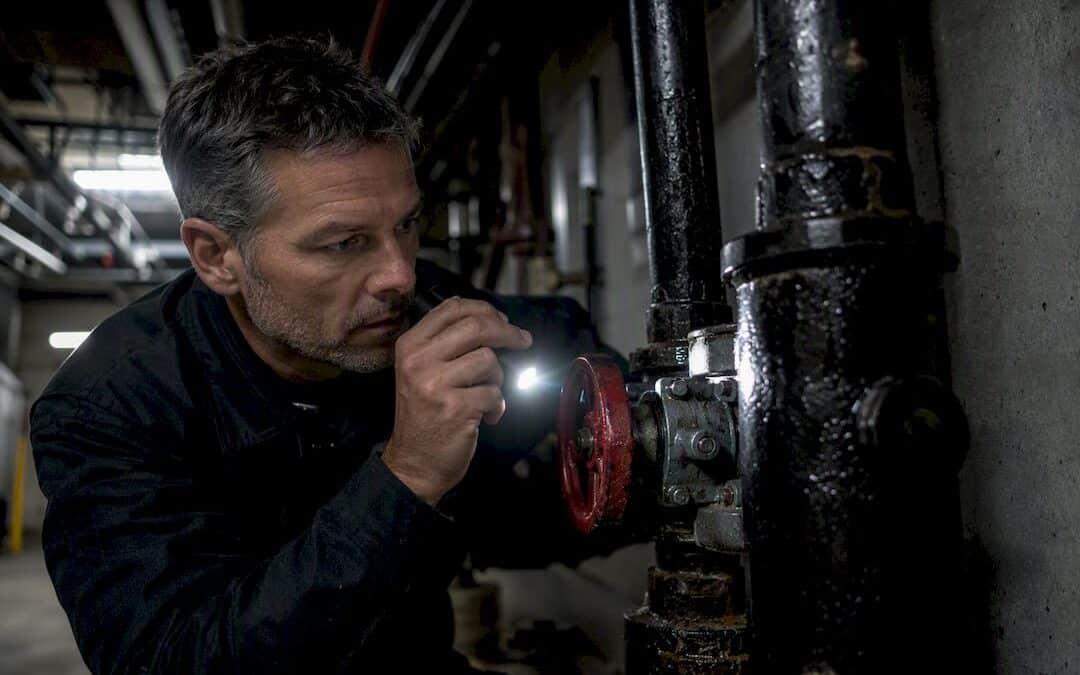
If you find a sprinkler pipe leak, isolate the affected riser or control valve immediately, only if it can be done without disabling protection to occupied areas, start an NFPA 25 impairment procedure, and notify your monitoring company or authority having jurisdiction (AHJ) if the shutdown affects system operation. This isn’t a “wait and see” situation: A significant portion of incidents where sprinklers failed to operate involved systems that had been shut off, often because a valve got closed and nobody documented it or reopened it.
- Isolate water at the correct valve, not just the nearest one
- Start the NFPA 25 impairment clock and log the time
- Call a licensed contractor if the fix touches welding, threading, or hydraulics
One-line verdict: isolate, document, then call Reliable-fire-protection or another licensed contractor if the repair impairs system operation.
Key Takeaways
Isolating water at the correct valve and starting NFPA 25 impairment documentation immediately protects both life safety and your compliance record.
| Point | Details |
|---|---|
| Act on discovery, not diagnosis | Isolate the affected valve and start the impairment clock before you know the exact cause. |
| Valve checks catch most failures | 59% of sprinkler failures involved a system that had been shut off and not reopened. |
| Match the fix to the cause | Loose couplings can wait for a technician; welding and threading always need a licensed contractor. |
| Watch the 10 hour and 24 hour thresholds | Extended outages trigger mandatory fire watch and AHJ notification under NFPA 25. |
| Reliable-fire-protection handles the full cycle | From emergency leak repair to five-year internal inspections, one Houston-based contractor manages triage through compliance documentation. |
Table of Contents
- Sprinkler Pipe Leak Triage: An 8-Point Checklist
- What Causes Most Sprinkler Pipe Leaks?
- How Do You Locate a Sprinkler Pipe Leak?
- Temporary Repairs and Impairment Rules You Can’t Skip
- When Do You Need to Hire a Licensed Fire Protection Contractor?
- Which Sprinkler Leaks Are Critical vs. Routine?
- How Long Does Sprinkler Leak Repair Take, and What Does It Cost?
- Why Fast, Documented Action Matters More Than Perfect Repairs
- Get Emergency Sprinkler Leak Repair From a Local Houston Contractor
- Sources
Sprinkler Pipe Leak Triage: An 8-Point Checklist
Run this in the first 10 to 30 minutes after discovery, before anyone starts troubleshooting the actual leak.
- Confirm no one is in immediate danger from water on floors, stairs, or near electrical panels.
- Identify the correct control valve for the affected zone, not the building’s main valve, if the system is zoned.
- Close that valve and confirm water flow has stopped at the leak point.
- Check whether closing the valve leaves any area unprotected. If it does, that area needs a fire watch.
- Photograph the leak, the valve position, and any visible pipe damage.
- Record the exact time you closed the valve. This starts your NFPA 25 impairment tracking.
- Notify your monitoring company so they don’t dispatch on a false alarm and note the outage correctly.
- Determine whether the outage will exceed 10 hours in a 24-hour period. If so, formal AHJ notification and a documented fire watch become mandatory.
Pro Tip: Keep a phone photo folder labeled by date and location for every impairment event. Insurance adjusters and AHJ inspectors both ask for exactly this: timestamped photos, pressure readings, and a written note of who was notified and when.
What Causes Most Sprinkler Pipe Leaks?
Most leaks trace back to a handful of repeatable culprits, and knowing which one you’re dealing with tells you whether this is a five-minute fix or a call to a certified contractor.
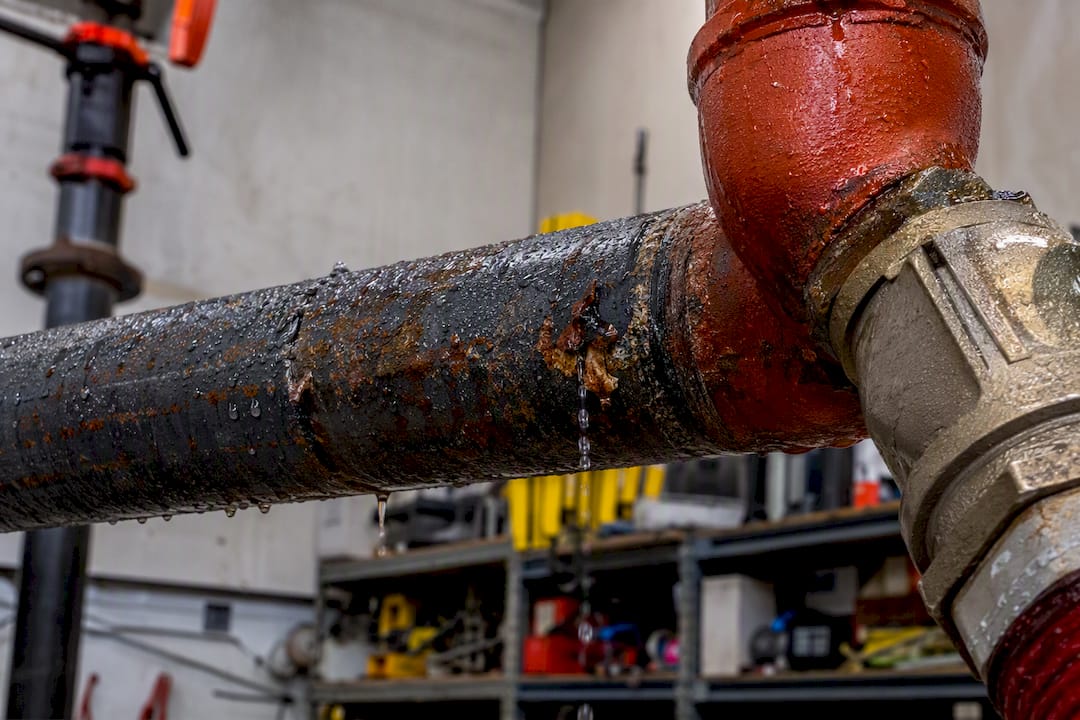
- Internal corrosion from dissolved oxygen. This is the biggest driver of pinhole leaks in wet steel systems. Oxygen trapped in standing water eats through pipe walls from the inside, often invisibly until it perforates. Look for rust-colored water at drains or discoloration near fittings.
- Tubercles and mineral scale. Bumpy internal deposits form over oxygen-corroded spots and eventually crack, creating a leak that seems to appear overnight even though it took years to develop.
- Weld seam corrosion. Factory weld seams on steel pipe corrode faster than the surrounding wall in some batches. A leak running in a straight line along a seam is a strong tell.
- Trapped water in dry or preaction systems. Low points in dry pipe don’t drain fully, and that pooled water becomes a corrosion hot spot. This is why sloped, well-drained dry systems last longer.
- Loose grooved couplings or joints. A weeping coupling is often just under torqued, not corroded. Worth checking before you assume the worst.
- Mechanical damage. Forklifts, ladders, and storage racking dent or crack pipe and heads more often than any corrosion mechanism.
- Freeze damage or overpressure. Common in unheated storage areas and garages during Texas cold snaps.
Bacterial corrosion, or MIC, gets a lot of attention, but oxygen-driven corrosion causes most pinhole leaks.pdf) in most systems, not bacteria. Galvanized pipe resists general corrosion longer than black steel but fails faster once zinc coating breaks down at a scratch or thread. CPVC doesn’t corrode at all, but it cracks under mechanical stress or chemical incompatibility, so the diagnostic approach is completely different.
Pro Tip: If you’re seeing repeated pinhole leaks across multiple locations in the same system, don’t treat each one as an isolated repair. That pattern usually means the whole system has an oxygen or water chemistry problem, and patching pinholes one at a time is throwing money at a symptom.
How Do You Locate a Sprinkler Pipe Leak?
Start with what the system is already telling you: check the main drain test results and the alarm panel for a residual pressure trend before you touch a single pipe. A gradual pressure drop over weeks points to a slow leak somewhere in the branch lines, while a sudden drop usually means a fresh break or a popped fitting.
- Review recent main drain test readings against baseline pressure.
- Walk the visible pipe runs looking for staining, drips, or bulging insulation.
- Remove insulation at any suspect run, since insulation hides slow leaks for months.
- Open a representative flushing connection and check water color and flow rate.
- Remove a sprinkler head near the end of a suspected branch line, when safe, to inspect the interior for scale or tuberculation.
- Use a borescope or ultrasonic thickness gauge for internal pipe condition when the leak isn’t visible from outside.
NFPA 25’s Chapter 14 internal inspection schedule requires this kind of internal look every five years, using flushing points, a removed head, and visual inspection for foreign material or microbiologically influenced corrosion. Field crews report that leaks on horizontal runs cluster near the 11 o’clock and 1 o’clock positions, where trapped air meets standing water and accelerates pitting. Focus your visual inspection there first.
- Discolored water at a flushing point signals internal corrosion, not just dirt
- A pressure drop with no visible leak often means a concealed pinhole above a ceiling
- Systems over 25 years old with no internal inspection history are overdue regardless of appearance
Temporary Repairs and Impairment Rules You Can’t Skip
Only attempt a temporary fix that restores full system integrity without bypassing a safety device. If the repair can’t do that, you’re in impairment territory, not DIY territory.
Acceptable stopgaps include retightening a loosely torqued grooved coupling, installing an AHJ-approved listed repair clamp on a small through-wall pinhole, and swapping a painted or damaged head for an interim listed replacement. What you should never attempt in-house: welding, threaded pipe replacement, or draining any section of the system without a planned, documented impairment.
- Notify the AHJ and monitoring company before work begins
- Log the exact start time and stated reason for impairment
- Assign a fire watch if the outage removes protection from any occupied area
- Document mitigation steps taken and confirm full system restoration in writing
NFPA imperative: Section 4.2 governs impairment procedures. Watch the practical thresholds closely: outages under 10 hours in a 24-hour window generally avoid mandatory fire watch, but anything longer typically triggers both a fire watch and formal AHJ notification.
When Do You Need to Hire a Licensed Fire Protection Contractor?
Hire a licensed contractor the moment a repair involves welding, threaded pipe replacement, hydraulic recalculation, backflow work, fire pump service, or any AHJ-approved system modification; for guidance on contractor hiring and workforce skills, consult the Trade Intel industry trades blog. Everything past a loose coupling or a swapped head belongs to a certified trade, not building maintenance staff.
Permanent repair methods a contractor should handle include:
- Section replacement using welded or threaded connections matched to the original pipe schedule
- Grooved coupling replacement with listed fittings rated for the system’s working pressure
- Full branch line replacement where corrosion is widespread rather than isolated
- Internal cleaning or flushing to clear obstructions found during inspection
- Nitrogen inerting or full pipe replacement when corrosion is systemic rather than localized
Run this four-question check before deciding: Is the leak at a fitting or a head? Is there visible pitting or corrosion nearby? Will the fix require draining or cutting the main? Will it change the system’s hydraulic characteristics? A yes to any of these means it’s time to call a contractor.
- Ask for proof of state contractor license and liability insurance
- Confirm welding and threading certifications for the technicians doing the work
- Look for NFPA-trained staff, not just general plumbers
- Ask about local emergency response times, since a slow contractor turns a small leak into extended downtime
Reliable-fire-protection’s sprinkler system inspection guide walks through exactly this kind of documentation and handoff process for Houston-area properties.
Which Sprinkler Leaks Are Critical vs. Routine?
Anything that impairs system operation, a closed valve, a painted-over head, or an active leak, counts as critical and needs immediate action. Cosmetic issues like paint overspray on a hanger can wait for scheduled maintenance.
NFPA 25 sets specific inspection frequencies to catch these issues before they become emergencies: weekly valve position checks, annual visual checks of piping and fittings, and five-year internal inspections, with dry and preaction systems needing more frequent attention due to trapped air and water cycling.
| Deficiency Type | Urgency | Required Action Timeline |
|---|---|---|
| Closed or tampered valve, active leak | Critical | Immediate |
| Corroded fitting with slow seep, painted head | Semi-critical | Within 30 days |
| Minor hanger damage, cosmetic overspray | Routine | Next scheduled maintenance |
How Long Does Sprinkler Leak Repair Take, and What Does It Cost?
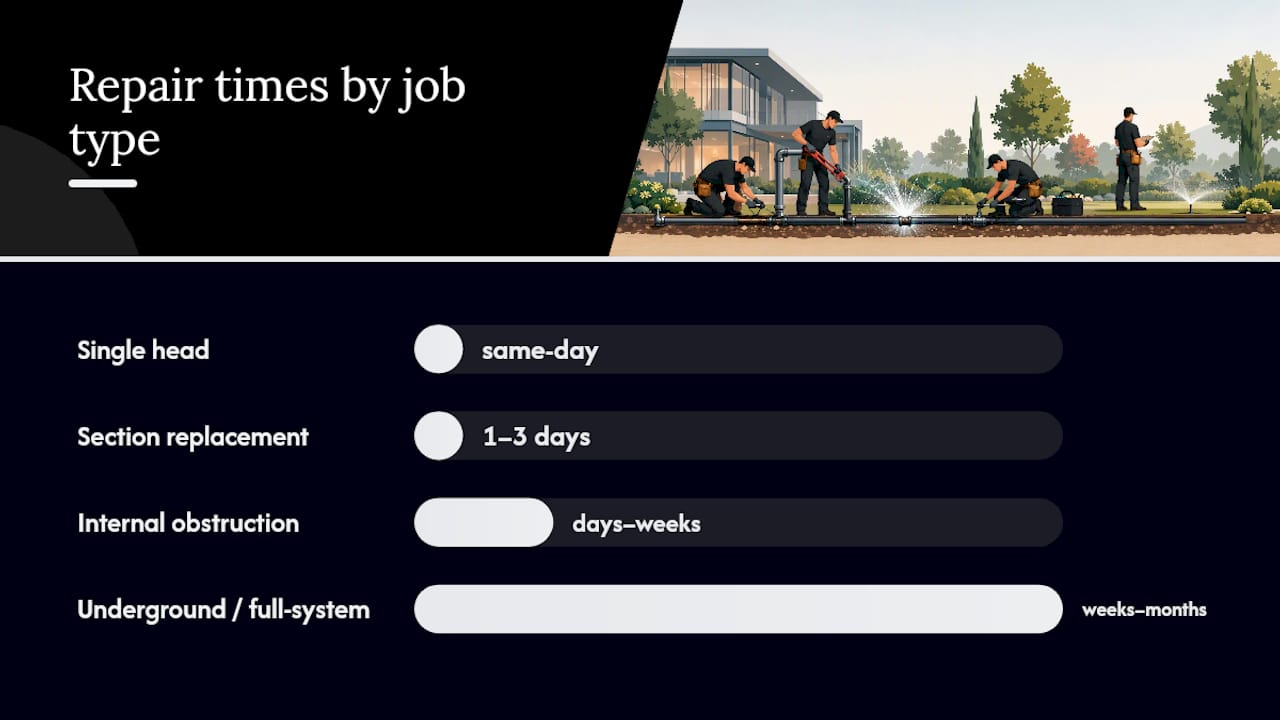
A single head replacement or coupling retightening usually wraps up same-day. Section replacement typically runs one to three days depending on access. Internal obstruction investigation and remediation can stretch from a few days to several weeks depending on what the borescope finds. Underground supply repairs or full-system replacement can take weeks to months once permits and excavation are involved.
Cost estimates vary widely based on access, required permits, and whether hydrostatic testing or hydraulic recalculation is needed, but rough U.S. bands look something like this: single head replacements are the cheapest fix, grooved coupling repairs cost more due to labor and parts, short section replacements climb further, and full branch or underground main repairs represent the largest jobs. Treat these as starting points only, not quotes.
- Fire watch labor hours add up fast during extended impairments
- Business disruption from shutting down a zone can exceed the repair cost itself
- Notify your insurer early since claim timelines often hinge on documented response speed
Why Fast, Documented Action Matters More Than Perfect Repairs
We built Reliable-fire-protection’s response process around one principle: a well-documented, NFPA 25 compliant impairment beats a rushed, undocumented fix every time, even when the rushed fix seems faster in the moment. Local emergency response and clean inspection paperwork protect both your building and your liability exposure.
Get Emergency Sprinkler Leak Repair From a Local Houston Contractor
Reliable-fire-protection is the alternative to waiting on hold with a national service provider. As a Houston-based, family-owned contractor, we send licensed technicians to your property fast, not a call center transfer three states away.
Our team handles emergency leak repair, full NFPA 25 compliance inspections, internal pipe assessments using borescope and ultrasonic tools, and permanent repairs from coupling replacement to full branch line work, all with 24/7 response for active leaks. We also coordinate impairment documentation and AHJ notification so your paperwork holds up if an inspector or insurer asks questions later.
Explore our sprinkler system maintenance workflow to see how we structure ongoing inspections, or reach out now for a free quote if you’re dealing with an active leak today.
Sources
- Sprinkler system inspection guide — Rimkus
- Microbiologically influenced corrosion in sprinkler systems — AXA XL