TL;DR: Central station fire alarm monitoring connects your building’s fire alarm control panel to a staffed, UL-listed facility that operates 24/7 and automatically dispatches the fire department when a verified alarm signal arrives. Houston’s IFC-based fire code and NFPA 72 require most commercial occupancies to use an approved supervising station, and UL-listed central station service is the gold standard. Beyond code compliance, it protects unoccupied buildings, supports insurance discounts, and provides documented records your AHJ expects at every inspection.
Your fire alarm goes off at 2 a.m. on a Sunday. The building is empty. Who calls the fire department?
If your system is connected to a central station, trained operators do — automatically, within seconds, while you’re still asleep. If it isn’t, the answer is nobody until a neighbor spots flames through the window.
That single scenario is the core reason Houston’s fire code and NFPA 72 both point toward central station monitoring as the standard for commercial properties. This guide explains exactly what central station monitoring is, how the signal chain works, what the code requires, and how to evaluate whether your building is covered correctly.
What Is Central Station Fire Alarm Monitoring?
UL Solutions defines monitoring and fire department notification as an essential feature of any code-required fire alarm system. Central station monitoring is the specific method that closes the gap between detection and response.
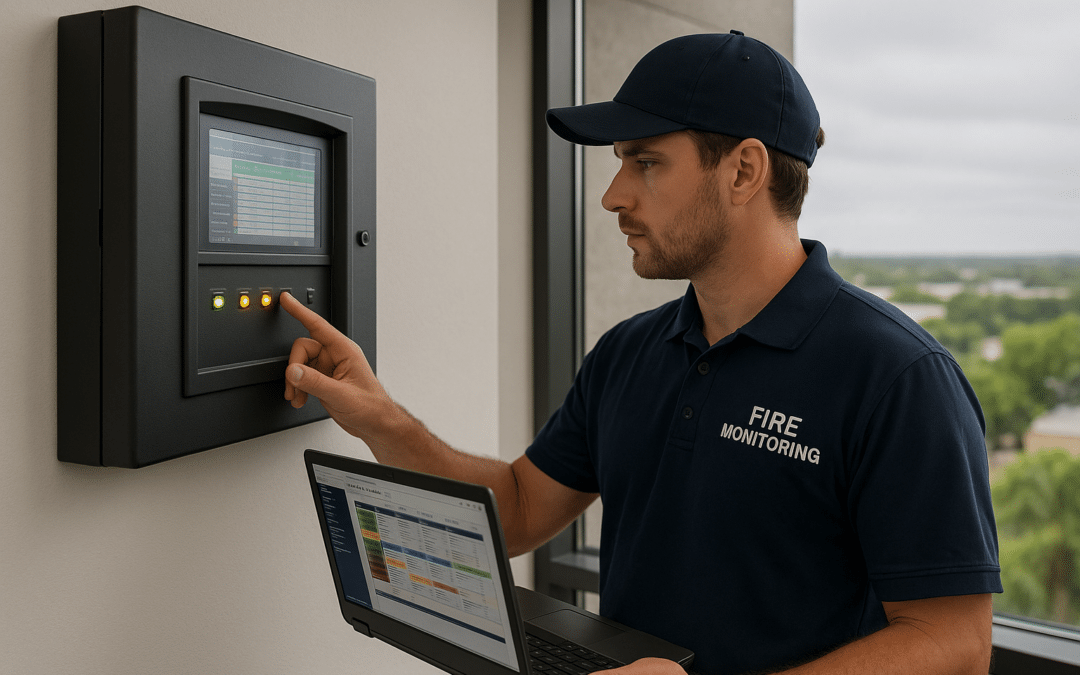
At its core, a central station fire alarm system is a monitored system that transmits signals to a UL-listed supervising station, where licensed operators manage alerts and contact the fire department automatically. Operators continuously monitor signals from fire alarm control panels (FACPs), smoke and heat detectors, and sprinkler systems around the clock.
The key distinction: unlike local fire alarms, which only sound within the building and rely on occupants to call for help, central station fire alarm monitoring instantly transmits alarm signals to a staffed facility — no human on-site required.
The Three Types of Supervising Stations (and Why Central Station Wins)
NFPA 72’s Supervising Stations chapter describes three types of supervising stations: Remote Supervising Station, Proprietary Supervising Station, and Central Station Service. Understanding each helps you see why central station is the standard choice for most Houston commercial buildings.
1. Remote Supervising Station
A remote station receives signals from multiple unrelated properties but is not held to the full ANSI/UL 827 central station listing and does not necessarily bundle in installation, testing, or maintenance services. Some municipal or county-operated monitoring arrangements fall into this category, though it is less common in new commercial construction today.
2. Proprietary Supervising Station
Proprietary fire alarms are monitored at a location owned and operated by the property owner — essentially an in-house dispatch center. This arrangement suits large campuses or building portfolios with dedicated security staff, but it carries significant overhead and staffing obligations.
3. Central Station Service (The Standard Choice)
Central station service is delivered by an independent, third-party company with no ownership interest in the properties it monitors. The central station must be UL-listed to ANSI/UL 827 and comply with strict requirements for staffing, signal handling, record-keeping, and runner service — meaning a qualified technician must be able to reach your property to investigate an unrestored alarm.
Central station service typically bundles installation, inspection, testing, and maintenance responsibilities under a single contract between the subscriber (the building owner) and the prime contractor. Because the provider is a specialist with dedicated staff working around the clock, this arrangement is by far the most common form of fire alarm monitoring for standard commercial buildings, retail locations, and multi-tenant properties.
How Central Station Monitoring Works: The Full Signal Chain
When a detector, pull station, or sprinkler waterflow switch activates, here is what happens:
- Detection: A smoke detector, heat detector, or sprinkler waterflow device activates and sends a signal to your Fire Alarm Control Panel (FACP).
- Panel Processing: The FACP identifies whether the event is an alarm, supervisory signal (e.g., a valve closed on your sprinkler system), or a trouble signal (equipment fault). On-site horns and strobes activate as programmed.
- Signal Transmission: The FACP transmits the signal off-site via cellular, IP, or radio to the UL-listed central monitoring station. Note: traditional POTS (copper phone line) transmission is being phased out as carriers retire landlines, and most central stations now treat landline-only accounts as legacy — if your building still relies on phone-line-only transmission, plan an upgrade.
- Operator Verification: Trained operators assess whether the signal is genuine or a false trigger using system data or audio/visual verification if available. NFPA 72 now allows the alarm signal to be verified when certain conditions are met before the fire department is dispatched — a process designed to reduce unnecessary responses while preserving speed when it matters.
- Dispatch & Notification: If confirmed or unresolvable, operators contact the local fire department, the Authority Having Jurisdiction (AHJ), and your designated building contacts immediately.
- Runner Service: For unrestored alarms or supervisory signals, a runner — a qualified technician dispatched to your site — investigates in person. This is a requirement of true central station service under NFPA 72, not just a phone call.
A minimum of two trained operators must be on duty at all times, and those operators cannot be assigned to other duties that would distract them from monitoring and transmission of alarms. Central stations themselves must be located in physically secure buildings with fire protection, backup power, and emergency lighting — not just a server room.
What Houston’s Fire Code Requires
Houston enforces the International Fire Code (IFC) alongside NFPA standards, with the Houston Fire Marshal’s Office and Harris County Fire Marshal handling plan reviews, inspections, and permitting. The City of Houston’s local code also adds targeted amendments on top of the IFC baseline, including enhanced alarm monitoring requirements.
In practical terms for commercial property managers in Greater Houston:
- Office buildings (Group B): A monitored fire alarm system is required under IFC Section 907.2.2 when a Group B building exceeds three stories or 55,000 square feet in total floor area, or when the building has an automatic sprinkler system installed. Given that Houston holds over 200 million square feet of office space, the vast majority of commercial office buildings exceed at least one of these thresholds.
- Schools: Texas school buildings must have fire alarm systems that meet or exceed NFPA 72 and IFC standards.
- Healthcare and assisted living: Hospitals, schools, hotels, and warehouses almost always require 24/7 monitored systems.
- Multi-family and hospitality: Occupancy-specific thresholds apply; consult your AHJ for the exact trigger.
- Harris and Fort Bend Counties: As of 2025, both Harris and Fort Bend Counties have transitioned to the 2021 IFC, which introduces stricter guidelines including specific protocols for how alarms are transmitted to dispatch centers.
The City of Houston Fire Prevention Bureau and Harris County Fire Marshal enforce these requirements as a condition of certificate of occupancy and annual business permit renewal. Non-compliance can result in significant financial penalties, forced business closures, and increased liability exposure in the event of a fire.
One frequently overlooked requirement: NFPA 72 requires an executed written contract with the company providing monitoring services — not just the hardware connection. If you cannot produce that contract during an inspection, you are not in full compliance regardless of whether signals are transmitting.
For a detailed breakdown of what NFPA 72 demands for your fire alarm system at every inspection cycle, see our guide on NFPA 72 fire alarm testing requirements for Houston commercial properties.
Central Station vs. Local-Only Alarm: A Direct Comparison
| Factor | Local Alarm Only | Central Station Monitoring |
|---|---|---|
| Fire dept. notification | Someone on-site must call | Automatic, within seconds |
| After-hours protection | None when building is empty | 24/7, including nights and weekends |
| Code compliance (IFC/NFPA 72) | Typically not sufficient | Meets or exceeds requirements |
| Insurance discounts | Generally not eligible | Eligible with UL certificate |
| Record-keeping for AHJ | None | Documented signal logs required |
| Sprinkler supervision | Not monitored off-site | Waterflow and valve tamper monitored |
The Insurance Angle: Real Savings, Not Just Compliance
Beyond code requirements, central station monitoring has a direct impact on your insurance costs. Many insurance providers offer discounts for properties equipped with monitored fire alarm systems, because professional monitoring reduces the statistical risk of total loss.
The discount almost always requires the system to be professionally monitored by a central station, and most insurers ask for a Certificate of Monitoring as proof. The typical discount ranges from 2% to 20% of the annual commercial premium, with most policyholders seeing 5% to 15%. For a commercial property paying $10,000 or more annually in property insurance, that is a meaningful offset against your monitoring contract costs.
Some insurers in today’s market will not issue a policy for certain commercial spaces at all without a current monitoring certificate — making central station service a coverage prerequisite, not just a discount opportunity.
What ‘UL-Listed’ Actually Means — and Why It Matters to Your AHJ
The phrase ‘central station’ is often used incorrectly to describe any monitored fire alarm system. Not every monitoring company qualifies.
A UL-listed central station must meet the requirements of ANSI/UL 827, the Standard for Central Station Alarm Services, which requires physically secure facilities, backup power systems, at least two independent means to retransmit a fire alarm signal to the fire department, minimum staffing requirements, and regular UL audits for ongoing compliance. UL conducts regular audits of certified central stations to ensure ongoing compliance — providing an additional, independent layer of assurance for building owners and AHJs.
When your Houston Fire Marshal inspector asks for documentation of your monitoring arrangement, a UL-listed central station certificate is the document that closes the conversation. A non-listed monitoring provider, no matter how responsive, may not satisfy your AHJ or your insurer.
Which Houston Businesses Need It Most
While most commercial occupancies in Houston require monitored fire alarm systems, the stakes are especially high for:
- Restaurants and commercial kitchens — High-frequency fire risk from cooking equipment, often operating with staff who exit quickly after close.
- Hotels and hospitality properties — Sleeping occupants cannot self-evacuate without notification; monitoring also supervises sprinkler systems guests rely on overnight.
- Healthcare and assisted living — Occupants may be non-ambulatory; every second of response time reduction is life-critical.
- Multi-family residential properties — Buildings are occupied around the clock but individual units may have no one home.
- Industrial and warehouse facilities — Large, often unoccupied facilities with high-value equipment and inventory where fire can spread unchecked before dawn.
- Schools and universities — After-hours events, summer closures, and large footprints make central station monitoring a code and operational necessity.
- Energy Corridor and downtown high-rises — Enhanced NFPA 72 requirements apply to buildings with occupied floors more than 55 feet above ground level, including voice evacuation systems tied to monitored panels.
What to Look for in a Houston Central Station Monitoring Provider
Not all monitoring contracts are equal. When evaluating a provider, confirm the following:
- UL-listed central station — Ask for the UL listing certificate, not just a claim of UL compliance.
- Redundant communication paths — Your system should use at least two independent signal paths (e.g., cellular plus IP). Avoid landline-only systems.
- Communication path testing — A compliant central station tests all unsupervised communication paths at least once every 12 hours.
- Non-proprietary equipment — Proprietary panels lock you into a single vendor. Non-proprietary systems give you freedom to switch providers without replacing hardware.
- Written monitoring contract — Required by NFPA 72. If the provider won’t put it in writing, that is a red flag.
- Local AHJ familiarity — Your provider should understand Houston Fire Marshal and Harris County Fire Marshal permit and inspection requirements, not just national code in the abstract.
- Inspection and testing bundled — True central station service can include installation, inspection, testing, and maintenance under one agreement, simplifying your compliance calendar.
If you are unsure what your system is currently connected to — or whether your existing monitoring arrangement satisfies your AHJ — a professional review is the fastest way to find out. See our guide on what a commercial fire alarm system costs in Houston to understand the full investment picture, including monitoring as part of a new installation.
Reliable Fire Protection: Central Station Monitoring for Houston Commercial Properties
Reliable Fire Protection is a family-owned, state-licensed fire protection company serving commercial, industrial, institutional, and multi-family properties across Greater Houston — from the Energy Corridor and Downtown to Katy, Sugar Land, Cypress, Pasadena, and 25 more neighborhoods and suburbs.
We design, install, inspect, repair, and monitor fire alarm systems connected to UL-listed central stations, using non-proprietary equipment so you are never locked into a single vendor. Every monitoring engagement comes backed by our 24-month satisfaction guarantee on parts, materials, and labor, plus 24/7 emergency response and same-day service availability.
Ready to confirm your building is covered correctly? Contact Reliable Fire Protection for a free quote and a plain-language review of your current monitoring status.
Recommended Reads
- NFPA 72 Fire Alarm Testing Requirements Explained for Houston Commercial Properties
- How Much Does a Commercial Fire Alarm System Cost in Houston?
- TCEQ Backflow Preventer Testing Requirements Every Houston Property Owner Should Know