Most commercial properties pay a monthly fee for professional fire alarm monitoring that varies by property size and risk level. First-year totals include activation and required testing and depend on system size. NFPA 72 compliance and UL-listing status push these numbers around more than almost anything else, and IBISWorld pegs the national benchmark at $66 a month. Reliable Fire Protection builds every quote around those two variables first.
TL;DR:
- Property size, dispatch tier, communication method, and redundancy requirements significantly influence initial and ongoing fire alarm monitoring costs.
- Equipment type, panel complexity, and response guarantees are the main factors causing cost variability between quotes, often more than stated monthly rates.
- Proper documentation of response times, backup power, and testing schedules is critical to ensure compliance and avoid unexpected fines or liabilities.
- Dual-path communication (cellular plus IP) is increasingly recommended for high-risk or high-occupancy buildings to improve reliability and reduce future retrofit costs.
- Comparing total ownership costs over three to five years, including activation, testing, false alarm fines, and equipment, yields better investment insights than focusing solely on monthly rates.
Table of Contents
- Fire Alarm Monitoring Cost: What Actually Matters When You’re Budgeting
- How Much Does Fire Alarm Monitoring Cost by Property Size?
- What Drives Your Monitoring Bill Up or Down?
- Communication Paths: Cellular, IP, Radio, or Dual-Path?
- Upfront Fees and Contract Models: What You’re Really Signing
- Ongoing Costs Most Owners Forget to Budget For
- How to Compare Fire Alarm Monitoring Quotes Without Getting Burned
- How Reliable Fire Protection Structures Monitoring Contracts
- A Facility Manager’s Honest Take on Monitoring Budgets
- Get a Free, Itemized Fire Alarm Monitoring Quote
- Sources
Fire Alarm Monitoring Cost: What Actually Matters When You’re Budgeting
Before you compare a single quote, get three facts straight. They decide whether a “cheap” proposal is actually cheap.
The advertised monthly rate almost never tells the whole story. A provider quoting a lower monthly rate than a competitor isn’t necessarily the better deal. Industry pricing guides show typical component ranges running $8 to $150 monthly depending on system size and dispatch level, and the cheapest number on that scale usually comes with fewer devices, no redundancy, and a bare-bones response tier. Experts who track this market caution that low advertised rates frequently omit ancillary charges that show up later as line items you didn’t budget for.
Your first-year cost includes activation, programming, and initial testing fees added on top of monthly costs; these fees vary based on site complexity.
Watch for these red flags before you sign anything:
- No mention of UL-listing for the central station receiving your signals
- Vague or missing language about communication redundancy (single-path only, no backup)
- Contract terms that don’t specify response times, retransmission duties, or testing schedules
- A quote that bundles “monitoring” without breaking out activation, hardware, and service fees separately
- No documentation trail promised after annual testing
If a proposal can’t answer basic questions about dispatch tier or backup power, that’s information worth having before you commit, not after.
How Much Does Fire Alarm Monitoring Cost by Property Size?
Cost bands shift dramatically based on device count, dispatch tier, and communication path. Here’s how that breaks down across common property types, using conservative industry ranges and typical first-year assumptions.
*First-year totals assume monthly monitoring times 12, plus activation/setup fee, plus one round of required testing. Actual totals vary with device count, dispatch tier, and communication path.
A small retail storefront with a dozen devices on a conventional panel and monitoring-only dispatch sits comfortably in that first row. Add addressable devices, a verified-dispatch tier, or dual-path communication, and the same footprint can push toward mid-size pricing.
Mid-size commercial buildings, think a three-story office or a small medical clinic, usually carry more devices, more zones, and often a higher dispatch tier because more people are on-site during business hours. That pushes both the monthly fee and the activation cost up a notch from small office pricing.
Apartment complexes are their own category because life-safety risk is spread across many independent units. Insurers and local authorities having jurisdiction (AHJs) frequently require redundant communication paths and faster response guarantees for multifamily properties, which is part of why the monthly range climbs even when device count per unit is modest.
Large or high-risk facilities, manufacturing plants, hospitals, warehouses storing hazardous materials, sit at the top of the range because they combine high device counts, addressable panels, mandatory dual-path communication, and often a private responder tier layered on top of standard municipal dispatch. A facility manager at this tier should expect the activation fee alone to sometimes exceed a small office’s entire first-year monitoring cost.
None of these bands are fixed. A property that looks like a “small office” on paper but sits in a jurisdiction with strict AHJ redundancy mandates can land in mid-size pricing territory fast. That’s why a site walk-through before quoting matters more than a phone estimate.
What Drives Your Monitoring Bill Up or Down?
Four variables explain almost all the spread between a $40 quote and a $250 quote for what looks, on paper, like a similar building.
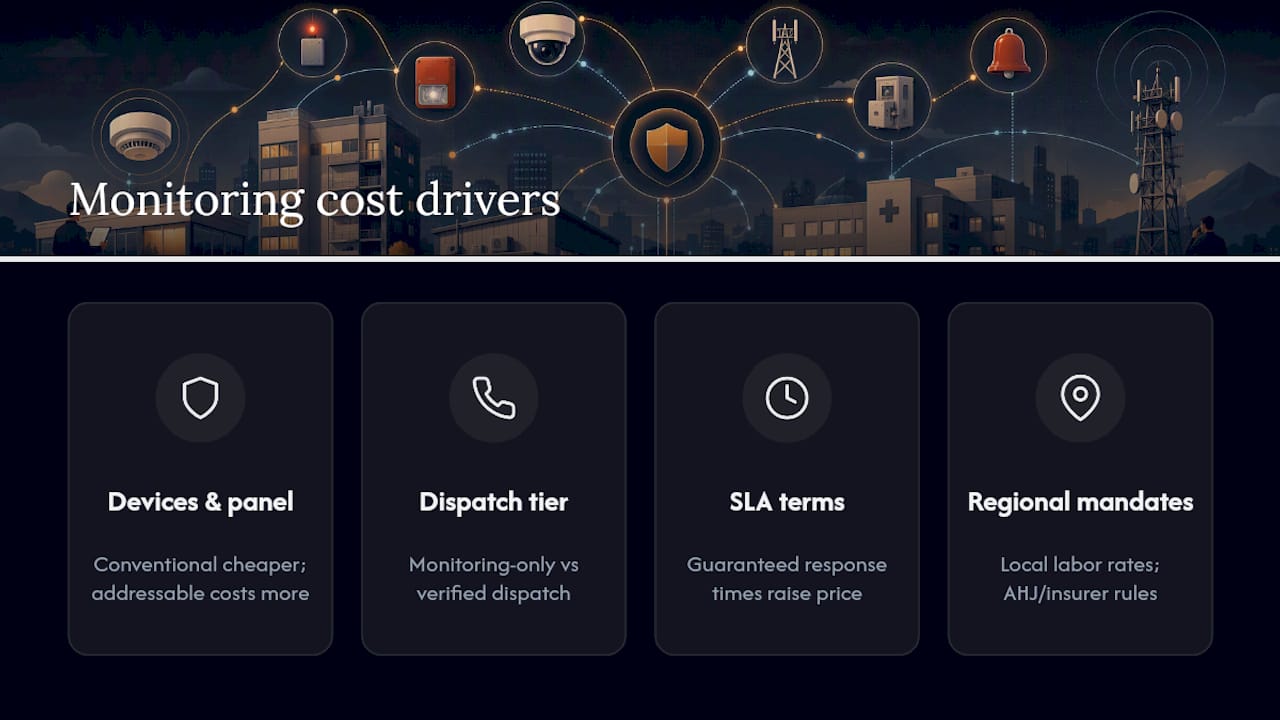
Device count and panel type. Every smoke detector, pull station, and heat sensor on your system needs to be programmed into the panel and mapped in the monitoring center’s database. A conventional panel groups devices into zones, which keeps programming simpler and cheaper. An addressable panel identifies each device individually, which costs more upfront in programming labor but gives responders exact location data during an actual event, a real advantage in larger buildings where “zone 4” could mean an entire wing.
Dispatch and response tier. Monitoring-only service simply relays a signal to your local fire department. Verified dispatch or private responder tiers add a human step: someone confirms the alarm isn’t false before, or in parallel with, calling 911. That extra layer costs more monthly but cuts down on false-dispatch penalties and insurance friction.
Service level agreement terms. Contracts that guarantee specific response times, scheduled timer tests, and documented retransmission duties tend to price higher than bare-minimum agreements, because the provider is committing staff and infrastructure to meet those numbers.
Regional labor and mandates. Technician labor rates vary by metro area, and some AHJs or insurers require redundancy or faster testing cycles that a lower-cost region wouldn’t mandate.
Pro Tip: Ask every provider to itemize dispatch tier and SLA terms separately from the base monitoring fee. If they can’t separate those numbers, they probably haven’t priced them independently either, and you have no way to negotiate one without the other.
Communication Paths: Cellular, IP, Radio, or Dual-Path?
The communicator connecting your panel to the monitoring center is one of the biggest hidden cost variables in a fire alarm quote, and it’s also where NFPA 72 gets specific.
NFPA 72 sets performance limits on how fast a signal has to travel end to end, commonly 90 seconds, and defines the central-station service elements a provider must deliver, including monitoring, retransmission, and recordkeeping. Those requirements shape which communication technology makes sense for your building.
- Cellular: Widely used, reasonably priced, and independent of phone lines, but a single-path cellular setup is only as reliable as coverage at your site.
- IP (internet-based): Often the cheapest to run month to month, but NFSA guidance notes IP communicators need 24-hour backup power for the internet equipment itself, which adds an upfront UPS cost many owners don’t anticipate.
- Radio: Reliable in areas with weak cellular or internet infrastructure, though antenna placement and roof-mounted hardware can add installation cost.
- Dual-path: Combines two of the above, typically cellular plus IP, so a failure in one path doesn’t take your entire monitoring offline.
Dual-path costs more upfront and adds a modest premium to the monthly fee, but for mid-size and larger properties that premium often pays for itself. It frequently reduces insurer scrutiny and lowers the odds of a costly false-dispatch penalty tied to a dropped signal.
As a practical rule, if your insurer or local AHJ hasn’t explicitly required dual-path, ask anyway. Many jurisdictions are moving toward requiring it for multifamily and high-occupancy buildings, and installing it now avoids a retrofit bill later. Fully code-compliant IP monitoring, including a properly sized 24-hour UPS, is worth budgeting for as a line item rather than an afterthought.
Upfront Fees and Contract Models: What You’re Really Signing
Two numbers matter beyond the monthly rate: what you pay to get connected, and how the contract structures equipment ownership over time.
- Activation and integration fees typically run $100 to $1,000, covering the labor to program your panel into the monitoring center’s system, test the connection, and document the setup. Complex, multi-building sites land at the higher end.
- Equipment-included contracts trade a lower upfront cost for a higher monthly rate, since the provider is financing the panel and devices over the life of the agreement. Buying equipment outright costs more initially but usually lowers your monthly bill and avoids the early-termination penalties that financed contracts often carry.
- Early termination penalties on financed equipment contracts can equal several months of remaining fees, so read that clause before you sign, not after you want to switch providers.
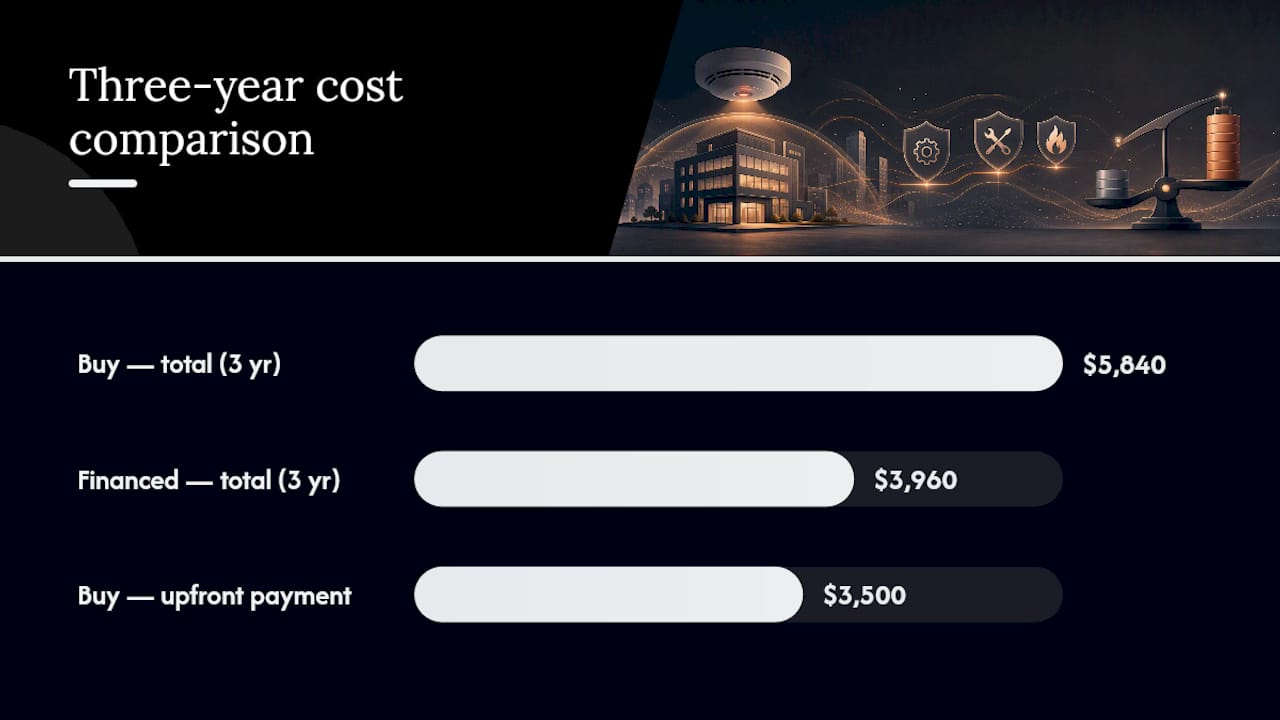
Here’s a simplified three-year comparison. Say a mid-size building can either buy equipment outright for $3,500 upfront at $65/month monitoring, or take an equipment-financed contract at $0 upfront and $110/month.
Buy-outright total over three years: $3,500 + ($65 × 36) = $5,840.
Equipment-financed total over three years: $0 + ($110 × 36) = $3,960.
The financed option looks cheaper over three years in this example, but stretch the same math to a five-year horizon and the buy-outright path pulls ahead. Ask providers to run this exact projection for your building; Solink’s guidance on comparing total cost over time makes the same point.
Ongoing Costs Most Owners Forget to Budget For
The monthly monitoring bill is the predictable part. What catches property managers off guard is everything layered on top of it.
- Annual and semiannual testing. Most jurisdictions require documented testing at least annually, with more frequent checks for certain suppression tie-ins. Expect this to run separately from your monthly fee unless it’s bundled into a maintenance plan.
- Battery and equipment replacement. Backup batteries typically last three to five years and cost a modest amount per unit to replace, but multiply that across a large device count and it adds up.
- False-alarm fines. Municipalities set their own penalty schedules, and repeat false dispatches can trigger fines that climb with each occurrence. Verified dispatch or a private responder tier reduces how often your building triggers a municipal fine in the first place.
- Bundled maintenance vs. pay-per-service. A bundled plan smooths these costs into a predictable annual number; paying per service means occasional larger bills whenever testing or a fine comes due.
Ancillary charges like these can add 10 to 20 percent or more to your annual operating cost beyond the base monitoring contract. That’s the gap between “what the contract says” and “what actually leaves your account” over twelve months, and it’s the number most owners underestimate when they first budget for monitoring.
How to Compare Fire Alarm Monitoring Quotes Without Getting Burned
A fair comparison requires every quote to answer the same questions in writing. If a provider dodges one, that’s your answer about how transparent the rest of the relationship will be.
- Request an itemized breakdown separating monthly monitoring, activation, dispatch tier, and any hardware costs.
- Confirm UL-listing for the central station actually receiving your signals, not just the equipment manufacturer’s certification.
- Ask about backup power and communication path, specifically whether it’s single-path or dual-path and what happens during an outage.
- Get the SLA in writing, including guaranteed response times, timer-test frequency, and retransmission duties.
- Read the contract term and renewal clause carefully, watching for auto-renewal, CPI-based rate increases, and early-termination fees.
- Ask whether the contract is transferable if you sell the property or change management companies.
On a site visit, ask the technician directly how many devices the quote covers and whether the panel is conventional or addressable, since that number should match what’s actually installed, not a rough estimate.
Pro Tip: Get three quotes for the exact same scope of work, not three different scopes. Providers will happily quote you a stripped-down monitoring-only tier next to a competitor’s verified-dispatch tier, and the price gap will look bigger than the actual value gap.
How Reliable Fire Protection Structures Monitoring Contracts
Reliable Fire Protection builds monitoring agreements around code compliance first, not the lowest possible sticker price. Every contract specifies dispatch tier, communication path, and testing schedule in writing before a client signs, matching the checklist above.
Clients receive documentation after every inspection and annual test, records that satisfy AHJ requirements and give property managers a paper trail if an insurer or fire marshal ever asks for proof. That’s consistent with what NFPA 72 requires of central-station service: recordkeeping isn’t optional, and a provider that treats it as an afterthought is a provider that will leave you exposed during a compliance review.
Reliable Fire Protection’s monitoring services cover the full range from small commercial buildings to large, multi-zone facilities, with technicians who explain panel type, device count, and dispatch tier before a quote is finalized rather than after.
A Facility Manager’s Honest Take on Monitoring Budgets
The cheapest quote almost always looks best in the moment you’re comparing numbers on a spreadsheet, and almost always looks worst two years into a contract with unexpected fees. If your building has real life-safety exposure, a hospital wing, a multifamily property, anything with high occupancy, pay for a listed central station and redundant communication paths. That premium is small compared to what a single missed signal costs in liability, let alone lives.
Build testing and false-alarm exposure into your annual maintenance line item now, not as a surprise expense later. And resist the instinct to shop purely on monthly rate. Total cost of ownership over a three- to five-year contract tells you far more than any single month’s invoice, and it’s the number that actually determines whether you made a smart call or a cheap one.
— Results
Get a Free, Itemized Fire Alarm Monitoring Quote
Reliable Fire Protection is the direct alternative to shopping blind through advertised monthly rates that never mention activation fees, dispatch tiers, or ancillary charges until the contract’s already signed. For property owners and managers across the Houston area, a quote request gets you a breakdown of monitoring, activation, testing, and dispatch tier before you commit to anything.
A Reliable Fire Protection monitoring package includes UL-focused central station service, documented NFPA 72 compliant testing, and a written SLA specifying response times and communication path, cellular, IP, or dual-path, based on what your building and its insurer actually require. After every inspection, clients receive test records and documentation ready for AHJ review, no digging for paperwork when a fire marshal asks.
Ask for an itemized comparison against any competing quote you’ve received, and request the UL and central-station documentation upfront. Start by requesting a free quote and system consultation to see exactly what your building needs and what it will actually cost across the life of the contract, not just the first invoice.
Sources
For deeper reference, NFPA 72 covers central-station service requirements in full, IBISWorld tracks national pricing trends, and NFSA explains backup power rules for IP communicators. Reliable Fire Protection’s fire alarm service pages cover local installation and maintenance details.
- Fire Alarm Monitoring Services in the US Procurement Price, Data and Insights | IBISWorld
- Fire Alarm Monitoring Cost: Price Ranges, Components, and Local Variations 2026 – Current Cost
- NFPA 72 — Central station service requirements and performance expectations (extract)
- Alarm system monitoring cost (Solink resources)
- Fire Sprinkler Monitoring & Supervision: NFPA 13 and NFPA 72 – National Fire Sprinkler Association