

TL;DR:
- Effective fire emergency training involves developing a facility-specific plan and role-based instruction for staff. Conducting documented drills and maintaining thorough records ensures compliance and readiness. Incorporating hands-on practice, scenario simulations, and regular refreshers improves staff response under real fire situations.
Fire emergency staff training is the process of educating employees to prevent fires, respond effectively when one occurs, and evacuate safely according to your facility’s emergency plan. OSHA standards 29 CFR 1910.157 and 1910.38, along with NFPA guidelines, set the legal floor for what that training must include. Knowing how to train staff for fire emergencies is not optional for business owners and facility managers. It determines whether your team acts with confidence or freezes when seconds count.
How to train staff for fire emergencies: the core components
Effective fire emergency response training starts before anyone enters a classroom or touches an extinguisher. You need a written Emergency Action Plan (EAP) specific to your facility. A generic template will not satisfy OSHA auditors, and it will not prepare your staff for the real layout of your building.

Your EAP must identify evacuation routes, assembly points, alarm signals, and the staff roles responsible for each function. Three distinct roles require separate training tracks: general employees, fire wardens, and designated extinguisher users. Mixing all three into one session produces confusion and leaves critical gaps.
Site-specific hazards drive the content of every session. A warehouse storing flammable liquids needs different training than a medical office. Walk your facility before designing any program. Identify which fire extinguisher types are installed, where they are located, and which staff members are authorized to use them.
| Prerequisite | Details | Format |
|---|---|---|
| Written EAP | Facility-specific routes, signals, and roles | Document |
| Staff role assignment | General, warden, extinguisher user | HR record |
| Hazard inventory | Site-specific risks and extinguisher types | Checklist |
| Training materials | Slides, handouts, scenario scripts | Digital or print |
| Documentation system | Sign-in sheets, completion records | Digital or paper |
Documentation is not a formality. Written training records must show who trained, what content was covered, and when. Verbal confirmation alone fails an OSHA audit.
How do you design role-based fire training programs?
Role-based training is the single biggest differentiator between programs that produce real readiness and programs that produce paperwork. General employees need to recognize alarm signals, know their evacuation route, and understand when to leave without attempting to fight a fire. Good fire training teaches staff when to intervene with an extinguisher and when to prioritize evacuation, reducing unnecessary risk.
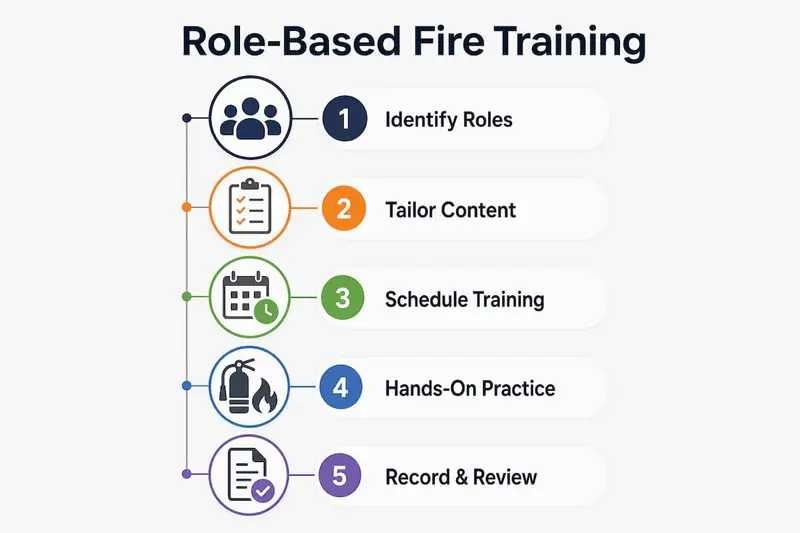
Designated extinguisher users require hands-on practice using the P.A.S.S. method: Pull the pin, Aim at the base, Squeeze the handle, Sweep side to side. OSHA 29 CFR 1910.157(g) requires this training at initial assignment and at least annually, with a hands-on session typically running 20–30 minutes. That hands-on requirement cannot be replaced by a video alone.
Fire wardens carry the heaviest responsibility. They sweep assigned areas, confirm evacuation, assist employees with mobility needs, and report to the incident commander at the assembly point. Warden training should include scenario practice, not just a checklist review.
Pro Tip: Blend online modules for foundational knowledge with live scenario exercises for skill application. Staff retain procedures far better when they practice under mild stress rather than just reading about them.
| Role | Training content | Delivery mode | Frequency |
|---|---|---|---|
| General employee | Alarm signals, routes, evacuation | Online module + drill | Annual + quarterly drill |
| Fire warden | Sweep, assist, report | In-person scenario | Annual + quarterly drill |
| Extinguisher user | P.A.S.S. method, fire classes | Hands-on live or VR | Annual |
VR fire extinguisher training improves retention by up to 75% at 30 days compared to lecture-only methods. It also reduces training time and cost while still meeting OSHA requirements. Blended programs that combine VR with a live demonstration represent the current best practice for extinguisher users.
Annual full sessions are the legal minimum. Quarterly 10-minute refreshers significantly improve skill retention in industrial environments. Schedule those refreshers on your calendar before the year starts, not after the first audit finding.
What are the best practices for conducting fire drills?
A fire drill is a performance test, not a rehearsal. Set clear objectives before each drill: what specific behavior are you measuring? Common objectives include alarm-to-evacuation time, muster accuracy, and successful PEEP (Personal Emergency Evacuation Plan) assistance for employees with mobility needs.
- Define the scenario in advance. Choose a blocked exit, a multi-floor evacuation, or a night-shift condition. Rotating scenarios prevents staff from memorizing a single path rather than learning to adapt.
- Assign observers with clipboards. Observers document what they see, not what they expect. One person cannot watch every exit and every stairwell simultaneously.
- Track quantitative metrics. Alarm-to-last-occupant interval and muster completion time are the two most telling numbers. Most drills fail by only confirming that evacuation happened, not how long it took.
- Run unannounced drills at least once per cycle. Announced drills measure preparation. Unannounced drills measure actual readiness.
- Hold a debrief within 48 hours. Post-drill debriefs that review failures and assign corrective actions with deadlines are critical to improving safety programs.
Drill scenarios should include realistic complications such as blocked exits and mobility assistance needs. Rotating these scenarios ensures staff adaptability beyond memorized escape routes.
Pro Tip: Let the drill fail. If you intervene to prevent an embarrassing outcome, you lose the data you need to fix the real problem. A failed drill with a documented corrective action is more valuable than a perfect drill that hid a gap.
OSHA recommends quarterly drills for general industry and monthly drills for healthcare settings. Document scenarios, outcomes, participant feedback, and corrective actions with assigned owners and deadlines for every drill.
How do you maintain training records and stay compliant?
Training records are your legal defense and your operational roadmap. OSHA requires documentation of who trained, what content was covered, the training method used, and the date. Records should be kept throughout the employee’s tenure and beyond for audit purposes.
Build your recordkeeping system around three training triggers:
- Initial assignment: Every new hire completes fire safety orientation before working independently.
- Annual recertification: All staff complete role-appropriate training each calendar year.
- Post-incident or role-change training: Any employee who changes roles or witnesses a fire-related incident receives updated training within 30 days.
Digital tracking systems make this manageable. A spreadsheet with automated reminders beats a paper binder that gets updated once a year. For Houston facility managers, the fire safety training guide from Reliable-fire-protection covers local compliance nuances that generic national templates miss.
| Training event | Documentation required | Retention period |
|---|---|---|
| Initial orientation | Attendee name, date, content outline | Duration of employment |
| Annual recertification | Sign-in sheet, content covered, trainer name | Duration of employment + audit buffer |
| Fire drill | Scenario, metrics, corrective actions | Minimum 3 years |
| Post-incident training | Incident reference, content, date | Duration of employment |
Compliance audits focus on gaps. An auditor who finds a missing sign-in sheet for one employee will look harder at everything else. Consistent records signal a program that runs by design, not by accident.
What are the most common fire training mistakes?
The most common mistake is treating fire drills as a formality rather than a test. When managers announce drills in advance, adjust routes to avoid disruption, and skip the debrief, they produce compliance theater instead of real readiness. Staff learn to walk calmly to the parking lot and back, not to respond under pressure.
Generic training programs are the second major failure point. A one-size-fits-all session delivered to a 200-person manufacturing facility produces the same result as no training for the employees who face the highest risk. Role-specific content, tied to actual site hazards, is what changes behavior.
Overdesignating responders creates a different problem. When too many employees are assigned extinguisher duty without adequate hands-on practice, the training burden exceeds what annual sessions can support. Limit designated responders to a manageable number and train them thoroughly.
- Skill fade is real. Without quarterly refreshers, employees forget P.A.S.S. steps and evacuation assignments within months.
- Inconsistent participation across shifts creates uneven readiness. Night-shift staff need the same drill frequency as day-shift staff.
- Lack of clear role communication leaves wardens uncertain of their authority during an actual event.
Pro Tip: VR training platforms and digital tracking tools reduce the cost of frequent refreshers significantly. A 10-minute VR module costs far less than a live demonstration and delivers measurable retention data you can attach to your compliance records. Fire safety training resources from partners like AGIL show how blended approaches work across different regulatory environments.
Key Takeaways
Effective fire emergency staff training requires role-specific content, documented drills with measurable metrics, and consistent refresher sessions to maintain real readiness beyond minimum compliance.
| Point | Details |
|---|---|
| Role-based training | Assign separate training tracks for general employees, fire wardens, and extinguisher users. |
| OSHA compliance | Document every session with attendee names, content, method, and date to survive audits. |
| Drill quality over frequency | Track alarm-to-evacuation time and muster accuracy, not just whether evacuation occurred. |
| Refresher cadence | Quarterly 10-minute sessions prevent skill fade between annual recertifications. |
| Post-drill debriefs | Hold debriefs within 48 hours and assign corrective actions with deadlines and owners. |
What I’ve learned from watching training programs succeed and fail
The programs that actually work share one trait: the manager treats the drill result as real information, not a performance to manage. I have seen facilities where the safety coordinator walked the evacuation route the morning of the drill to clear obstacles. That is not a test. That is a stage set.
Role-specific training is where most programs leave money on the table. A fire warden who has only read a checklist will hesitate at a blocked stairwell. A warden who has practiced that exact scenario twice will act. The difference is not intelligence or motivation. It is repetition under realistic conditions.
Documentation determines audit outcomes more often than actual training quality does. I have seen well-run programs fail inspections because records were incomplete. I have also seen mediocre programs pass because the paperwork was airtight. Both outcomes are wrong, but the lesson is clear: build your records system before you need it.
The technology argument is real but often oversold. VR training works. Digital tracking works. Neither replaces a live debrief where your team talks through what went wrong and why. The best programs use technology to reduce cost and increase frequency, then use human conversation to build the judgment that technology cannot teach.
Complacency is the slow killer of fire safety programs. The facility that had a clean audit last year is the one most likely to skip the quarterly refresher this year. Build the schedule, lock it in, and treat it as non-negotiable.
— Reliable-fire-protection
Fire alarm systems and staff training work together
Staff training and fire alarm systems are two sides of the same safety program. Your team needs to know exactly what each alarm signal means, which zones it covers, and what action it requires. Without that knowledge, even the best fire alarm system produces hesitation instead of response.
Reliable-fire-protection serves Houston businesses with fire alarm installation, inspection, and maintenance services designed to integrate with your facility’s emergency plan. When your alarm system and your staff training reinforce each other, your response time drops and your compliance posture strengthens. Contact Reliable-fire-protection to schedule a consultation and align your fire safety products and services with a training program built for your specific facility.
FAQ
What does OSHA require for fire safety training?
OSHA standards 29 CFR 1910.157 and 1910.38 require hands-on extinguisher training at initial assignment and annually, plus a written Emergency Action Plan. Records of all training sessions must be maintained throughout the employee’s tenure.
How often should employees complete fire drills?
OSHA recommends quarterly drills for general industry and monthly drills for healthcare settings. Each drill must be documented with scenarios, outcomes, and corrective actions assigned to specific owners.
What is the P.A.S.S. method in fire extinguisher training?
P.A.S.S. stands for Pull the pin, Aim at the base of the fire, Squeeze the handle, and Sweep side to side. OSHA requires designated extinguisher users to practice this method hands-on at least once per year.
How long should a hands-on fire extinguisher training session be?
A 20–30 minute hands-on session commonly meets OSHA 29 CFR 1910.157(g) requirements for designated extinguisher users. VR-based training can meet the same standard while reducing time and cost.
What records do you need to keep after a fire drill?
Every drill record must include the scenario used, evacuation metrics such as alarm-to-last-occupant time, participant feedback, and corrective actions with assigned owners and deadlines. Retain these records for a minimum of three years.