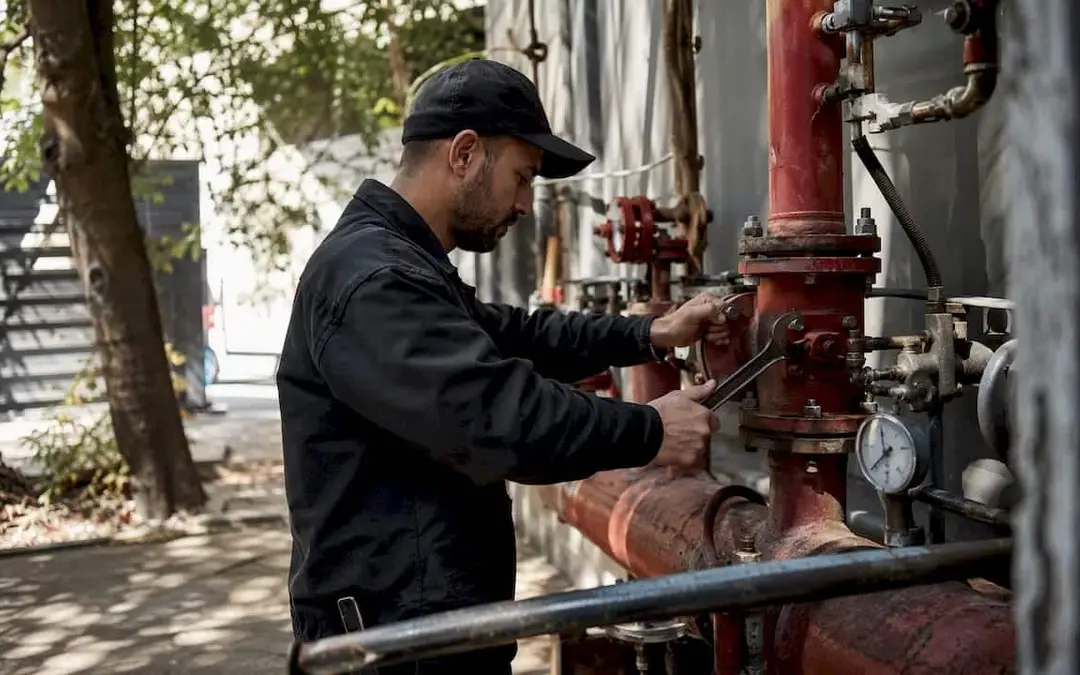
Regular equipment inspections materially reduce safety risk, unplanned downtime, and lifecycle cost while supporting compliance and insurance requirements. That is the short answer. The longer one involves a NIST analysis finding that reactive-maintenance-heavy facilities carry roughly 3.3 times more downtime than proactive counterparts, plus materially higher defect and lost-sales rates. For a facility manager, that gap is the entire business case.
The immediate next step: build a critical-equipment inventory and schedule a daily or shift-level check for your top five highest-risk assets. That single action, done this week, starts closing the gap.
Why inspections belong on your priority list:
- They catch worn or failed safety-critical components before an injury or lost-time incident occurs
- They feed the data that lets you shift from reactive to preventive or predictive maintenance
- Documented inspections satisfy OSHA, NFPA, and FM Global requirements and protect you during insurance claims
- They extend asset life and reduce the frequency of costly emergency repairs
Key Takeaways
Regular equipment inspections reduce safety incidents, unplanned downtime, and lifecycle cost while creating the documented compliance record that protects facilities during audits and insurance claims.
| Point | Details |
|---|---|
| Reactive maintenance costs more | Facilities relying on reactive maintenance carry roughly 3.3 times more downtime than proactive peers, per NIST analysis. |
| Criticality drives cadence | Score assets on safety, production, and replacement cost; top-quartile assets need shift or daily checks. |
| ITM is a multi-tier cycle | NFPA-style fire protection ITM runs from weekly valve checks through 5-year internal inspections; skipping any tier creates compliance and insurance risk. |
| Document every finding | A corrective action without a recorded close-out date is not a closed finding; documentation is the compliance record. |
| Reliable-fire-protection | Provides qualified ITM inspections, compliance documentation, and 24/7 emergency response for fire protection systems in Houston. |
Table of Contents
- Why regular equipment inspections deliver measurable business value
- What your inspection checklist should cover
- How often should you inspect your equipment?
- How inspections fit into your maintenance strategy
- Common inspection program obstacles and how to fix them
- Industry-specific regulations and standards you need to know
- Fire protection ITM: what the NFPA schedule actually requires
- How to build or scale an inspection program from scratch
- How to prioritize equipment when you cannot inspect everything at once
- How to make the business case to leadership
- What inspection programs look like before and after implementation
- Reliable-fire-protection keeps your fire systems inspection-ready
- Sources
Why regular equipment inspections deliver measurable business value
Safety is the most immediate argument. An inspection that catches a cracked hoist hook, a leaking hydraulic line, or a faulty emergency stop before the next shift prevents an incident that would cost far more than the inspection itself, in human terms and in direct liability. OSHA citations, workers’ compensation claims, and production shutdowns all follow from deferred checks.
Uptime is the financial argument. Preventive maintenance reduces unplanned downtime and can extend equipment life in the range of 20–40%, according to Honeywell’s industry reporting. Reactive maintenance, by contrast, tends to cost several times more per repair event because it involves emergency labor rates, expedited parts, and cascading damage from a component that ran to failure.
Stat to quote to leadership: The NIST economics analysis found reactive-maintenance-heavy establishments had approximately 3.3 times more downtime than proactive peers, alongside higher defect rates and lost-sales impacts.
Compliance and insurance are the third pillar. Insurers increasingly scrutinize inspection records when evaluating claims. A fire suppression system that failed because documented NFPA-style ITM was skipped can result in a denied claim or legal penalty. The documentation trail from a consistent inspection program is your defense.
Asset life is the long-term payoff. Lubrication checks, calibration, and early-wear identification add years to equipment that would otherwise reach failure prematurely. Replacing a $40,000 compressor five years early because no one checked belt tension is a cost that never shows up in a downtime report but hits the capital budget hard.
What your inspection checklist should cover
A solid equipment maintenance checklist works through six categories. Skipping any one of them leaves a gap that will eventually surface as an incident or an unplanned repair.
Visual condition
- Leaks: hydraulic fluid, coolant, fuel, or process fluids pooling under or around equipment
- Corrosion, cracks, or deformation on structural members, frames, and pressure vessels
- Worn, missing, or bypassed safety guards and covers
- Loose fasteners, frayed cables, and damaged hoses
Operational checks
- Start, stop, and emergency-stop response within expected parameters
- Abnormal noise, vibration, or heat during operation
- Control and sensor response, including limit switches and interlocks
- Calibration status on measurement-critical instruments
Fluid and lubrication
- Oil and coolant levels; contamination or discoloration
- Filter condition and replacement intervals
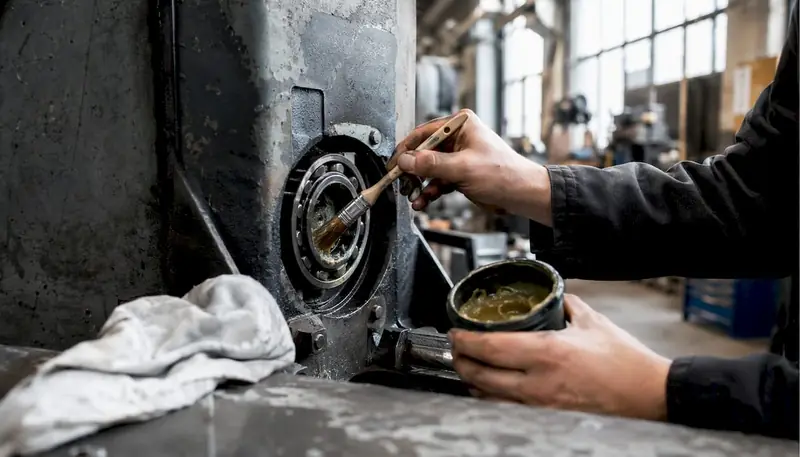
- Grease points serviced per manufacturer schedule
Electrical systems
- Connection tightness and signs of arcing or overheating at terminals
- Insulation damage on cables and conductors
- Circuit loading versus rated capacity
- Proper labeling and lockout/tagout point identification
Safety devices
- Emergency stops tested and confirmed functional
- Fire extinguishers: pressure gauge in green, pin intact, no visible damage. A fire extinguisher checklist covers the specific steps for commercial properties
- Alarms, detectors, and warning systems confirmed active
- Signage legible and correctly placed
Documentation
Record every finding immediately: the date, the inspector’s name, what was found, what corrective action was taken or scheduled, and the follow-up deadline. A finding without a follow-up date is just a note. A finding with a closed corrective action is evidence of a functioning program.
For a ready-to-use template, the safety inspection checklist guide from Reliable-fire-protection covers compliance officer needs across commercial properties.
How often should you inspect your equipment?
The right cadence depends on the asset class, usage intensity, and regulatory requirements. Here is a practical baseline:
Pro Tip: Criticality drives cadence. A conveyor that feeds a single production line is more critical than a backup pump with a standby unit. Assign a criticality score (1–3) to each asset and let that score determine whether it gets daily, weekly, or monthly formal checks.
OSHA’s shift-inspection requirements for cranes and forklifts are not optional. For 24/7 operations, that means a documented check every single shift, not once per day.
How inspections fit into your maintenance strategy
Maintenance strategy sits on a spectrum. Reactive maintenance (RM) means you fix things after they break. Preventive maintenance (PM) means you service equipment on a time or usage schedule. Predictive maintenance (PdM) means you monitor condition data and intervene only when a threshold is crossed.
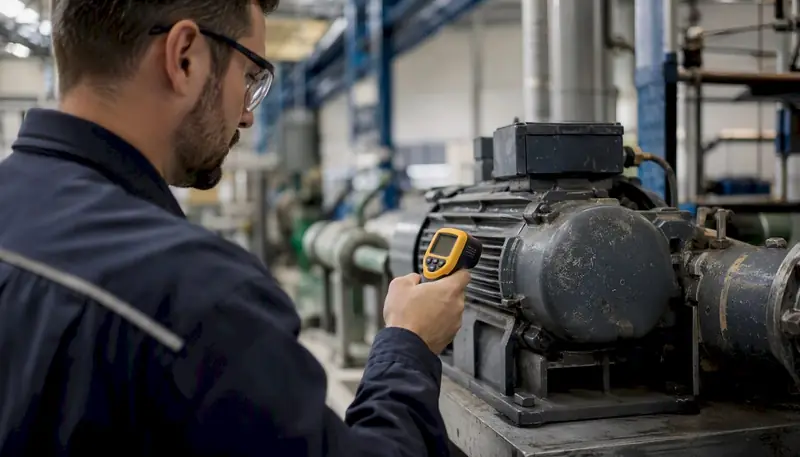
Inspections feed all three, but they are most powerful as the foundation of PM and the data source for PdM. A daily shift check that catches a bearing running hot gives you the trigger to schedule a replacement before failure. That is PdM in its simplest form, and it requires no sensors, just a trained inspector and a documented trend.
The NIST analysis makes the cost case clearly: reactive-maintenance-heavy operations carry roughly 3.3 times more downtime. RM has the lowest upfront cost which is why it persists, but that math reverses quickly once you account for emergency labor, expedited parts, and lost production. Most facilities benefit from a blended approach: PM schedules for stable assets, targeted PdM for high-criticality or high-wear equipment.
Pro Tip: Transitioning from pure PM to PdM works best as a pilot. Pick two or three high-criticality assets, add a vibration or temperature sensor, and log readings for 90 days alongside your existing inspection records. The pattern that emerges tells you whether condition-based triggers are worth the investment before you commit to a facility-wide rollout.
Common inspection program obstacles and how to fix them
The most common reason inspection programs fail is not lack of intent. It is incomplete asset inventories, inconsistent checklists, and documentation that lives in someone’s notebook rather than a system anyone else can access.
Incomplete inventories mean some equipment never gets assigned to a schedule. Fix: conduct a physical walkthrough with a floor plan and tag every asset. Even a spreadsheet is better than nothing.
Inconsistent checklists produce inconsistent findings. One inspector checks lubrication; another skips it. Standardize checklists per asset class and make them non-negotiable. Mobile forms in a CMMS (computerized maintenance management system) like Fiix, UpKeep, or IBM Maximo enforce consistency because the inspector cannot submit without completing every field.
Missing documentation is the single biggest compliance risk. If it is not recorded, it did not happen. Implement a rule: no corrective action is considered closed until the follow-up is documented and signed off.
Contractor coordination creates gaps when outside vendors perform ITM and their records never make it into your system. Require contractors to submit inspection reports in a format your CMMS can accept, and assign an internal owner to verify receipt.
Pro Tip: To build the ROI case for leadership, run a 90-day pilot on your five most critical assets. Track downtime events, repair costs, and parts consumption before and after formalizing the inspection schedule. A single avoided breakdown on a critical press or compressor typically covers months of inspection labor costs.
Industry-specific regulations and standards you need to know
Inspection obligations vary significantly by sector. The table below maps the most common regulatory references:
| Industry / Equipment | Key Standard | Core Requirement |
|---|---|---|
| Cranes and derricks | OSHA 1926.1412 | Shift visual + annual qualified-person inspection; documented corrective actions |
| Wire ropes | OSHA 1926.1413 | Pre-shift, monthly, and annual qualified inspections; discard criteria |
| Powered industrial trucks | OSHA 1910.178 | Pre-use examination; per-shift if 24/7; defects corrected before return to service |
| Fire protection systems | FM Global DS 2-81 | Weekly through 5-year ITM cycles; impairment permits required |
| Electrical systems | NFPA 70E / OSHA | Arc-flash hazard assessment; qualified-person inspections; lockout/tagout |
| Food processing | FDA / FSMA / HACCP | Equipment sanitation and calibration checks integrated into food safety plans |
| Construction fire safety | NFPA / local AHJ | Fire safety regulations in construction require inspection during active build phases |
Qualified person vs. competent person: OSHA uses both terms, and they are not interchangeable. A competent person can identify hazards and has authority to correct them. A qualified person has specific training, credentials, or experience for the task. Annual crane inspections require a qualified person; shift checks require a competent person. Know which applies to each task in your program.
For food processing, contamination risk adds a layer: lubricants must be food-grade where contact is possible, and calibration records for temperature and pressure instruments are part of FSMA documentation. Electrical inspections under NFPA 70E require an arc-flash hazard analysis before any energized work, which typically means a licensed electrical contractor for anything beyond visual checks.
Fire protection ITM: what the NFPA schedule actually requires
Fire protection inspection, testing, and maintenance (ITM) is not a once-a-year event. NFPA-style ITM programs run on a continuous, multi-tiered cycle from weekly checks through five-year internal inspections. Skipping a tier does not just create a compliance gap; it can void insurance coverage or expose the building owner to legal liability after a loss.
Weekly tasks typically include verifying that control valves are in the open position and that supervisory signals are active. Monthly checks add a main drain test, a water-flow alarm test, and a visual inspection of sprinkler heads for paint, corrosion, or physical damage. Annual tasks include a full inspector’s test, a fire pump performance test, and a review of spare sprinkler heads and the correct wrench. Five-year tasks require an internal inspection of dry-pipe and preaction systems and a full obstruction investigation.
Fire pump churn tests deserve specific attention. Isolating a pump for testing temporarily impairs protection. FM Global’s DS 2-81 recommends treating ITM from a “total system health” perspective and using a formal Red Tag permit system whenever any part of the system is taken out of service. The permit documents the impairment, notifies the authority having jurisdiction (AHJ) and insurer, and sets a return-to-service deadline.
Battery float voltage on alarm panels, detector sensitivity readings, and spare-head inventory are the three items most commonly found out of compliance during annual fire alarm inspections. None of them are difficult to check; they just require a scheduled task and someone accountable for it.
Pro Tip: Coordinate ITM outage windows with your in-house emergency response team before the contractor arrives. A 30-minute pre-test briefing that confirms who holds the impairment permit, who notifies the monitoring station, and who has authority to extend or abort the test eliminates the improvised decisions that introduce new hazards during testing.
For a detailed look at annual fire safety inspection workflows and documentation practices, Reliable-fire-protection’s resource covers the full cycle.
How to build or scale an inspection program from scratch
- Create a complete asset inventory. Walk every area of the facility and tag every piece of equipment. Record the asset ID, location, manufacturer, model, installation date, and maintenance history. Assign a criticality score (1 = low, 3 = high) based on safety consequence, production impact, and cost to replace.
- Standardize checklists per asset class. Use the six-category framework from the checklist section above. Define minimum check items for each class and set them as non-negotiable fields in your documentation system.
- Choose your documentation tools and assign roles. A CMMS is the right answer for most facilities with more than 50 assets. For smaller operations, a mobile form tool with cloud storage works. Assign a named owner to every asset’s inspection schedule and a backup for absences.
- Pilot on critical assets first. Run the formal schedule on your top-10 critical assets for 60–90 days. Capture downtime events, repair costs, and parts consumption. Calculate the cost of any avoided breakdown. That data is your ROI report for leadership.
- Audit annually and refine. Review the program every 12 months: which assets generated the most findings, which checklists produced the most corrective actions, and whether any PdM triggers are now justified based on condition trends. Adjust cadence up or down based on evidence, not habit.
How to prioritize equipment when you cannot inspect everything at once
Risk-based prioritization keeps a limited inspection budget focused where failure hurts most. Score each asset on three axes: safety consequence (injury or fatality risk), production consequence (does failure stop the line?), and replacement cost or lead time. Multiply the scores and rank the list. The top quartile gets daily or shift checks; the bottom quartile can run on monthly or quarterly schedules.
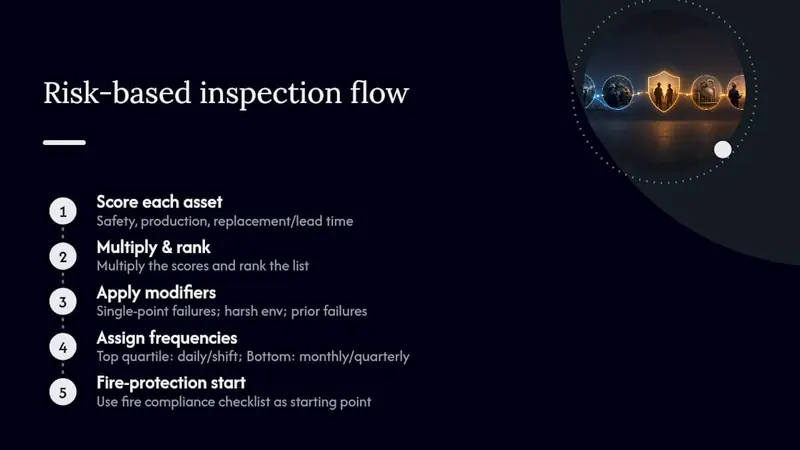
Single-point-of-failure assets always rank high regardless of their age or condition. A backup pump with a standby unit is lower priority than the only pump feeding a critical process. Equipment in harsh environments (high heat, chemical exposure, heavy cycling) moves up the list because wear accelerates. Equipment with a history of failures moves up automatically.
The fire compliance checklist for commercial properties is a useful starting point for the fire-protection subset of any facility’s asset list.
How to make the business case to leadership
Non-technical stakeholders respond to three things: cost, liability, and peer comparison. Lead with cost. Use the NIST finding that reactive-maintenance-heavy facilities carry roughly 3.3 times more downtime than proactive peers, then translate that into dollars using your own average hourly production value. A facility running $50,000 per hour of production that avoids even two hours of unplanned downtime per quarter has already justified a full-time inspection program.
Liability is the second lever. Frame it as risk transfer: documented inspections are the evidence that the organization exercised reasonable care. Without them, a single OSHA citation or insurance claim denial can cost more than years of inspection labor.
Peer comparison closes the argument. Most industries have published benchmarks for maintenance spend as a percentage of asset replacement value. Showing leadership where the facility sits relative to that benchmark makes the abstract concrete.
Present the pilot data from your first 90 days. A before-and-after comparison of downtime events, repair costs, and near-miss incidents on the pilot assets is more persuasive than any industry statistic because it uses the organization’s own numbers.
What inspection programs look like before and after implementation
A mid-size food processing plant running on a reactive maintenance model typically shows a recognizable pattern: three to five unplanned line stoppages per month, a parts room stocked with emergency spares ordered at premium prices, and an OSHA recordable incident rate above industry average. Inspection records, when they exist at all, live in paper binders that no one reviews until something breaks.
After formalizing a risk-prioritized inspection program, the same facility typically sees unplanned stoppages drop within the first two quarters as the most common failure modes, worn conveyor belts, failing bearings, and clogged filters, get caught during scheduled checks rather than at the point of failure. Emergency parts orders shift toward planned purchases. The OSHA recordable rate falls as safety-device checks become routine.
A commercial property management company that added monthly fire protection ITM checks to its existing annual inspection program found that battery float issues on alarm panels and obstructed sprinkler heads were present in a significant share of buildings. Neither defect was visible without a scheduled check. Both would have produced failed systems in an actual fire event.
The pattern across industries is consistent: the first 90 days of a formalized program surface a backlog of deferred findings. That backlog is not a sign the program is failing. It is the program working.
What inspectors see in the field that in-house teams miss
The findings that surprise facility managers most are rarely the dramatic ones. Each one passes a casual walkthrough and fails a documented inspection.
Documented inspection history also changes how contractors diagnose problems. A pump that has been running slightly below rated pressure for six months tells a different story than one that failed without warning. The trend is the diagnosis. Without records, every failure looks like a random event rather than the end of a predictable curve.
Close contractor oversight during ITM matters for a different reason: testing can introduce hazards if not managed carefully. A technician who closes a control valve to test a flow switch and does not reopen it fully before leaving has impaired the system. A formal impairment permit with a return-to-service sign-off prevents that outcome.
Reliable-fire-protection keeps your fire systems inspection-ready
Reliable-fire-protection provides qualified inspection, testing, and maintenance for fire alarms, sprinkler systems, fire extinguishers, suppression systems, and backflow preventers across Houston and surrounding areas. Every inspection produces documented findings, corrective action records, and compliance-ready reports your insurer and AHJ can review. The team handles impairment management, coordinates with monitoring stations, and provides 24/7 emergency response when a system needs immediate attention.
For facility managers who need to close a compliance gap or establish a formal ITM program, the starting point is a free site assessment. Reliable-fire-protection’s certified inspectors walk the property, identify gaps against NFPA and local code requirements, and deliver a prioritized action plan. Learn how fire alarm systems work and what a full inspection covers, then contact Reliable-fire-protection to schedule your assessment.
Sources
The sources below are the primary references for building a compliant, defensible inspection program:
- DS 2-81 Fire protection system inspection, testing and maintenance (FM Global)
- Economics of Manufacturing Machinery Maintenance: A Survey and Analysis of U.S. Costs and Benefits (NIST AMS 100-34)
- OSHA 1926.1412 — Cranes and derricks: inspection requirements
- OSHA 1910.178 — Powered industrial trucks
- The benefits of preventive maintenance (Honeywell insights)
This article is general information, not a substitute for advice from a qualified lawyer. Consult a qualified legal professional about your own circumstances before acting on anything here.