

TL;DR:
- Proper hazard classification is crucial for designing effective fire protection systems, especially considering Houston’s local regulations. Mistakes in classification, particularly in storage environments, can lead to undersized sprinkler systems that fail during a fire, increasing property damage and liability. Regularly reviewing and updating classifications based on current conditions and tenant activities is essential for safety and compliance.
Many Houston commercial properties fail fire inspections not because of faulty equipment, but because of a misclassification that happened before a single sprinkler head was ever installed. Getting the hazard level wrong means your system is designed for the wrong threat, and when a fire breaks out, the consequences are immediate and severe. Houston’s local regulations add another layer of requirements that go beyond national standards, so property owners and managers need to understand both. This guide walks you through exactly what hazard classification means, how it applies to your property, and what steps you need to take to stay compliant and genuinely safe.
Table of Contents
- What is hazard classification and why does it matter?
- Types of hazard classifications under NFPA 13
- Houston regulations and code amendments: What property owners must know
- Common missteps: How misclassification leads to unsafe design
- Applying hazard classification: Steps to compliance and safer properties
- Our take: Why accurate hazard classification is Houston’s ultimate fire safety priority
- Reliable protection and next steps for Houston properties
- Frequently asked questions
Key Takeaways
| Point | Details |
|---|---|
| Hazard classification sets fire protection needs | The type of fire hazard determines crucial sprinkler system design and water demand. |
| Houston codes require strict compliance | Local amendments demand permits and operational approvals unique to commercial sites. |
| Misclassification risks catastrophic loss | Undersized or misaligned protection systems can fail in real emergencies. |
| Correct classification is a process | Stepwise evaluation and periodic review ensure ongoing compliance and safety. |
What is hazard classification and why does it matter?
Hazard classification is the process of categorizing a building or space based on its potential fire risk. That risk is measured by the type, quantity, and arrangement of combustible materials present, along with how quickly a fire could grow and spread. The classification you receive directly shapes every major decision in your fire protection system design, from the type of sprinkler heads used to the water pressure required.
Under NFPA 13, the national standard for sprinkler system installation, your building’s hazard class determines two critical design variables: design density and remote area. Design density is the gallons per minute per square foot (gpm/ft²) that your sprinkler system must deliver, while remote area is the square footage that must be covered simultaneously during a fire event. Design density and remote area vary significantly across classifications, with Light Hazard requiring roughly 0.10 gpm/ft² over 1,500 ft² and Extra Hazard Group 2 demanding up to 0.40 gpm/ft² over 2,500 ft², creating dramatically higher water supply demands.
For Houston commercial property owners, this matters because an undersized system fails silently. Your property looks compliant on paper during a routine inspection, but if a fire occurs in a storage area that was classified too low, the sprinklers cannot deliver enough water fast enough to control the fire. By the time the alarm sounds, you’re already in crisis.
Here is why getting classification right is foundational:
- It legally establishes the minimum performance standard for your system
- It determines the water supply requirements from your utility connection
- It drives the spacing, type, and number of sprinkler heads installed
- It affects your insurance coverage and premium calculations
- It must match your actual occupancy and storage conditions, not just what was there when the building was originally inspected
Understanding your occupancy classifications guide is the starting point for any serious compliance review. And if you’re newer to fire protection concepts, reviewing fire safety basics for commercial settings will give you the context you need before diving deeper.
A critical point: Hazard classification is not a one-time determination. It must reflect current conditions, not the conditions that existed when the building was first approved.
Types of hazard classifications under NFPA 13
NFPA 13 organizes occupancies into three primary hazard groups, each with specific subclassifications. Understanding where your property fits is not just a regulatory exercise. It is the foundation of every dollar you spend on fire protection.
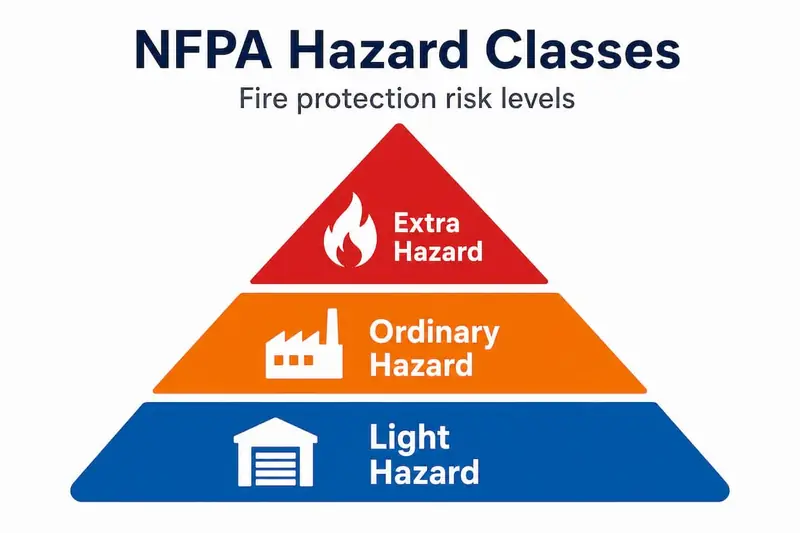
| Hazard class | Typical design density | Remote area | Houston examples |
|---|---|---|---|
| Light Hazard | ~0.10 gpm/ft² | 1,500 ft² | Office buildings, churches, schools |
| Ordinary Hazard Group 1 | ~0.15 gpm/ft² | 1,500 ft² | Parking garages, laundries, bakeries |
| Ordinary Hazard Group 2 | ~0.20 gpm/ft² | 1,500 ft² | Cold storage, wood product facilities |
| Extra Hazard Group 1 | ~0.30 gpm/ft² | 2,500 ft² | Chemical plants, spray booths |
| Extra Hazard Group 2 | ~0.40 gpm/ft² | 2,500 ft² | Flammable liquid warehouses, oil refineries |
These design density and area requirements come directly from the density/area curves in NFPA 13 and cannot be adjusted based on preference or budget. They are minimum thresholds established through fire behavior research.
Here is what separates properties that pass from those that fail:
- Light Hazard spaces have low quantities of combustibles and limited fire growth potential. Most Houston professional offices and medical clinics fall here.
- Ordinary Hazard Group 1 covers spaces with moderate combustibles and predictable fire development. Think parking structures and commercial laundries.
- Ordinary Hazard Group 2 applies to spaces with higher commodity quantities or combustible materials stored on shelving. Many Houston retail storage rooms fall here, not in the Light Hazard category as owners often assume.
- Extra Hazard Group 1 applies to spaces with significant dust, lint, or shavings present. Woodworking shops along the Houston Ship Channel area often fall here.
- Extra Hazard Group 2 covers spaces with flammable or combustible liquids. Given Houston’s petrochemical industry, many industrial facilities carry this classification.
A mismatch between actual conditions and the assigned classification can lead directly to fire damage restoration situations that could have been prevented entirely. Meeting fire protection regulations and understanding zoning fire requirements for your specific area of Houston helps you connect the classification to real enforcement expectations.
Houston regulations and code amendments: What property owners must know
Houston and Harris County operate under the International Fire Code (IFC), but with locally adopted amendments that create requirements beyond what you will find in the standard national version. These amendments affect when permits are required, what documentation you must submit, and how enforcement happens.
Here are the key local requirements every Houston commercial property owner should know:
- Hazardous materials permits are required when stored quantities exceed specific thresholds. For example, more than 55 gallons of combustible liquids triggers a hazardous materials permit through the Harris County Fire Code Hub. Storage below that threshold does not automatically exempt you from classification requirements, but it changes the permit pathway.
- Operational permits are required for commercial and warehouse facilities that share fire suppression systems. This is more common than owners realize in multi-tenant industrial parks across north Houston and the Greenspoint area.
- HFMO (Houston Fire Marshal’s Office) enforcement is particularly strict for industrial sites, where the combination of flammable materials and high occupancy creates the greatest potential for catastrophic fires.
- Permit thresholds are tied directly to hazard classification. If your renovation changes the occupancy type or significantly increases the fire load in a given area, you are likely required to file for a new permit and have the system redesigned.
- Documentation standards in Houston require that hazard classification decisions be made by a licensed fire protection engineer and that those decisions be recorded in the system design drawings submitted for permit.
| Requirement | Threshold | Authority |
|---|---|---|
| Hazmat storage permit | Over 55 gal combustibles | Harris County Fire Code Hub |
| Operational permit | Shared fire systems | HFMO |
| System redesign permit | Occupancy change or fire load increase | City of Houston / Harris County |
| Industrial enforcement | Flammable/explosive materials | HFMO |
Pro Tip: Do not wait for a scheduled inspection to discover a permit gap. If your property has changed tenants, added warehouse shelving, or shifted storage practices, pull your permit history and compare it to current conditions before the inspector does.
Understanding Houston fire codes and referencing industry fire standards gives you a complete picture of both the regulatory baseline and the best practices expected in the Houston market.
Common missteps: How misclassification leads to unsafe design
The most dangerous classification errors are not usually the obvious ones. Most property owners know a chemical warehouse is not the same as an office building. The errors that cause real harm happen in edge cases, particularly around storage.

Misclassifying materials in storage, especially plastics and commodities stored at height, leads directly to undersized sprinkler systems that cannot control a real fire event. Storage height is a key variable because stacked commodities trap heat and accelerate fire growth. A pallet of expanded polystyrene stored 10 feet high presents a completely different fire challenge than the same material stored on a shelf at 4 feet.
The most common classification mistakes include:
- Classifying a storage area as Ordinary Hazard when the actual commodity is Group A plastics, which require Extra Hazard ratings
- Ignoring changes in storage height when the system was originally designed for lower racking
- Failing to reclassify a space after a tenant change brings in more combustible inventory
- Treating a mixed-use space as a single classification when different zones within the same building have different fire loads
- Overlooking the impact of packaging materials, which often have a higher fire hazard rating than the products they contain
Remember: The fire does not care what the permit says. It responds to what is actually stored in the room.
Pro Tip: Always evaluate the full fire load in a space, not just what is visible during a walkthrough. Ask tenants about stored materials, packaging types, and maximum inventory levels. The worst-case scenario is what your system must be designed for.
Applying fire protection best practices means staying current on storage conditions year-round. A structured fire prevention checklist helps you catch reclassification triggers before they become compliance violations. Preventing a fire event also means avoiding the kind of damage that leads to water damage complications from oversized suppression system discharges.
Applying hazard classification: Steps to compliance and safer properties
Knowing the theory is one thing. Implementing it correctly across a real Houston commercial property takes a structured, repeatable process. Here is how to approach it:
- Identify all occupancies and uses within the building, including every storage area, mechanical room, and tenant space. Do not assume that a space used for one purpose today was always used that way.
- Classify each zone independently using NFPA 13 criteria. Mixed-use buildings may have multiple classifications across different areas, and each zone must meet the standard for its own classification.
- Document everything in writing, including the reasoning behind each classification decision. Houston inspectors expect documentation, and it protects you legally if a classification decision is ever challenged.
- Check permit requirements against your current Harris County fire code thresholds. If your stored materials exceed hazmat thresholds or your system serves multiple tenants, obtain the appropriate operational permits before your next inspection cycle.
- Commission a licensed fire protection engineer to review and sign off on the system design based on current classifications. This step is required for permit submissions in Houston and cannot be delegated to a general contractor.
- Schedule inspections and testing in line with your classification tier. Extra Hazard properties typically require more frequent system testing and documentation. Following fire safety testing steps ensures you stay ahead of enforcement requirements.
- Review classification annually or whenever your tenancy, storage type, or building layout changes significantly.
Pro Tip: Do not rely solely on the classification listed in your original permit drawings. Buildings change, tenants change, and storage practices evolve. The permit drawing reflects a moment in time, not current conditions. Your responsibility as a property owner or manager is to the current fire load, not the historical one.
Our take: Why accurate hazard classification is Houston’s ultimate fire safety priority
After working with commercial properties across Houston for years, one pattern stands out clearly: the properties that suffer the most serious fire losses are rarely the ones without sprinkler systems. They are the ones with systems that were designed for a different version of the building.
Misclassification is the single greatest risk factor in commercial fire protection, and it almost never happens intentionally. It happens because a lease was signed and a tenant moved in different inventory than the one before. It happens because someone added pallet racking and doubled the storage height without realizing the fire load implications. It happens because the person who made the original classification decision left the company, and nobody reviewed it when conditions changed.
The most effective property managers we work with do not treat compliance as a checkbox. They treat it as a live document. They know their current hazard classifications, they review them when anything changes, and they do not assume that passing last year’s inspection means the system is appropriate for this year’s conditions.
There is an uncomfortable truth in fire protection: code compliance is the floor, not the ceiling. Meeting minimum requirements keeps you legally protected, but only accurate, current hazard classification actually keeps your property safe. Many properties sit in a gray zone where they would technically pass a standard inspection but would fail catastrophically in an actual fire event because nobody updated the classification after conditions changed.
Our advice, grounded in years of Houston fire protection experience, is to treat every tenant change, renovation, or storage adjustment as a trigger for a classification review. Read the fire safety tips developed specifically for Houston property managers and use them as a regular audit reference. The properties that survive fires well are the ones where someone was paying attention before the alarm sounded.
Reliable protection and next steps for Houston properties
Getting hazard classification right is a process, and you do not have to navigate it alone.
Reliable Fire Protection specializes in helping Houston commercial property owners move from uncertainty to verified compliance. We support every step of the process, from initial occupancy review and hazard classification assessment through permit preparation, system design, and ongoing inspections. Our team understands both the national NFPA 13 standards and Houston’s local amendments, so we can identify gaps that a general review might miss. Whether you need to verify your current classification, redesign a system after a tenant change, or get a full sprinkler system compliance workflow in place, we have the experience to get it done correctly. Explore our sprinkler inspection guide for Houston properties and learn how your fire alarm system integrates with your overall protection strategy.
Frequently asked questions
How do I determine the correct hazard classification for my Houston property?
Consult NFPA 13 guidelines, assess all occupancies and current storage conditions in every zone, then cross-reference Houston’s local amendments and permit thresholds. The design density requirements for each classification tier will tell you exactly what your system must be capable of delivering.
What happens if my property is misclassified for hazard level?
Misclassification typically results in an undersized fire suppression system that cannot control a real fire event. Undersized systems from misclassification lead directly to failed inspections, increased property loss risk, and potential liability following a fire incident.
Do Houston properties need permits for hazardous materials?
Yes. Houston requires operational permits for hazardous materials that exceed locally established thresholds, including more than 55 gallons of combustible liquids. Thresholds vary by material type, and the Harris County Fire Code Hub outlines all applicable permit categories.
How often should hazard classification be reviewed for compliance?
Hazard classification should be reviewed immediately whenever occupancy type, storage materials, or arrangement changes significantly within the property. Annual reviews are strongly recommended as a baseline practice, even when no obvious changes have occurred, since gradual shifts in storage practices can accumulate into a meaningful reclassification need over time.
Recommended
- Commercial fire safety guide: achieve Houston compliance fast
- Understand Occupancy Classifications for Fire Safety
- Fire Protection Standards 2025: Houston Compliance Impact
- Fire Safety Regulations Explained: Impact on Houston Property Managers
- Fire Alarm System University Place TX
- Fire Alarm System Services in Bellaire, TX