
TL;DR:
- Property managers must treat fire classifications as dynamic elements, not just construction-phase paperwork, to ensure ongoing compliance and safety.
- Accurate classification affects wall materials, sprinkler design, and insurance coverage, requiring regular reviews with tenant changes and renovations.
Property managers who treat fire classifications as construction-phase paperwork are leaving serious compliance gaps open on their properties. These classifications aren’t bureaucratic checkboxes. They are the technical foundation that determines which materials go into your walls, how your sprinkler system gets designed, and whether your building survives an inspection or a claim. Houston’s enforcement environment makes this especially consequential. Get classifications wrong or let them go stale after a tenant change, and you’re looking at failed inspections, insurance exposure, and real safety risk to everyone inside.
Table of Contents
- What are fire classifications and why they matter
- How fire classifications drive code compliance in Houston
- Types of fire classification systems and when to apply them
- When classifications change: triggers and compliance risks
- Common pitfalls when specifying fire classifications
- Our perspective: Fire classifications are Houston’s compliance linchpin
- Partner with Houston’s fire compliance experts
- Frequently asked questions
Key Takeaways
| Point | Details |
|---|---|
| Fire classifications define safety | They set the technical standard for how materials and systems perform under fire—and compliance depends on getting them right. |
| Houston codes enforce them | Houston’s local fire codes make classification-based compliance a continuous responsibility, not a one-time event. |
| Mistakes risk lives and liability | Misclassifying a space can mean failed inspections, increased hazards, and legal or insurance consequences. |
| Ongoing review is essential | You must reassess fire classification after any tenant, use, or storage change to maintain compliance. |
What are fire classifications and why they matter
Fire classifications are standardized ratings that describe how building materials, stored goods, and building spaces behave in a fire. They answer three essential questions: How fast will this material let flames spread? How much hazard does this occupancy create? What protection level do these stored goods require?
The most visible classification system most property managers encounter involves interior finish materials. Flame spread classes like Class A, B, and C are assigned so that interior finishes and surface materials are chosen to limit how quickly fire travels along surfaces and how much smoke they produce. These ratings give code officials the data they need to set minimum requirements for different occupancies and locations within a building.
A quick breakdown of the main classification types:
| Classification type | What it rates | Primary code reference |
|---|---|---|
| Interior finish class (A/B/C) | Flame spread and smoke development of surface materials | IBC/IFC Table 803.3 |
| Sprinkler hazard classification | Combustibility and quantity of contents in a space | NFPA 13 |
| Commodity classification | Fire hazard of stored goods (Group I to IV, plastics) | NFPA 13/230 |
Common misconception: Many property managers assume all three systems are the same thing described different ways. They aren’t. Interior finish class tells you about the walls and ceilings. Sprinkler hazard classification tells you how intensive your suppression system needs to be. Commodity classification applies specifically to storage scenarios. Mixing them up creates serious design and compliance mismatches.
Houston properties are governed by codes that make these classifications enforceable, not advisory. Local code adoption pulls these standards directly into the legal requirements your building must meet. Checking in with Houston fire safety tips early in any project is a smart starting point before a single material gets specified.
How fire classifications drive code compliance in Houston
Fire classifications don’t just describe physical properties. They translate directly into compliance requirements that building codes enforce at both the design and operational stages. For a Houston property manager, this means your obligations don’t end when construction wraps up.
Houston operates under a framework that aligns closely with the International Fire Code while incorporating local amendments. Harris County fire code amendments make classification-based compliance an ongoing obligation for operating properties, not just a new construction formality. This is a critical distinction. You can be fully compliant at opening day and fall out of compliance six months later because a new tenant changes the nature of the space.
Here’s how the compliance chain typically works for a Houston commercial property:
- Identify occupancy type. The building’s use determines which baseline classifications apply.
- Specify interior finishes. Select materials that meet the Class A, B, or C requirements for the spaces involved.
- Classify operational hazards. Determine whether the space is light, ordinary, or extra hazard for sprinkler design purposes.
- Document commodity classifications. If any storage is involved, assign the correct commodity group to drive rack storage and suppression design.
- Submit for AHJ review. Houston’s Authority Having Jurisdiction reviews and approves the classification basis before system installation.
- Maintain ongoing documentation. Any change to use, contents, or tenants must trigger a review of the classification and its downstream requirements.
The new construction vs. existing building distinction matters enormously. New construction must meet current code in full. Existing buildings have some protected status under older code editions, but that protection evaporates the moment you renovate, change occupancy, or introduce new hazards. Reviewing local fire safety regulations specific to Houston gives you a practical baseline for what applies to your property right now.
Pro Tip: Keep a classification log for your property that records when each classification was established, by whom, and what triggered any subsequent review. Inspectors and insurance carriers increasingly ask for this documentation, and having it ready demonstrates active compliance management.
The Houston fire safety compliance guide is a useful reference for managers navigating these distinctions in real operational scenarios.
Types of fire classification systems and when to apply them
Understanding when each system applies is where most errors happen. The three main classification systems serve distinct purposes, and applying the wrong one to a situation creates dangerous gaps between actual hazard and designed protection.
Interior finish classification applies to walls, ceilings, and floor coverings inside the building envelope. Class A materials have a flame spread index of 0 to 25 and smoke developed index up to 450. Class B runs 26 to 75. Class C covers 76 to 200. Exit corridors and stairwells typically require Class A in commercial buildings. Assembly areas and high-occupancy spaces often demand the same. Office interiors in lower-occupancy zones may accept Class B or C materials.

Sprinkler hazard classification under NFPA 13 groups spaces by how intensely they would burn. Light hazard covers offices, classrooms, and churches. Ordinary hazard Group 1 covers parking garages, laundries, and restaurant service areas. Ordinary hazard Group 2 includes machine shops, auto showrooms, and post offices. Extra hazard applies to facilities with flammable liquids, painting operations, or heavy woodworking. This classification drives the density of water application your sprinkler system must deliver.
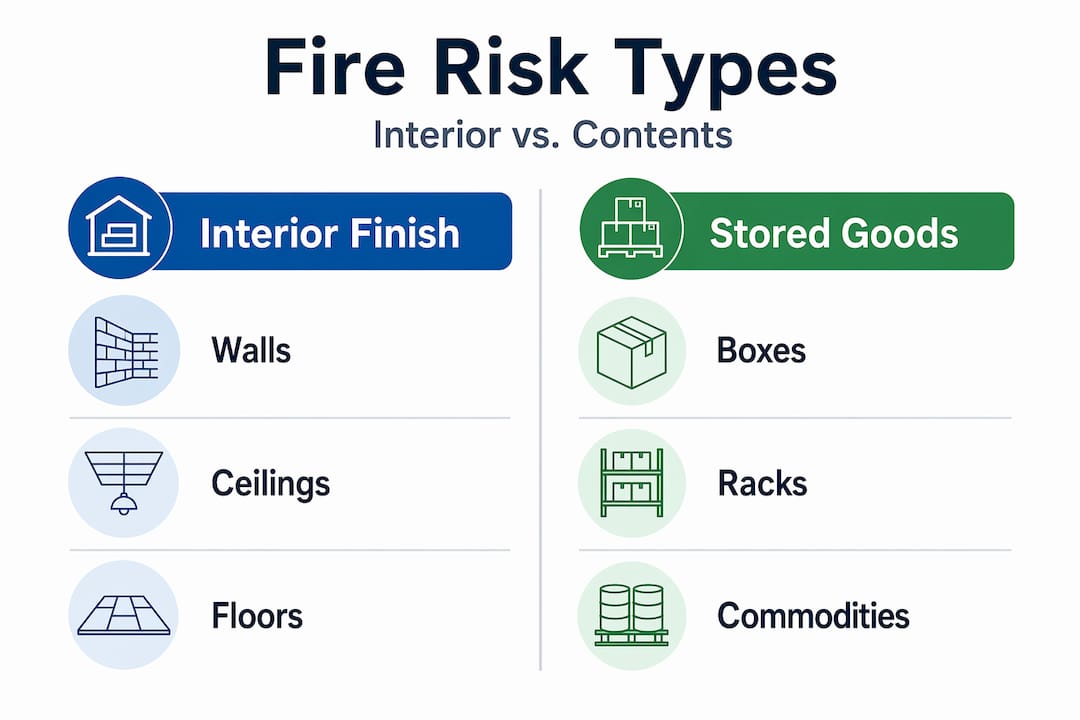
Commodity classification governs stored goods. As NFPA 13 occupancy classifications show, these systems are related but not interchangeable. Using the wrong classification basis misaligns system design with the actual hazard, which can result in a sprinkler system that performs fine on paper but fails when it matters most.
| Application | Correct classification system | Common error |
|---|---|---|
| Selecting wall panels for a corridor | Interior finish class (A/B/C) | Using hazard class instead |
| Designing sprinkler density for a warehouse | Commodity classification | Using building occupancy class instead |
| Sizing suppression for an office floor | Sprinkler hazard classification | Over-applying commodity rules |
Houston-specific example: A mixed-use building in Midtown brings in a new tenant who operates a product fulfillment operation on the ground floor. The space was previously classified as ordinary hazard for light retail. The fulfillment operation introduces plastic-wrapped goods stacked in racks, which shifts the commodity classification entirely and requires a full re-evaluation of the suppression system. The property manager who doesn’t recognize this trigger is suddenly out of compliance.
Understanding fire safety zoning in Houston for mixed-use scenarios is especially important, since zoning often interacts with occupancy type in ways that affect which classifications are required.
When classifications change: triggers and compliance risks
Getting classifications right at the start is necessary, but it isn’t sufficient. Property managers need to treat fire classification as something that evolves with the property. Tenant and storage changes are among the most common triggers that force classification re-evaluation, because the hazard potential of a space changes and the existing protection level may no longer be appropriate.
The most common triggers for re-evaluation in Houston commercial properties:
- New tenant with different use. A yoga studio replacing a restaurant brings entirely different hazard levels, contents, and egress assumptions.
- Storage additions or changes. A distributor who starts storing aerosol products, rubber tires, or expanded plastics in a previously ordinary hazard warehouse has created an extra hazard scenario overnight.
- Renovation or buildout. Any alteration to a sprinklered space that changes ceiling height, adds mezzanines, or modifies aisle configurations requires classification review.
- Change of occupancy classification. Converting office space to daycare, a warehouse to a distribution center, or retail to restaurant all require formal re-evaluation.
- New high-piled storage. Storing materials more than 12 feet high typically triggers classification as a high-piled storage occupancy with its own code requirements.
“When the hazard potential of a space changes, the fire protection classification must be re-evaluated to ensure the installed systems still provide appropriate protection levels.”
The consequences of ignoring these triggers are significant. A suppression system designed for ordinary hazard light retail cannot adequately protect a fulfillment center with commodity Class III or IV goods. During an inspection, the fire marshal may identify the mismatch and issue a notice of violation. Worse, during an actual fire, underperforming systems increase loss severity and expose the property owner to liability.
From an insurance perspective, misclassification can void coverage. Carriers write commercial property policies based on disclosed occupancy and hazard classifications. If an incident reveals that the actual hazard was materially different from what was classified, the carrier has grounds to dispute or deny the claim.
Pro Tip: Build tenant intake checklists that include classification-relevant questions. What materials will be stored? What processes will be conducted? What quantities? Getting this information upfront gives you time to evaluate compliance before the tenant takes possession, not after.
Using the Houston fire prevention checklist as part of your leasing process adds a structured layer of documentation that protects you if questions arise later.
Common pitfalls when specifying fire classifications
Even experienced property professionals make classification errors. The complexity of the systems, the number of code references involved, and the pace of tenant transitions all create opportunities for mistakes that have real financial consequences.
The most frequent pitfalls:
- Confusing sprinkler hazard with building occupancy. NFPA 13 hazard classifications and IBC occupancy groups are different systems. Treating them as equivalent leads to undersized or oversized suppression systems.
- Relying on the previous tenant’s documentation. A prior tenant’s classification is often irrelevant once the space changes use. Always start fresh with each new occupancy evaluation.
- Delegating classification entirely to the contractor. Contractors design systems, but property managers and owners bear compliance responsibility. Understanding the basis for classification decisions is your obligation, not optional.
- Ignoring storage quantity thresholds. Many commodity classification rules don’t trigger until stored quantities exceed a certain threshold. Once that threshold is crossed, the entire classification can shift.
- Failing to document classification reviews. Undocumented decisions are nearly impossible to defend during inspections or litigation. Every classification decision needs a paper trail.
Misidentifying the code requirement driving the classification is at the root of many compliance failures, whether that means confusing NFPA 13 hazard classification with building life-safety occupancy or misclassifying stored commodities entirely.
The practical fix involves three habits: always trace the classification back to its code basis, consult with your local Authority Having Jurisdiction when in doubt, and document every decision with date, basis, and responsible party. Understanding Houston fire safety testing requirements helps you verify that systems are actually performing to the classification they were designed around.
Our perspective: Fire classifications are Houston’s compliance linchpin
Here’s what we’ve seen working with commercial properties across Houston: most property managers who run into classification problems didn’t make a careless mistake. They made a timing mistake. They treated classification as a construction-phase decision, got it right at the start, and then never revisited it as the property evolved.
Houston’s code enforcement culture doesn’t reward that approach. Local inspectors are active, and the city’s ongoing development means the Authority Having Jurisdiction encounters classification issues constantly. They know what misaligned documentation looks like, and they follow up.
The more uncomfortable truth is that the real cost of a classification error isn’t the fine. It’s what happens after. Insurance carriers who learn that a property was operating with an incorrect or outdated classification have grounds to complicate or deny claims. Tenants who suffer losses in a fire can pursue liability against a property owner who failed to maintain accurate classifications. The direct financial exposure from either scenario dwarfs the cost of getting classification right.
Our advice to every property manager we work with is this: treat fire classification as a living document, not an archived one. It belongs in your routine property management workflow alongside lease reviews and system inspections. Every time a tenant changes, a buildout happens, or new storage shows up in a warehouse bay, that’s a classification event. It deserves a documented review, full stop.
Staying ahead of classification issues is exactly the kind of proactive approach described in our Houston fire compliance tips resource. The difference between managers who stay compliant and those who scramble comes down to whether they’ve built classification review into their systems or left it to chance.
Partner with Houston’s fire compliance experts
Accurate fire classification is the foundation that makes every other safety investment work correctly. Without it, even a well-designed sprinkler system or fire alarm installation may not meet the protection level your property actually needs.
At Reliable Fire Protection, we help Houston property managers and business owners navigate fire classification requirements with confidence, from initial specification through ongoing compliance reviews. Whether you’re preparing for an inspection, onboarding a new tenant, or evaluating a renovation’s compliance impact, our team brings hands-on Houston expertise to every engagement. Explore our resources on fire regulations for Houston managers and connect with our team for a consultation tailored to your property’s specific classification needs. We’re local, certified, and ready to help you stay compliant and keep occupants safe.
Frequently asked questions
What are the main types of fire classifications property managers must specify?
You must specify interior finish classes, sprinkler hazard classifications, and storage commodity classes. These classification systems are not interchangeable, and each requires its own documentation and code basis.
How often should fire classification be reassessed in a Houston property?
Reassess fire classification whenever tenants, building use, or stored contents change. Tenant and storage changes are among the most common triggers for re-evaluation, and annual reviews are a reasonable baseline minimum.
What happens if I misclassify a space or material in Houston?
Misclassifying can lead to failed inspections, code violations, and liability exposure. Misclassification can also void insurance policies if carriers determine the disclosed hazard didn’t match the actual risk at time of loss.
Which Houston agency enforces fire classification rules?
The Authority Having Jurisdiction, typically Houston’s fire marshal’s office, enforces these requirements. Local fire code amendments give the AHJ broad authority to apply classification-based requirements to both new and existing properties.
Does the same fire classification apply for both new and existing buildings?
Existing buildings are subject to ongoing classification review as occupancy, contents, or tenants change. Classification compliance is an ongoing obligation for operating properties, not a one-time construction formality.
Recommended
- Understand Occupancy Classifications for Fire Safety
- Fire Safety Regulations Explained: Impact on Houston Property Managers
- Commercial fire safety guide: achieve Houston compliance fast
- Fire Protection Standards 2025: Houston Compliance Impact
- Fire Alarm System University Place TX
- Fire Alarm System Services in Bellaire, TX