

TL;DR:
- Skipping a fire suppression permit in Texas risks failed inspections, voided insurance, and legal liabilities. Permits are required before work begins for systems like sprinklers, kitchen hoods, and alarm-integrated suppression devices, and they ensure code compliance and system reliability. Proper approval involves plan review, staged inspections, and acceptance tests handled by licensed professionals to protect property and life safety.
Skipping a fire suppression permit might seem like a harmless shortcut when you’re racing a construction deadline or managing tight renovation budgets. But what looks like saved time almost always turns into failed inspections, voided insurance policies, and serious legal exposure. Texas fire codes exist to protect lives and property, and the permit process is the mechanism that keeps those codes from being ignored. Understanding exactly how permits work, when you need them, and what can go wrong is the single most practical step any Texas commercial property owner or manager can take.
Table of Contents
- What fire suppression permits are and when you need them
- How the Texas permit process ensures life safety and code compliance
- Common pitfalls: How permit oversights can lead to costly failures
- How to get your permits approved: A practical checklist for Texas properties
- The uncomfortable truth: What permit compliance actually requires in Texas
- Enhance compliance with professional fire protection solutions
- Frequently asked questions
Key Takeaways
| Point | Details |
|---|---|
| Permits are mandatory in Texas | Most commercial fire suppression work requires advance permits and plan review, not just notifications. |
| Use only licensed professionals | Texas law restricts fire suppression work to properly registered and qualified firms and managers. |
| Inspections follow every step | Each phase—plan, install, test—must be documented, inspected, and kept up-to-date per AHJ rules. |
| Non-compliance risks are severe | Skipping permits invites steep fines, project delays, and increased liability for owners and managers. |
| Proactive planning prevents delays | Early coordination and record-keeping smooth the approval process and keep Texas properties safer. |
What fire suppression permits are and when you need them
A fire suppression permit is an official written authorization issued by the local governing authority that allows you to legally install, modify, or repair a fire safety system on your property. It is not a certificate of completion or a stamp of approval after the fact. The permit must be in hand before any work begins.
In Texas, the systems covered under this permit requirement are broader than most owners realize. Here’s what typically triggers a permit application:
- Wet and dry pipe sprinkler systems in new or existing commercial buildings
- Kitchen hood suppression systems in restaurants, cafeterias, and food processing facilities
- Clean agent and CO2 suppression systems in server rooms, labs, and specialized equipment spaces
- Fire alarm systems with integrated suppression components
- Pre-action systems in warehouses, cold storage, and data centers
When do you legally need a permit? The triggers include new construction, changes in building occupancy, major renovations that alter the fire suppression layout, system expansions beyond a set number of heads, and any repair that modifies the hydraulic design. Even switching from one suppression agent to another may require a fresh permit and plan review.
The key governing body here is the Authority Having Jurisdiction, or AHJ. In Harris County, that’s the local fire marshal. Other Texas cities and counties have their own AHJs, each with specific submission requirements. Texas fire code compliance rules vary by municipality, so confirming your local AHJ’s specific requirements before submitting anything is always your first move. In Texas, fire suppression systems require permits, plan review, and inspection through the AHJ before installation and before final acceptance.
Permit requirements at a glance
| Scenario | Permit required? | Plan review required? |
|---|---|---|
| New sprinkler installation | Yes | Yes |
| Adding more than 20 sprinkler heads | Yes | Yes |
| Replacing a damaged sprinkler head | Typically no | No |
| Changing building occupancy type | Yes | Yes |
| New kitchen hood suppression system | Yes | Yes |
| Minor component repair (same spec) | Usually no | No |
| System relocation/expansion | Yes | Yes |
Use this table as a starting reference, but always confirm with your local AHJ because local amendments to the International Fire Code or NFPA standards can shift these thresholds. For a detailed walkthrough of what the suppression system setup guide covers, reviewing the installation process before your permit application will save you from common documentation errors.
How the Texas permit process ensures life safety and code compliance
Once you understand what triggers a permit, the next question is: why does the process involve so many steps? The answer is that each stage catches a different category of failure before it becomes a real problem.
Here is how the process typically flows from start to finish:
- Pre-application review: Confirm the applicable codes (NFPA 13, NFPA 17A, NFPA 96, local amendments) and verify your AHJ’s specific submission format.
- Plan submission: Licensed engineers or contractors submit detailed plans with hydraulic calculations, equipment schedules, and layout drawings to the AHJ.
- Technical plan review: The AHJ reviews the design against adopted standards. Corrections may be required before approval is granted.
- Permit issuance: Written permit is issued. Work may begin only after this step.
- Staged inspections: Rough-in inspection (before concealment), intermediate, and final inspections occur at defined milestones.
- Acceptance testing: Functional tests confirm the system performs as designed under real conditions.
- Final approval: AHJ stamps and signs off, and the system is accepted for occupancy.
The reason hydraulic calculations matter so much is that a sprinkler system’s water supply, pipe sizing, and head spacing are all interdependent. Pull one piece out of alignment, and the system may not deliver adequate water density during a fire. Water-based systems require hydraulic calculations and plan review before permitting or installation, which is why skipping the design stage is never “saving time.” You’re actually removing the only safeguard that confirms the system will work when it counts.
The licensing angle adds another layer. Texas does not allow just any contractor to perform fire suppression work. Only registered and licensed firms with qualified Responsible Managing Employees can legally plan, install, maintain, and certify suppression systems statewide. The Texas State Fire Marshal’s Office enforces these qualifications. Hiring an unlicensed contractor may be cheaper upfront, but it immediately voids any path to a valid permit and leaves you personally exposed to liability.
Important: Working without a permit is not a technicality. It’s a legal violation that can trigger stop-work orders, mandatory demolition of completed work, and personal liability if a fire occurs and the system fails.
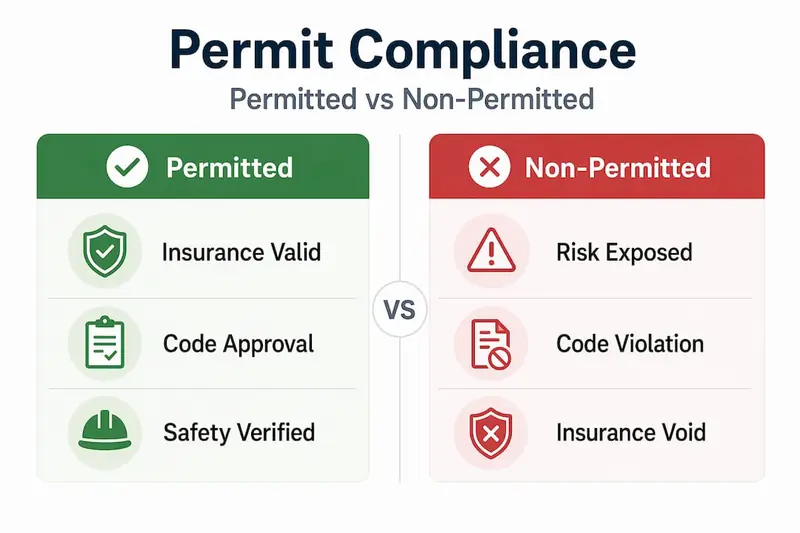
Permitted vs. non-permitted installations
| Factor | Permitted job | Non-permitted job |
|---|---|---|
| Insurance validity | Maintained | Often voided |
| Code compliance | Confirmed by AHJ | Unverified |
| System reliability | Tested and accepted | Unknown |
| Liability on failure | Contractor’s record | Property owner’s risk |
| Resale/occupancy impact | Clean record | Potential legal hold |
| Fine or penalty exposure | Minimal if compliant | High |
Pro Tip: Always request the contractor’s SFMO license number and verify it through the Texas Department of Insurance before signing any agreement. A fire safety certification check on your contractor takes five minutes and can protect you from months of complications. For property managers who oversee multiple buildings, partnering only with certified fire protection companies keeps your entire portfolio protected.

Common pitfalls: How permit oversights can lead to costly failures
Even owners who understand the permit process in theory make avoidable errors in practice. These are the scenarios we see most often, and each one carries significant consequences.
- Starting work before written permit approval. Verbal approval from a plan reviewer is not a permit. Nothing starts until you have a signed, issued permit document in hand.
- Making field changes without resubmitting plans. If your contractor discovers a structural conflict and reroutes piping on-site, those changes must be resubmitted to the AHJ. Deviations from approved plans require resubmittal before proceeding, and “we built it close enough” is not a defense during an inspection.
- Missing required signatures or stamps. Plans submitted without a Responsible Managing Employee’s stamp are rejected outright, which resets your timeline.
- Assuming plan approval equals final approval. Plan approval authorizes construction. Final approval only comes after passing every inspection and acceptance test. These are different milestones with different consequences if skipped.
- No documentation on-site. If your stamped plans are at the office when the inspector arrives, the inspection fails. Full stop.
- Outdated drawings during renovation. Using plans from a previous permit cycle without updating them for the current scope is a common and costly oversight.
The broader issue is that permits coordinate multiple review stages and require specific qualified signatures before the AHJ completes its review. This design reduces the likelihood of failed acceptance tests, but only when each stage is handled correctly.
Pro Tip: Print a copy of your stamped, approved plans and keep them in a waterproof folder mounted near the work area. Inspectors expect to see the actual permitted drawings on-site, not a digital version on your phone.
For a structured look at avoiding these missteps from the start, the sprinkler system workflow details each phase and what documentation belongs where. You can also walk through an inspection step-by-step guide to know exactly what each inspector will look for before they arrive.
How to get your permits approved: A practical checklist for Texas properties
Turning all of this knowledge into a smooth permit approval takes planning and attention to detail. Here is a practical sequence that works for most Texas commercial properties.
- Identify your AHJ and confirm adopted codes. Contact the local fire marshal’s office to confirm which edition of the IFC, NFPA 13, and any local amendments apply to your project.
- Hire a licensed, SFMO-registered contractor or engineer. Verify credentials before signing any agreement.
- Prepare complete plan sets. Include hydraulic calculations, site plans, equipment specifications, and a materials list that meets AHJ format requirements.
- Submit plans early. AHJ review cycles can take days to weeks depending on jurisdiction. Submitting early gives you time to respond to correction comments without delaying your overall schedule.
- Respond to comments promptly and in writing. If the AHJ requests changes, resubmit a revised plan set that specifically addresses each comment. Never proceed on a verbal agreement.
- Receive your written permit. Confirm the permit is fully issued before any work begins on-site.
- Schedule staged inspections in advance. Do not wait until a stage is complete to call for inspection. Schedule rough-in inspections early so delays do not ripple through your timeline.
- Keep all documentation on-site. Stamped plans, the issued permit, and any approved revision sheets must be accessible throughout the entire project.
- Pass acceptance testing. System function tests must be witnessed by the AHJ or an approved representative. Have your contractor present to address any issues discovered during testing.
- Secure final sign-off. Obtain the AHJ’s written acceptance before claiming the system is code-compliant. It is the property owner’s responsibility to maintain current code compliance throughout the life of the building.
Pro Tip: Build a simple project log that records every submission, every AHJ response, and every inspection date and outcome. If a resubmittal is ever needed, that log becomes your fastest path back to compliance. Review the fire safety testing requirements specific to Houston to make sure your acceptance test checklist covers every line item your AHJ will evaluate.
The uncomfortable truth: What permit compliance actually requires in Texas
Here is what most articles on this topic won’t say directly: the permit process is not primarily a bureaucratic exercise. It is a legally binding accountability structure. And many Texas property owners treat it like a formality until something goes wrong.
We’ve seen it repeatedly. A manager inherits a building where a previous owner skipped permits on a suppression system expansion. The system looks functional. No alarms, no visible problems. Then an insurance carrier sends an auditor who discovers the unpermitted work during a policy renewal review. The resulting delay in renewal, plus the cost of retroactive permitting and potentially rebuilding portions of the system to current code, far exceeds what proper permitting would have cost the first time.
The contrarian take is this: getting close enough to compliance is often more expensive than full compliance. Partial adherence creates liability without protection. If a fire occurs and the investigation reveals your system deviated from permitted plans, your property insurance can deny the claim, your tenants can sue for damages, and you face potential criminal exposure if injuries result.
The practical wisdom is to stop treating the permit process as an obstacle and start treating it as a record of due diligence. When you partner with contractors who take scope, documentation, and code compliance seriously, the permit process becomes routine rather than stressful. Cheap bids that skip documentation steps or dismiss AHJ comments quickly end up being the most expensive decisions you make. For a full breakdown of what this looks like across a property’s life cycle, reviewing the compliance process guide offers a timeline-based view that helps property managers build compliance into their annual operations calendar.
Enhance compliance with professional fire protection solutions
Navigating fire suppression permits in Texas is manageable when you have the right team behind you. The permit process moves faster, inspections pass more reliably, and documentation stays organized when licensed professionals handle design, submission, and inspection coordination from the start.

Reliable Fire Protection works with Houston-area commercial property owners and managers to handle every stage of the suppression system process, from initial permit application to final acceptance testing. Our licensed team understands what local AHJs expect, what documentation errors cause delays, and how to keep your systems performing at code for the long term. Whether you need help with a new installation, a system upgrade, or an inspection prep review, our sprinkler workflow compliance and full range of fire safety products are ready to support your compliance goals. Contact us for a free consultation and let us help you get it right the first time.
Frequently asked questions
Do all fire suppression modifications need a permit in Texas?
Most system installations, replacements, or major upgrades require a permit and plan review before any work starts. Minor like-for-like repairs may be exempt, but always confirm with your local AHJ first.
Who can submit fire suppression plans for approval?
Only registered and licensed firms with qualified Responsible Managing Employees are authorized to submit fire suppression plans to Texas AHJs. Submissions from unlicensed parties are rejected outright.
What documents should I keep on-site during and after installation?
You must keep approved, stamped plans and the issued permit document on-site and accessible for every inspection and acceptance test. Digital copies on a phone do not satisfy this requirement.
Can I start work before my suppression permit is issued?
No. Starting without an issued permit can result in a stop-work order, mandatory removal of completed work, and penalties. Verbal approvals or pending status do not authorize construction.
Recommended
- How to Select Suppression Systems for Houston Properties
- Fire Suppression Agents: Protecting Houston Properties
- Why fire suppression systems save Houston businesses in 2026
- Fire suppression systems: what Houston businesses need
- Fire Alarm System University Place TX
- Fire Alarm System Services in Bellaire, TX