TL;DR:
- Industrial fire risks stem from combustible dust, welding, and dense equipment, requiring strict safety controls. Proper permit systems, hazard analysis, firefighter training, realistic emergency drills, and ongoing risk assessments are essential for prevention. Verifying compliance through culture and technology greatly reduces the gap between documentation and actual safety performance.
Industrial facilities carry fire risks that most office environments never face. Combustible dust, welding operations, high-pressure fuel lines, and dense equipment layouts create conditions where a single oversight can trigger a catastrophic loss. Facility managers and safety officers who rely on industrial fire safety best practices grounded in regulatory compliance, not just intuition, are the ones who prevent incidents before ignition. This guide covers the controls, programs, and training frameworks you need to protect personnel, assets, and operations in an OSHA and NFPA-aligned program.
Table of Contents
- Key takeaways
- 1. Build a hot work permit system that actually controls hazards
- 2. Manage combustible dust with a formal hazard analysis program
- 3. Select the right fire extinguishers and maintain them rigorously
- 4. Develop emergency action plans that work under real fire conditions
- 5. Integrate fire risk assessments into your ongoing safety program
- 6. Establish industrial fire safety training as a facility-wide culture
- My perspective on what actually separates safe facilities from compliant ones
- How Reliable-fire-protection can support your fire safety program
- FAQ
Key takeaways
| Point | Details |
|---|---|
| Hot work permits prevent fires | A written permit with site inspection, combustible clearance, and dedicated fire watch is non-negotiable under NFPA 51B. |
| Combustible dust needs formal analysis | A Dust Hazard Analysis with 5-year revalidations identifies and controls explosion risks before they escalate. |
| Extinguisher programs require training | OSHA mandates hands-on training and documented inspection schedules, not just hanging equipment on the wall. |
| Emergency plans must be practiced | Written EAPs only work when tested under realistic drill conditions, including limited visibility scenarios. |
| Layered controls reduce escalation | Combining ignition control, fuel management, engineered safeguards, and early detection cuts incident severity significantly. |
1. Build a hot work permit system that actually controls hazards
Most industrial fires tied to welding, cutting, and grinding operations are not accidents in the traditional sense. They are permit and watch failures where the work was authorized but the controls were skipped, rushed, or delegated to someone without authority.
A compliant hot work permit under NFPA 51B requires more than a signature. Before any hot work begins, the issuing supervisor must verify:
- All combustible materials removed or shielded within 35 feet of the work area
- Atmospheric testing completed in confined or potentially flammable environments
- Fire suppression equipment positioned at the work site
- A dedicated fire watch assigned with no competing duties
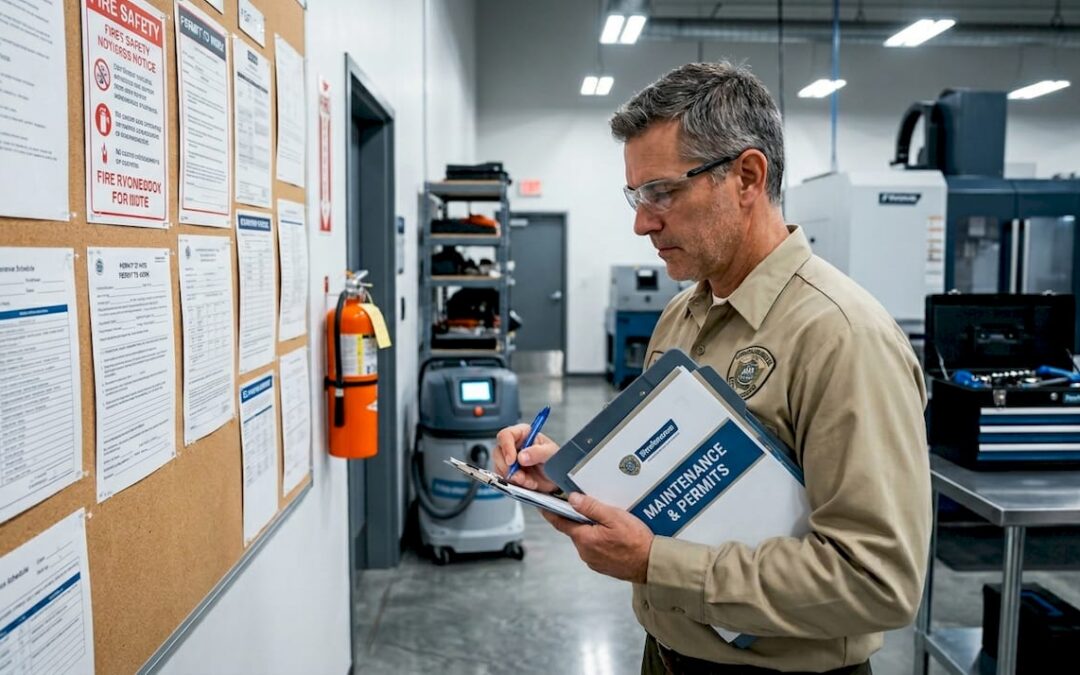
The fire watch role carries specific post-work obligations. Fire watch monitoring must continue a minimum of 60 minutes after work ends, and up to 3 hours in high-risk conditions like areas with hidden cavities, combustible insulation, or residual heat sources. The fire watch personnel must have the authority to stop work immediately if conditions become unsafe.
Pro Tip: Treat the permit as a communication document, not a checkbox. Walk the fire watch through the completed permit before work starts so they understand exactly what was verified and what to watch for.
Permit documentation should be retained for a defined period, typically 12 months minimum, and reviewed during post-incident analysis or routine audits. Common failures include permits issued without a physical site walk, fire watch duties shared with production responsibilities, and permits that expire mid-shift without re-authorization.
2. Manage combustible dust with a formal hazard analysis program
Combustible dust is one of the most underestimated hazards in industrial fire prevention. Facilities handling grain, metal powders, wood flour, sugar, or plastic particulate can develop explosive dust concentrations from accumulation patterns that go unnoticed until a disturbance event occurs.
The Dust Explosion Pentagon explains why dust fires escalate so quickly: fuel (the dust), dispersion, confinement, oxygen, and an ignition source all combine in a way that turns a deflagration into a pressure wave capable of structural damage. Understanding this model shapes the control strategy.
NFPA 660 mandates a Dust Hazard Analysis for facilities where combustible dust is generated, processed, or conveyed. The DHA must be revalidated every 5 years or whenever a process change occurs that affects dust type, generation rate, or equipment layout. That revalidation requirement is not advisory. It is the mechanism that keeps your safeguards calibrated to your actual operations.
Engineered controls at the dust collector interface deserve specific attention because that is where safeguard failures most commonly occur. Your DHA will specify spark arrestors, isolation valves, and explosion vents matched to your dust properties. Those specifications are only protective when the equipment is maintained and tested against the DHA’s assumptions.
Pro Tip: Schedule dust collector maintenance and safeguard verification on the same calendar cycle as your DHA revalidation. If the DHA assumptions change, the equipment requirements change with them.
Housekeeping is not a secondary control. Allowing dust to accumulate on overhead beams, pipe runs, and equipment surfaces creates a secondary explosion hazard even when primary containment systems are in place. Weekly sweeping programs and pneumatic cleaning protocols using non-sparking tools need to be written into standard operating procedures, not left to individual discretion.
3. Select the right fire extinguishers and maintain them rigorously
Fire extinguisher programs in industrial settings fail in two ways: wrong equipment for the hazard, and compliant-looking equipment that is actually out of service. Both create a false sense of coverage that can cost lives.
OSHA 29 CFR 1910.157 requires that all employees know where extinguishers are located and how to report a fire. For employees designated to use extinguishers, annual hands-on training covering the PASS technique (Pull, Aim, Squeeze, Sweep) is mandatory. This is not a video-based requirement. It means live or simulated fire training with actual extinguisher discharge.
Selecting the correct extinguisher class matters more in industrial settings than anywhere else:
- Class A covers ordinary combustibles like wood, paper, and cloth
- Class B covers flammable liquids and gases
- Class C covers energized electrical equipment
- Class D covers combustible metals found in metalworking environments
- Class K covers commercial cooking operations
Many industrial areas require ABC dry chemical units as a baseline, with Class D extinguishers in metal fabrication zones and Class K in on-site cafeteria or food processing areas.
The inspection schedule is equally non-negotiable. Monthly visual checks confirm the extinguisher is in its designated location, the pressure gauge reads in the green, and the pin and tamper seal are intact. Annual maintenance goes deeper, requiring a trained inspector to verify internal components and discharge mechanism function. Hydrostatic testing under NFPA 10 is required every 5 to 12 years depending on extinguisher type, detecting internal corrosion or cylinder fatigue that visual inspection cannot catch.
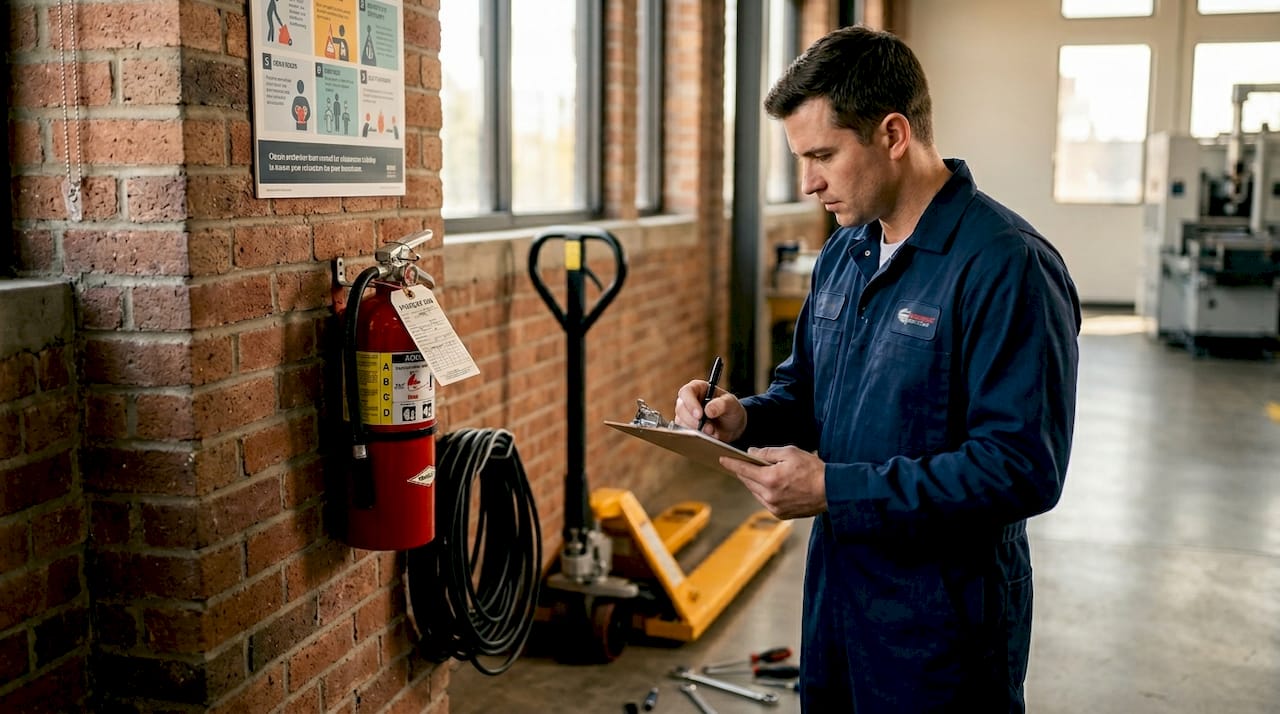
Inspection logs must be retained and available for audit. A missing tag or undocumented annual service is a compliance gap that becomes a liability issue in a post-incident review. For a structured approach to your documentation process, the extinguisher inspection guide from Reliable-fire-protection covers Houston industrial facility requirements in practical detail.
4. Develop emergency action plans that work under real fire conditions
A written Emergency Action Plan that lives in a binder and never gets practiced is not a safety program. It is documentation that satisfies an audit checklist and fails on the day you need it.
OSHA 29 CFR 1910.38 specifies the minimum elements of a compliant EAP:
- Procedures for reporting fires and other emergencies
- Evacuation procedures and exit route assignments
- Procedures for employees who must remain to perform critical operations before evacuating
- Methods to account for all employees after evacuation
- Rescue and medical duties for designated employees
- Names and job titles of personnel employees can contact for plan details
Role clarity for critical operations personnel is often the weakest link. Some processes cannot be abandoned instantly without creating secondary hazards. Employees responsible for shutting down reactors, depressurizing lines, or isolating fuel supplies need specific training on when and how to perform those tasks before evacuating, not general instructions to “use judgment.”
Pro Tip: Run at least one annual drill under simulated smoke conditions using low-visibility training goggles. You will immediately identify evacuation routes that look clear on a map but create bottlenecks or confusion in practice.
Emergency plans must be tested under realistic conditions including scenarios where alarm systems trigger during shift changes, when some employees are in remote areas, and when primary exit routes are blocked. Document what broke down in each drill and update the plan accordingly. The plan should reflect your actual facility, not the facility as it existed when the plan was first written.
5. Integrate fire risk assessments into your ongoing safety program
A one-time fire risk assessment is not a fire risk assessment program. The most effective fire risk assessment guidelines treat hazard identification as a continuous process tied to operational changes, near-miss reporting, and scheduled review cycles.
Fire hazard identification techniques vary by operation type. In chemical processing, Process Hazard Analysis methods like HAZOP studies systematically identify ignition scenarios tied to specific equipment failures or procedural deviations. In warehousing and fabrication, zone-based assessments map ignition sources against fuel inventories and suppression coverage. Both approaches produce a prioritized risk register that drives corrective action budgets and maintenance schedules.
The critical output of any fire risk assessment is not the written document. It is the corrective action log with assigned owners and completion dates. Assessments that produce findings with no follow-through accountability create documented awareness of risk without actually reducing it.
Industrial safety standard practices under NFPA and OSHA frameworks both assume that assessments inform system design, maintenance intervals, and training content. When you update a process, add a new chemical, or expand a facility, the risk assessment loop must restart for the affected areas. Facilities that connect hazard management layers from ignition source control through engineered safeguards and detection systems reduce both incident frequency and severity.
6. Establish industrial fire safety training as a facility-wide culture
Industrial fire safety training cannot be an annual compliance event. The facilities with the strongest fire safety records treat training as an ongoing operational habit built into shift briefings, onboarding, contractor orientation, and post-incident reviews.
For fire prevention in industry, the training program should cover distinct competency levels. General employees need evacuation procedures, alarm recognition, and extinguisher location awareness. Designated responders need hands-on extinguisher training, fire watch qualification, and hot work permit authorization. Safety officers and supervisors need fire risk assessment methods, permit-to-work oversight, and emergency command responsibilities.
Contractor management is a frequent gap in industrial fire safety training. Contractors performing hot work, electrical work, or maintenance in high-hazard areas must complete a site-specific safety orientation before starting. Their permit authorization, fire watch qualification, and emergency response knowledge must be verified, not assumed. Many of the most serious industrial fires on record involved contractors who were competent in their trade but unfamiliar with the site’s specific hazards and controls.
You can strengthen your facility’s workplace fire hazard awareness by regularly reviewing common failure patterns and adjusting training content to address the gaps you see in your own operations.
My perspective on what actually separates safe facilities from compliant ones
I have reviewed fire investigation reports, audit findings, and near-miss analyses across a wide range of industrial operations. The pattern I keep seeing is this: the facilities that have fires are often technically compliant. They have the permits, the extinguishers, the written plans. What they lack is integrity between the documentation and the actual operation.
The hot work permit is the clearest example. I’ve seen permits issued over the phone, fire watch duties assigned to operators already managing two other tasks, and post-work monitoring times recorded without any verification that monitoring occurred. The permit looked fine. The fire watch failed anyway.
The same disconnect shows up in combustible dust programs. Safeguards like spark arrestors are installed during the DHA process, but nobody verifies they are functioning six months later. The DHA assumptions drift out of alignment with reality, and the program becomes a paper defense rather than an actual barrier.
What I believe works is treating each control layer as something that must be verified, not just documented. Build verification into your inspection rounds, your permit closures, and your drill debriefs. The technology exists to support this. Digital permit-to-work platforms with location-verified sign-offs, automated fire detection with real-time dashboards, and sensor-based dust monitoring all make the gap between documentation and reality much harder to ignore.
The facilities I respect most are the ones where a front-line employee can tell you what the fire watch does and why the 60-minute post-work monitoring period exists. That level of understanding does not come from a policy document. It comes from a culture that takes fire safety training seriously at every level.
— Reliable-fire-protection
How Reliable-fire-protection can support your fire safety program
Reliable Fire Protection works with industrial facility managers in the Houston area to build and maintain fire protection programs that satisfy NFPA and OSHA requirements without cutting corners. Whether your facility needs a new fire alarm system installed and integrated with your emergency response plan, a structured fire extinguisher inspection and training program, or a full suppression system evaluation for high-hazard areas, the team brings certified expertise to every project. Review your extinguisher coverage with the fire extinguisher selection guide to confirm you have the right equipment for every fire class in your facility. Contact Reliable-fire-protection today for a free consultation and site assessment.
FAQ
What is the minimum fire watch duration after hot work?
Under NFPA 51B, fire watch must remain a minimum of 60 minutes after hot work ends and up to 3 hours in high-risk conditions such as areas with hidden cavities or residual heat sources.
How often does a Dust Hazard Analysis need to be updated?
NFPA 660 requires DHA revalidation every 5 years or whenever a process change affects dust type, generation rate, or equipment layout at the facility.
What does OSHA require for fire extinguisher training?
OSHA 29 CFR 1910.157 requires annual hands-on training for designated employees, covering extinguisher location, proper use, and the PASS technique with practical discharge experience.
What must an industrial Emergency Action Plan include?
An OSHA-compliant EAP must include fire reporting procedures, evacuation routes, critical operations protocols, employee accountability methods, and contact information for plan administrators.
How often should industrial fire extinguishers be inspected?
Monthly visual checks, annual maintenance by a qualified inspector, and hydrostatic testing every 5 to 12 years based on extinguisher type are all required under NFPA 10 and OSHA standards.