
TL;DR:
- Addressable alarm systems assign a unique digital address to each device, enabling precise and real-time identification during fires. They improve response speed, maintenance efficiency, and compliance documentation compared to conventional zone-based systems. Their scalability and automation capabilities make them a smarter long-term investment for complex or multi-floor commercial properties.
Addressable alarm systems are defined as fire detection networks where every device carries a unique digital address, allowing the control panel to identify exactly which detector, pull station, or module has triggered or failed. The role of addressable alarms goes far beyond sounding a horn when smoke appears. These systems tell you precisely which device on which floor is reporting a problem, in real time, so your team and the fire department respond to the right location immediately. For property managers and business owners responsible for occupied buildings, that precision is not a luxury. It is the difference between a controlled response and a chaotic evacuation.
How do addressable alarms work?
Addressable fire alarm systems operate on a Signaling Line Circuit, commonly called an SLC loop. The control panel continuously polls every device on that loop, requesting a status update from each one. Polling happens multiple times per minute, delivering specific location data in under 3 seconds. That speed matters because a 3-second identification window gives responders a meaningful head start before conditions worsen.

Each device on the loop carries a unique digital address, programmed during installation. When a smoke detector in Room 214 activates, the panel does not just report “Zone 3 alarm.” It reports “Smoke Detector 214A, Third Floor, East Wing.” That specificity is the core function of addressable alarms and what separates them from older technology.
Wiring configuration also determines system reliability. Class A loop wiring enables fault-tolerant communication, allowing device signals to continue even if one wire segment is cut. Class B wiring lacks that redundancy, meaning a single break can silence all devices downstream. For commercial properties where uptime and reliability are non-negotiable, Class A is the standard worth specifying.
Pro Tip: Ask your fire alarm contractor to document the cause-and-effect programming during installation. Undocumented programming is one of the most common sources of costly system rework when technicians change or expand the system later.
SLC loops support 50 to 250 or more devices, and advanced panels support 3,000+ devices in networked configurations using protocols like TdNET and FlashLink. That scalability makes addressable systems the right fit for multi-building campuses, high-rises, and growing commercial portfolios.
Key components in a standard addressable system include:
- Control panel: The brain that processes all device data and triggers outputs
- SLC loop: The communication pathway connecting all addressable devices
- Addressable detectors: Smoke, heat, and multi-criteria sensors with individual addresses
- Modules: Input and output modules that connect third-party equipment to the system
- Annunciator panels: Remote displays that mirror control panel data at entry points
Addressable alarms vs. conventional alarms: key differences
The most practical way to understand addressable alarms in fire safety is to compare them directly with conventional systems. Conventional systems group devices into zones. When a zone triggers, you know the general area but not the specific device. Addressable systems report the exact device, its type, and its current analog reading.
| Feature | Conventional System | Addressable System |
|---|---|---|
| Alarm location reporting | Zone level only | Exact device and location |
| Wiring | Multiple zone circuits | Single SLC loop |
| Self-monitoring | Limited | Continuous device polling |
| False alarm reduction | Minimal | Drift compensation and analog reporting |
| Integration capability | Basic relay outputs | HVAC, elevators, access control, PA systems |
| Upfront cost | Lower | Higher |
| Long-term cost over 10–15 years | Higher labor and disruption | Lower due to efficiency gains |
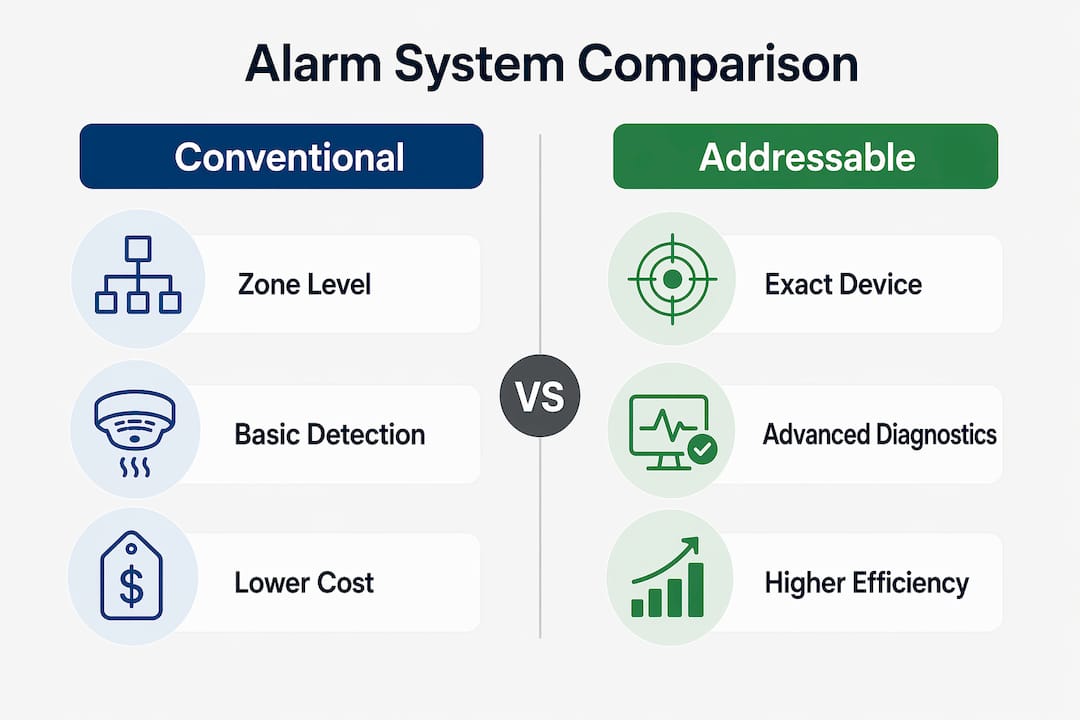
Conventional systems made sense for small, single-floor buildings where a zone alarm gave enough information. For any property with multiple floors, complex layouts, or high occupancy, zone-level reporting creates dangerous delays. Firefighters arriving at a 10-story building told only “alarm on floors 3 through 5” face a very different search than those told “pull station, stairwell B, floor 4.”
Addressable systems use proprietary protocols like CLIP, SIGA, and Simplex TrueAlarm that are incompatible with conventional devices. Parts are never interchangeable between the two system types without violating safety listings. This means your upgrade decision is a full system commitment, not a partial retrofit. Understanding that upfront prevents budget surprises later.
For more on how fire alarm systems work at a technical level, that resource breaks down the full detection-to-response chain in plain language.
What are the benefits of addressable alarms for property managers?
The benefits of addressable alarms are most visible in three areas: emergency response speed, maintenance efficiency, and false alarm reduction. Each one has a direct dollar value for your operation.
Addressable systems reduce emergency response times by pinpointing exact device locations, allowing responders to quickly locate fire sources. Faster location means faster suppression, which means less structural damage and lower insurance claims. For a property manager, that translates directly into reduced liability exposure.
Maintenance shifts from reactive to proactive with an addressable system. Diagnostic intelligence identifies specific devices needing service before they fail, reducing labor hours significantly. Instead of testing an entire zone to find one dirty detector, a technician goes directly to the flagged address. That efficiency compounds over years of operation.
False alarms carry real costs. A single false alarm can trigger fines from local fire departments, disrupt tenants, and erode occupant trust in the system. Adjusting alarm sensitivity by device location greatly reduces nuisance alarms, minimizing costly evacuations and operational disruptions. A detector near a commercial kitchen can be set to a higher threshold than one in a server room, all within the same system.
Additional benefits worth noting:
- Staged evacuations: Addressable systems can alert only the affected floor and the floor above, reducing panic and crowd congestion on stairwells
- Compliance documentation: Point-specific event logs provide auditable records for insurance reviews and code inspections
- Scalability: Adding devices or expanding to new floors requires only programming changes, not new wiring infrastructure
- Lower total cost of ownership: Despite higher upfront costs, addressable systems reduce total ownership cost over 10–15 years due to lower labor hours and fewer false alarms
Pro Tip: If your property has 25 or more detectors, the math on addressable systems almost always favors the upgrade. Request a 10-year total cost comparison from your fire alarm contractor before making a decision.
For a structured approach to keeping your system in top shape, the fire alarm maintenance tips guide from Reliable-fire-protection covers the inspection and upkeep steps that protect your investment.
How do addressable alarms improve compliance and operational efficiency?
Addressable alarms simplify compliance in ways that conventional systems cannot match. The system logs every event with a timestamp and device address. That data satisfies the documentation requirements of annual inspections, insurance audits, and fire code reviews without requiring manual record reconstruction.
Here is how addressable systems support compliance and operational efficiency in practice:
- Annual inspections become faster. Technicians pull device-specific fault histories from the panel instead of walking every zone. Inspection time drops, and so does the cost of your annual service contract.
- Code audits have a clear paper trail. Point-specific logs show exactly when each device was tested, what it reported, and how the system responded. That record satisfies NFPA 72 documentation requirements directly.
- Automated responses reduce human error. Addressable systems integrate with fire pumps, HVAC, access control, and PA systems, enabling tailored automated fire response actions. When a detector activates, the system can simultaneously shut down HVAC to stop smoke spread, recall elevators to the ground floor, and unlock emergency exits without anyone touching a control panel.
- Staged evacuations protect occupants. Rather than triggering a full building alarm for a localized event, the system alerts only the affected area and adjacent floors. This approach reduces stairwell congestion and the risk of injuries during evacuation.
- Scalability supports property changes. Renovations, tenant buildouts, and floor reconfigurations require only reprogramming rather than rewiring. That flexibility keeps your system code-compliant through property changes without major capital expenditure.
The importance of addressable alarm systems becomes clearest during an actual inspection or insurance review. Adjusters and inspectors respond differently to a system that produces a printed event log versus one that requires a technician to reconstruct history from memory. That documentation advantage alone justifies the upgrade for many commercial property owners.
Reviewing your fire alarm system checklist before your next inspection is a practical way to confirm your system meets current code requirements.
Why addressable systems are the smarter long-term investment
Property owners often view addressable alarms only as compliance tools, missing their potential for advanced life safety automation and operational efficiency. That framing is the most expensive mistake I see in commercial fire safety. A system that only checks a compliance box is a missed opportunity.
From working with commercial properties across Houston, the maintenance efficiency gains alone typically justify the upgrade within the first five years. A building manager who used to schedule full-zone tests twice a year now receives a panel notification when a single detector drifts out of calibration. The technician arrives, addresses that one device, and leaves. No full-floor disruption. No tenant complaints.
The installation phase carries real risk if cause-and-effect programming is not documented carefully. Undocumented programming is one of the most common sources of costly system rework. I have seen properties pay for a second full installation because the original contractor left no programming records. Require documentation as a contract deliverable, not an afterthought.
Addressable systems enable complex automation like staged evacuation, elevator recall, and exit door unlocking. These are not features that show up on a code checklist. They are the difference between a building that manages a fire event and one that is managed by it. View your addressable alarm system as operational risk management infrastructure, not just a regulatory requirement.
— Reliable-fire-protection
Upgrade your property’s fire alarm system with Reliable-fire-protection
Reliable fire protection serves commercial property owners and managers across Houston with expert fire alarm system assessments, addressable alarm installations, and ongoing maintenance programs. If your building still runs on a conventional zone-based system, the upgrade to addressable technology delivers measurable gains in safety, compliance, and operational cost. Reliable-fire-protection’s certified technicians handle everything from initial consultation and system design through installation and annual inspections. To understand exactly how fire alarm systems work and what an addressable upgrade would look like for your property, visit the Reliable-fire-protection website and request a free assessment today.
Key takeaways
Addressable alarm systems deliver precise, real-time device identification that makes every aspect of commercial fire safety faster, cheaper, and more defensible in a compliance review.
| Point | Details |
|---|---|
| Exact device identification | Every detector reports its unique address, giving responders a precise location in under 3 seconds. |
| Lower long-term cost | Addressable systems reduce total ownership cost over 10–15 years through fewer labor hours and false alarms. |
| Proactive maintenance | Diagnostic alerts identify specific failing devices before they cause system failures or missed inspections. |
| Compliance documentation | Point-specific event logs satisfy NFPA 72 requirements and simplify insurance audits automatically. |
| Automation beyond alarms | Integration with HVAC, elevators, and access control enables automated responses that reduce fire damage and occupant risk. |
FAQ
What is the primary role of addressable alarms?
The role of addressable alarms is to identify and communicate the exact status of every individual device in a fire alarm network, enabling faster emergency response and proactive maintenance. Each device carries a unique digital address that the control panel reads multiple times per minute.
How do addressable alarms differ from conventional systems?
Conventional systems report alarms at the zone level, while addressable systems report the exact device, floor, and location. Addressable systems also support self-monitoring, analog sensitivity adjustment, and integration with building automation systems that conventional systems cannot match.
When should a property owner upgrade to an addressable system?
Properties with 25 or more detectors, multiple floors, or complex layouts benefit most from addressable technology. The long-term cost savings on labor and false alarm reduction typically outweigh the higher upfront investment within the first several years of operation.
Can addressable and conventional devices be mixed in one system?
No. Addressable systems use proprietary protocols like CLIP, SIGA, and Simplex TrueAlarm that are incompatible with conventional devices. Mixing device types violates safety listings and creates unreliable system behavior that can fail during an actual fire event.
How do addressable alarms help with fire code compliance?
Addressable systems generate point-specific event logs with timestamps for every device activation, fault, and test. Those records satisfy NFPA 72 documentation requirements directly and provide auditable evidence during annual inspections and insurance reviews.
Recommended
- The Importance of Fire Alarms: Ensuring Safety and Protection
- Fire Alarm Benefits in Hospitality: A Property Manager’s Guide
- Role of Fire Alarms in Houston Commercial Buildings
- Why Fire Alarms Matter for Houston Commercial Properties
- Fire Alarm System University Place TX
- Fire Alarm System Bellaire TX