
TL;DR:
- Most businesses overlook the importance of customer care in fire safety, focusing instead on equipment and inspection compliance. Building effective communication, empathy, and feedback loops enhances occupant trust, speeds emergency responses, and reduces violations. Implementing deliberate processes, technology support, and continuous measurement leads to a genuinely safer and more responsive fire safety program.
Most businesses treat fire safety as a checklist. Install the extinguishers, pass the inspection, file the paperwork, and move on. But customer care in fire safety is the layer most property owners never think about until something goes wrong. It shapes how occupants respond during emergencies, how smoothly inspections run, and whether your safety program actually builds trust or just generates compliance documents. This article lays out the practical strategies, modern tools, and proven frameworks for weaving genuine service quality into your fire safety operations.
Table of Contents
- Key takeaways
- Customer care in fire safety: more than good manners
- Best practices for integrating customer care into fire safety
- Technology and tools that improve fire safety support
- Measuring success and continuous improvement
- My take on why this matters more than most businesses realize
- How Reliable Fire Protection serves businesses with this approach
- FAQ
Key takeaways
| Point | Details |
|---|---|
| Customer care drives compliance | Fire safety outcomes improve significantly when communication, empathy, and follow-up are built into every interaction. |
| Vulnerable occupant planning is required | From April 2026 in England, RPEEPs are mandatory, showing how person-centered care is now codified in fire safety law. |
| Feedback loops improve safety | Collecting and acting on stakeholder input helps organizations move from policy-driven to genuinely people-centered fire safety. |
| Technology supports responsiveness | Helplines, scheduling software, and secure information systems make fire safety support faster and more transparent. |
| Measure what you manage | Tracking response times, follow-up rates, and satisfaction data is the only way to build lasting improvements. |
Customer care in fire safety: more than good manners
The term “customer care” sits awkwardly next to “fire suppression,” but it represents something the industry increasingly recognizes as a formal discipline. In fire safety management, customer care refers to every interaction between safety professionals, property managers, and the people who live or work in a building. It covers how inspections are scheduled and communicated, how corrections are explained, how emergencies are handled emotionally as well as physically, and how feedback gets absorbed and acted on.
Modern fire departments now formalize training in non-technical skills such as empathy, clear communication, and post-incident follow-up, recognizing that the quality of a service interaction affects public trust just as much as the technical response does.
Here is why that matters for your business specifically:
- Compliance outcomes improve when occupants understand what is expected of them and trust the people delivering the message.
- Emergency response gets faster when evacuation plans are communicated clearly in advance and residents know exactly what to do.
- Reputation holds up when neighbors, tenants, and local fire officials see you as a responsive, responsible property manager.
- Repeat violations drop when corrections are explained in plain language with realistic timelines rather than handed down as enforcement actions.
“Customer care in fire safety is powered by listening to real experiences, not just enforcing rules, allowing fire departments to better tailor services to community needs.” — David Wales, The Foundation
This shift from enforcement-first to service-first thinking is not soft. It is strategic. Businesses that build it into their fire safety operations consistently see fewer compliance gaps and stronger relationships with the fire officials who inspect their properties.
Best practices for integrating customer care into fire safety
Getting customer care principles into your fire safety operations takes deliberate process design, not just a good attitude. Here is how to do it at a practical level.
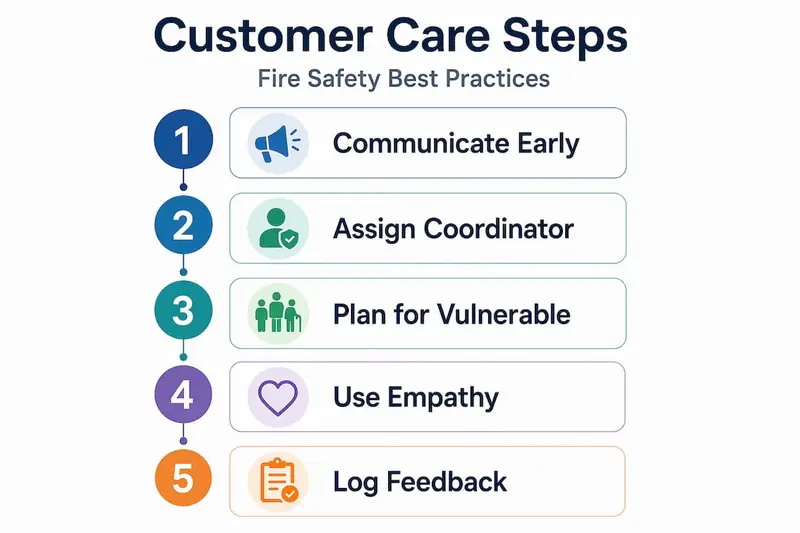
1. Establish clear communication protocols before, during, and after inspections.
Fire departments like Livermore-Pleasanton require at least 48 hours notice for inspections and use online scheduling forms paired with pre-inspection checklists to set expectations upfront. Adopt this model internally. Send occupants a summary of what the inspection covers, who will conduct it, and what to expect when corrections are issued. Transparency before the visit reduces anxiety and increases cooperation.
2. Assign an internal coordinator for every inspection cycle.
Central Pierce Fire and Rescue structures its inspections around education rather than punishment, providing a dedicated point person to translate correction items into actionable work orders. Your business should mirror this. Designate a single coordinator who owns the correction list, manages timelines, and communicates progress back to both the fire authority and your building occupants.
3. Plan specifically for vulnerable occupants.
From April 2026 in England, Responsible Persons must implement Residential Personal Emergency Evacuation Plans for residents who need evacuation assistance. These RPEEPs require person-centered fire risk assessments and documented evacuation statements. Even where RPEEPs are not legally required in your jurisdiction, the underlying principle applies: every building with occupants who may need extra support during an evacuation should have an individualized, agreed-upon plan in place.
4. Use empathy and plain language in every safety communication.
Non-technical skills like empathy can transform fire response from a stressful event into a positive service experience. Whether you are posting evacuation maps, sending inspection reminders, or conducting safety briefings, use language your occupants actually understand. Skip the regulatory jargon. Write at a level your least experienced tenant can act on immediately.
5. Handle complaints and feedback as data, not noise.
Create a documented process for receiving and responding to fire safety complaints. Log them, categorize them, assign ownership, and close the loop with the person who raised the concern. This is standard customer service practice in every other industry, and it works exactly the same way in fire safety.
Pro Tip: When issuing a correction notice, always include a realistic timeline, a named contact for questions, and a written summary of what the correction actually prevents. Occupants who understand the “why” comply faster and with less friction.
Technology and tools that improve fire safety support
Customer-centered fire safety is much easier to deliver when you have the right systems behind it.

Communication and helpline infrastructure
Structured fire safety helplines serve as the operational front door of your customer care program. South Wales Fire and Rescue runs a dedicated Business Safety Helpline from Monday through Friday, 9am to 5pm, with urgent concerns addressed via 999 and follow-up within two business days after reporting. For your own operations, this translates to having a named contact and a documented response SLA for all fire safety inquiries, not just the critical ones.
Secure information systems for sensitive data
For properties with vulnerable occupants, the RPEEP framework offers a model worth studying. Only the flat or floor number and the level of evacuation assistance needed are shared with fire responders. No medical data is held by the fire service. Secure Information Boxes maintain rapid access while protecting resident privacy. The consent can be withdrawn at any time. This privacy-by-design approach builds trust with the exact occupants who are most at risk.
| Tool | Primary benefit | Customer care impact |
|---|---|---|
| Business fire safety helpline | Rapid response to non-emergency queries | Reduces anxiety, builds accountability |
| Online inspection scheduling | Transparent, self-service booking | Sets expectations, improves preparation |
| Secure Information Boxes | Privacy-safe data access for responders | Protects vulnerable occupants’ dignity |
| CRM or ticketing system | Tracks all inquiries and complaints | Closes feedback loops, prevents things falling through |
Pro Tip: If your building uses a Secure Information Box or similar system, review its contents annually and confirm consent is still active. Outdated data creates both operational and legal problems.
The fire detection system setup guide from Reliable Fire Protection covers how technology integration supports both compliance and the occupant experience during the installation and testing phases, which is worth reviewing if you are upgrading your systems.
Measuring success and continuous improvement
A fire safety support program with no measurement is just good intentions. You need to know whether your communication practices are actually landing, your inspections are closing on time, and your occupants feel adequately prepared.
Continuous Quality Improvement (CQI), used formally by accredited fire departments, involves self-assessment, performance data analysis, and systematic changes to exceed community expectations. Businesses can apply the same framework at the property level. Track these metrics:
- First-response time on fire safety inquiries (target: same business day acknowledgment)
- Inspection closure rate (percentage of correction items resolved within the agreed timeline)
- Occupant feedback scores collected after drills, inspections, or safety briefings
- Repeat violation rate across consecutive inspection cycles
- Training completion rate for staff who manage fire safety procedures
Collecting feedback does not require a sophisticated system. A short survey sent after each inspection or drill, combined with a quarterly review of complaint logs, gives you enough data to spot patterns and fix them before they become compliance failures.
According to David Wales of The Foundation, direct interviews with community members revealed priorities that no internal policy review would have surfaced. The same principle applies inside your building. Talk to your tenants and staff. Ask what confused them during the last drill. Ask what they wish they had known before the last inspection. That conversation is free, and the information is worth more than any audit report.
Pro Tip: After each fire drill, send a three-question survey to participants: What worked well? What was confusing? What would help you feel more prepared next time? The answers will improve your next drill more than any template ever will.
For a structured look at how this measurement process connects to inspection workflows, the fire safety inspection guide for Texas 2026 is a practical starting point, especially if you are managing multiple properties.
My take on why this matters more than most businesses realize
I’ve spent years watching businesses invest heavily in fire suppression hardware and almost nothing in the communication layer around it. The equipment works. The paperwork gets filed. And then a drill runs and half the building doesn’t know which exit to use, because no one ever actually explained it to them in plain terms.
What I’ve learned is that the gap between a building that passes inspection and a building that is genuinely safe often comes down to whether the people inside it have been treated as participants in their own safety rather than bystanders. When you assign a real person to manage corrections, when you explain the purpose of a sprinkler check before the technician walks in, when you send a follow-up note after a drill telling people what you are going to change next time, you get a completely different level of engagement.
The fire safety consulting world has been slow to formalize this, but the data is there. Buildings with strong communication cultures see fewer repeated violations, faster evacuation times, and less panic when something actually goes wrong. That is not soft. That is measurable risk reduction.
My recommendation: treat every fire safety interaction the same way you would treat a customer service touchpoint in your core business. Because it is one.
— Reliable Fire Protection
How Reliable Fire Protection serves businesses with this approach
Reliable Fire Protection understands that fire safety is not just about installing the right equipment. It is about making sure the people responsible for a property have the information, support, and follow-through they need to stay compliant and confident. As a Houston-based, family-owned fire protection company, Reliable Fire Protection builds its service model around clear communication, scheduled follow-ups, and a team that treats every client like a long-term partner rather than a work order.
Whether you need to understand how your fire alarm system works, get a sprinkler installation on schedule before your next inspection, or work through a fire extinguisher compliance plan for your Houston business, Reliable Fire Protection provides the technical expertise and the customer-focused service approach that closes the loop. Contact Reliable Fire Protection today for a free quote and find out what customer-centered fire safety actually looks like in practice.
FAQ
What is customer care in fire safety?
Customer care in fire safety refers to the communication, responsiveness, and support practices that accompany fire safety services, including how inspections are scheduled, how corrections are communicated, and how occupants are supported before and after emergencies.
How do you improve fire safety compliance through better communication?
Assigning a dedicated internal coordinator, providing clear correction timelines, and following up with occupants after inspections all reduce repeat violations and speed up compliance. Central Pierce Fire and Rescue uses exactly this model with measurable results.
What is a Residential Personal Emergency Evacuation Plan (RPEEP)?
An RPEEP is a person-centered evacuation plan for residents who need assistance leaving a building. From April 2026, Responsible Persons in England are legally required to create and maintain these plans with resident consent.
How should businesses handle fire safety complaints?
Log every complaint, assign ownership, set a response timeline, and close the loop with the person who raised it. Treating complaints as data rather than disruptions is the fastest way to improve your fire safety support program.
What metrics should you track to measure fire safety customer care?
Track inquiry response times, inspection correction closure rates, repeat violation rates, occupant feedback scores, and staff training completion. These five metrics give a clear picture of whether your fire safety service delivery is improving over time.