
TL;DR:
- Fire hazards often remain hidden until they cause significant damage, making identification essential for safety and legal compliance.
- A thorough inspection involves understanding the fire triangle, preparing documentation, and systematically checking for ignition, fuel, and oxygen sources, especially in high-risk zones.
Unidentified fire hazards have a way of staying hidden until they cause serious damage. For property owners and managers, knowing how to identify fire hazards is not just a best practice. It is a legal obligation and a direct line of defense against loss of life, structural damage, and costly liability. This guide gives you a practical, step-by-step approach to finding and documenting fire risks across your property, covering everything from preparation and inspection to recording your findings and staying compliant with fire safety standards.
Table of Contents
- Key takeaways
- How to identify fire hazards: what to prepare first
- Step-by-step hazard identification across your property
- Common mistakes that lead to missed hazards
- Documenting and verifying your findings
- My take on what actually makes hazard identification work
- Protect your property with the right fire safety systems
- FAQ
Key takeaways
| Point | Details |
|---|---|
| Know the three hazard categories | Every fire hazard falls under ignition, fuel, or oxygen sources. Inspect for all three separately. |
| Prepare before you inspect | Gather past inspection reports, safety policies, and the right tools before starting your walkthrough. |
| High-risk zones need extra attention | Storerooms, electrical panels, kitchens, and waste areas are where missed hazards most often hide. |
| Document everything you find | Record each hazard, who is at risk, and what corrective action is needed with a clear deadline. |
| Schedule re-inspections regularly | Fire safety is an ongoing process. Conditions change, and your assessments need to keep pace. |
How to identify fire hazards: what to prepare first
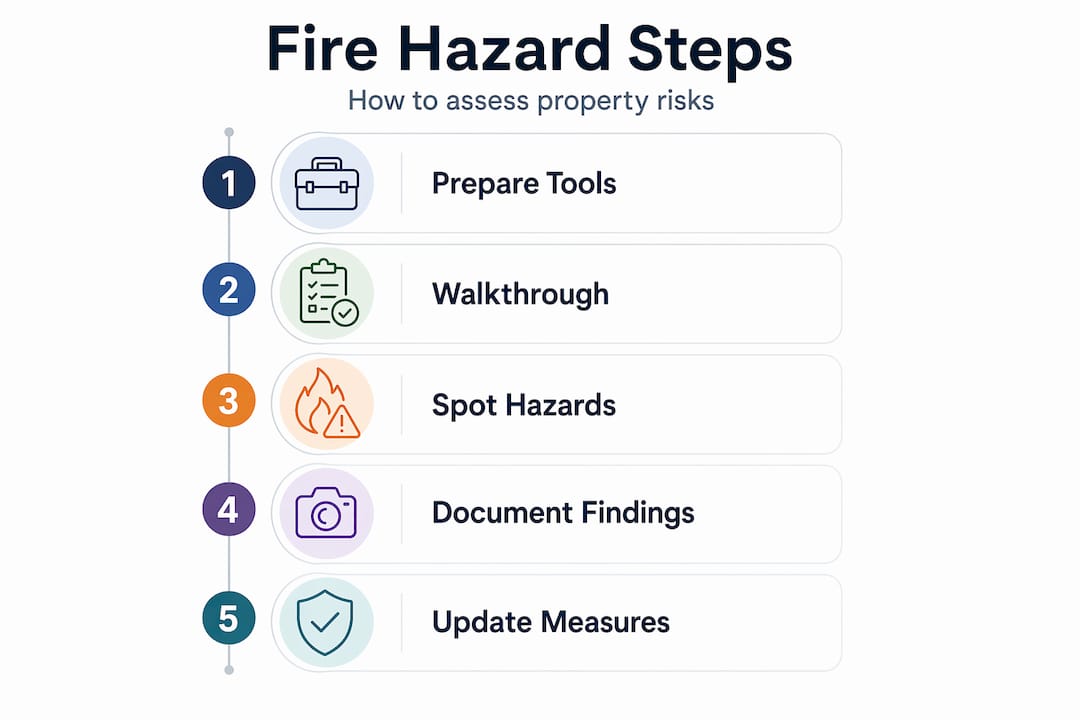
Walking into a fire hazard inspection without preparation is one of the most common ways property managers miss critical risks. Before you start any walkthrough, you need a clear framework in place.
Start by understanding the three core categories that define every fire hazard. Ignition, fuel, and oxygen sources form the fire triangle, and any hazard you find will fit into at least one of those categories. This mental model keeps your inspection structured rather than random.
Next, pull together your documentation. You will want:
- Previous fire inspection reports and any incident records
- Your property’s current fire safety policy
- Floor plans showing exits, electrical panels, and storage areas
- Maintenance logs for heating systems, electrical equipment, and cooking appliances
On the tools and personnel side, the minimum you need for a basic fire safety assessment includes a flashlight for checking confined or poorly lit spaces, a clipboard or digital device for recording findings, personal protective equipment if you are entering storage areas with unknown materials, and a printed or digital fire hazard checklist to guide your walkthrough systematically.
For larger or more complex properties, bring in a certified fire safety professional. They can catch risks that an untrained eye will miss, and their sign-off carries weight with insurers and inspectors.

| Tool or document | Purpose |
|---|---|
| Previous inspection reports | Identify recurring or unresolved hazards |
| Fire safety checklist | Keep the walkthrough structured and consistent |
| Flashlight | Inspect dark or obstructed areas thoroughly |
| Floor plans | Cross-reference hazard locations with exits and panels |
| PPE | Protect yourself in areas with unknown materials |
Step-by-step hazard identification across your property
The most reliable method for spotting fire hazards is treating your walkthrough like an audit of the fire triangle. Rather than walking through a space and hoping problems stand out, you scan each area deliberately for ignition sources first, then fuel sources, then oxygen-related conditions. Searching separately for each component yields a far more complete picture than relying on instinct.
Here is how to work through a property systematically:
-
Inspect for ignition sources. Check every piece of electrical equipment for frayed wiring, overloaded outlets, or faulty connections. Look at portable heaters, cooking appliances, and any machinery that generates heat. Note equipment that is left on when not in use. A single overloaded power strip in a server room or break room is an ignition source.
-
Check for fuel sources. Walk storage areas, hallways, and workspaces for combustible materials: paper stock, cardboard, flammable liquids, fabrics, and plastics. Pay close attention to how close these materials are to any heat source. Clutter is not just a housekeeping issue. It is a fuel accumulation problem.
-
Assess oxygen sources. Ventilation systems can accelerate fire spread significantly. Look for areas with poor airflow management, compressed gas cylinders stored incorrectly, and any oxidizing chemicals near combustibles. Note how fire could travel through the space if it started in a given spot.
-
Focus on high-risk zones. Kitchens, electrical rooms, boiler rooms, waste storage areas, and loading docks require extra time. These spaces combine ignition and fuel sources in close proximity, making them the most likely starting points for fires.
-
Log every finding in real time. Do not rely on memory. Use your checklist or a mobile app to record the location, the type of hazard, and its current condition while you are still in the space. Photo documentation is worth the extra 30 seconds.
-
Repeat the process for every floor and zone. A hazard on the second floor that is connected to HVAC ductwork can affect the entire building. Treat each area as its own unit while also considering how hazards interact across the property.
Pro Tip: Before your walkthrough, look at your property from the perspective of how a fire would travel, not just where it would start. Ask yourself: if ignition happened here, what would feed it and where would it go? That shift in thinking catches a surprising number of risks that a standard inspection misses.
Common mistakes that lead to missed hazards
Even experienced property managers make assessment errors. The biggest culprit is recognition bias. When you work in or manage a space daily, you stop seeing its hazards. That stack of cardboard boxes near the electrical panel has been there for six months, so your brain has filed it as part of the furniture. It is not. It is a fire waiting for a trigger.
Here are the most common mistakes and how to avoid them:
-
Skipping storerooms and cupboards. These spaces accumulate combustible materials faster than anywhere else in a building. Hidden accumulations near heat or ignition sources are one of the leading causes of preventable fires. Open every door during your walkthrough.
-
Ignoring how ventilation affects fire spread. An open duct or poorly managed air handling system turns a contained fire into a building-wide emergency in minutes. Consider ventilation as a risk multiplier, not a neutral factor.
-
Failing to coordinate in shared spaces. If your property has multiple tenants, contractors, or a managing agent, coordinating across all responsible parties is legally required in many jurisdictions and practically necessary everywhere. One occupant’s storage habits can create hazards in shared corridors or mechanical rooms.
-
Treating the checklist as optional. Walkthroughs without a structured fire hazard checklist consistently miss things that a systematic review catches. Checklists also provide documented proof of due diligence if an incident occurs.
Pro Tip: Ask a colleague who is unfamiliar with the property to walk a section with you. Fresh eyes without the familiarity bias you have developed will flag hazards you have learned to overlook.
Documenting and verifying your findings
Identifying a hazard without recording it is almost as useless as not finding it at all. Spotting hazards without taking action leaves you legally exposed and operationally unsafe. Your documentation needs to be specific enough for someone unfamiliar with the property to understand exactly what was found and what needs to happen next.
For each hazard you record, capture:
- The exact location within the property
- The category of hazard (ignition, fuel, or oxygen)
- Who is at risk: employees, residents, visitors, or contractors
- What controls, if any, are currently in place
- The corrective action required, who is responsible, and the deadline
Proper documentation of hazards and corrective action plans is what transforms a walkthrough into a legal record of compliance. Pair your written notes with your fire alarm and suppression system records to get a complete picture of your property’s current protection level.
After your initial assessment, coordinate your findings with your existing fire prevention measures. Check whether your fire alarm coverage reaches the highest-risk zones you identified. Verify that fire extinguishers are correctly positioned and rated for the hazard types in each area. Confirm that emergency exits are accessible and clearly marked.
| Action item | Responsible party | Deadline |
|---|---|---|
| Remove combustibles from panel room | Facilities manager | Within 48 hours |
| Inspect and test electrical wiring | Licensed electrician | Within 2 weeks |
| Reposition flammable liquid storage | Warehouse supervisor | Within 1 week |
| Verify alarm coverage in storerooms | Fire safety contractor | Within 30 days |
Regular re-inspections and monitoring are what keep your hazard controls from becoming outdated. Properties change. Tenants change. Equipment gets added or moved. Build re-inspection into your calendar at least annually, or sooner if you make significant changes to how the space is used.
My take on what actually makes hazard identification work
I have reviewed dozens of fire safety assessments for properties across a range of industries, and the pattern I see most often is this: the property manager did a walkthrough, filled out a form, and considered the job done. The problem is that a single walkthrough with no follow-through is closer to theater than safety management.
What actually works is treating hazard identification as the first step in an ongoing process, not the process itself. The integration of hazard identification with fire prevention measures is where the real safety gains come from. Finding a hazard has no value unless it drives a specific corrective action with a deadline and an owner.
I have also learned that the managers who do this best are not the ones with the most technical knowledge. They are the ones who stay curious and slightly skeptical, who ask why something is stored where it is, who check the storeroom nobody else bothers with. That mindset, paired with a structured checklist and a willingness to bring in outside expertise, outperforms intuition every time.
If you manage a shared property, stop trying to own the entire process alone. Get your tenants and contractors involved in the walkthrough. The coordination across all responsible persons is not just a regulatory checkbox. It closes the gaps that solo inspections always leave open.
— Reliable-fire-protection
Protect your property with the right fire safety systems
Once you have completed your fire safety assessment and identified your property’s hazard profile, the next step is making sure your detection and suppression systems match the risks you found.

Reliable Fire Protection works with residential and commercial property owners across Houston to design and install fire protection systems that align directly with their specific risk profile. Whether your assessment revealed gaps in detection coverage, inadequate extinguisher placement, or a need for a full fire alarm system upgrade, Reliable Fire Protection has certified technicians ready to help. You can also explore the full range of fire safety products and services available for your property type, from sprinkler systems to suppression solutions. Contact Reliable Fire Protection today for a free quote and get the protection your assessment calls for.
FAQ
What does a fire hazard include?
A fire hazard includes anything that can start a fire or contribute to its spread, such as ignition sources, combustible materials, and conditions that increase oxygen availability. Each hazard should be removed or controlled to reduce risk.
How often should a fire safety assessment be done?
Most properties require a formal fire safety assessment at least once a year, and immediately after any significant change in property use, occupancy, or layout. Re-inspections and monitoring keep safety controls current and legally defensible.
What are the most commonly missed fire hazards?
Storage rooms and cupboards are consistently where combustible build-up near ignition sources goes unnoticed. Poor ventilation management and overloaded electrical circuits in low-traffic areas are also frequently overlooked.
Do I need a professional to identify fire hazards?
Property owners can conduct initial walkthroughs using a structured checklist, but certified fire safety professionals are recommended for larger, more complex, or multi-occupancy properties. Their assessments carry legal weight and catch hazards that untrained inspectors miss.
What should I do after identifying a fire hazard?
Document the hazard with its location, risk level, and who is affected, then assign a corrective action with a deadline and a responsible party. Identifying hazards only adds real value when it leads to specific mitigation steps that are tracked through to completion.