
TL;DR:
- Fire extinguisher maintenance in Houston requires monthly inspections, annual professional checks, and periodic testing.
- Proper record-keeping, including tags and digital logs, is essential for compliance and inspection readiness.
- Bundling fire safety services and digital management systems improve compliance and reduce enforcement issues.
Over 60% of commercial property fires involve missing or poorly maintained fire extinguishers, and Houston businesses are not immune to that risk. A forgotten monthly check or an expired inspection tag can mean the difference between a contained incident and a total loss. Beyond the safety stakes, Texas law and federal OSHA standards impose real penalties on property owners who fall behind on maintenance. This guide walks you through every requirement, every tool, and every step you need to keep your extinguishers compliant and your property protected in 2026.
Table of Contents
- Understanding fire extinguisher maintenance requirements
- Tools, materials, and records needed for Houston compliance
- Monthly, annual, and advanced fire extinguisher maintenance steps
- Common mistakes, troubleshooting, and Houston-specific compliance tips
- A Houston expert’s take on fire extinguisher maintenance: What actually works
- Connect with Houston’s reliable fire protection experts
- Frequently asked questions
Key Takeaways
| Point | Details |
|---|---|
| Houston’s rules align with NFPA | Houston follows national standards for fire extinguisher maintenance, including monthly and annual checks. |
| Professional inspection required annually | Only licensed Texas firms can perform annual maintenance for business compliance. |
| Digital logs simplify compliance | Using digital record-keeping improves efficiency and helps avoid costly mistakes. |
| Bundling inspections saves time | Combining extinguisher checks with alarm or sprinkler service streamlines compliance and reduces costs. |
Understanding fire extinguisher maintenance requirements
Houston business and property owners operate under a layered set of rules that come from three different sources: the National Fire Protection Association, the Texas State Fire Marshal, and the federal Occupational Safety and Health Administration. Understanding how these three bodies interact is the first step toward staying compliant.
NFPA 10 is the national standard that most local codes adopt by reference. It sets the inspection calendar that governs nearly every extinguisher in your building. NFPA 10 requires monthly visual inspections, annual professional inspections, 6-year internal examinations, and hydrostatic testing at intervals that vary by extinguisher type. These are not suggestions. They are the baseline from which local enforcement begins.
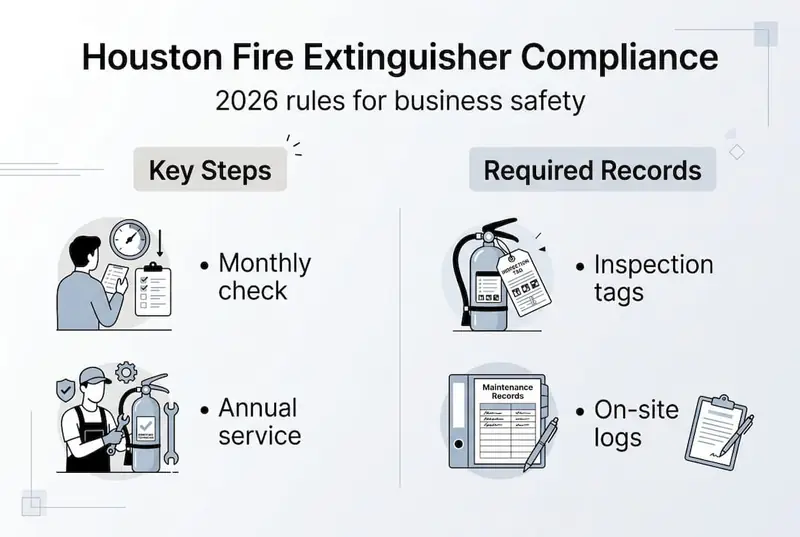
At the state level, the Texas State Fire Marshal requires licensed professionals for all annual inspections and mandates that records be kept on-site at commercial properties. You cannot simply have a maintenance-savvy employee sign off on the annual check. The technician must hold a valid Texas license, and their work must be documented properly.
OSHA 29 CFR 1910.157 applies directly to Houston workplaces and mirrors the NFPA schedule, requiring both monthly visual checks and annual professional maintenance. OSHA inspectors can cite employers for missing tags or incomplete logs during routine workplace inspections.
Here is a quick overview of required inspection intervals by extinguisher type:
| Extinguisher type | Monthly visual | Annual pro inspection | 6-year internal | Hydrostatic test |
|---|---|---|---|---|
| Dry chemical (stored pressure) | Yes | Yes | Yes | Every 12 years |
| CO2 | Yes | Yes | No | Every 5 years |
| Wet chemical (Class K) | Yes | Yes | Yes | Every 12 years |
| Halon | Yes | Yes | No | Every 12 years |
| Water/foam | Yes | Yes | Yes | Every 5 years |
For a deeper look at what a compliant Texas fire safety inspection actually involves, the step-by-step breakdown is worth reviewing before your next scheduled check. The Houston extinguisher inspection guide also covers local enforcement patterns that state-level documents do not address.
Key obligations for Houston businesses at a glance:
- Monthly visual checks must be performed and logged by any responsible employee
- Annual inspections require a Texas-licensed fire protection professional
- 6-year internal examinations apply to specific extinguisher types
- Hydrostatic testing frequency depends on the agent and cylinder material
- All records must remain on-site and be available during authority inspections
The cost of non-compliance goes beyond fines. Insurance carriers increasingly review inspection records during claims, and a lapse in maintenance documentation can jeopardize a payout after a fire event.
Tools, materials, and records needed for Houston compliance
With the rules clarified, it is time to gather everything you will need for effective maintenance. Successful compliance is not just about doing the work. It is about proving you did the work, and that requires the right materials and documentation systems.
Here is what every Houston property owner should have in place:
- Inspection tags attached to each extinguisher with date, technician name, and license number
- Monthly log sheets or a digital equivalent for employee-performed visual checks
- QR code labels that link to digital inspection records for faster audits
- Service report forms completed by the licensed technician after each annual visit
- Hydrostatic test certificates stored with the unit or in a centralized file
Inspection records must be kept on-site for commercial properties in Texas, which means a binder in the manager’s office is not optional. It is required. If an authority having jurisdiction (AHJ) walks through your facility, they expect to see that documentation immediately.

| Material | Frequency of use | Responsible party |
|---|---|---|
| Inspection tag | Every annual visit | Licensed technician |
| Monthly log sheet | Every 30 days | Designated employee |
| QR code label | Set up once, updated digitally | Owner or technician |
| Service report | Every annual inspection | Licensed technician |
| Hydrostatic certificate | Per test schedule | Certified test lab |
Digital logs and QR codes streamline compliance and reduce the risk of lost paperwork, which is one of the most common reasons Houston businesses fail inspections. Several affordable platforms now let you scan a code on the extinguisher, pull up its full history, and add a new entry in under a minute.
For a complete look at how to organize your documentation workflow, the Houston inspection workflow resource covers this in practical detail. You can also download a ready-to-use Houston inspection checklist that maps each task to the correct interval and responsible party.
Pro Tip: Schedule your annual extinguisher inspection on the same day as your fire alarm or sprinkler service visit. Bundling these appointments with one licensed provider saves time, reduces scheduling gaps, and often lowers your overall service cost.
Monthly, annual, and advanced fire extinguisher maintenance steps
With your resources ready, here is the step-by-step process for each maintenance interval.
Monthly visual inspection (employee performed)
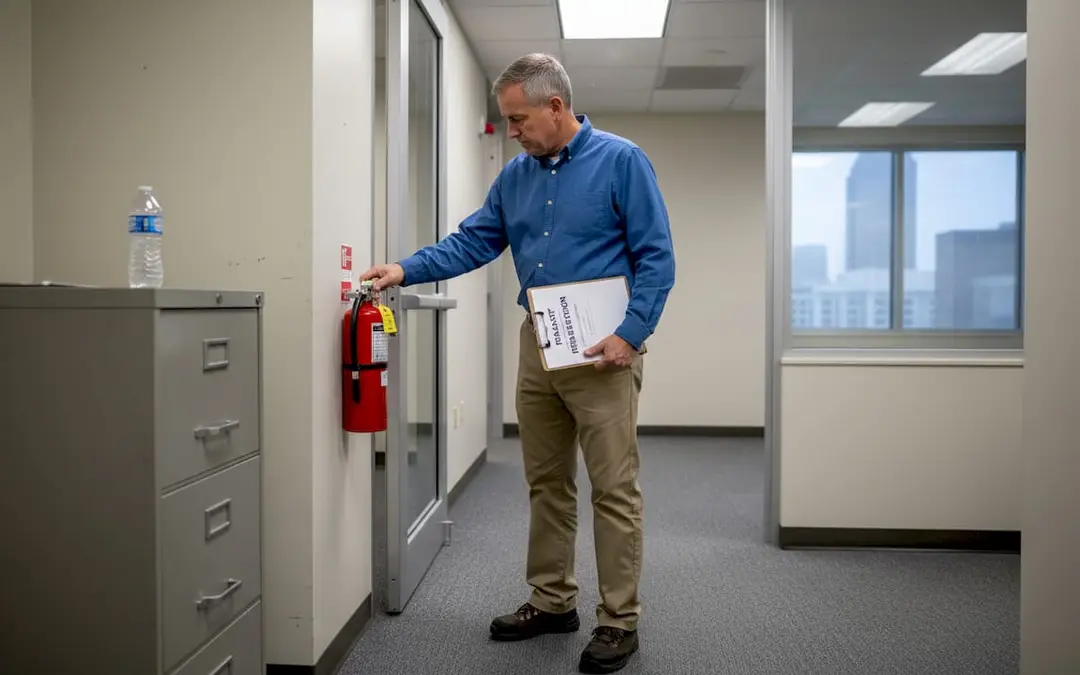
- Confirm the extinguisher is mounted in its designated location and is accessible without obstruction
- Check that the pressure gauge needle is in the green zone
- Verify the safety pin and tamper seal are intact
- Inspect the body for visible dents, corrosion, or damage
- Confirm the inspection tag is current and legible
- Log the check with the date and your initials on the monthly sheet
Monthly visual inspections and annual professional maintenance are both required under NFPA 10 and OSHA standards. Missing even one monthly check creates a gap in your compliance record that an AHJ can flag.
Annual professional inspection (licensed technician)
- Technician verifies all visual inspection points listed above
- Discharges and weighs CO2 units to confirm agent quantity
- Checks hose, nozzle, and valve assembly for wear or blockage
- Recharges any unit that has been partially or fully discharged
- Affixes a new inspection tag with license number and date
- Provides a written service report for your on-site records
For Houston businesses, annual inspection costs typically run $25 to $50 per unit. That is a small figure compared to the liability exposure of a failed inspection or an extinguisher that does not work when you need it.
6-year and 12-year advanced maintenance
- At the 6-year mark, a licensed technician empties and internally examines stored-pressure dry chemical units
- All internal components, O-rings, and valves are inspected and replaced as needed
- At the 12-year mark, OSHA requires hydrostatic testing for most cylinder types to verify structural integrity under pressure
- A certified test lab performs the hydrostatic test and issues a dated certificate
- Units that fail testing must be removed from service immediately
For a full breakdown of what each step involves, the essential checklist steps resource covers the technical details. Understanding the commercial safety role of each extinguisher type also helps you prioritize which units need the most attention.
Pro Tip: Keep a simple spreadsheet that lists each extinguisher by location, type, last annual date, and next hydrostatic test due date. Reviewing it quarterly takes ten minutes and prevents expensive last-minute scrambles.
Common mistakes, troubleshooting, and Houston-specific compliance tips
As you implement these routines, here is how to avoid trouble and ensure seamless local compliance.
The most frequent mistakes Houston property owners make include:
- Skipping monthly checks because the extinguisher looks fine from across the room
- Missing the 6-year internal exam because it is easy to confuse with the annual inspection
- Using unlicensed technicians to save money on annual service
- Storing records off-site or only in a digital system without a physical backup on the premises
- Blocking extinguisher access with furniture, equipment, or signage
If you discover a problem during your monthly check, here is how to handle common issues:
- Pressure gauge in the red zone: Tag the unit out of service immediately and call your licensed provider for recharge or replacement
- Missing or illegible tag: Do not wait for the annual visit. Contact your service provider to re-tag the unit
- Lost inspection logs: Reconstruct what you can from service invoices and technician reports, then implement a digital system going forward
- Expired extinguisher: Units past their hydrostatic test date must be removed from service until tested or replaced
Critical safety notice: The Houston AHJ may conduct unannounced site visits and has authority to issue violations, require immediate corrective actions, or shut down operations in severe non-compliance cases. Do not assume a clean record from last year protects you this year.
Houston-specific tips worth knowing:
- The local AHJ can differ by municipality within the greater Houston area. Confirm which authority governs your specific address
- Bundling extinguisher inspections with other fire system services through one provider simplifies your compliance calendar
- Digital record-keeping platforms that timestamp entries are increasingly favored during AHJ audits because they are harder to falsify
For a list of vetted providers, the top Houston extinguisher services page is a useful starting point. The Houston government safety tips resource also covers AHJ-specific enforcement patterns for property managers.
A Houston expert’s take on fire extinguisher maintenance: What actually works
After years of servicing commercial properties across Houston, one pattern stands out clearly: the businesses that stay compliant are not the ones with the most extinguishers. They are the ones with the best systems.
Monthly visual checks done on paper and filed in a binder work, but they break down the moment a manager leaves or a binder gets misplaced. What actually holds up under AHJ scrutiny is a digital log tied to a QR code on each unit, updated in real time by a licensed technician and verified monthly by a designated employee.
We have also seen how bundled inspection services change behavior. When a property owner schedules extinguisher, alarm, and sprinkler checks together, they stop thinking of fire safety as a series of separate tasks and start treating it as a single, manageable system. That shift in mindset is what prevents the costly oversights.
As local enforcement increases across Harris County, the properties that will avoid violations are those that treat compliance as an ongoing operation, not an annual event. The Houston inspection guide is a good reference to revisit each quarter, not just once a year.
Connect with Houston’s reliable fire protection experts
Staying compliant with fire extinguisher maintenance in Houston does not have to be complicated, but it does require the right partner.
At Reliable Fire Protection, we work with Houston business and property owners every day to simplify their fire safety obligations. From monthly log setup to annual licensed inspections and advanced hydrostatic testing, our team handles every interval so you can focus on running your business. Our inspection guide Houston walks you through what to expect, and our guides on types of extinguishers and the restaurant extinguisher expert guide help you match the right equipment to your specific risk profile. Contact us today for a free quote.
Frequently asked questions
How often must fire extinguishers be inspected in Houston?
Monthly visual checks and annual professional inspections are both required for Houston businesses under NFPA 10 and OSHA standards. Missing either interval creates a compliance gap that local authorities can cite.
What records do Houston property owners need for fire extinguisher maintenance?
Texas State Fire Marshal requires records of annual and hydrostatic inspections to be kept on-site at commercial properties. Digital logs are strongly recommended to reduce the risk of lost documentation during an AHJ audit.
Who can perform annual fire extinguisher inspections in Houston?
Only technicians licensed by the Texas State Fire Marshal can legally perform and certify annual fire extinguisher inspections for commercial properties in Houston.
How much does annual fire extinguisher inspection cost in Houston?
Professional annual inspections in Houston typically cost $25 to $50 per unit, making it one of the most affordable fire safety investments a business can make.
What happens if maintenance records are missing during inspection?
If records are not available on-site, Houston AHJ may issue violations or require immediate corrective actions, which can disrupt business operations until compliance is restored.
Recommended
- Government fire safety tips for Houston managers 2026
- Fire Safety Inspection Checklist 2026 for Houston
- Fire Extinguisher Inspection Workflow for Houston Compliance
- Fire Extinguisher Inspection Guide for Houston Businesses
- Fire Alarm System University Place TX
- Fire Alarm System Services in Bellaire, TX