

TL;DR:
- Choosing the right fire alarm system is critical for compliance and safety in Houston properties.
- Addressable systems are recommended for multi-tenant buildings due to their precision and scalability.
- Ongoing maintenance and regular testing are essential to ensure system effectiveness and regulatory compliance.
Picture this: it’s 11 p.m. and your phone rings. A fire alarm is blaring at your Houston property, and you have no idea if it’s a real emergency or the third false alarm this month. That moment of uncertainty is exactly what the wrong fire alarm system creates. Choosing the right system means the difference between a fast, coordinated evacuation and a chaotic, costly false response. Houston’s local fire code amendments add another layer of complexity that out-of-state guides simply miss. This article walks you through every step, from understanding system types to staying compliant long after installation.
Table of Contents
- Understand fire alarm system types and Houston requirements
- Essential features and detectors: What to look for
- Step-by-step: Selecting the right system for your property
- Verification and maintenance: Staying compliant and safe
- Why ‘set it and forget it’ fire alarm strategies fail in Houston
- Get professional help choosing and maintaining your fire alarm system
- Frequently asked questions
Key Takeaways
| Point | Details |
|---|---|
| Address local codes | Houston property owners must choose fire alarms that comply with local amendments and fire marshal approvals. |
| Select top features | Dual-sensor detectors and UL 217 compliance maximize safety and reduce false alarms. |
| Maintain regularly | Monthly tests and replacing detectors every 10 years keep systems legal and reliable. |
| Get professional guidance | Consulting Houston fire alarm specialists ensures your property stays both safe and code-compliant. |
Understand fire alarm system types and Houston requirements
Not all fire alarm systems are built the same, and in Houston, the type you choose directly affects your compliance standing, your tenants’ safety, and your bottom line. There are two primary categories every property owner should know: conventional systems and addressable systems.
Conventional fire alarm systems divide a building into zones. When a detector triggers, the panel shows which zone is affected, but not the exact device. These systems are simpler and less expensive upfront, making them a reasonable fit for smaller, single-use buildings with straightforward layouts.
Addressable fire alarm systems assign a unique identifier to every single device on the network. When something triggers, the panel tells you exactly which detector, in which room, on which floor. For large commercial buildings or multi-tenant properties, this precision is not a luxury. It’s a necessity.
| Feature | Conventional system | Addressable system |
|---|---|---|
| Coverage precision | Zone-level | Device-level |
| Upfront cost | Lower | Higher |
| Best for | Small, single-use buildings | Large or multi-tenant properties |
| Fault identification | Limited | Pinpoint accurate |
| Scalability | Difficult | Easy to expand |
Houston follows the International Fire Code with local amendments, and those amendments matter. The Houston Fire Marshal enforces specific requirements around system design, installation, and inspection intervals. For multi-tenant or commercial buildings, Houston-specific fire alarm codes require that systems support rapid identification and response. Failing to meet these standards can result in fines, forced shutdowns, or worse, delayed emergency response during an actual fire.
You can explore the full range of types of fire alarms available for commercial properties to get a clearer picture of what fits your building class. If you are still early in the process, a fire alarm selection guide can help you map system types to your specific occupancy needs.
Here is a quick checklist to help you decide which system fits your situation:
- Addressable system: Multi-tenant residential, large commercial, healthcare, or high-rise properties
- Conventional system: Small retail spaces, single-family homes, or low-occupancy warehouses
- Hybrid system: Mid-size buildings with mixed occupancy or phased renovation plans
A single false alarm in a commercial building can cost thousands in lost productivity, emergency response fees, and tenant frustration. Slow evacuation during a real fire can cost lives. The system you choose sets the baseline for both outcomes.
For multi-tenant Houston properties, prioritize addressable fire alarm systems because they deliver the precise response that local amendments demand.
Essential features and detectors: What to look for
Once you know which system type fits your property, the next question is which detectors and features will actually perform when it counts. This is where many property managers get tripped up, often choosing based on price alone rather than function.
There are three main detector types you need to understand:
| Detector type | How it works | Best use case |
|---|---|---|
| Photoelectric | Detects light-scattering from slow, smoldering fires | Living areas, bedrooms, near kitchens |
| Ionization | Detects fast-flaming fires using a small electrical current | Utility rooms, garages |
| Dual-sensor | Combines both technologies | Highest-risk or mixed-use spaces |
According to testing data, dual-sensor detectors are best for general use because they catch both fire types, and false alarms most often trace back to poor detector selection and incorrect placement rather than equipment failure.
When evaluating any detector or system, look for these must-have features:
- UL 217 compliance: This is the standard certification for smoke alarms in the United States. Do not accept anything less.
- Sealed, long-life batteries: Ten-year sealed batteries eliminate the risk of a dead battery going unnoticed. They also satisfy Houston code requirements in many occupancy types.
- Ten-year rated lifespan: Detectors degrade over time. A unit rated for 10 years gives you a clear replacement schedule.
- Interconnected capability: When one alarm sounds, all alarms in the building sound. This is critical for larger properties.
- Low false-alarm rate: Check manufacturer data on nuisance alarm rates before purchasing.
Placement mistakes are one of the most common reasons fire alarms fail to perform. Installing a detector too close to a kitchen, bathroom, or HVAC vent creates conditions for constant false triggers. The National Fire Protection Association recommends keeping smoke alarms at least 10 feet from cooking appliances. Ceiling placement is generally preferred, but high-humidity areas require special consideration.
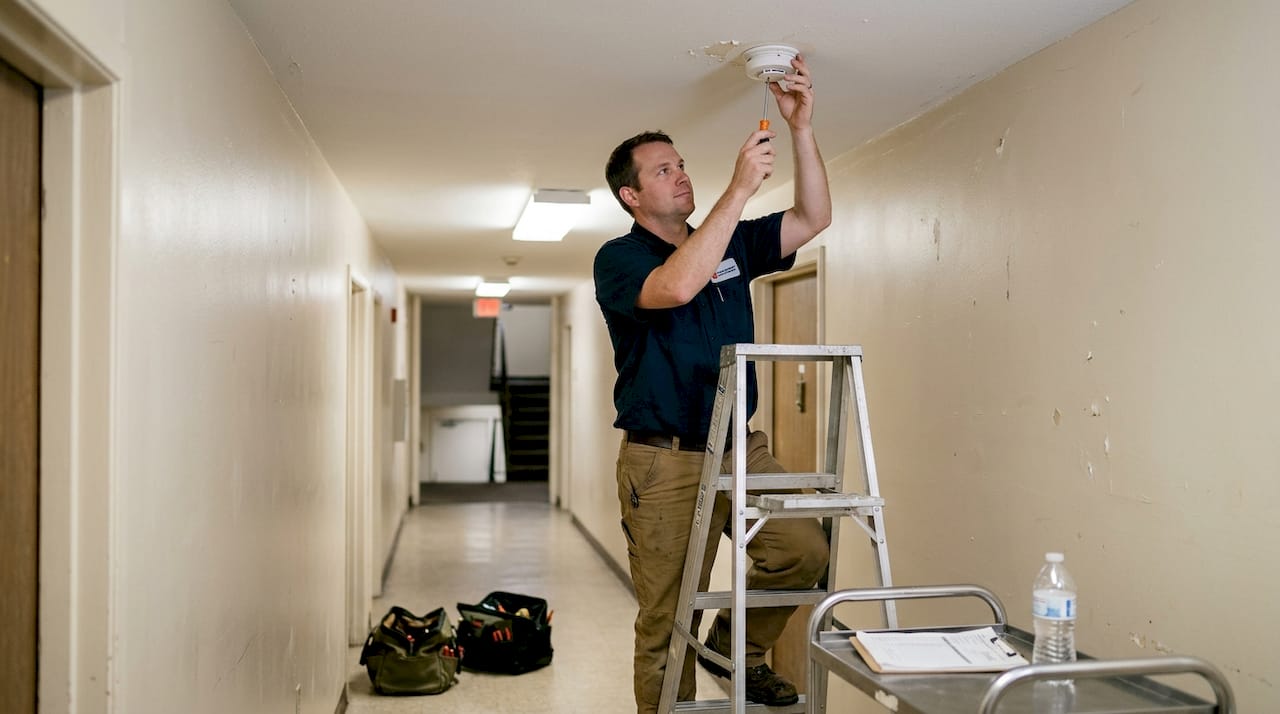
Pro Tip: Test every alarm in your building monthly and keep a written log. Houston inspectors can request maintenance records during inspections, and documented testing is one of the fastest ways to demonstrate compliance.
For a deeper look at how the installation process works, review the fire alarm installation steps specific to Houston properties. Understanding how fire alarms work at a mechanical level also helps you ask better questions when evaluating vendors.
Step-by-step: Selecting the right system for your property
Knowing what types and features exist is only half the job. Here is a practical workflow that takes you from initial assessment to final permit approval.
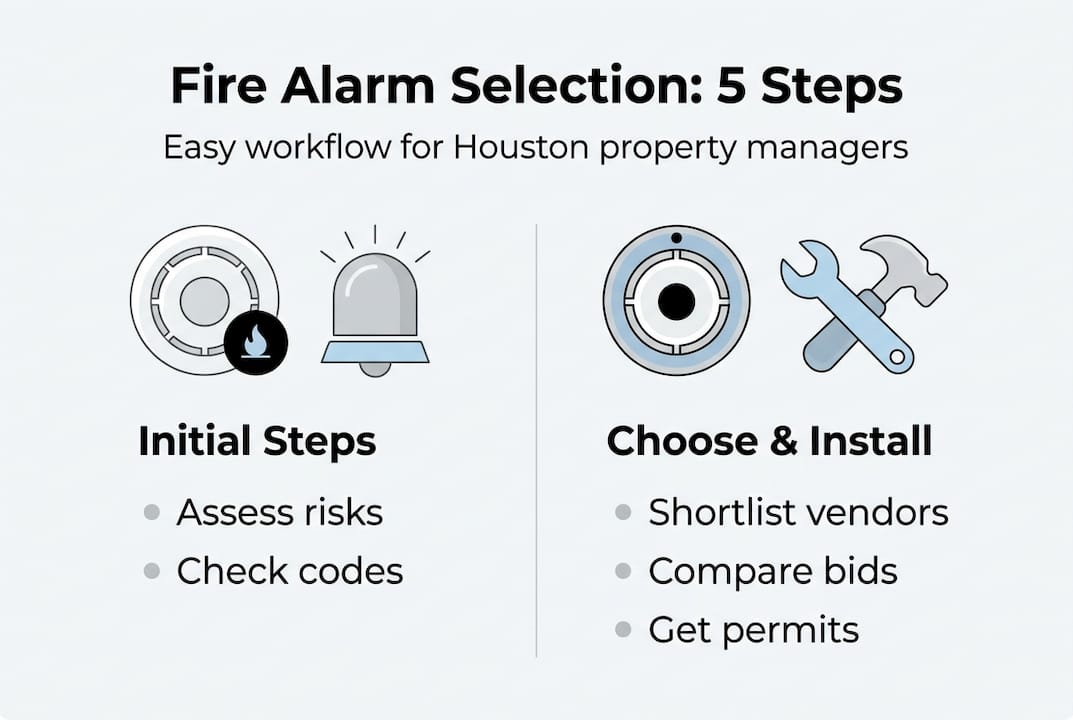
Step 1: Assess occupancy and special risks
Start by documenting your building’s occupancy type, square footage, number of floors, and any special hazards like chemical storage, commercial kitchens, or server rooms. These factors directly determine which system class is required under Houston code.
Step 2: Consult Houston amendments and fire marshal requirements
Do not rely on generic national standards alone. Always verify with the Houston Fire Marshal for the latest local amendments before finalizing any system design. Requirements can change, and what passed inspection two years ago may not pass today.
Step 3: Shortlist vendors with UL-listed products
Only consider vendors whose products carry UL listing. This is non-negotiable. Ask each vendor for documentation and confirm that their installation crews are licensed in Texas.
Step 4: Compare proposals carefully
Do not evaluate bids on price alone. Compare service contracts, warranty terms, 24/7 monitoring options, and response time guarantees. A cheaper system with poor monitoring support can cost far more in the long run.
Step 5: Obtain permits and schedule installation
In Houston, fire alarm installations require a permit from the city. Your vendor should handle permit applications, but confirm this in writing before signing any contract. After installation, a city inspector will verify the system meets code before it is officially approved.
Pro Tip: Ask every vendor for at least three local Houston references from properties similar to yours. A company that has worked in your building class and neighborhood will understand the specific inspection expectations in your area.
It also helps to understand the difference between alarms vs. suppression systems, since some properties require both. Reviewing why fire alarms matter for Houston buildings can reinforce the case for investing in the right system from the start.
Verification and maintenance: Staying compliant and safe
Installation day is not the finish line. Houston fire alarm systems require ongoing attention to stay both legal and effective. Many property managers treat compliance as a one-time event and then pay for that mistake during their next inspection.
Here is what a solid maintenance routine looks like:
- Monthly testing: Physically test every alarm and document the result with date, tester name, and outcome
- Annual professional inspection: A licensed fire alarm technician must inspect the full system at least once per year
- Battery checks: Even sealed-battery units should be verified during annual inspections
- Log maintenance: Keep a written or digital log of all tests, inspections, repairs, and replacements
- Permit and inspection records: Store copies of your installation permit and all inspection reports on site
Common compliance pitfalls include failing to replace detectors on schedule, skipping annual inspections, and losing documentation during staff turnover. All three can result in penalties or failed inspections.
Fire alarms must be tested regularly and replaced every 10 years. Tracking that replacement cycle in a simple spreadsheet or property management platform eliminates the guesswork.
Skipping maintenance to save time or money is a short-term decision with long-term consequences. A single missed inspection can trigger fines, void your insurance coverage, or leave your tenants unprotected during the one moment that matters most.
For properties in central Houston, alarm system maintenance services are available to handle inspections, testing, and documentation on your behalf, removing the burden from your team entirely.
Why ‘set it and forget it’ fire alarm strategies fail in Houston
Here is something most fire safety guides will not tell you: the biggest risk for most Houston property managers is not choosing the wrong system. It is choosing the right system and then walking away from it.
We see this pattern regularly. A property owner invests in a quality addressable system, passes the initial inspection, and then treats fire safety as a closed item. No monthly tests. No updated logs. No vendor relationship. Then, two years later, an inspection reveals three failed detectors, outdated documentation, and a system that no longer meets current local amendments.
Relying purely on code minimums is also a trap. Code tells you the floor, not the ceiling. A building that barely meets minimum requirements has no buffer when something goes wrong, whether that is a detector that fails early or a new tenant who introduces unexpected fire risks.
The role of fire alarms in a building is not passive. It is an active safety layer that requires real attention. Property managers who treat fire safety as an ongoing operational priority, not a one-time project, consistently have fewer emergencies, lower liability exposure, and smoother inspection outcomes. That shift in mindset is worth more than any single equipment upgrade.
Get professional help choosing and maintaining your fire alarm system
If keeping up with Houston’s fire alarm requirements, vendor comparisons, and maintenance schedules feels like a full-time job, that is because it practically is.
Working with a certified Houston fire alarm specialist takes the guesswork out of every stage, from understanding how fire alarm systems work to selecting the right equipment for your specific property type. Whether you manage a single commercial building or a portfolio of multi-tenant properties, Midtown Houston fire alarm services and broader Houston coverage are available through Reliable Fire Protection. Our team handles design, installation, permitting, and ongoing maintenance so your systems stay compliant and your tenants stay safe. Contact us today for a free quote.
Frequently asked questions
What is the best type of fire alarm for a Houston apartment building?
Addressable fire alarm systems are generally best for multi-tenant properties because they allow quick identification and response to issues. Addressable systems for multi-tenant properties are specifically aligned with Houston’s local fire code amendments.
How often should fire detectors be replaced in Houston?
Fire detectors must be replaced every 10 years, and units with sealed batteries are preferred for meeting Houston compliance requirements.
How can I avoid false fire alarms in my building?
Choose dual-sensor detectors and pay close attention to placement, keeping units away from kitchens, bathrooms, and HVAC vents to minimize nuisance triggers.
What Houston regulations affect fire alarm selection?
Houston follows the International Fire Code with local amendments, so always verify with the Houston Fire Marshal and confirm that all selected systems carry UL listing before installation.