TL;DR:
- Proper fire system selection requires thorough risk assessment tailored to Houston facilities.
- Matching suppression systems to hazard types and occupancy is critical for code compliance and safety.
- Expert guidance ensures adherence to Houston codes, NFPA standards, and insurance requirements, reducing risks.
Choosing the wrong fire suppression system for your Houston facility is not just a compliance headache. It can mean catastrophic property loss, voided insurance claims, and serious liability exposure. Houston’s mix of petrochemical plants, data centers, commercial kitchens, and mixed-use office buildings creates fire risk profiles that generic, off-the-shelf solutions simply cannot address. NFPA standards, local Houston Fire Marshal requirements, and insurer mandates all pull in different directions, and navigating them without a clear process is a recipe for costly mistakes. This guide walks you through a proven, step-by-step selection process built specifically for Houston facilities managers and business owners who need real answers.
Table of Contents
- Step 1: Assess your fire risks and facility needs
- Step 2: Compare suppression system types and their applications
- Step 3: Ensure compliance with NFPA, Houston, and insurance codes
- Step 4: Consider environmental impact, human safety, and long-term support
- What many miss: Why expert assessment beats DIY and the real compliance pitfalls
- Get expert help with your Houston fire suppression systems
- Frequently asked questions
Key Takeaways
| Point | Details |
|---|---|
| Risk assessment first | Start with a professional assessment to address fire hazards, occupancy, and special assets before selecting any suppression system. |
| System type matters | Match your suppression system to each space’s use, hazard, and compliance needs for safe, effective coverage. |
| Stay code compliant | Meeting NFPA, local Houston codes, and insurance standards is essential to avoid liability and denied claims. |
| Think long term | Choose eco-friendly, occupant-safe systems with a plan for ongoing maintenance and testing. |
Step 1: Assess your fire risks and facility needs
Every smart suppression system decision starts with a clear picture of what you’re protecting. Before you compare products or call a contractor, you need a thorough risk assessment that captures your building’s unique profile. As fire suppression technology updates confirm, identifying hazards and occupancy type is the essential first step in any selection process.
Start by gathering the following building information:
- Total square footage and floor plan layout, including ceiling heights and compartmentalization
- Occupancy type: office, warehouse, restaurant, data center, industrial, or mixed use
- Special hazards: flammable liquids, cooking equipment, high-voltage electronics, or chemical storage
- Asset sensitivity: irreplaceable archives, server equipment, or precision machinery that water could destroy
- Existing fire systems: alarms, extinguishers, sprinklers, and any suppression already in place
Houston’s industrial landscape adds layers that most generic guides ignore. Facilities near the Ship Channel often handle Class B flammable liquid hazards. Data centers in the Energy Corridor need agent systems that won’t damage servers. Restaurant groups across Midtown and Montrose face grease fire risks that demand kitchen-specific suppression. Knowing your industry context shapes every decision that follows.
| Facility type | Primary hazard | Key asset at risk |
|---|---|---|
| Office building | Electrical, paper | Records, electronics |
| Commercial kitchen | Grease, cooking oil | Equipment, structure |
| Data center | Electrical, overheating | Servers, data |
| Industrial/warehouse | Flammable liquids, dust | Inventory, machinery |
| Mixed-use retail | General combustibles | Merchandise, structure |
Once you have this data, document your existing controls and any gaps. Note which zones lack coverage, where hazards are concentrated, and where water-based systems could cause secondary damage.
“A risk assessment is not a formality. It is the document that justifies every system design decision that follows, and it is the first thing an inspector or insurer will ask for.”
Pro Tip: For complex or multitenant properties, engage a licensed fire protection engineer before finalizing your assessment. They can identify hazards that facility managers routinely miss and produce documentation that satisfies both the Houston Fire Marshal and your insurer.
With your risk profile documented, you have the foundation to evaluate your Houston suppression system needs with real precision.
Step 2: Compare suppression system types and their applications
With your facility’s risks mapped, you’re ready to match each area to the right suppression system. The four main categories each serve distinct environments, and selecting the wrong one for a given zone can mean code violations, system failure during an actual fire, or unnecessary damage to protected assets.
Here is a side-by-side comparison of the primary system types:
| System type | Best use | Governing code | Key advantage | Key limitation |
|---|---|---|---|---|
| Water sprinkler | Offices, warehouses, retail | NFPA 13 | Low cost, proven reliability | Damages electronics, archives |
| Clean agent | Data centers, server rooms | NFPA 2001 | Safe for equipment and people | Higher upfront cost |
| Wet chemical | Commercial kitchens | NFPA 96 | Designed for grease fires | Limited to kitchen applications |
| CO2 / dry chemical | Industrial, unmanned spaces | NFPA 17/17A | Effective on Class B/C fires | Not safe for occupied spaces |
As NFPA standards specify, matching system type to hazard and environment is non-negotiable: water sprinklers under NFPA 13 for offices and warehouses, clean agents under NFPA 2001 for data centers, wet chemical under NFPA 96 for kitchens, and CO2 or foam for industrial settings.
Here is a numbered process for choosing the correct system for each zone:
- Identify the hazard class for each room or zone (Class A ordinary combustibles, Class B flammable liquids, Class C electrical, Class K cooking oils).
- Check occupancy status: Is the space staffed during business hours? Occupied spaces rule out CO2 and certain dry chemical systems.
- Evaluate asset sensitivity: Electronics and archival materials require clean agents or water mist rather than standard sprinklers.
- Confirm code requirements for that specific occupancy and hazard class before finalizing your choice.
- Consider hybrid approaches for mixed-use floors, where one zone may need sprinklers and an adjacent server room needs a clean agent system.
Houston’s industry standards for fire protection increasingly recognize that large commercial properties rarely fit a single-system solution. Pre-action sprinkler systems, water mist systems, and acoustic suppression technologies are emerging options worth evaluating for facilities with complex, mixed-hazard profiles.
Pro Tip: If your facility includes a data center or telecommunications room, water mist systems are worth serious consideration. They use far less water than traditional sprinklers and can be listed for occupied spaces, giving you protection without the asset damage risk.
Step 3: Ensure compliance with NFPA, Houston, and insurance codes
After narrowing your system choices, compliance becomes critical for legal operation and peace of mind. Houston businesses operate under a layered compliance framework that includes federal NFPA standards, the International Building Code (IBC), Houston Fire Marshal requirements, and individual insurer mandates. Missing any one layer can trigger failed inspections, fines, or denied claims.
The primary code references you need to know:
- NFPA 10: Portable fire extinguishers
- NFPA 13: Installation of sprinkler systems
- NFPA 17 / 17A: Dry and wet chemical systems
- NFPA 96: Ventilation control and fire protection for commercial cooking
- NFPA 2001: Clean agent fire extinguishing systems
- NFPA 25: Inspection, testing, and maintenance of water-based systems
The Authority Having Jurisdiction (AHJ) in Houston is the Houston Fire Marshal’s Office. The AHJ has final say on plan approval, installation inspection, and occupancy permits. Even a system that meets NFPA standards on paper can fail Houston’s local AHJ review if installation details or documentation are incomplete. Staying current with Houston fire code compliance requirements is not optional.

Insurers add another layer. Many commercial property policies require specific suppression systems as a condition of coverage. A building without a compliant system may face higher premiums or outright coverage denials after a loss. Following Houston fire protection best practices protects both your property and your policy.
The statistics are stark. Properly installed sprinklers reduce fire deaths by up to 87%, according to NFPA research. Code noncompliance is one of the leading reasons insurers deny fire-related claims.
Common Houston code and inspection pitfalls to avoid:
- Failing to obtain AHJ plan approval before installation begins
- Using system components not listed for the specific hazard class
- Skipping required hydraulic calculations for sprinkler systems
- Neglecting kitchen hood suppression system integration with cooking equipment shutoffs
- Missing required signage, access panels, or inspector test connections
- Allowing inspection intervals to lapse under NFPA 25 schedules
Step 4: Consider environmental impact, human safety, and long-term support
Compliance doesn’t stand alone. System safety, sustainability, and ongoing support also drive smart selection. A suppression system that passes inspection on day one but lacks a viable maintenance plan will drift out of compliance and may fail when you need it most.
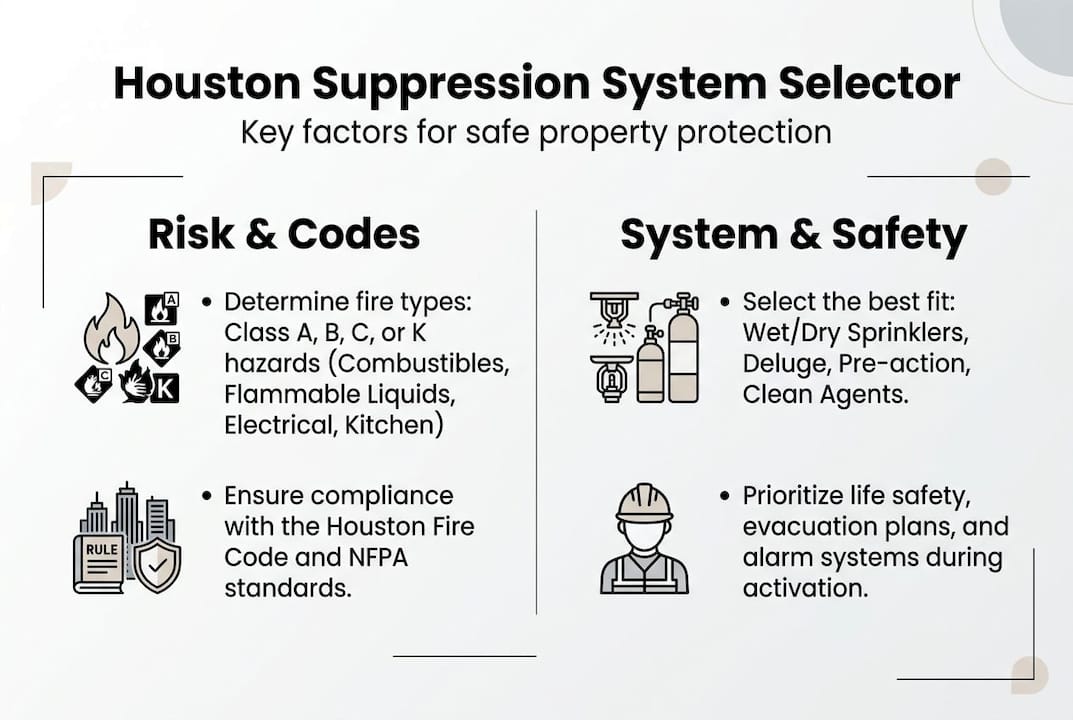
On the environmental side, Halon-based agents have been phased out under the Montreal Protocol due to ozone depletion. If your facility still uses Halon 1301 or 1211 systems, you are operating with an agent that cannot be legally refilled in the United States. The NFPA 2001 design framework directs facilities toward eco-friendly clean agents that are both effective and compliant with current environmental regulations.
Houston facilities should evaluate clean agents on these criteria:
- Global Warming Potential (GWP): Lower GWP agents are increasingly favored by regulators and insurers
- Ozone Depletion Potential (ODP): Must be zero for any agent purchased today
- Listed for occupied spaces: Confirm the agent is approved under NFPA 2001 for use where people work
- Local environmental regulations: Harris County and the Texas Commission on Environmental Quality (TCEQ) may impose additional requirements
- Refill availability: Some newer agents have limited local supply chains, which affects your emergency response time
For long-term support, build your maintenance schedule around NFPA 25 for water-based systems and manufacturer-specified intervals for clean agent and chemical systems. This typically means annual inspections at minimum, with quarterly checks on certain components. Documenting every inspection, test, and repair creates the paper trail that protects you during insurer audits and AHJ reviews.
The value of fire suppression in 2026 is not just about stopping fires. It is about maintaining a system that stays compliant, stays funded, and stays ready every single day.
Pro Tip: Room integrity testing, sometimes called a door fan test, is required for clean agent systems to verify that the protected enclosure will hold agent concentration long enough to suppress a fire. This test is frequently skipped during budget cuts and is one of the most common reasons clean agent systems fail during an actual event.
What many miss: Why expert assessment beats DIY and the real compliance pitfalls
Here is the uncomfortable reality that most guides won’t say plainly: designing a compliant, effective fire suppression system for a Houston commercial property is not a checklist job. We have seen facilities that followed every published guide, downloaded every NFPA document, and still ended up with systems that failed AHJ inspection or, worse, failed during an actual fire event.
The reason is almost always the same. Generic research does not account for Houston-specific AHJ interpretations, local amendment histories, or the way inspectors apply code language to unusual building configurations. A data center in a converted warehouse, a restaurant inside a high-rise, a mixed-use building with both office and industrial tenants: these scenarios require engineering judgment, not just code lookups.
We have also seen the financial fallout from amateur installs and off-the-shelf system purchases. One improperly documented suppression system can void a commercial property insurance policy entirely, leaving a business owner personally exposed to millions in fire losses. The legal liability from a system that fails to suppress a fire due to design error is even more severe.
The suppression system workflow that actually protects Houston businesses runs through qualified engineers, licensed installers, and experienced inspectors who know the local AHJ. Periodic professional consultation, not just at installation but at every major renovation or occupancy change, is the investment that prevents small oversights from becoming catastrophic failures.
Get expert help with your Houston fire suppression systems
If you’re ready to move beyond guesswork, connect with trusted Houston experts for peace of mind. Reliable Fire Protection works with Houston business owners and facilities managers every day to design, install, and maintain suppression systems that meet NFPA standards, satisfy the Houston Fire Marshal, and hold up under insurer review.
Our team handles everything from initial site assessment to final inspection sign-off. We know Houston’s AHJ requirements, we understand the unique hazard profiles across Houston’s commercial districts, and we bring certified expertise to every project. Whether you need a full review of your suppression systems for Houston properties or are starting fresh with a new facility, our setup and installation guide walks you through what to expect. Contact us today for a free site assessment and let us build a system that protects your people, your property, and your bottom line.
Frequently asked questions
What is the most common fire suppression system for offices in Houston?
Water sprinkler systems under NFPA 13 are the most common for offices and warehouses, and they are typically required by code for commercial occupancies above a certain size.
Do Houston businesses need both code compliance and insurance approval for suppression systems?
Yes. Both NFPA and local AHJ codes and insurer requirements must be satisfied independently, and failing either one can result in fines, failed inspections, or denied claims after a loss.
Are clean agent systems safe for people working in the protected space?
Yes, when properly designed and installed to NFPA 2001 standards, clean agents are approved for occupied areas, provided concentration levels and discharge times meet listed safety thresholds.
How often should suppression systems be inspected in Houston?
Maintenance per NFPA 25 requirements calls for at least annual inspections for most suppression systems, with some components requiring quarterly or monthly checks depending on system type and local AHJ requirements.
Recommended
- Fire suppression systems: what Houston businesses need
- Fire Suppression Agents: Protecting Houston Properties
- Why choose fire suppression systems for Houston in 2026
- Why fire suppression systems save Houston businesses in 2026
- Fire Alarm System University Place TX
- Fire Alarm System Services in Bellaire, TX