

TL;DR:
- Correct occupancy classification is essential to ensure fire safety compliance and avoid costly upgrades.
- It depends on building use, occupant load, and hazard level, with local Houston amendments affecting requirements.
- Many owners misjudge or assume contractors handle classifications, risking violations, higher insurance, or retrofit costs.
Getting your building’s occupancy classification wrong in Houston is not a minor paperwork slip. It can mean a failed inspection, a spike in insurance premiums, or a costly mid-project retrofit that stops construction cold. Most business owners and property managers assume their contractor handled it, or that the old permit still applies after a renovation. Misclassification risks failed inspections and higher insurance costs, yet it remains one of the most common compliance gaps we see across Houston properties. This guide breaks down exactly how occupancy classifications work under Houston’s current codes, what triggers mandatory upgrades, and how to protect your property from the consequences of getting it wrong.
Table of Contents
- What are occupancy classifications in fire safety?
- Overview of occupancy groups under IBC and Houston amendments
- Mixed-use and special cases: Nonseparated, separated, and accessory occupancies
- Compliance triggers: Sprinklers, egress, and other fire safety systems
- A Houston expert’s perspective: What most owners and managers get wrong
- Need expert help with occupancy classifications or fire safety upgrades?
- Frequently asked questions
Key Takeaways
| Point | Details |
|---|---|
| Classification drives safety requirements | Your building’s occupancy group determines when you need sprinklers, extra exits, and fire-resistant construction. |
| Houston enforces local amendments | Houston uses 2021 IBC/IFC codes plus city amendments that especially affect schools, daycares, and mixed-use properties. |
| Know triggers for upgrades | Major renovations, increased occupancy, or tenant changes can require new permits, sprinklers, and egress systems. |
| Plan for inspection success | Clarifying your classification upfront with city officials prevents last-minute inspection failures and insurance complications. |
What are occupancy classifications in fire safety?
An occupancy classification is essentially a label that describes how a building is used, who uses it, and what hazards that use creates. It is the foundation of fire safety code. Every fire protection requirement tied to your property, from sprinkler thresholds to required exits, flows directly from this classification.
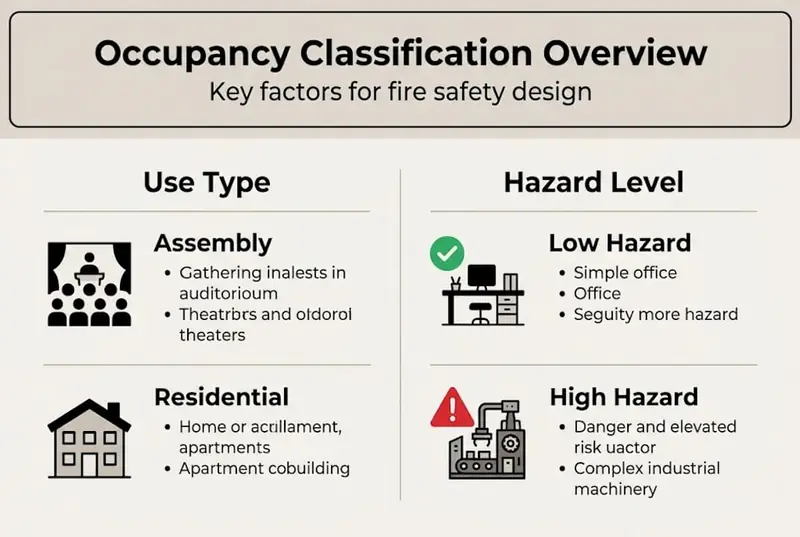
IBC and NFPA 101 define occupancy by use type, occupant load, and hazard level. That means a 3,000-square-foot space used as an office carries different fire protection obligations than the same square footage used as a restaurant or a daycare. The use, not just the size, drives the rules.
Houston primarily follows the International Building Code (IBC) and International Fire Code (IFC). These are model codes adopted across the country, but cities tailor them with local amendments. Houston enforces 2021 IBC/IFC with specific local amendments that affect everything from sprinkler requirements to egress configurations. If you are working from an older code cycle or assuming the national standard applies without local tweaks, you are already behind.
You can also reference Houston fire safety regulations for a broader look at how the local code framework is structured.
Here is what occupancy classification governs:
- Fire protection systems: Sprinkler type, suppression systems, alarm requirements
- Egress: Number of exits, corridor widths, travel distances
- Construction type: Fire resistance ratings for walls and floors
- Occupant load calculations: How many people can legally occupy the space
- Permit requirements: What triggers a new permit vs. a simple inspection
“The classification assigned to a building determines virtually every life safety requirement that follows. Getting it right at the start is far less expensive than correcting it after the fact.”
Property managers often confuse the occupancy classification with zoning. Zoning tells you what a space is legally permitted to be used for in the city’s land-use framework. Occupancy classification tells the fire marshal what life safety protections that use requires. A space can be zoned commercial but classified under multiple occupancy groups depending on what actually happens inside.
Another common source of confusion: occupancy classification is not permanent. If you change how a space is used, even partially, the classification may change. That change can trigger new code requirements even if you never touch a wall.
| Classification factor | What it affects |
|---|---|
| Use type | Required systems, egress design |
| Occupant load | Exit counts, corridor width |
| Hazard level | Sprinkler type, fire ratings |
| Square footage | Sprinkler thresholds, permits |
Overview of occupancy groups under IBC and Houston amendments
IBC defines 12 main occupancy groups with 26 subgroups, covering everything from assembly spaces to hazardous materials facilities. Understanding which group applies to your building is the first real step toward compliance.
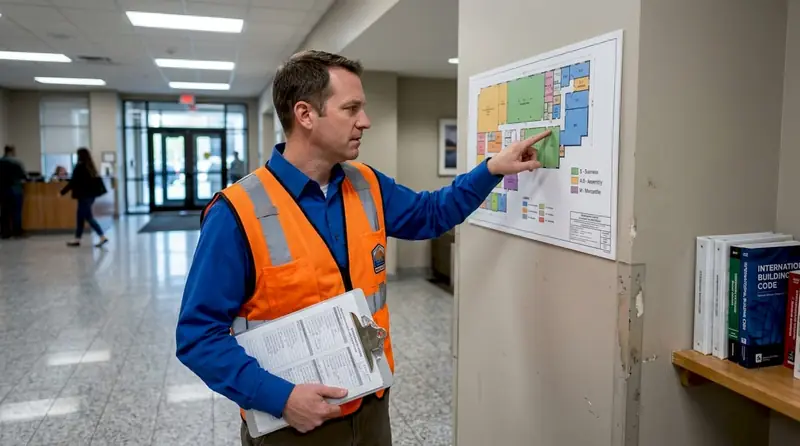
Here is a quick reference for the groups most relevant to Houston business owners and property managers:
| Group | Typical use | Key fire safety trigger |
|---|---|---|
| A (Assembly) | Restaurants, theaters, churches | Sprinklers, occupant load limits |
| B (Business) | Offices, banks, clinics | Standard egress, alarm systems |
| E (Educational) | Schools, daycares | Houston-specific sprinkler and egress rules |
| F (Factory) | Manufacturing, workshops | Hazard-based sprinkler requirements |
| H (Hazardous) | Chemical storage, labs | Strict suppression and separation rules |
| I (Institutional) | Hospitals, nursing homes | Smoke compartments, sprinklers required |
| M (Mercantile) | Retail stores, markets | Occupant load, exit placement |
| R (Residential) | Apartments, hotels | Smoke alarms, sprinkler thresholds |
| S (Storage) | Warehouses, parking garages | Area-based sprinkler triggers |
| U (Utility) | Sheds, fences, minor structures | Minimal requirements |
Statistic: IBC’s 26 subgroups mean a single building type like “educational” can fall under different subgroups with meaningfully different fire safety obligations.
Houston’s amendments affect E occupancies specifically, particularly schools and daycares with children. These local rules tighten sprinkler requirements and egress configurations beyond what the base IBC requires. If you manage a facility that serves minors, the standard national code is not enough.
To identify which group applies to your building, follow these steps:
- Define the primary use of the space as it actually operates today, not as originally permitted.
- Calculate your occupant load using IBC Table 1004.5 occupant load factors.
- Match the primary use to the IBC occupancy group descriptions.
- Check for Houston-specific amendments that apply to your group.
- Verify with the Houston Permitting Center or a licensed life safety consultant before filing any permits.
For assembly spaces, the A group alone has five subgroups (A-1 through A-5), and the differences matter. A nightclub and a lecture hall are both assembly occupancies, but they carry different sprinkler requirements based on occupant load and use. Check Houston sprinkler requirements to understand how these thresholds are applied locally.
Mixed-use and special cases: Nonseparated, separated, and accessory occupancies
Most real-world Houston buildings do not fit neatly into one occupancy group. A strip center might have a yoga studio, a nail salon, and a small restaurant sharing the same structure. A school might have a commercial kitchen or a maintenance room storing cleaning chemicals. These situations require a careful look at how the IBC handles mixed occupancies.
The IBC gives you three primary ways to handle a building with multiple uses:
- Separated occupancies: Physical fire barriers (rated walls and floors) divide each occupancy group. Each section must independently meet its group’s requirements.
- Nonseparated occupancies: No barriers required between groups, but the most restrictive requirements of any group in the building apply to the whole structure.
- Accessory occupancies: A secondary use that is subordinate to the main use and occupies no more than 10% of the floor area. It does not need to meet its own group’s requirements if thresholds are met.
IBC Table 508.4 governs fire separation ratings between occupancy groups in separated buildings, while Table 509 addresses incidental use separations. These tables determine exactly what fire-resistance rating a wall or floor assembly needs to achieve.
For further detail on incidental and accessory uses, the IBC makes important distinctions that affect whether a furnace room, generator space, or storage area triggers its own set of fire protection requirements.
Common classification mistakes in mixed-use buildings:
- Over-classifying accessory spaces: Treating a small break room or supply closet as a separate occupancy when it qualifies as accessory, adding unnecessary cost.
- Under-classifying incidental uses: Ignoring a boiler room or commercial kitchen, which IBC Table 509 specifically lists with required separation ratings.
- Assuming the main tenant use covers everything: A retail space with an attached stockroom holding large quantities of flammable product may shift into H occupancy territory.
Pro Tip: If a secondary space qualifies as an accessory occupancy, you can often avoid the cost of rated fire barriers entirely. Review IBC Section 508.2 carefully and consult the Houston Permitting Center before defaulting to full separation. The savings in construction cost can be significant. Also consider that installing fire sprinklers throughout a nonseparated mixed-use building can sometimes be cheaper than constructing rated separations.
Compliance triggers: Sprinklers, egress, and other fire safety systems
Occupancy classification directly determines whether sprinklers and egress upgrades are mandated for your building. This is where the classification stops being theoretical and starts costing real money.
Houston’s most common compliance triggers by occupancy:
- Assembly (A-2): Restaurants and bars over 5,000 square feet or 100 occupants require sprinklers. A permit must be filed before renovation begins.
- Educational (E): Any new or substantially renovated school or daycare in Houston must meet current sprinkler and egress requirements, including Houston-specific amendments.
- Institutional (I-2): Per NFSA I-2 occupancy guidance, hospitals and nursing homes require full sprinkler coverage and smoke compartmentation.
- Mercantile (M): Large retail stores with high occupant loads trigger both sprinkler and multiple-exit requirements.
- Change of occupancy: Any shift from one group to another, even between subgroups, can require a full code analysis and system upgrades.
Before starting any construction or renovation project, check these items:
- Confirm the current occupancy classification on your existing building permit.
- Determine if the new use changes the classification or subgroup.
- Calculate the occupant load for the proposed use.
- Check Houston’s amendment schedule for your specific group.
- Identify whether your project triggers sprinkler, alarm, or egress upgrades.
Pro Tip: Contact the Houston Fire Marshal’s office during pre-design, not after construction documents are complete. A 30-minute early conversation can prevent a redesign that costs thousands of dollars and weeks of delay.
“The best time to ask about code compliance is before the first drawing is made. The worst time is during the inspection.”
Regular sprinkler system inspections are also part of maintaining compliance after installation. Use a Houston fire prevention checklist to track ongoing obligations between major renovations.
A Houston expert’s perspective: What most owners and managers get wrong
After years of working on fire safety compliance across Houston, the pattern we see most often is not ignorance of the code. It is misplaced confidence. Owners assume their contractor knows the local amendments. Contractors assume the architect handled it. Nobody calls the permitting center until there is a problem.
Houston’s amendments evolve faster than most realize. The shift to 2021 IBC/IFC brought real changes to how E occupancies, mixed-use buildings, and certain assembly spaces are treated. Relying on what passed inspection five years ago is a risk that is not worth taking.
The other area where we consistently see unnecessary cost is accessory and incidental spaces. Managers either ignore them entirely, which can create a code violation, or over-classify them and build expensive fire-rated separations that were never required. Both mistakes cost money.
Understanding why sprinkler systems matter for your specific occupancy group is the starting point for smarter planning. A little early coordination with a life safety consultant and the Houston Permitting Center eliminates most of the surprises.
Need expert help with occupancy classifications or fire safety upgrades?
Sorting out occupancy classifications and the compliance systems they require is exactly the kind of work Reliable Fire Protection handles every day across Houston.

Whether you are dealing with a mixed-use building, a change of occupancy, or a renovation that triggered new sprinkler or alarm requirements, our team provides consultation, system design, installation, and ongoing inspections. We can help you understand fire alarm system basics, walk you through fire sprinkler installation requirements for your specific occupancy, or keep your systems passing with our sprinkler inspection guide. Contact Reliable Fire Protection today for a free consultation and get the Houston-specific guidance your property needs.
Frequently asked questions
What is the main code used for occupancy classification in Houston?
Houston enforces 2021 IBC/IFC with local amendments that modify fire safety requirements beyond the base national code. Always verify which amendment cycle applies to your specific project.
How do I find out my building’s occupancy classification?
Your building permit documents list the occupancy classification assigned at the time of construction or last renovation. You can also consult the Houston Fire Marshal’s office directly for clarification.
When are sprinklers required based on occupancy in Houston?
Classification triggers sprinklers at specific area or occupant load thresholds, such as assembly spaces over 5,000 square feet or 100 occupants, with additional rules per Houston’s local amendments.
Can a building have more than one occupancy classification?
Yes. Mixed occupancies follow IBC Table 508.4 and are handled as separated or nonseparated, depending on whether fire barriers are installed between uses.
Recommended
- Fire Safety Terms Defined: 25% Fewer Violations in Houston
- Fire Safety Regulations Explained: Impact on Houston Property Managers
- 7 Types of Fire Safety Systems Every Building Needs
- Fire Safety System Components for Houston Buildings
- How wall cladding meets UK hygiene and fire regulations
- Fire Alarm System University Place TX
- Fire Alarm System Services in Bellaire, TX