

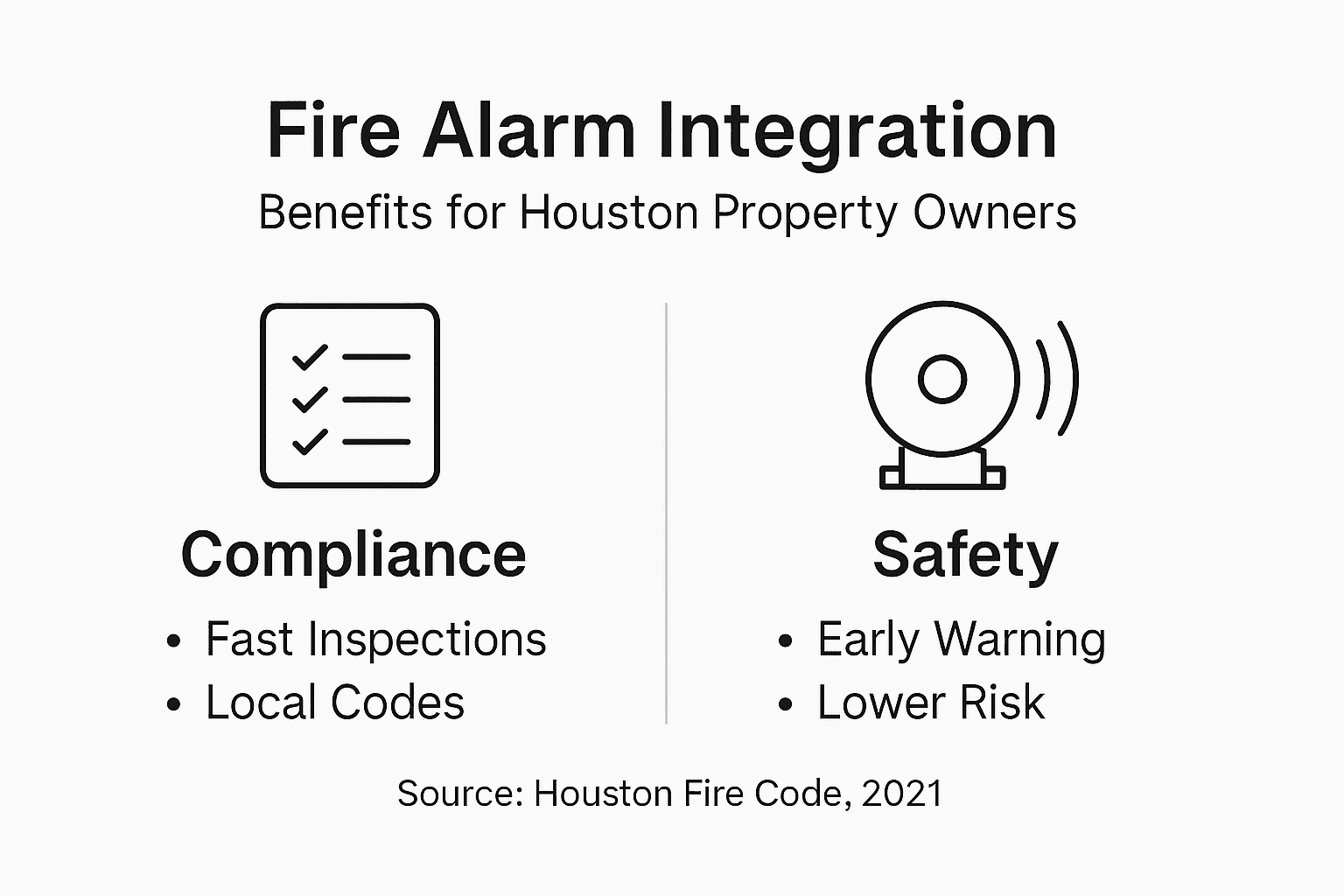
Managing tenant safety in a Houston commercial property can feel complex when fire alarms and notification devices operate independently. Integration brings peace of mind by connecting detection and alert systems as one powerful network, ensuring a unified response so everyone receives timely warnings. This approach not only supports compliance with Houston fire code but also streamlines inspections and reduces liability. Discover how integrated fire alarms safeguard your property and enhance tenant trust.
Table of Contents
- Fire Alarm Integration: What It Means
- Key Types of Fire Alarm Systems
- Houston Fire Code and Compliance Demands
- Benefits for Property Managers and Tenants
- Cost, Liability, and Maintenance Considerations
Key Takeaways
| Point | Details |
|---|---|
| Fire Alarm Integration | Connecting all fire detection and notification systems ensures a coordinated response, improving efficiency in emergencies. |
| Compliance with Houston Fire Code | Integrated systems simplify compliance by providing documented proof that safety functions work in unison, facilitating inspections. |
| Benefits for Property Managers | Integrated systems enhance operational efficiency, reduce liability exposure, and build tenant confidence through better safety management. |
| Cost Considerations | While installation and maintenance have upfront costs, they safeguard against significant liabilities, making them a worthwhile investment. |
Fire Alarm Integration: What It Means
Fire alarm integration sounds technical, but it’s actually straightforward: connecting all your fire detection and notification systems into one coordinated network. Instead of having separate, standalone devices scattered throughout your building, integration links them together so they communicate and respond as a unified system.
Think of a fire alarm control unit as the brain of your building’s fire safety system. This panel monitors every connected device—smoke detectors, heat sensors, pull stations, alarm bells, and notification devices—and coordinates their actions. When one sensor detects smoke, the entire system activates simultaneously across all zones.
Why Integration Matters for Your Building
Without integration, your fire safety relies on independent devices that don’t talk to each other. A sensor in the basement might trigger an alarm while the third floor remains silent. Tenants in different zones might receive warnings at different times. That’s chaos when seconds matter.
Integrated systems eliminate these gaps. Here’s what you gain:
- Unified response: All alarms sound at the same time across the entire building
- Coordinated reporting: The control panel logs every activation, giving you a complete safety record
- Supervisory functions: The system tracks which devices are working properly and alerts you to maintenance issues
- Faster notification: All occupants receive alerts simultaneously, speeding evacuation
An integrated fire alarm system ensures that detection devices, notification appliances, and supervisory functions work together efficiently—transforming multiple independent safety tools into one coordinated network.
How Integration Works Practically
Modern fire alarm integration often uses Internet of Things (IoT) technology to enhance monitoring capabilities. Sensors collect data about environmental conditions throughout your building—temperature, smoke density, air quality—and transmit this information to your control panel in real time.
This continuous monitoring means you get:
- Faster fire detection (minutes matter in smoke spread)
- Earlier warning for building occupants
- Real-time status updates on all safety devices
- Automatic logging of alarm events and system performance
The beauty of integrated systems is that they provide multiple types of signals—alarm signals when fire is detected, supervisory signals when equipment needs attention, and trouble signals when something malfunctions. Your property managers always know the system’s status.
What Integration Means for Houston Building Code Compliance
Houston buildings must meet strict fire safety codes. Integrated fire alarm systems help you maintain compliance because they provide documented proof that your building’s fire safety functions work together properly. Code inspectors want to see evidence that your detection, notification, and supervisory systems operate as one coordinated unit.
Integration also simplifies annual inspections. Rather than testing dozens of independent devices separately, your fire protection company can verify that everything communicates properly through the control panel. This reduces downtime and gets inspections completed faster.
The Property Manager Advantage
Integrated systems give you better building management. You can access system status from the control panel, review alarm history, schedule maintenance alerts, and verify that all safety devices are functioning. When a tenant calls about a false alarm, you have the exact time and location recorded in your system.
You also reduce liability. Documented integration means you can prove to insurance companies and tenants that your fire safety systems work together as designed—not as scattered, unreliable devices.
Pro tip: Request a system walkthrough from your fire protection provider to understand exactly how your integrated alarm system communicates with each device in your building, ensuring you can respond confidently when tenants ask about evacuation procedures.
Key Types of Fire Alarm Systems
Houston buildings use different fire alarm system types depending on their size, layout, and specific safety needs. Understanding these options helps you choose the right solution for your property and ensures compliance with local fire codes.
Each system type has distinct advantages. The right choice depends on your building’s complexity, budget, and coverage requirements. Let’s break down the main options property managers encounter.
Conventional Fire Alarm Systems
Conventional systems divide your building into multiple zones, with detection devices grouped by area. When smoke or heat is detected in a zone, the entire zone’s alarm activates, alerting occupants across that section.
These systems work well for smaller buildings or properties with straightforward layouts. Here’s what you get:
- Lower upfront installation cost
- Simple operation and maintenance
- Reliable performance in smaller structures
- Fewer components to monitor
The trade-off: you know which zone has a problem, but not the exact device location. If zone three activates, fire safety personnel must search that entire area to find the detector.
Addressable Fire Alarm Systems
Addressable systems take precision to the next level. Each detection device has its own address within the system, allowing pinpoint identification of where a problem exists.

When a sensor on the fourth floor activates, your control panel displays “Conference room 401—smoke detector activated.” Emergency responders know exactly where to go, cutting response time significantly.
Addressable systems suit larger or multi-floor buildings:
- Precise device location identification
- Faster emergency response
- Better record-keeping for compliance
- Scalable to building expansions
These systems cost more initially but save time and resources during emergencies and inspections.
Here is a quick comparison of major fire alarm system types to help in selection:
| System Type | Best For | Key Benefit | Main Limitation |
|---|---|---|---|
| Conventional | Small/simple layouts | Low upfront cost | No exact device location |
| Addressable | Medium/large properties | Pinpoint problem location | Higher initial installation fee |
| Intelligent/Wireless | Complex/renovated buildings | Fewer false alarms | Site conditions may impact use |
Intelligent and Wireless Systems
Intelligent systems use advanced technology to reduce false alarms. They analyze environmental data—temperature changes, smoke density patterns—rather than triggering immediately on any smoke detection.
Wireless systems eliminate running cables through walls and ceilings, reducing installation disruption and costs. Both technologies offer flexibility that conventional and addressable systems cannot match.
These advanced systems provide:
- Reduced false alarm rates
- Easier installation with minimal structural changes
- Real-time environmental monitoring
- Integration with building automation systems
Key System Components Across All Types
Regardless of which system type you choose, smoke detectors, heat detectors, and manual pull stations form the detection foundation. Your control panel receives signals from these devices and triggers notification appliances—bells, horns, strobes, and voice announcements.
All systems also coordinate with other safety equipment. Your fire alarm can automatically unlock doors, stop elevators at the nearest floor, and activate sprinkler systems when needed.
The system type you select determines how quickly emergency responders locate the fire and how efficiently your building’s safety systems coordinate during an emergency.
Choosing the Right System for Your Houston Property
Smaller buildings—offices under 10,000 square feet—often thrive with conventional systems. Mid-size properties benefit from addressable technology. Large, complex buildings with multiple floors and tenants typically need intelligent or addressable systems for reliable coverage and compliance.
Consider your building’s layout, occupancy changes, renovation plans, and inspection frequency when deciding. Your fire protection provider can assess your specific needs and recommend the best approach.
Pro tip: Ask your fire protection company to demonstrate how their addressable system identifies specific device locations on the control panel—this visual clarity helps property managers understand exactly what happens during an alarm activation.
Houston Fire Code and Compliance Demands
Houston doesn’t follow a generic fire code—the city has specific requirements layered on top of national standards. Property managers must navigate both the International Fire Code and Houston-specific amendments to stay compliant. Integrated fire alarm systems are central to meeting these demands.
Non-compliance carries serious consequences: fines, operational shutdowns, liability exposure, and tenant safety risks. Understanding what Houston requires helps you avoid these pitfalls and protect your building effectively.
What Houston Actually Requires
The 2021 Houston Fire Code chapter 9 outlines detailed fire protection and life safety system regulations. These standards cover installation, inspection, and maintenance of fire alarm systems. But here’s the critical part: Houston has city-specific amendments that go beyond the International Fire Code.
These amendments address Houston’s unique environment—climate, building density, occupancy patterns—ensuring systems work reliably in local conditions. You cannot simply install a generic fire alarm and expect compliance.
Installation and Alteration Permits
Before installing or modifying any fire alarm system, you need a permit from Houston’s Fire Permits Office. This isn’t optional paperwork; it’s a legal requirement that verifies your installation meets Houston fire code standards.
Permits ensure:
- Licensed contractors perform the work
- Installation follows Houston-specific standards
- System design matches your building’s layout
- Equipment meets approved specifications
- Documentation is filed with the city
Skipping permits exposes you to code violations and fines. It also invalidates insurance coverage if a fire occurs—insurers won’t pay claims when installations weren’t permitted.
Inspection and Maintenance Compliance
Installing a system is step one. Keeping it compliant requires regular inspections and maintenance documented by professionals. Houston fire code demands annual testing, quarterly inspections, and immediate repair of failed components.
Your integrated fire alarm system must be:
- Inspected annually by a licensed fire protection company
- Tested quarterly to verify all devices function
- Maintained with documented service records
- Updated when building layouts change
- Upgraded when code requirements change
These records prove to inspectors and insurers that you’re managing fire safety actively, not reactively.
Integration with City Amendments
Houston amendments require fire alarm systems to meet both International Fire Code standards and Houston-specific requirements. This dual compliance matters because what passes in another Texas city might not meet Houston standards.
Key amendments often address:
- Specific detection device spacing in Houston’s humid climate
- Alarm notification requirements for multi-tenant buildings
- Integration with other life safety systems (sprinklers, emergency lighting)
- Evacuation route signage and communication standards
Houston fire code compliance isn’t about meeting minimum standards—it’s about meeting Houston’s specific demands, which often exceed national minimums.
Why Property Managers Can’t Handle This Alone
Fire codes change. Houston amendments get updated. Equipment technology evolves. Staying compliant requires professional guidance from fire protection companies familiar with local requirements.
Your responsibility is ensuring your building remains compliant year after year. Working with experienced Houston-based fire protection professionals keeps you aligned with current codes and protects your liability exposure.
Pro tip: Schedule a compliance audit with your fire protection provider annually—before Houston Fire Department inspections—to identify any gaps and address them proactively rather than facing violations during official inspections.
Benefits for Property Managers and Tenants
Integrated fire alarm systems aren’t just regulatory checkboxes—they deliver tangible benefits that protect your building’s operations, finances, and most importantly, human safety. Both property managers and tenants gain real advantages when systems are properly integrated.
These benefits extend beyond emergency response. They influence insurance premiums, tenant satisfaction, liability exposure, and daily building operations. Understanding what you gain helps justify the investment to stakeholders and board members.
Safety and Early Detection Benefits
Early fire detection saves lives and reduces property damage significantly. Integrated systems detect smoke or heat faster than occupants notice danger, triggering immediate alerts across the entire building.
When every floor, zone, and tenant space receives notification simultaneously, evacuation happens faster. There’s no delay waiting for one zone’s alarm to trigger. Everyone knows at the same time that danger exists.
You also benefit from:
- Reduced fire spread time (detection happens in minutes, not hours)
- Faster emergency responder arrival through automatic dispatch
- Lower property damage from shortened fire exposure
- Reduced smoke inhalation injuries among occupants
Liability and Insurance Advantages
Integrated fire alarm systems lower your liability exposure significantly. Insurance companies recognize that proper fire safety systems reduce claims risk, often offering premium discounts for buildings with documented, maintained integrated systems.
Documented compliance with fire protection standards and coordinated emergency responses demonstrates to insurers that you manage building safety seriously. This translates directly to lower insurance costs and better coverage terms.
You’re also protected legally. When a fire occurs, insurers won’t deny claims if your system was properly installed, maintained, and documented. Tenants and regulatory agencies see clear evidence you invested in their safety.
Tenant Confidence and Attraction
Tenants want to feel safe. An integrated fire alarm system—visibly present and professionally maintained—signals that you prioritize their well-being. This confidence matters for tenant retention and your ability to attract quality occupants.
When prospective tenants see:
- Visible fire detection devices throughout the building
- Professional maintenance records available
- Clear evacuation signage and communication systems
- Documented compliance with Houston fire codes
They perceive the building as professionally managed and safe. This justifies higher lease rates and reduces tenant turnover.
Operational Efficiency
Integrated systems reduce false alarm costs and disruption. Modern addressable and intelligent systems pinpoint problems precisely, reducing unnecessary evacuations and emergency responder callouts.
Fewer false alarms mean:
- Lower emergency response costs (each callout carries fees)
- Reduced tenant disruption and frustration
- Better community relations with fire departments
- More accurate maintenance records showing actual problems
Accessibility and Compliance
Integrated fire alarm systems include audible and visible notification devices compliant with ADA standards, ensuring all occupants—including those with hearing or vision impairments—receive emergency alerts.
This dual notification approach meets federal accessibility requirements and ensures equitable safety for all building occupants. It also demonstrates your commitment to inclusive building operations.
Integrated fire alarm systems protect lives, reduce costs, satisfy regulatory requirements, and signal to tenants that you manage their safety with professionalism.
Peace of Mind for Property Managers
You manage complex buildings with competing priorities. An integrated fire alarm system gives you confidence that one critical safety system works reliably across your entire property.
You know devices communicate properly. You have documented maintenance records proving compliance. You can respond confidently when tenants ask about evacuation procedures. That peace of mind reduces stress and liability exposure.
Here’s how integrated fire alarm systems impact key stakeholders:
| Stakeholder | Advantage Gained | Real-World Impact |
|---|---|---|
| Property Manager | Central status control, records | Faster compliance, less stress |
| Tenant | Rapid notifications, clear signage | Safer evacuation, higher trust |
| Insurer | Reduced claim risk evidence | Potential premium discounts |
| Emergency Services | Precise incident location info | Quicker, targeted response |
Pro tip: Share your fire alarm system’s maintenance and testing schedule with tenants through a building newsletter or website—this transparency builds confidence in your safety management and reduces tenant concerns about alarm system reliability.
Cost, Liability, and Maintenance Considerations
Integrated fire alarm systems require upfront investment and ongoing maintenance costs. But viewing this as pure expense misses the bigger picture—these costs protect against catastrophic financial and legal consequences. Understanding both sides helps you budget effectively and make informed decisions.
The real question isn’t whether you can afford proper fire alarm integration. It’s whether you can afford the costs of system failure, liability exposure, and regulatory violations.
Initial Installation Costs
Integrated fire alarm system installation varies by building size, complexity, and system type. Conventional systems cost less upfront than addressable or intelligent systems. A small office building might spend $5,000-$15,000, while larger commercial properties often invest $20,000-$50,000 or more.
These costs cover:
- Control panel and wiring infrastructure
- Detection devices (smoke detectors, heat sensors, pull stations)
- Notification appliances (bells, horns, strobes, speakers)
- Professional installation and system testing
- Permit fees and inspections
While significant, this cost is typically a one-time investment spread over 10-15 years of system life. Break that down monthly, and it becomes manageable.
Ongoing Maintenance and Compliance Costs
Annual maintenance is where costs continue. Houston fire code and NFPA 72 standards require regular maintenance, inspection, and testing to ensure reliability and compliance.
Your annual costs typically include:
- Quarterly inspections by licensed technicians
- Annual system testing and certification
- Battery replacement (typically every 3-5 years)
- Component repairs or replacements
- System updates when building layouts change
Expect to budget $1,500-$5,000 annually depending on system size and complexity. Some months require nothing; others involve batteries or repairs. Spread across 12 months, it’s predictable overhead.
The True Cost of Non-Compliance
Skipping maintenance or compliance creates liability exposure that far exceeds maintenance costs. Houston Fire Department violations can result in fines ranging from $500-$5,000 per violation. If your system fails during a fire, liability escalates dramatically.
A single fire incident in an improperly maintained building can cost hundreds of thousands in property damage, potential lawsuits, and regulatory fines. Insurance claims get denied if system maintenance wasn’t documented. That’s when maintenance costs look cheap.
Liability Risk Reduction
Fire alarm systems with secondary power supplies and regular battery inspections demonstrate your commitment to occupant safety and compliance. Documentation of maintenance proves you managed this responsibility seriously.
This documentation protects you legally by showing:
- You invested in proper systems
- You maintained compliance consistently
- You didn’t ignore known problems
- You responded professionally to code requirements
If a fire occurs despite proper maintenance, that documentation reduces your liability exposure significantly. Insurers are more likely to approve claims, and juries see evidence of responsible management.
Budgeting Strategically
Capitalize initial installation costs over multiple years if needed. Many property managers include system maintenance in annual building operating budgets as a standard line item. This prevents surprise expenses and ensures consistent compliance.
Track all maintenance work, inspections, and testing. These records are invaluable during insurance claims, regulatory audits, and potential litigation.
Integrated fire alarm maintenance costs are predictable, manageable, and far less expensive than the consequences of system failure, regulatory violations, or fire incidents.
Insurance Premium Benefits
Proper maintenance often qualifies buildings for insurance premium discounts. Some insurers offer 5-15% reductions for documented fire alarm compliance. Over a 10-year system lifespan, these discounts can offset maintenance costs entirely.
Pro tip: Request a cost-benefit analysis from your insurance agent showing how fire alarm maintenance discounts compare to annual maintenance costs—this documentation helps justify budget approval to building boards and owners.
Secure Your Houston Building with Expert Fire Alarm Integration
Managing fire safety in Houston means facing unique challenges like strict local codes, the need for coordinated system responses, and minimizing liability risks through documented maintenance. If you want to overcome these hurdles and gain the peace of mind that comes from having a fully integrated fire alarm system that complies with Houston’s demanding fire codes, Reliable Fire Protection is here to help. We specialize in designing and maintaining fire alarm systems that connect every sensor, notification device, and supervisory function into one reliable network.
Explore how our comprehensive fire protection services provide tailored solutions for Houston properties of all sizes. Don’t wait for a costly compliance failure or emergency to act. Visit Reliable Fire Protection today to request your free quote and take the first important step toward safer, code-compliant fire alarm integration with trusted local experts.
Frequently Asked Questions
What is fire alarm integration?
Fire alarm integration is the process of connecting all fire detection and notification systems within a building into a unified network, allowing them to communicate and respond together, rather than as standalone devices.
Why is fire alarm integration important for buildings?
Fire alarm integration ensures a unified response across the entire building when smoke or heat is detected, reducing confusion and improving safety during emergencies by alerting all occupants simultaneously.
How does fire alarm integration enhance compliance with local fire codes?
Integrated fire alarm systems help maintain compliance with local fire codes by demonstrating that all fire safety functions work together correctly, simplifying inspections, and providing documented proof that safety measures are in place.
What are the benefits of addressable fire alarm systems compared to conventional systems?
Addressable fire alarm systems provide precise location identification of activated devices, enabling faster emergency response and better record-keeping compared to conventional systems, which only indicate the affected zone without specific device details.