

TL;DR:
- Fire alarm zoning divides buildings into monitored areas to aid quick emergency response.
- Proper design, documentation, and regular updates ensure code compliance and effective safety.
- Advanced zoning integrates with building systems for phased evacuation and automated responses.
Most Houston business owners treat fire alarm zoning as a checkbox on a code compliance form. That’s a costly assumption. Zoning isn’t just a technical detail buried in your building’s wiring plan. It’s the system that tells firefighters exactly where to go when seconds count. A poorly zoned building forces emergency responders to guess, and that delay can turn a contained incident into a catastrophic loss. This guide breaks down what fire alarm zoning actually is, how it’s designed for real buildings, and what you need to do right now to make sure your Houston property is genuinely protected.
Table of Contents
- What is fire alarm zoning and why does it matter?
- How fire alarm zones are designed for real-world effectiveness
- Integration, advanced zoning, and life-saving strategies
- Practical steps: How to ensure fire alarm zoning compliance in Houston
- Why most fire alarm zoning plans fall short—and what Houston properties must do differently
- Get expert fire alarm zoning help for your Houston property
- Frequently asked questions
Key Takeaways
| Point | Details |
|---|---|
| Clear zone definitions | Effective zoning helps responders and staff quickly identify emergency areas and act fast. |
| Mandatory labeled plans | Houston properties must display accurate, oriented zone charts near control panels to stay compliant. |
| Advanced designs save lives | Phased evacuation zones and BMS integration increase occupant safety, especially in large properties. |
| Compliance prevents issues | Avoid fines and disruptions by following zoning best practices and regular inspections. |
What is fire alarm zoning and why does it matter?
At its core, fire alarm zoning means dividing a building into defined areas, each monitored by its own group of detectors. When an alarm triggers, the control panel identifies which zone it came from, not just that something is wrong somewhere in the building. That distinction is everything during an emergency.
Understanding how fire alarm systems work makes zoning easier to grasp. Think of it like a city divided into neighborhoods. If a crime occurs, dispatchers don’t send responders to search the entire city. They send them to the right block. Zoning does the same thing for fire response.
There are two primary zone types every property manager should know:
- Detection zones: Groups of detectors covering a defined physical area, such as a floor, a wing, or a specific room type. These zones identify where the alarm originated.
- Alarm and evacuation zones: These control which notification devices activate and guide occupants during an evacuation. They may overlap with detection zones or cover broader areas depending on building layout.
- High-risk area zones: Mechanical rooms, electrical closets, and storage areas with flammable materials require separate dedicated zones because the fire behavior and response strategy in those spaces differs significantly from open office areas.
| Zone type | Primary function | Typical location |
|---|---|---|
| Detection zone | Locates alarm source | Floors, wings, rooms |
| Evacuation zone | Controls notification devices | Stairwells, corridors |
| High-risk zone | Isolates dangerous areas | Mechanical, electrical rooms |
From a legal and insurance standpoint, proper zoning isn’t optional. Houston properties must meet local fire codes, and insurers increasingly scrutinize zoning documentation during claims. A building with outdated or missing zone maps can face denied claims and significant fines. Your fire detection setup guide is a good starting point for understanding what local compliance looks like in practice.
The myth that zoning only matters for large high-rises is flat-out wrong. A 5,000-square-foot restaurant or a mid-size office building benefits just as much from clear zoning because the principle is the same: faster identification means faster response.
How fire alarm zones are designed for real-world effectiveness
With zoning definitions covered, it’s crucial to see how they’re applied in real-world designs. Good zone design isn’t about cramming as many detectors as possible into one group. It’s about logical boundaries that match how a building is actually used.

For small buildings under 10,000 square feet, a single floor often constitutes one zone per functional area, such as the kitchen, the dining area, and the storage room. Medium-sized properties with multiple floors typically assign one zone per floor, with additional zones for high-risk spaces. Large campuses or high-rises use a more granular approach, sometimes zoning individual corridors or tenant suites.
Here’s a quick comparison of effective versus poor zoning layouts:
| Factor | Good zoning | Poor zoning |
|---|---|---|
| Zone size | Matches functional areas | Covers entire building in one zone |
| High-risk areas | Separately zoned | Lumped with general areas |
| Zone plan location | Posted near control panel | Missing or outdated |
| Occupant guidance | Clear evacuation zones | Vague or overlapping |
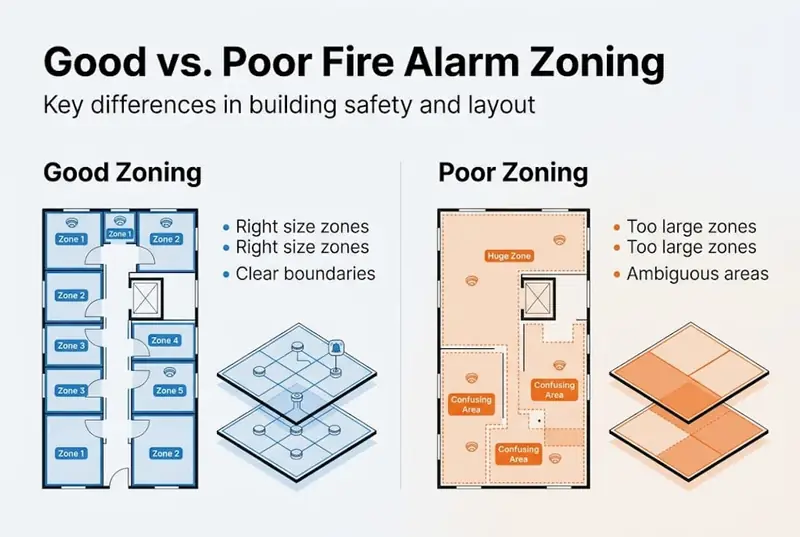
One of the most common compliance mistakes we see is missing or incorrectly oriented zone plans near the control panel. Zone plans are mandatory near control panels, and non-compliance is one of the top issues flagged during inspections. The plan must match the actual layout of the building and be oriented so that north on the diagram matches the building’s actual orientation.
Here’s a practical sequence for designing zones in a new or renovated property:
- Map every functional area and identify high-risk spaces first.
- Group detectors by logical physical boundaries, not just by wiring convenience.
- Assign separate zones to mechanical rooms, server rooms, and storage areas.
- Create evacuation zones that align with your emergency action plan.
- Post accurate, correctly oriented zone plans at every control panel location.
- Review the layout against your Houston zoning requirements before final sign-off.
Pro Tip: Walk your building with your zone map in hand before any inspection. If you can’t match every zone on the diagram to a physical space in under two minutes, your responders won’t be able to either.
Also review your fire alarm installation checklist to confirm that detector placement within each zone meets spacing and coverage requirements. A well-designed zone means nothing if the detectors inside it are poorly positioned.
Integration, advanced zoning, and life-saving strategies
Once basic zoning is understood, it’s time to explore how larger buildings use advanced zoning for even greater safety. Many property managers assume that upgrading to a modern addressable fire alarm system eliminates the need for traditional zoning. That’s a misunderstanding worth correcting.
Addressable systems can identify individual devices by exact location, which is a significant advantage. But even addressable systems retain zoning for quick indication, because zones provide the organizational framework that makes that device-level data actionable during an emergency. Knowing that detector 47B on floor 6 is in Zone 12, the east mechanical corridor, is far more useful than just knowing the device address.
For larger Houston properties, integration with a Building Management System (BMS) takes zoning to another level. A BMS can automatically trigger HVAC shutdowns, unlock stairwell doors, and alert security teams the moment a specific zone activates. That kind of coordinated response is only possible when zones are clearly defined and mapped into the BMS.
“Phased evacuation via zones saves lives in high-rises by moving occupants floor by floor rather than triggering a full building evacuation that creates dangerous crowding in stairwells.”
Phased evacuation is one of the most practical benefits of advanced zoning. Instead of evacuating an entire 30-story building when a detector triggers on floor 12, a phased plan evacuates floors 11, 12, and 13 first, then expands outward if needed. This reduces panic, prevents stairwell bottlenecks, and keeps people safer.
Here are advanced strategies that improve both safety and code compliance for complex properties:
- Integrate zone data with your BMS for automated emergency responses.
- Use phased evacuation protocols tied to specific zone triggers.
- Program zone-specific alerts to notify different response teams, such as security versus maintenance.
- Schedule quarterly zone tests to confirm every detector and notification device in each zone functions correctly.
- Review integrating fire alarm zones with your building’s other safety systems for a unified approach.
Pro Tip: If your building has a BMS, ask your fire alarm contractor whether your current zone map has been imported into it. Many buildings have both systems but they’re not actually talking to each other.
Exploring the full range of fire safety systems your building should have helps you see where zoning fits into a broader, layered protection strategy.
Practical steps: How to ensure fire alarm zoning compliance in Houston
Now that you understand the systems and strategies, here’s how to ensure your property stays compliant and safe. Compliance isn’t a one-time event. It’s an ongoing responsibility that falls squarely on the building owner and property manager.
Start by verifying your current zoning map. Pull the zone plan from your control panel and walk the building floor by floor. Confirm that every detector, pull station, and notification device is in the correct zone on the diagram. If the map hasn’t been updated since your last renovation or tenant change, it’s almost certainly inaccurate.
Here’s what inspectors will check during annual reviews:
- Zone plans posted at every control panel, correctly oriented and current.
- All detectors and devices functioning within their assigned zones.
- High-risk areas zoned separately from general occupancy spaces.
- Evacuation zone logic matching your written emergency action plan.
- Documentation of the last full zone test with results on file.
Common compliance failures that lead to fines include missing zone charts, zones that no longer reflect the building’s current layout after renovations, and detectors that have been added to a zone without updating the map. Zone plans must be correctly oriented and kept current, and non-compliance is a major issue flagged in Houston inspections.
Pro Tip: Treat your zone map like a living document. Every time a wall goes up, a tenant moves in, or a detector gets added, update the map the same week. Waiting until the next inspection creates gaps that inspectors will find.
For help with your detection system setup or to verify your current fire alarm zoning installation meets Houston code, working with a licensed local contractor is the most reliable path forward. Legal responsibility for zoning compliance rests with the building owner, but the right partner makes that responsibility manageable.
Why most fire alarm zoning plans fall short—and what Houston properties must do differently
Here’s the uncomfortable truth we see repeatedly: most zoning plans are designed to pass an inspection, not to actually work during a fire. There’s a real difference between those two goals.
Buildings that treat compliance as the finish line tend to have zone maps that are technically correct on paper but haven’t been walked or tested in years. Staff don’t know what the zones mean. Responders arrive and spend precious time orienting themselves to a diagram that doesn’t match what they’re seeing.
The properties that genuinely protect their occupants do three things differently. They review their zone maps every time the building changes. They train staff to understand what each zone covers and what to do when a specific zone triggers. And they work with contractors who understand the role fire alarms play in Houston buildings beyond just meeting minimum code requirements.
Code compliance is the starting line. Real safety is built through proactive design, regular reviews, and a team that actually understands the system protecting them.
Get expert fire alarm zoning help for your Houston property
Understanding zoning is the first step. Making sure your system is correctly designed, mapped, and compliant is the next one.

At Reliable Fire Protection, we work with Houston business owners and property managers to design, install, and verify fire alarm zoning systems that go beyond minimum code requirements. Whether you’re starting from scratch or auditing an existing system, our team brings local expertise and certified credentials to every project. Review our fire alarm system overview to understand what a complete system looks like, explore our Houston fire alarm solutions for your area, or browse our full range of fire protection services to find the right fit for your property.
Frequently asked questions
What exactly is a fire alarm zone?
A fire alarm zone is a defined area in a building monitored by specific detectors, helping responders quickly locate the source of an alarm. Detection zones and evacuation zones serve different but complementary roles in the overall system.
Why are zone plans required near fire alarm panels?
Zone plans near panels let responders identify which building zone has triggered, speeding up emergency response. Zone plans are mandatory at control panels and must reflect the building’s current layout.
How do zones in fire alarms affect evacuation?
Well-designed zones enable phased evacuations, guiding people safely from the most at-risk areas first rather than triggering a chaotic full-building exit. Phased evacuation via zones is especially critical in high-rise buildings.
Who is responsible for zoning compliance in a Houston building?
Building owners and property managers are responsible for maintaining current, correctly mapped fire alarm zoning for their property. Zone plans must be accurately maintained and updated after any structural or occupancy changes.
Recommended
- Fire Alarm Installation Guide for Houston Property Managers
- How to Choose Fire Alarm System for Houston Properties
- How to choose fire alarms for Houston properties: 5 steps
- Fire Alarm vs. Suppression: 40% Less Damage with Both
- Fire Alarm System University Place TX
- Fire Alarm System Services in Bellaire, TX