
What is a safety inspection checklist and why does it matter?
A safety inspection checklist is a structured tool that guides inspectors through a systematic review of workplace conditions, equipment, and practices to identify hazards before they cause injuries. Think of it as the difference between a pilot’s pre-flight rundown and a casual glance at the cockpit. One catches problems; the other hopes for the best.
These checklists serve three core functions: identifying hazards, verifying that controls are working, and creating a documented record that satisfies OSHA compliance requirements. Without a checklist, inspections tend to focus on whatever catches the eye that day, which means the same overlooked corner stays overlooked indefinitely.
The hazard types a thorough checklist covers include:
- Physical hazards: Unguarded machinery, fall risks, inadequate lighting, noise exposure
- Chemical hazards: Improper storage, missing Safety Data Sheets, inadequate ventilation
- Ergonomic hazards: Repetitive motion tasks, awkward lifting postures, poorly adjusted workstations
- Biological hazards: Exposure risks in healthcare, food processing, or outdoor work environments
- Fire and emergency hazards: Blocked exits, missing extinguishers, inoperative alarms
OSHA’s guidance is direct on this point: inspections should be integrated with injury logs and incident reports to identify root causes, not just visible conditions. A checklist that only captures what an inspector can see on a good day misses the patterns that injury data reveals.
Core components every safety inspection checklist needs
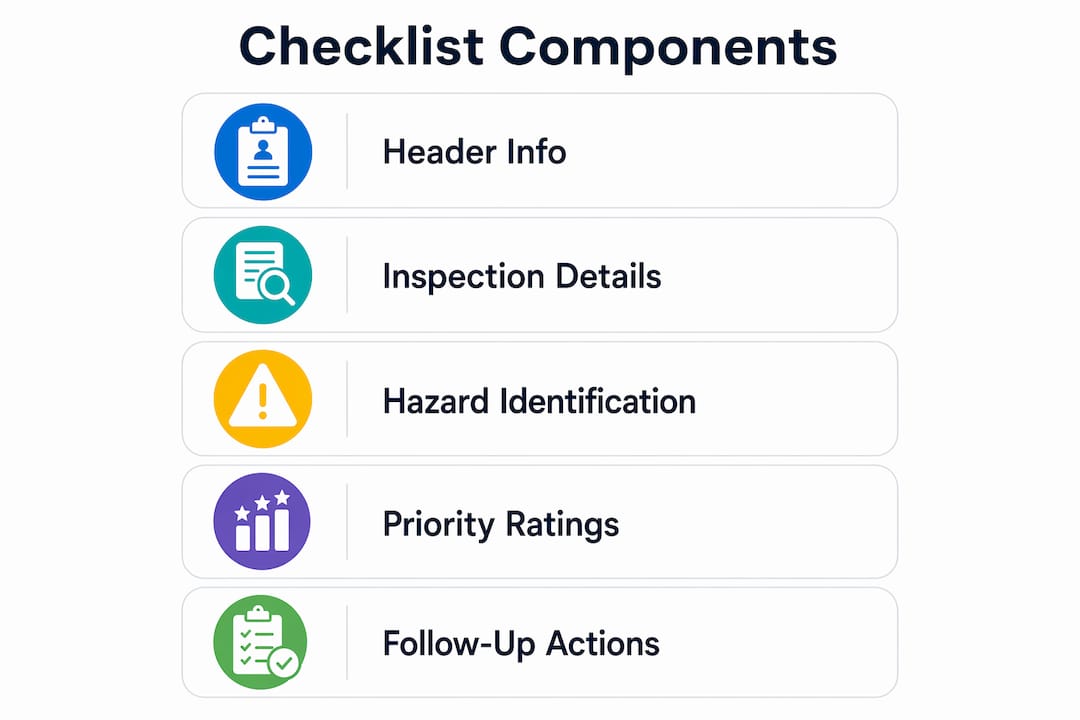
A well-built checklist does more than list things to look at. It captures who conducted the inspection, where and when, what was found, and what action is required. That structure turns a walkthrough into a defensible record.

| Checklist Component | What to Include |
|---|---|
| Header information | Inspector name, date, location, department, shift |
| Hazard identification items | Specific conditions to observe per area or task |
| Hazard control verification | Confirmation that existing controls are functioning |
| PPE compliance | Whether required equipment is available, worn, and in good condition |
| Emergency preparedness | Exit routes, alarm functionality, extinguisher status |
| Housekeeping and environment | Aisle clearance, spill management, lighting, signage |
| Corrective action fields | Space to note findings, assign owners, and set deadlines |
The format of individual checklist items matters more than most safety managers realize. Binary compliant/non-compliant fields reduce inspector subjectivity and produce cleaner data for trend analysis. Subjective scoring scales (“1 to 5”) introduce inconsistency across inspectors and make it harder to spot recurring problems over time.
Common categories to include in a general industry checklist:
- Walking surfaces and stairways: Guardrail heights, non-slip treads, aisle clearance
- Machine guarding: Belts, pulleys, and cutters guarded; lockout/tagout procedures in place
- Electrical safety: Exposed wiring, panel access, GFCI protection in wet areas
- Chemical storage: Proper labeling, secondary containment, SDS accessibility
- Emergency exits: Unobstructed paths, illuminated signage, doors operable from inside
- Fire protection: Extinguishers charged and mounted, sprinkler clearance maintained
Pro Tip: Leave blank lines at the bottom of each checklist section so inspectors can note conditions that do not fit any listed item. Hazards that fall outside the standard categories are often the ones that cause injuries.
How to prioritize hazards and set response timelines
Not every finding carries the same urgency, and treating them equally is how corrective action lists grow into unmanageable backlogs. A tiered priority system keeps the most dangerous conditions at the front of the line.
Industry best practices establish a clear framework:
- Immediate danger (imminent hazard): Work stops. Correct before resuming operations. Examples include exposed live electrical conductors, blocked emergency exits, or an unsecured load above workers.
- High risk: Must be resolved within 24–48 hours. These are conditions with a realistic probability of serious injury if left unaddressed.
- Medium risk: Should be corrected within 7–14 days. Conditions that pose a hazard but allow for a controlled corrective timeline.
- Low risk: Schedule for the next routine maintenance cycle, typically within 30 days.
OSHA’s own walk-around guidance reinforces this approach: all serious and recognized hazards get addressed immediately, while remaining hazards are prioritized for further control. The key is using a risk assessment matrix that weighs both the severity of a potential outcome and the likelihood of it occurring. A low-probability catastrophic event, like a structural failure, should never land in the low-priority bucket just because it has not happened yet.
Priority ratings also serve a practical management function. When you bring a hazard list to leadership and every item looks equally urgent, nothing gets funded. A tiered list with clear timelines gives decision-makers a framework for allocating resources, and it gives you a documented basis for follow-up when deadlines pass.
Inspection frequency, recordkeeping, and documentation
How often you inspect depends on the nature of the work. Construction sites require weekly inspections, while general industry typically schedules monthly or quarterly formal inspections supplemented by informal walkthroughs. Office environments with few machines may operate on a quarterly cycle; manufacturing floors with multiple processes warrant weekly reviews.
OSHA’s recordkeeping standard 29 CFR 1910.1020 requires employers to retain employee exposure records for at least 30 years and medical records for the duration of employment plus 30 years. Inspection records that document hazard exposure belong in that retention framework.
Documentation best practices for every inspection:
- Record the inspector’s name, credentials, and the date and time of the inspection
- Note exact locations of findings, not just general areas (“northwest corner of Bay 3,” not “the warehouse”)
- Attach timestamped photos to each finding to prevent disputes and support resource requests
- Log corrective actions with an assigned owner and a specific deadline
- File completed checklists where they are accessible for OSHA review and internal audits
Pro Tip: Photographic documentation linked to specific checklist items does more than clarify what was found. When you need budget approval for a repair, a photo of the actual condition is far more persuasive than a written description.
Training staff to use the checklist correctly is as important as the checklist itself. Inspectors who do not understand what they are looking for will mark items compliant by default. A brief orientation covering the purpose of each checklist category, how to document findings clearly, and what triggers an immediate stop-work call takes less than an hour and dramatically improves data quality.
Best practices for managing and updating your checklists
A checklist written in 2020 and never touched since is a liability, not a tool. The best checklists are living documents reviewed and updated at least annually, and immediately after any incident, near-miss, or regulatory change.
Practical update triggers to build into your program:
- After any incident or near-miss: Add checklist items that would have caught the condition
- After equipment changes or new processes: Retire items that no longer apply; add ones that do
- After OSHA standard updates: Cross-reference your checklist against revised requirements
- After a failed inspection: Identify which checklist items were absent or unclear
Customizing checklists for specific environments is not optional in high-hazard industries. A generic industrial safety checklist applied to a chemical processing facility will miss dozens of relevant conditions. Industry trade associations often publish sector-specific checklist templates that reflect the common hazards in that environment, and they are a faster starting point than building from scratch.
Pilot testing a revised checklist with two or three experienced inspectors before rolling it out catches ambiguous items before they produce inconsistent data. If three inspectors mark the same item differently, the item is not clear enough.
Pro Tip: Rotating inspectors between departments gives a fresh perspective that catches hazards regular occupants have stopped noticing. The tradeoff is additional training time, but the hazard detection improvement is worth it.
Fire safety inspection checklist essentials for US commercial properties
Fire safety inspections carry specific compliance obligations under OSHA fire safety regulations and local fire codes, and the stakes for non-compliance are high. A missed item on a fire safety checklist is not just a paperwork problem.
Core elements every commercial fire safety checklist must cover:
- Fire alarm systems: Test functionality, verify audibility throughout the building, check battery backup
- Fire extinguishers: Confirm monthly visual checks, annual service tags, correct type for the hazard class, and unobstructed mounting locations
- Suppression systems: Verify sprinkler head clearance (minimum 18 inches below heads), check control valve positions, confirm last service date
- Emergency exits: Confirm all exit doors open from the inside without a key, exit signs are illuminated, and paths are completely clear
- Emergency lighting: Test battery-operated units, verify coverage of all exit routes
- Fire suppression for special hazards: Kitchen hood systems, server room suppression, and similar specialized systems require separate verification
The difference between a compliant and non-compliant checklist entry is specificity. Compare these two:
| Non-Compliant Entry | Compliant Entry |
|---|---|
| “Fire extinguisher checked” | “Extinguisher at Station 4 (ABC, 10 lb): pressure gauge in green, tag dated March 2026, mounting bracket secure, access unobstructed” |
| “Exit signs OK” | “Exit sign above north stairwell door: illuminated, battery backup tested, no obstructions within 10 feet” |
| “Sprinklers inspected” | “Sprinkler heads in Bay 2: no paint, corrosion, or physical damage; 18-inch clearance maintained; control valve locked open” |
For Houston commercial properties, local fire codes layer additional requirements on top of federal OSHA standards. A fire safety inspection checklist built for the Houston market accounts for both sets of requirements. Reliable-fire-protection works with commercial clients across Houston to conduct thorough fire safety inspections and document findings in a format that satisfies both OSHA and local fire marshal requirements.
Statistic callout: OSHA requires that fire extinguishers be visually inspected monthly and receive a full maintenance check annually, per 29 CFR 1910.157. Missing either creates a citable violation.
How to respond to identified hazards after an inspection
The most common failure in inspection programs is not the inspection itself. It is what happens after. Each finding needs a corrective action record with a unique tracking ID, an assigned owner, a deadline, and a verification step confirming the fix actually worked.
A practical post-inspection response workflow:
- Triage findings by priority level immediately after the inspection, before leaving the site
- Issue stop-work for imminent hazards and notify the responsible supervisor in writing
- Assign corrective actions with a named owner for each finding, not a department or a team
- Set deadlines aligned to the priority tier: immediate, 24–48 hours, or 7–14 days
- Track open items in a centralized log, not a spreadsheet buried in someone’s inbox
- Verify completion by physically confirming the fix, not just accepting an email that says it is done
- Close the loop by updating the inspection record with the corrective action date and verifier’s name
The action gap, where findings get logged but never resolved, is where inspection programs lose credibility with workers and regulators alike. When employees report hazards and see nothing change, they stop reporting. That silence is far more dangerous than any single unresolved finding.
For fire-related findings specifically, Reliable-fire-protection provides fire detection response guidance that helps safety managers understand urgency thresholds for alarm and suppression system deficiencies.
Which tools and technology help you conduct better inspections?
Paper checklists work, but they create friction at every step: transcribing field notes, attaching photos, tracking corrective actions, and generating reports. Mobile inspection apps eliminate most of that friction.
The core capabilities to look for in any inspection platform:
- Mobile data entry with offline functionality for areas without reliable connectivity
- Photo capture directly linked to checklist items, with automatic timestamps and GPS tagging
- Corrective action workflows that assign owners, set deadlines, and send automated reminders
- Reporting and trend analysis that surfaces recurring findings across locations or time periods
- Integration with OSHA 300 logs and incident reporting systems
Enterprise-level platforms typically add features like multi-site dashboards, role-based access, and API connections to existing EHS management systems. Entry-level field apps cover the basics at lower cost and are often sufficient for single-location operations.
OSHA’s own Hazard Awareness Advisor is a free online tool that generates a customized hazard report based on your workplace activities and equipment. It is a useful starting point for building or auditing a checklist, particularly for smaller operations without a dedicated EHS team.
Whatever platform you choose, the technology should serve the checklist, not replace it. A well-designed digital form still requires a trained inspector who knows what to look for.
Legal implications and liabilities tied to inspection documentation
Inspection records are legal documents. How you document findings, and what you do with them afterward, directly affects your exposure in the event of an OSHA citation, a workers’ compensation claim, or personal injury litigation.
Key legal considerations every compliance officer should understand:
- Documented knowledge creates duty to act. Once a hazard appears in an inspection record, you have established that the employer knew about it. Failure to correct it within a reasonable timeframe strengthens any negligence claim.
- OSHA citation history follows you. Repeat violations carry significantly higher penalties than first-time citations, and OSHA reviews prior inspection records when determining violation classification.
- Incomplete records can be worse than no records. A checklist that shows an item was marked compliant when it was not creates a paper trail of negligence, not compliance.
- Corrective action documentation is your defense. A complete record showing a hazard was identified, assigned, corrected, and verified demonstrates good faith and due diligence, which courts and OSHA both weigh favorably.
- Retention matters. OSHA’s 30-year retention requirement for exposure records means inspection documentation tied to chemical or noise hazards must be preserved accordingly.
The practical takeaway: treat every inspection record as if it will be reviewed by an OSHA compliance officer or a plaintiff’s attorney. That standard of documentation protects workers and the organization simultaneously.
For fire safety specifically, a commercial fire alarm inspection that is properly documented and followed up creates a defensible compliance record. Reliable-fire-protection provides inspection services with full documentation packages for Houston commercial clients who need that level of accountability.
Key Takeaways
A safety inspection checklist is only as effective as the corrective action process it triggers: documented findings without assigned owners and verified fixes create liability, not compliance.
| Point | Details |
|---|---|
| Tiered hazard response | Immediate hazards stop work; high-risk findings must be resolved within 24–48 hours; medium-risk findings should be corrected within 7–14 days, in line with industry best practices. |
| OSHA retention requirements | Employee exposure records must be kept for at least 30 years under 29 CFR 1910.1020. |
| Living document standard | Review and update checklists at least annually and after every incident or regulatory change. |
| Corrective action ownership | Each finding needs a named owner, a deadline, and a physical verification step to close the loop. |
| Photo documentation | Timestamped photos attached to findings prevent disputes and support management resource requests. |