
TL;DR:
- Most enclosed storage buildings require sprinklers where code triggers apply, plus detection, extinguishers, and water access. Early AHJ consultation helps ensure compliance with local standards and avoids costly redesigns during construction.
For most enclosed public storage buildings, the priority stack is this: automatic sprinklers where IBC/IFC Section 903.2.9 triggers apply, addressable fire detection integrated with a supervising station; portable ABC extinguishers in common areas per NFPA 10; verified water supply and fire-apparatus access; and operational controls covering tenant commodities, housekeeping, and staff training. The governing standards are NFPA 13 (sprinkler design), NFPA 25 (sprinkler inspection), NFPA 72 (alarm systems), and the International Fire Code (IFC/IBC), but your local Authority Having Jurisdiction (AHJ) has final say on which edition is adopted and what local amendments apply.
- Confirm which IFC/IBC edition your jurisdiction has adopted before any design work begins.
- Identify your Group S-1 fire area square footage and aggregate area across the site.
- Document the commodity mix tenants store, especially mattresses, upholstered furniture, and plastics.
- Verify water supply capacity and hydrant locations relative to the building footprint.
- Contact Reliable-fire-protection or a licensed contractor for a site survey before your AHJ meeting.
Pro Tip: Bring facility floor plans, measured square footage by fire area, hydrant locations, and a sample commodity list to your first AHJ meeting. Inspectors move faster when you show up prepared.
Table of Contents
- What codes actually require for storage facility fire protection
- Which systems to install and why
- Operational controls that cut fire risk and keep systems working
- Inspection, testing, and maintenance schedules you must follow
- How to plan and budget a retrofit or new installation
- Where systems and operations most often fail
- Realistic cost ranges and project timelines
- Key Takeaways
- Why the AHJ meeting should come before the contractor call
- Reliable-fire-protection covers storage facility projects from survey to sign-off
- Authoritative references to bring to your AHJ meeting
What codes actually require for storage facility fire protection
The primary framework is IBC/IFC Chapter 9 and NFPA 13, adopted in some form by virtually every U.S. jurisdiction. Your AHJ, typically the local fire marshal, interprets the adopted edition and can impose stricter requirements than the model code. That is why early AHJ consultation is not optional.
Under IBC Section 903.2.9, automatic sprinklers are required for Group S-1 storage occupancies when any of these conditions exist:
- A single fire area exceeds the maximum area specified by code
- The aggregate area across the building exceeds the maximum combined area specified by code
- The building exceeds a few stories in height
- The facility’s predominant use is storage of upholstered furniture or mattresses and the area exceeds the threshold specified by code (note: a state-level interpretation has clarified this threshold does not apply to typical self-storage where such items are stored only incidentally)
Some jurisdictions adopt NFPA 1 or local amendments that set lower thresholds. UpCodes notes that certain code versions require self-service storage facilities to install sprinklers throughout as Ordinary Hazard Group 2 under NFPA 13, regardless of area. Verify the adopted local edition with your AHJ.
IFC Appendix D governs fire-apparatus access. Dead-end access roads are limited to 150 feet, minimum gate widths apply, and buildings exceeding 62,000 sq ft require separate access roads (with a sprinkler exception extending that threshold to 124,000 sq ft for fully sprinklered buildings). These metrics affect site design and whether the AHJ will grant any sprinkler exceptions.
Sprinkler installation runs approximately $2.50–$3.00 per sq ft as a baseline estimate. Verify with local bids — dry-pipe systems, high ceilings, and high-hazard commodities all push costs higher.
Minimum documents to bring to your AHJ meeting: site plan with fire area boundaries marked, total and per-area square footage, commodity examples, hydrant locations, and any existing system drawings. A fire marshal consultation early in the process can prevent costly redesigns later.
Which systems to install and why
For most enclosed storage buildings that hit code triggers, the required system stack is NFPA 13-compliant sprinklers, addressable detection connected to a supervising station, and NFPA 10 portable extinguishers in common areas. Here is how each layer fits together:
| System | Primary Purpose | Typical Trigger |
|---|---|---|
| NFPA 13 wet-pipe sprinklers | Automatic fire control at stored goods | S-1 area thresholds (IBC 903.2.9) |
| NFPA 13 dry-pipe sprinklers | Same, for unheated drive-up units | Unheated spaces where wet-pipe would freeze |
| Addressable fire alarm/detection | Early warning, zone-level identification | NFPA 72; required when sprinklers are required |
| Portable ABC extinguishers | First-response suppression in common areas | NFPA 10 portable extinguishers in common areas |
| Backflow preventer | Protects municipal water supply | Required at sprinkler system connection |
| Fire department connection (FDC) | Allows fire department to supplement system | Required with sprinkler installation |
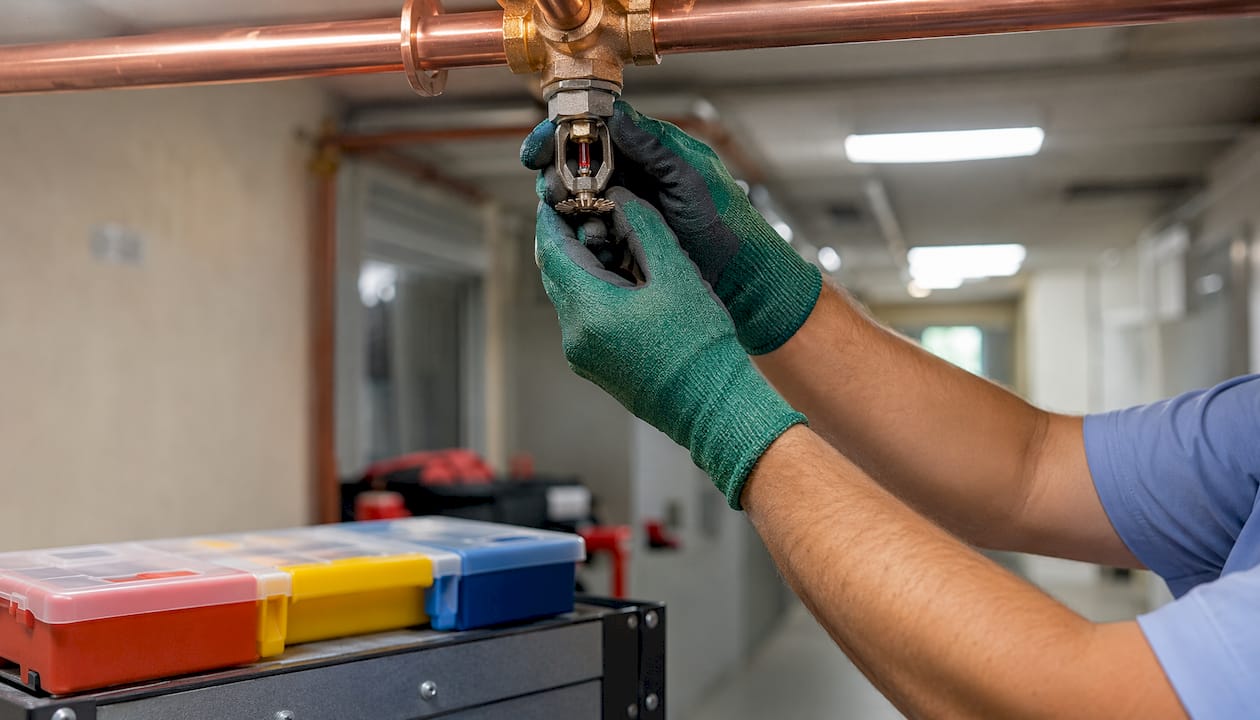
NFPA 13 dedicates specific chapters to miscellaneous storage, palletized and rack storage, and plastic/rubber commodities. The chapter that applies to your facility depends on how tenants actually use their units, which directly affects sprinkler density and pipe sizing.
Wet-pipe systems are standard for climate-controlled enclosed buildings. Drive-up units without heat require dry-pipe or antifreeze systems. Backflow preventers protect the municipal water supply at the system connection point and are required in most jurisdictions.
Pro Tip: Tell your contractor whether the design should assume ordinary-hazard storage or a higher hazard density. If tenants store expanded plastics or bulk rubber goods, commodity classification can shift the design from ordinary to extra-hazard, changing pipe sizing and cost significantly.
Operational controls that cut fire risk and keep systems working
Operational failures, not hardware gaps, are the most common cause of fire-protection breakdowns in storage facilities. Unauthorized hazardous storage, blocked equipment, and untrained staff create conditions where even a well-designed system cannot perform.
Implement these controls immediately:
- Prohibited commodities policy: Ban compressed gas cylinders, lithium-ion battery banks, flammable liquids, and bulk plastics from tenant units. State this explicitly in the lease.
- Tenant declaration: Require tenants to declare commodity types at move-in; flag high-fuel-load items for a manager review.
- Signage: Post visible “No Flammable Storage” and extinguisher-location signs at every corridor entry.
- Common-area inspections: Walk corridors weekly to confirm extinguishers are unobstructed and sprinkler heads have 18 inches of clearance below them.
- Control room access: Lock sprinkler control valves and alarm panels; limit key access to trained staff only.
A lease clause example: “Tenant shall not store flammable liquids, compressed gases, lithium batteries in bulk, or any commodity classified as high-hazard under NFPA 13 without prior written approval from management. Violation constitutes grounds for immediate termination of the rental agreement.”
Staff training should cover extinguisher operation (PASS technique), alarm response and evacuation procedures, and how to locate and manually close a sprinkler control valve in an emergency. Staff fire emergency training is often the fastest gap to close.
Pro Tip: Schedule a joint site walk with your AHJ or fire inspector after drafting your commodity policy. Informal buy-in before a formal inspection saves time and avoids surprise violations.
Inspection, testing, and maintenance schedules you must follow
NFPA 25 governs sprinkler inspection and testing, NFPA 72 covers alarm systems, and NFPA 10 sets extinguisher service intervals. Missing any of these creates both a compliance gap and a real operational risk.
| Interval | Sprinklers (NFPA 25) | Alarms (NFPA 72) | Extinguishers (NFPA 10) |
|---|---|---|---|
| Weekly | Visual check of control valves | — | — |
| Monthly | — | Supervisory signal test | Visual inspection |
| Quarterly | Alarm valve, waterflow | Smoke detector sample | — |
| Annual | Full flow test, inspector’s test valve | Full system test | Annual service tag |
| 5-Year | Internal pipe inspection | — | — |
| 6-Year | — | — | Internal examination |
| 12-Year | — | — | Hydrostatic test |
Required recordkeeping: inspection tags on each device, written contractor reports after every test, and a corrective-action log showing how deficiencies were resolved and when. Retain records for a minimum of three years, or longer if your AHJ requires it. Keep a sprinkler maintenance log accessible on-site for AHJ review.
Pro Tip: Designate one staff member as the inspection coordinator. That person schedules contractors, collects reports, and keeps the log binder ready for AHJ visits. Without a single owner, inspection records go missing.
How to plan and budget a retrofit or new installation
Start by confirming whether your facility hits any IBC/IFC sprinkler triggers. If a threshold is borderline, request a written code interpretation from the AHJ before spending on engineering.
Step-by-step implementation checklist:
- Measure all fire areas and document aggregate square footage.
- Meet the AHJ with plans, commodity list, and hydrant locations.
- Request a written code interpretation if any trigger is borderline.
- Hire a licensed fire protection engineer for system design.
- Submit permit application with engineered drawings.
- Develop a phased installation plan to minimize tenant disruption.
- Complete installation and schedule commissioning inspection.
- Obtain final AHJ sign-off and update your preplan documents.
| Project Stage | Typical Duration |
|---|---|
| Site survey and design | 2–4 weeks |
| Permit review and approval | 3–8 weeks |
| Sprinkler installation | 2–6 weeks (varies by size) |
| Detection system installation | 1–3 weeks |
| Commissioning and final inspection | 1–2 weeks |
The $2.50–$3.00 per sq ft baseline applies to standard wet-pipe systems in typical enclosed storage. Dry-pipe systems, high ceilings above 20 feet, high-hazard commodity classifications, and hydrant upgrades can push total installed cost well above that range. Budget separately for permit fees, engineering fees, commissioning, and any temporary business disruption during installation.
Where systems and operations most often fail
The top failure modes in storage facilities, ranked by frequency and impact, are obstructed sprinkler heads, disabled or closed control valves, blocked extinguishers, and unauthorized hazardous storage.
- Obstructed sprinkler heads: Tenants or staff stack goods too close to ceiling heads. Prevention: enforce an 18-inch clearance rule and check it on every corridor walkthrough.
- Closed or tampered control valves: A valve left closed after maintenance is the single most common reason a sprinkler system fails to operate. Prevention: install tamper switches on all control valves and supervise them through the alarm panel.
- Blocked extinguishers: Carts, boxes, and signage drift in front of extinguisher cabinets. Prevention: paint floor zones around each cabinet and include them in weekly patrols.
- Unauthorized hazardous storage: Tenants bring in lithium battery banks, propane cylinders, or bulk plastics without disclosure. Prevention: periodic unit audits (with lease-permitted right of entry) and a clear written policy.
A documented pattern in storage-facility fire incidents: fires that spread beyond a single unit almost always involve one of three conditions — a sprinkler system that was shut off or impaired, a commodity load far higher than the system was designed for, or a fire that started in an area with no sprinkler coverage at all. The hardware was present; the operational controls were not. (Fire Engineering)
Pro Tip: Pair weekly walkthroughs with a simple CCTV alert tied to the control-valve room. Any unauthorized access to the sprinkler valve room should trigger an immediate notification to the manager on duty.
Realistic cost ranges and project timelines
Typical sprinkler retrofit baseline is $2.50–$3.00 per sq ft for a standard wet-pipe system in an enclosed storage building. That number climbs fast with complexity.
| Item | Typical Range |
|---|---|
| Sprinkler retrofit (wet-pipe, standard) | $2.50–$3.00/sq ft |
| Dry-pipe system premium | Add $1.00–$2.00/sq ft |
| Addressable detection (per device) | $150 installed |
| Hydrant/FDC upgrade | $5,000–$20,000+ depending on site |
| Permit and engineering fees | Costs vary depending on jurisdiction |
Small projects under 12,000 sq ft can move from permit to commissioning in 8–12 weeks when the AHJ review is straightforward. Larger retrofits with phased installation and hydrant upgrades routinely run 6–9 months. Insurance carriers often reduce property premiums after a compliant sprinkler system is installed, which offsets a portion of the capital cost over time. The long-term ROI of suppression systems is well-documented for commercial properties.
Pro Tip: Bundle detection and sprinkler work into one contract. A single contractor coordinating both trades reduces scheduling gaps, cuts total project time, and gives you one point of accountability for commissioning.
Key Takeaways
Effective fire protection for public storage facilities requires sprinklers where code triggers apply, addressable detection, properly placed extinguishers, verified water access, and consistent operational controls enforced through tenant policy and staff training.
| Point | Details |
|---|---|
| Sprinkler triggers | IBC 903.2.9 requires sprinklers when fire area exceeds code maximums or aggregate area thresholds specified by code. |
| Baseline retrofit cost | Wet-pipe sprinkler installation runs $2.50–$3.00/sq ft; dry-pipe and high-hazard designs cost more. |
| Inspection compliance | NFPA 25, NFPA 72, and NFPA 10 set mandatory intervals; keep written records on-site for AHJ review. |
| Operational controls | Commodity policies, weekly patrols, and staff training prevent the most common fire-protection failures. |
| Reliable-fire-protection | Provides site surveys, sprinkler design and installation, alarm systems, and ongoing inspection services for storage facilities. |
Why the AHJ meeting should come before the contractor call
Most managers call a contractor first and the AHJ second. That order creates problems. The AHJ can require design changes after a permit is submitted, which means paid engineering work gets revised or scrapped. A 30-minute pre-application meeting with the fire marshal, with floor plans in hand, surfaces those requirements before a dollar is spent on design.
There is also a subtler issue with commodity classification. A facility that opens as a standard self-storage operation can drift into higher-hazard territory as tenants move in. One unit storing bulk lithium batteries or a pallet of expanded foam changes the hazard profile for the entire fire area. The sprinkler system designed for ordinary-hazard storage may not perform adequately against that load. Operational controls are not a soft add-on; they are what keeps the installed system matched to the actual risk.
The facilities that pass AHJ inspections cleanly share one trait: they treat fire protection as an ongoing operational discipline, not a one-time construction item. Weekly walkthroughs, a designated inspection coordinator, and a lease that actually prohibits hazardous goods are worth more than the most expensive suppression system installed in a facility with no one watching it.
Reliable-fire-protection covers storage facility projects from survey to sign-off
Storage facility managers in the Houston area need a contractor who understands both the code triggers and the operational realities of self-storage. Reliable-fire-protection handles the full scope: site surveys, code interpretation support, sprinkler system design and installation, addressable fire alarm systems, backflow preventers, extinguisher service, and ongoing inspection and maintenance contracts.
Services most relevant to storage facility managers:
- Sprinkler system design, installation, and commissioning (wet-pipe and dry-pipe)
- Addressable fire alarm systems and monitoring integration
- Portable extinguisher supply, placement, and annual service
- Backflow preventer installation and testing
- NFPA 25, NFPA 72, and NFPA 10 inspection and maintenance contracts
- 24/7 emergency response for system impairments
Request a free site survey or quote at reliable-fire-protection.com. Reliable-fire-protection’s team will assess your facility’s square footage, commodity mix, and current system status, then give you a clear scope and cost estimate you can bring to your AHJ meeting.
Authoritative references to bring to your AHJ meeting
Bring printed, highlighted copies of the relevant code sections to every AHJ meeting. Inspectors respond well to managers who have done the reading.
- IBC/IFC Section 903.2.9: The primary sprinkler trigger for Group S-1 occupancies, including area thresholds and the mattress/upholstered furniture provision.
- NFPA 13 (current adopted edition): Sprinkler system design standard, including Chapters 13–17 for storage occupancies and commodity classification tables.
- NFPA 25: Inspection, testing, and maintenance requirements for water-based fire protection systems.
- NFPA 72: National Fire Alarm and Signaling Code; governs detection system testing and documentation.
- NFPA 10: Standard for portable fire extinguishers, including placement, travel distance, and service intervals.
- IFC Appendix D: Fire-apparatus access road requirements, dead-end limits, gate widths, and aerial access metrics.
- Facility preplan documents: Sprinkler coverage maps, wet vs. dry pipe designation, alarm panel locations, and FDC locations per Fire Engineering preplanning guidance.
Local amendments vary significantly. Always confirm the adopted code edition and any local amendments with your AHJ before relying on any model-code citation. A provision that applies in one jurisdiction may be amended or replaced in the next county.