

TL;DR:
- Proper fire safety documentation is essential for legal compliance, accountability, and effective emergency management. Maintaining complete, organized records—such as inspection logs, system designs, and training certificates—ensures readiness during inspections and mitigates liabilities. Adhering to local fire codes and NFPA standards helps Houston property owners keep vital documentation accessible, up-to-date, and operationally useful.
Most Houston business owners and property managers treat fire safety documentation as a necessary evil: a stack of papers to produce during inspections, then file away and forget. That assumption leads to real consequences. Failed audits, six-figure fines, voided insurance claims, and genuine safety disasters trace back to incomplete or outdated records more often than most people realize. This guide explains which documents your property must maintain, how Houston’s adopted fire code interacts with NFPA standards, and what best practices will protect your business when an inspector shows up unannounced.
Table of Contents
- Why fire safety documentation matters for compliance and safety
- Key types of fire safety documentation Houston properties need
- How fire codes and NFPA standards control documentation—and what Houston enforces
- Best practices for maintaining fire safety documentation
- The overlooked reality: Why most properties fail fire documentation audits
- Simplify compliance and safety with expert help
- Frequently asked questions
Key Takeaways
| Point | Details |
|---|---|
| Proves compliance | Accurate fire safety documentation demonstrates you meet Houston’s legal and code requirements. |
| Assigns accountability | Clear records ensure staff know their roles and inspectors can verify responsibilities. |
| Supports real safety | Documented routines make emergency actions repeatable for staff and occupants, not just theoretically compliant. |
| Local code prevails | Always follow Houston’s adopted fire code when retention rules differ from referenced NFPA standards. |
| Must be accessible | Keep documentation organized and ready for inspection or emergency review, not just filed away. |
Why fire safety documentation matters for compliance and safety
Fire safety documentation is not a formality. It is the mechanism that connects your safety systems to the people responsible for using them, testing them, and fixing them. When something goes wrong, an inspector or attorney will ask for the paper trail first.
The National Fire Sprinkler Association explains that fire safety records such as plans, risk assessments, inspection, testing, and maintenance logs, training records, and system documentation are used to demonstrate due diligence, assign accountability, and provide a verifiable history that inspectors and Authorities Having Jurisdiction (AHJs) can review during audits or enforcement actions.
Think about what that means practically. If a sprinkler head fails during a fire and your records show the system was never tested on schedule, liability shifts dramatically in the wrong direction. Good documentation builds a defensible record that shows you did everything required by law and industry standards.
Documentation also structures your day-to-day operations. According to WPS Evacuation specialists, documentation for emergency operations such as evacuation procedures, assigned roles and responsibilities, drill records, and post-incident communication logs turns regulatory requirements into repeatable, practiced procedures for your staff and building occupants.
Here is what strong fire safety documentation accomplishes for your Houston property:
- Proves legal compliance with Houston’s adopted fire code and referenced NFPA standards
- Assigns clear responsibility so staff know exactly what to do and when
- Creates an auditable trail that protects you during incident investigations
- Converts static safety plans into living operational tools that staff actually use
- Enables efficient annual reviews and fast updates when systems change
Poor documentation, on the other hand, leads to failed inspections, reinspection fees, potential shutdown orders, and increased liability exposure. Review your fire alarm checklist steps and your overall inspection guide for Houston properties to see exactly how documentation fits into each phase of system verification.
“Documentation transforms a compliance checkbox into an operational asset that keeps buildings, staff, and occupants safer every day.”
Now that you see documentation is more than a formality, let’s explore what kinds of documents you actually need to maintain.
Key types of fire safety documentation Houston properties need
Houston properties operate under a layered documentation framework. Each type of system, each stage of its life, and each type of event generates its own required record. Missing even one category is enough to trigger a violation.
The table below summarizes the major document categories, the governing standard, and general retention guidance.
| Document type | Governing standard | Who maintains it | General retention |
|---|---|---|---|
| ITM records for water-based systems | NFPA 25 | Building owner or manager | Per adopted fire code (typically 3+ years) |
| Fire alarm design and installation records | NFPA 72 Chapter 7 | Installing contractor and owner | Life of system for acceptance docs |
| Acceptance test records | NFPA 72 and NFPA 25 | Owner with contractor copy | Life of system |
| Training logs and drill records | Local fire code | Designated fire safety officer | Per adopted code cycle |
| Occupant notification and evacuation plans | Local fire code | Building owner | Current version always available |
| Maintenance work orders and repair records | NFPA 25 / NFPA 72 | Owner or contractor | Per adopted fire code |
For water-based fire protection systems, NFPA 25 ITM recordkeeping requires that all inspection, testing, and maintenance work be recorded at the required frequencies and remain available for AHJ review. The jurisdiction’s adopted fire code, often the International Fire Code (IFC) in Houston area municipalities, can also affect how long you need to keep those records and where they must be stored.

For fire alarm systems, NFPA 72 Chapter 7 sets out a minimum required documentation list that changes by project stage, covering design documents, installation records, testing reports, and ongoing record maintenance. The standard applies specifically where required by governing laws, codes, or standards, which means your local AHJ determines enforcement.
Pro Tip: Ask your fire protection contractor to provide a documentation package at the end of every inspection or installation visit. This should include the completed test report, a copy of the as-built drawings if anything changed, and a signed service record. Store these digitally and in a labeled physical binder at the property.
Additional document types that Houston properties frequently overlook include:
- Impairment records when systems are taken offline for repair or construction
- Hot work permits for welding or cutting near fire protection systems
- Change-of-use notifications when building occupancy or layout shifts
- Contractor credentials verifying that the service technician is properly certified
Refer to the fire alarm installation guide for a detailed breakdown of alarm-specific documents, and review the sprinkler system inspection resource to see how ITM documentation works for water-based systems.
Knowing what documents to keep is crucial. Now let’s look at how different standards and local codes affect your documentation responsibilities.
How fire codes and NFPA standards control documentation—and what Houston enforces
Many property managers assume that following NFPA standards is all they need. Not quite. NFPA standards are model codes referenced by your local jurisdiction, but Houston’s adopted fire code controls what is actually enforceable on your property.
The NFSA clarifies that documentation timelines and retention rules come from both the adopted fire code and the referenced standards. The adopted fire code makes recordkeeping and access rules enforceable, and it can override differences in retention periods found in the NFPA standards themselves.
Here is a simplified comparison of how the two frameworks approach documentation:
| Documentation element | IFC-based adopted code (common in Houston area) | NFPA 25 standalone requirement |
|---|---|---|
| ITM record retention | Minimum 3 years, on premises or approved location | Records available for AHJ review; duration varies |
| Acceptance test records | Life of the system | Life of the system |
| Availability for inspection | Must be on premises or easily accessible | Must be available to AHJ on request |
| Enforcement mechanism | Local fire marshal or AHJ | Referenced through adopted code |
| Responsible party | Building owner or designated manager | Building owner or occupant |
The practical takeaway is this: when NFPA 25 and your local adopted code give different instructions, the local code wins. This is why working with a Houston-based fire protection company that understands local enforcement priorities gives you a significant advantage over relying solely on national standards documents.
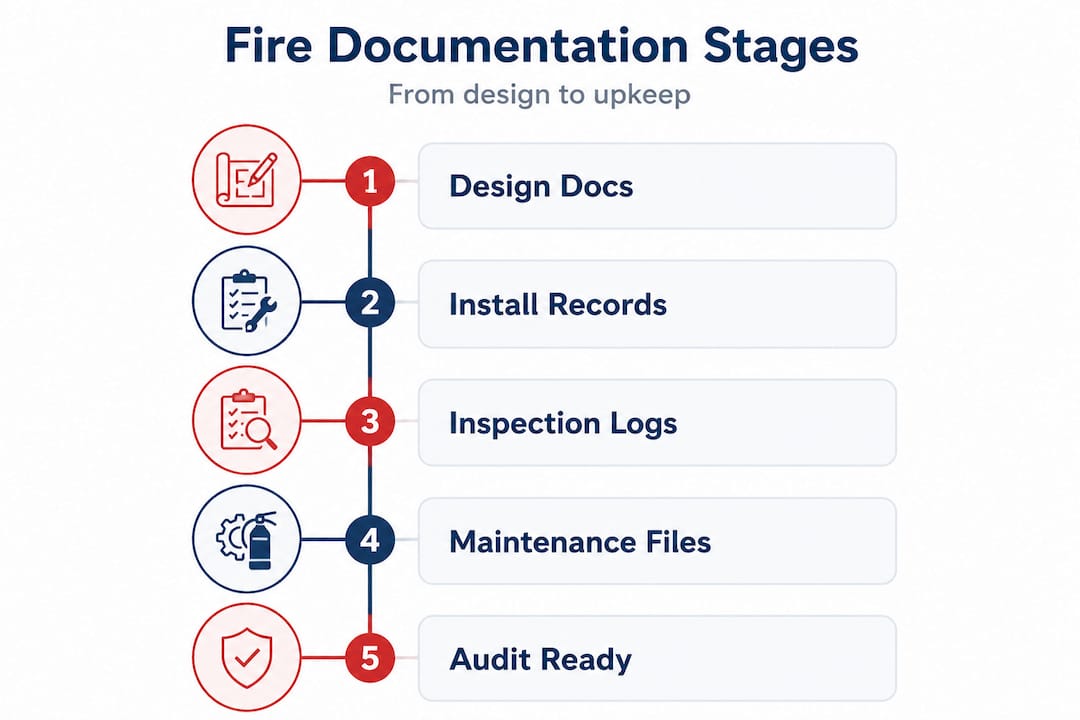
Stage-specific documentation is especially important. Design documents capture what was planned. Installation records capture what was actually built. Acceptance tests verify it all works. Maintenance records prove it stays working. Each stage has distinct requirements, and gaps at any stage create compliance exposure.
Pro Tip: Ask your city’s fire marshal office which edition of the IFC or local fire ordinance is currently adopted. Houston-area municipalities do not all adopt the same code edition simultaneously, so the specific retention and access rules may vary depending on whether your property sits inside Houston city limits or in a nearby suburb.
For a broader look at how residential and commercial requirements differ, see NFPA vs fire code differences, and review the sprinkler compliance workflow to see how the code layers work for water-based systems specifically.
Now that you understand the baseline and nuances of what the law requires, let’s cover practical tips for maintaining and organizing essential documentation.
Best practices for maintaining fire safety documentation
Even property managers who understand what documents are required frequently fall short on how they manage those documents over time. Knowing what to keep is only half the battle. Organization, accessibility, and consistent updating are what make your records genuinely useful.
Follow these steps to build a documentation system that holds up under a surprise inspection:
- Create a central documentation file. Whether physical or digital, every property should have one designated location for all fire safety records. Separate folders or tabs for alarms, sprinklers, extinguishers, training, and evacuation plans keep things retrievable fast.
- Assign a documentation owner. One person should be responsible for updating records after every inspection, drill, or system change. Without a named owner, records stagnate.
- Schedule an annual review. WPS Evac’s building-owner compliance framework treats the fire safety plan as a living document that needs annual review, documented fire drills, and updated contact and building information. Set a calendar reminder every year, and do not skip it.
- Verify retention schedules. Cross-check your record-keeping timeline against both the adopted local fire code and the relevant NFPA standard. When they differ, follow the longer retention period to stay on the safe side.
- Document every drill. Record the date, the building areas covered, the number of participants, any issues observed, and corrective actions taken. Drill records are one of the first things a fire marshal requests.
- Keep contractor credentials on file. Every technician who services your fire protection systems should be certified. Retain copies of those credentials alongside the service records they generate.
- Update records after any system modification. If a tenant buildout adds a new sprinkler zone or a fire alarm panel is upgraded, the as-built drawings and acceptance test reports must be updated immediately.
“A fire safety file that cannot be located within three minutes during an inspection is functionally useless, regardless of how complete it might be.”
A very common mistake is keeping only the most recent inspection certificate and discarding previous records. Historical documentation matters. It shows a pattern of compliance over time, which is exactly what an AHJ wants to see during an enforcement review. Missing earlier records suggests gaps in maintenance, even if the current certificate looks clean.
Explore our fire system maintenance tips for a deeper look at how ongoing maintenance connects to compliant documentation practices.
With best practices in hand, let’s review what most property owners and managers overlook until it’s too late.
The overlooked reality: Why most properties fail fire documentation audits
After working with Houston businesses across industries and property types, a pattern becomes obvious: the properties that fail fire documentation audits are not the ones that never had inspections. They are the ones that kept only the most recent certificate and called it a day.
Box-checking is the real problem. A technician visits, generates a test report, the manager files it, and everyone moves on. But what happened to the previous year’s report? Where is the acceptance test from the original installation? Who is listed as the fire safety coordinator, and is that person still employed at the property? Those questions expose gaps that a fire marshal will find in the first five minutes.
Annual reviews and updated contact information are treated as bureaucratic overhead until an emergency makes the absence of that information catastrophic. We have seen evacuations slowed because the posted floor plan reflected a layout from six years ago, before three major tenant renovations changed every corridor and exit path.
Real safety means treating your documentation file as an active operational tool, not a compliance artifact. Leadership should be able to open that file and immediately identify who is responsible for each system, when it was last serviced, what the current evacuation procedure is, and when the next drill is scheduled. If any of those answers require a search, your system needs attention.
The fire inspection guide for Texas properties in 2026 covers exactly what inspectors look for and why active, current documentation is the difference between a clean report and a violation notice.
Simplify compliance and safety with expert help
Understanding the full scope of fire safety documentation is one thing. Executing it consistently while managing a Houston property or business is another challenge entirely. That is where professional support changes the equation.
Reliable Fire Protection works with Houston business owners and property managers to build documentation systems that actually work in the field. From understanding how fire alarm systems work to ensuring your sprinkler system compliance records meet both NFPA and local code requirements, our team handles the technical and paperwork details so you can focus on running your business. Browse our full range of fire safety products and services, or contact us today for a free quote. Houston-based, locally trusted, and ready to help your property stay fully compliant and genuinely safe.
Frequently asked questions
What fire safety documents are required for Houston businesses?
Houston businesses typically need fire safety plans, inspection, testing, and maintenance records, alarm and sprinkler documentation, and annual drill logs per the adopted fire code and referenced NFPA standards. The full documentation list includes plans, risk assessments, system records, training logs, and accountability assignments reviewable by the AHJ.
How long do I need to retain fire safety inspection records in Houston?
Retention usually follows the local adopted fire code, with IFC-based jurisdictions typically requiring at least three years on premises or an approved location, while acceptance documents for some installations must be kept for the life of the system.
Who checks fire safety documentation during an inspection?
Houston’s fire marshal or the Authority Having Jurisdiction (AHJ) reviews all required documentation during scheduled or surprise audits. Inspectors and AHJs use these records to verify due diligence, assign accountability, and confirm a verifiable history of system maintenance.
Do I need separate documentation for alarms and sprinklers?
Yes, each system has its own documentation requirements. Sprinklers fall under NFPA 25 ITM records that must prove work was performed at required frequencies, while fire alarms require NFPA 72 Chapter 7 documentation covering design, installation, testing, and ongoing record maintenance as separate deliverables.