

TL;DR:
- Houston’s 2025 fire code amendments impose stricter detection, alarm, and egress standards across properties.
- Regular inspection, maintenance, and documentation of fire safety systems are essential to ensure compliance and safety.
- Ongoing staff training and quarterly drills are critical for preparedness and meeting enforcement requirements.
Houston property owners face a sharper compliance challenge in 2025 than ever before. Local fire code amendments now require stricter detection, alarm, and egress standards across residential and commercial buildings. Miss a deadline or skip a routine inspection, and you’re looking at fines, insurance denials, or worse. This guide walks you through the most actionable fire prevention steps for Houston properties, from understanding updated code requirements to running staff drills that actually prepare your team. Whether you manage a single rental unit or a multi-story commercial building, these tips will help you stay compliant and genuinely protected.
Table of Contents
- Understand fire codes and compliance requirements
- Inspect, maintain, and upgrade fire extinguishers
- Prioritize fire detection and alarm systems
- Conduct regular training, audits, and exit monitoring
- Why compliance-first fire prevention is non-negotiable in Houston
- Fire safety solutions to safeguard your Houston property
- Frequently asked questions
Key Takeaways
| Point | Details |
|---|---|
| Stay code-compliant | 2025 Houston regulations require up-to-date alarm, sprinkler, and detection systems to avoid fines and protect property. |
| Regular inspections matter | Monthly extinguisher and system checks are vital, as most fire losses stem from overlooked maintenance. |
| Train staff and audit | Quarterly drills and thorough audits ensure your entire team responds well during an emergency. |
| Document everything | Proper recordkeeping of checks and drills is your best protection in case of a fire or inspection. |
| Invest in integration | Combining detection, alarms, and training creates a proactive fire-safe environment for Houston properties. |
Understand fire codes and compliance requirements
Fire prevention starts with knowing exactly what the law expects from you. In 2025, Houston and Harris County adopted updated versions of the International Fire Code with local amendments that affect everything from alarm placement to sprinkler coverage. Staying current with these changes is not optional. It’s the foundation of every smart prevention strategy.
The Texas State Fire Marshal’s Office conducts inspections using NFPA 101 and NFPA 1 as the primary standards. That means your property must align with both the state-level code and Houston’s local amendments. If those two sets of rules conflict, the stricter requirement wins. Property managers who assume last year’s setup still qualifies are often the ones caught off guard during inspections.
Non-compliance carries real financial consequences. Fines can reach thousands of dollars per violation, and insurance carriers increasingly deny claims when fire safety systems are found to be out of code at the time of a loss. Some carriers are now canceling policies outright after failed inspections. Review Houston fire safety regulations 2025 to understand exactly which standards apply to your property type.
Here’s a quick checklist of the core code elements every Houston property should have in place:
- Smoke and heat detectors in all required zones, tested and documented
- Sprinkler systems installed and inspected per IFC and local amendment schedules
- Fire alarm panels connected and monitored, with updated addressable systems where required
- Egress routes clearly marked, illuminated, and free of obstructions at all times
- Fire extinguishers mounted, accessible, and serviced on schedule
- Suppression systems in kitchens and high-risk areas, where applicable
For a full breakdown of what applies to commercial buildings specifically, the Texas fire code compliance guide covers property-type distinctions in detail. Getting this right upfront saves you from scrambling during an inspection.
Inspect, maintain, and upgrade fire extinguishers
Code updates are the foundation. Now let’s focus on extinguishers, your first line of defense against fire.
Extinguishers are often the most overlooked piece of fire safety equipment. They sit on the wall, nobody touches them, and months go by without a second glance. That’s a problem. Over 60% of commercial fires involve poor extinguisher maintenance, whether that means a discharged unit, a blocked access point, or a device that hasn’t been professionally serviced in years.
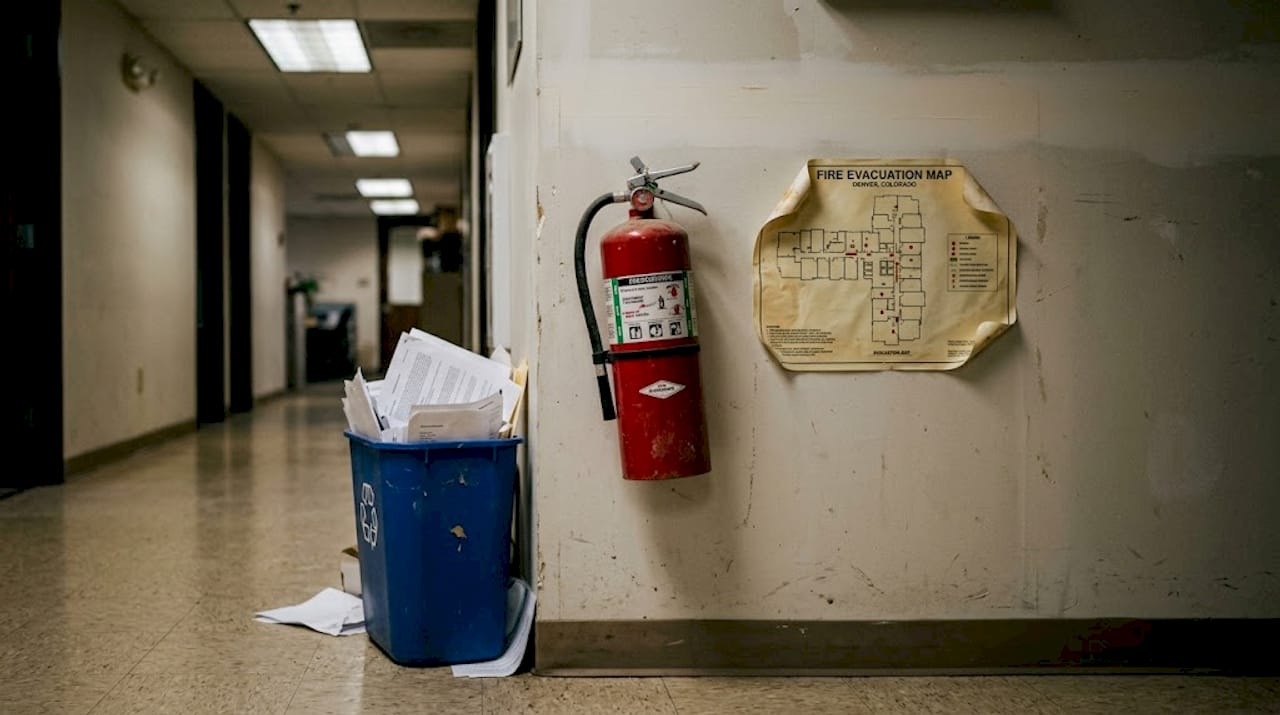
Monthly visual inspections are required by code and take less than five minutes per unit. Check the pressure gauge needle (it should sit in the green zone), look for visible damage or corrosion, confirm the safety pin is intact, and verify the unit is mounted at the correct height. Per NFPA 10, extinguishers should be mounted so the handle is between 3.5 and 5 feet from the floor, with at least 36 inches of clearance around the unit.
| Common defect | Code requirement |
|---|---|
| Low or no pressure | Gauge must read in the green zone |
| Missing safety pin or tamper seal | Must be intact and unbroken |
| Damaged or corroded body | Unit must be replaced immediately |
| Blocked or hard-to-reach location | 36-inch clearance required at all times |
| No service tag or outdated tag | Annual professional service required |
Annual professional maintenance goes deeper than a visual check. A certified technician will weigh the unit, inspect internal components, and verify the discharge mechanism works correctly. Understand the differences between fire extinguisher types before your next service visit so you can confirm you have the right class for each area of your property.
Pro Tip: Use a digital logbook app or a simple shared spreadsheet to record every inspection date, the inspector’s name, and any corrective action taken. This documentation protects you during audits and proves due diligence if a claim is ever disputed.
For a step-by-step walkthrough of what to check each month, the extinguisher checklist steps resource is worth bookmarking and sharing with your maintenance team.
Prioritize fire detection and alarm systems
With extinguishers checked, let’s move to proactive detection. Houston’s code now expects advanced systems that go beyond basic smoke detectors.
The 2025 Harris County fire code amendments place significant emphasis on detection and alarm performance. Older ionization-only smoke detectors are no longer sufficient in many occupancy types. Multi-sensor detectors that combine photoelectric, heat, and carbon monoxide sensing are now the standard for commercial buildings and multi-family residential properties.
Addressable fire alarm systems are a major upgrade worth understanding. Unlike conventional systems that only tell you a zone is triggered, addressable panels identify the exact device that activated. That means faster response, easier troubleshooting, and better documentation for inspections. Wireless systems offer similar precision with easier installation in older buildings where running new conduit is impractical.
| Detection system type | Pros | Cons |
|---|---|---|
| Conventional panel | Lower upfront cost | Only identifies zone, not device |
| Addressable panel | Pinpoints exact device, detailed logs | Higher installation cost |
| Wireless system | Flexible, minimal construction | Requires battery management |
| Multi-sensor detector | Reduces false alarms, broader detection | Higher per-unit cost |
Integration is where modern systems really earn their value. When your detection system connects directly to your sprinkler controls and alarm panel, the response time between detection and suppression drops significantly. That gap is where property damage and life risk increase. Review the Houston fire prevention checklist to see how detection fits into your overall compliance picture.
To evaluate whether your current system needs an upgrade, ask these questions:
- Is your alarm panel more than 10 years old?
- Does your system log activation events with timestamps?
- Are detectors placed in every required zone per current IFC standards?
- Has your system been tested and documented within the last 12 months?
If you answered no to any of those, it’s time to look at fire detection technologies 2026 to understand what’s available and what makes sense for your property type.
Conduct regular training, audits, and exit monitoring
All the right systems won’t matter if your team isn’t ready in real time. Let’s make sure your people and processes are up to code.
Annual and bi-annual fire safety audits, along with quarterly staff drills for high-rise properties, are required under Houston fire codes and Texas OSHA. These aren’t suggestions. They’re enforceable requirements with documentation expectations attached.
A good fire drill does more than get people out of the building. It tests whether staff know which exits to use, who is responsible for sweeping restrooms and conference rooms, and how to account for everyone once outside. Run drills at different times of day. A 2 p.m. drill on a Tuesday tells you very little about how your team would respond at 8 a.m. or during a busy event.
Pro Tip: After every drill, hold a five-minute debrief. Ask staff what confused them, which exits felt unclear, and whether signage was visible. That feedback loop is more valuable than the drill itself.
Audits should assess every layer of your fire safety program:
- System functionality: Are alarms, detectors, and sprinklers operational and documented?
- Egress compliance: Are all exit doors unobstructed, properly labeled, and illuminated?
- Training records: Can you produce sign-in sheets from the last drill cycle?
- Extinguisher logs: Are monthly inspection records complete and current?
Common mistakes that show up in audits include propped-open fire doors, expired extinguisher tags, missing exit signs above secondary exits, and no documentation of the last system test. These are easy to fix before an inspector finds them. Use the fire safety inspection guide to run your own internal audit before the official one.
“Integrated fire safety systems, where detection, suppression, and alarms work as one connected network, are the most reliable path to both code compliance and genuine life safety.” For Houston fire safety training resources, your team can build the habits that keep compliance consistent year-round.
Why compliance-first fire prevention is non-negotiable in Houston
Here’s an uncomfortable truth: most property managers treat fire prevention like a checklist they complete once a year. They swap out a detector battery, get a technician to sign the extinguisher tag, and call it done. That approach is increasingly dangerous in Houston’s 2025 enforcement environment.
We’ve seen properties lose insurance coverage not because they had no systems in place, but because those systems weren’t integrated, documented, or tested consistently. An alarm that works in isolation but doesn’t trigger the sprinkler panel is a liability, not an asset. A fire drill that happens once a year at the same time every year doesn’t prepare anyone for a real emergency.
The property owners who come out ahead are the ones who treat Houston fire prevention best practices as an ongoing operational discipline, not a compliance event. Schedule a quarterly internal review. Walk the property. Check the logs. Talk to your maintenance team. That mindset shift is what separates properties that pass inspections from properties that are genuinely safe.
Fire safety solutions to safeguard your Houston property
Ready to take the next step? These solutions ensure you’re not only compliant but truly protected.
Understanding how fire alarm systems work is a great starting point, but putting that knowledge into action requires the right partner. Reliable Fire Protection serves Houston property owners and managers with certified inspections, alarm and sprinkler system installations, staff training support, and full compliance audits.
From your first extinguisher inspection to a complete system overhaul, our team brings local expertise and certified credentials to every job. We know Houston’s code requirements inside and out, and we work with both residential and commercial clients across the city. Visit Reliable Fire Protection to request a free quote and find out exactly where your property stands today.
Frequently asked questions
What are Houston’s key fire code changes for 2025?
Houston and Harris County are enforcing updated IFC amendments from October 1, 2025, with stronger requirements for detection, alarms, sprinklers, and egress across most property types.
How often should fire extinguishers be checked in Houston properties?
Extinguishers require a monthly visual inspection and an annual professional service per local codes and NFPA 10 standards.
Are regular fire safety audits required for Houston commercial buildings?
Yes, annual or bi-annual audits are required, and high-rise properties must also conduct quarterly staff fire drills per the Houston Fire Code and Texas OSHA.
What is the biggest fire prevention mistake property managers make?
Neglecting extinguisher maintenance is the most common failure. Over 60% of commercial fires are linked to poorly maintained or inaccessible extinguishers.
How can I make sure my staff is ready for an emergency?
Run quarterly drills at varied times, provide hands-on training, and keep all exit routes clear and well-marked throughout the year.
Recommended
- Government fire safety tips for Houston managers 2026
- 7 Fire Safety Best Practices for Houston Property Managers
- 7 Essential Fire Safety Compliance Tips for Houston Buildings
- Fire Protection Best Practices for Houston 2025
- Fire Alarm System University Place TX
- Fire Alarm System Services in Bellaire, TX